Daily Gales

Monday, December 10, 2001
Good Evening
TEMPERATURE: Max. 5.8C — Min. 4.7C — Reset 4.7C — Rain 7.2 mm
WEATHER: We are well into the winter weather pattern now although the winter solstice is another 11 days away.With the heavy dark clouds and almost daily gales the area is not too hospitable.The Sea Lions are always on the move hauling out in the lee as the wind changes direction.
MARINE LIFE: There are 35-40 Cormorants,mostly on the South East Rocks and 250 gulls on the East ridge of Gr.Race,another 300 or so gulls along the south and west shores. Other birds that we see every day are Black Turnstones.Starlings and crows.
posted by Carol or Mike S at 6:05 PM
Good Morning
WEATHER: Sky Overcast — Vis. 15 Miles — Wind North 13 Knots — Sea 3 Foot Moderate with Low South East Swell
posted by Carol or Mike S at 7:24 AM

Branded sealion

Friday, November 16, 2001
Good evening
TEMPERATURE: Max. 10.0ºC — Min 7.9ºC — Reset 8.5ºC — Rain 3.4mm
MARINE LIFE: The Sea Lions have moved higher along the shore as the higher tides and sea swells cover their usual rocky haul-outs.Just before nightfall there were 34 Northern and 16 California Sea Lions in the East Bay area,one group of 7 Northern and 2 California on a grassy area 3 metres from the house and about 5 metres from the shore.Another gathering of 27 Northern,21 California and 2 juvenile Northern Elephant Seals have hauled out on the south side of Gr. Race on a flat area by the fog horn tower about 5 metres above sea level.One California Sea Lion has a brand on it’s rump which is difficult to read -first 2 numbers 73 are clear,the last number could be 1
HUMAN INTERACTION:there were 2 Pleasure craft through the M.P.A. today
Good morning
WEATHER: Sky cloudy — Vis. 15 miles — Wind west 7 knots — Sea rippled with a low north east swell

Eagle predation

Thursday, November 15, 2001
Good evening
TEMPERATURE: Max. 12.1ºC — Min. 9.1ºC — Reset 9.3ºC — Rain 8.2
MARINE LIFE:Just after 9:00 this morning a mature Bald Eagle entered the M.P.A.,it’s arrival ‘announced’ by a mass ‘lift-off’ of the 500+ gulls and cormorants.The 22 Black Oyster Catchers also took flight ‘sounding’off with their characteristic shrill whistling,also alerted were the ever present Starlings,Crows and Black Turnstones that scurried among the rocks to be as inconspicuous as possible.The Eagle took up it’s ‘post’ on the rocky ridge along the east shore of Gr. Race and things were quiet until about 9:40 when he took off and was immediately joined by 250-300 gulls.In a dive among the circling gulls the Eagle ‘took’ an immature gull landed on the ridge,spent 15minutes feeding then left the carcass to eager Crows.The Eagle flew to the high point on the SE rocks and sat there until about 11:30 when he again took flight-one circle around the shore of Gr. Race with the gulls in pursuit the Eagle swooped down over the rocks in front of the Learning Centre. When he came back into view there was an immature gull hanging from his talons.The gulls continued to circle the Eagle harrassing it to the point where instead of setting down it flew about 100 metres out over the water where it lost hold of the gull. The Eagle made 4 attempts to retrieve the gull caught up in the tide and moving quite rapidly eastward. The 5th and as it turned out final attempt at reclaiming it’s prey was only partly successful. The eagle did manage to grab hold onto the wing but could not maintain it’s grip and the gull dropped again into the choppy water. I don’t know if the Eagle gave up because of fatigue or the constant interference by the gulls,maybe a combination of the two,but he flew off towards Bentinck Island.A lot of energy expended in the search for food,quite a contrast to the leisurely stroll down the well stocked aisle of the corner grocery store most of us take for granted! The small east bay was popular again today as a haul-out area,by nightfall 57 California and 13 Northern, very noisy Sea Lions were gathered together no more than 6 metres from the house.Might have to resort to earplugs tonight,at the very least will have to sleep with the window closed.One California Sea Lion has the number 768 branded on his rump-an indication he must have made a nuisance of himself, possibly near a fish ladder.
HUMAN INTERACTION:1 Tour boat through M.P.A. at 16:40
posted by Carol or Mike S at 6:09 PM
Good morning
WEATHER: Sky overcast — Vis 15 miles — Wind north 9 knots Sea rippled low east swell –occasional rain shower
posted by Carol or Mike S at 7:19 AM

Seabird feeding frenzy

Thursday, November 01, 2001
WEATHER: We had calm seas for most of the day although the wind has increased to over 24knts in the past 1/2 hour.
MARINE LIFE: Fishing was good for the birds and sea lions today! Just after 10a.m. the sky was filled with hundreds and hundreds of sea birds,gulls,cormorants and common murres streaming across the islands southward to a tideline about 1/2 km. away.Looking with the telescope I estimated 3500-4000 sea birds feeding—-by 13:30 most had dispersed. In a space of three hours we saw 5 Steller(northern)sea lions catch salmon (-that looked to be 5-8lbs) in the kelp bed between North Rocks and Gr. Race. The birds,especially gulls rush over to get any bits of fish that break away as the sea lion thrashes the fish back and forth at the surface.The two juvenile elephant seals that were hauled out in the little bay with a group of about 20 harbour seals, swam out into the large kelp bed along the east side of Gr. Race just before 14:00 and had not returned before dark.Have not seen the large bull elephant seal that spends a good portion of the year stretched out atop West Rock.Did a boat tour around all the islands today and counted 97 California and 27 Steller sea lions. Also counted over 800 Cormorants.
posted by Carol or Mike S at 10:03 PM
Good evening
Max. 10.0ºC — Min. 8.1ºC — Reset 9.7ºC — Rain 1.6 mm
posted by Carol or Mike S at 6:04 PM
Good morning
Sky overcast — Vis. 13 miles — Rain showers — Wind north east 5 knots Sea rippled
posted by Carol or Mike S at 7:12 AM

Herring Balls in Race Passage.

Thursday, September 27, 2001

We enjoyed a fairly typical fall day weather-wise here at Race Rocks today.
Temperatures max 12.0 C — min 9.1 C — reset 11.3 C — Total rain fall for the day 0.4 mm.
Returning from a noon meeting on campus we did a boat tour around all the islets – we counted
280 Northern or Steller sea lions – 295 Californian sea lions and 220 Harbour seals hauled out on the rocks. We also counted approx. 80 Cormorants. Earlier in the day we saw 2 ‘ fish balls’ with several hundred sea birds feeding just east of Great Race.


Predation by the Black Oystercatcher….1999

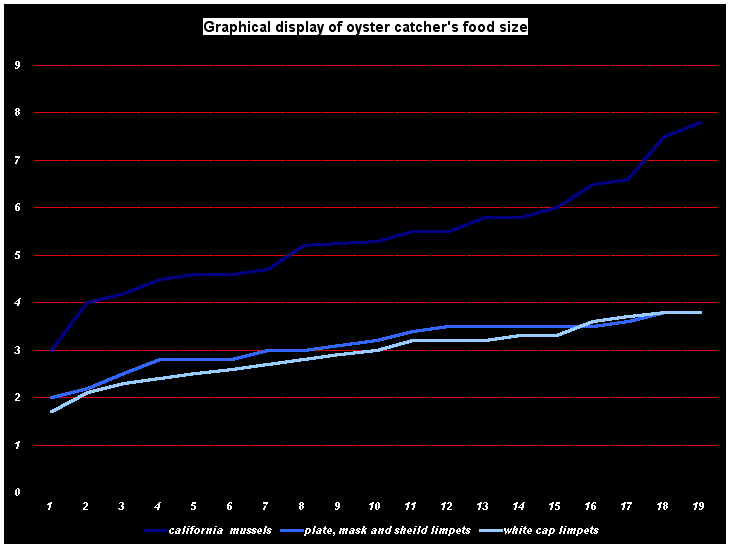
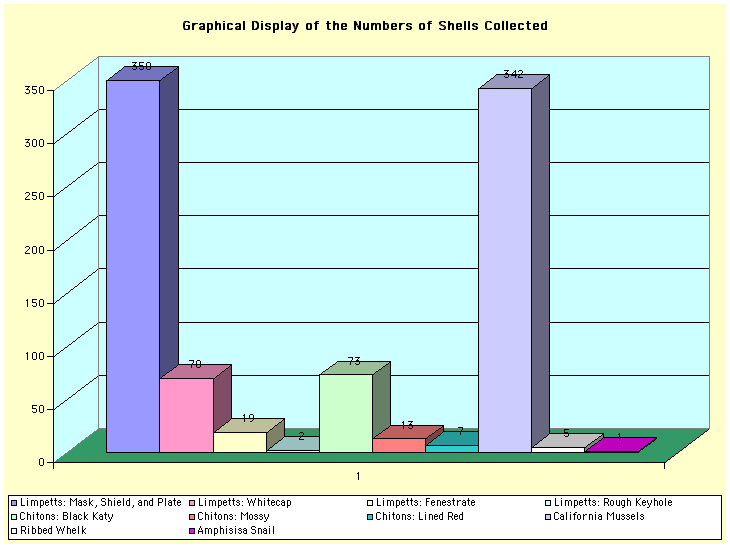
In September of 1999, the students of the Environmental Systems Class collected the shells in the midden surrounding the nest of a pair of Black OysterCatchers at Race Rocks, They analysed the size, species diversity, and species frequency of the shells. The following data and charts are presented in order to provide information about the role of this seabird in the intertidal ecology of Race Rocks.

Numbers of Shells Collected Near Black Oyster Catcher’s Nest
    Limpets: Mask, Shield, and Plate 350    
    Limpets: Whitecap 70    
    Limpets: Fenestrate 19    
    Limpets: Rough Keyhole 2    
    Chitons: Black Katy 73    
    Chitons: Mossy 13    
    Chitons: Lined Red 7    
    California Mussels 342    
    Ribbed Whelk 5    
    Amphisia Snail 1    
         

Average Size of the Oyster Catcher’s Food california mussels –5.2875 cm plate,mask,shield limpets–3 cm whitecap limpets 5.2875 cm 3 cm 2.985 cm Size of Oyster Catcher’s Food: Raw Data, in cm

california mussels plate, mask and shield limpets white cap limpets
3 2 1.7
4 2.2 2.1
4.2 2.5 2.3
4.5 2.8 2.4
4.6 2.8 2.5
4.6 2.8 2.6
4.7 3 2.7
5.2 3 2.8
5.25 3.1 2.9
5.3 3.2 3
5.5 3.4 3.2
5.5 3.4 3.2
5.5 3.5 3.2
5.8 3.5 3.2
6. 3.5 3.3
6.5 3.5 3.6
6.6 3.6 3.7
7.5 3.8 3.8
7.8 3.8 3.8
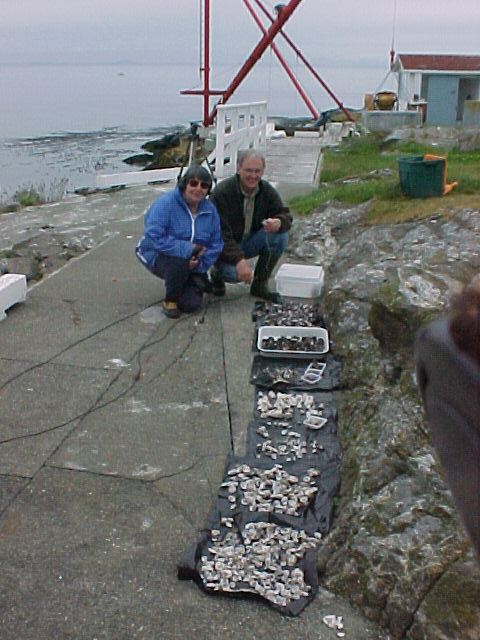
gfcarolshell

Garry Fletcher and Ecoguardian Carol Slater examining sorted shells of black oystercatcher prey from on midden.

Image1 Image3

Temperature rise

temperature rise today is reflected in the return of the seagulls and 150 cormorants +60 starlings, 25 black Turnstons, 15 black oyster catchers, 16 crows, 21 bald eagles [10 mature

5 sealions hauled out on North  rock.  120  sealions  on West race. 22 on great race .

143/32  second nature  was out with BCTEL  learning Channel promo visit. Angus, Garry, and Chris with them.

SPECIES LIST From: William Head, Rosedale Rocks, Race Rocks by Donna Gibbs

SPECIES LIST:

Compiled by:Donna Gibbs of the Vancouver Acquarium on dives made at Rosedale Rock, West Race Rocks and William Head in the summer of 1997. Groupings are made in Phylums or Divisions.

Dive 432 – Rosedale, Race Rocks – June 12, 1997

Epiphytic red algae (Smithora, Antithamnion, Ceramium, Polysiphonia)Iridescent blade red algae (Iridea)

Encrusting coralline algae (Lithothamnion)

Branching coralline algae (Bossiella, Corallina, Calliarthron)

Bull kelp (Nereocystis)Blade kelp (Costaria)

Blade kelp (Alaria)

Woody-stemmed kelp (Lessoniopsis, Eisenia, Pterygophora)

 Tar spot (Codium setchellii)
 Tan finger sponge (Isodictya quatsinoensis)Orange-red encrusting sponge (Ophlitaspongia pennata)

Thick, dark red encrusting sponge (Plocamia karykina)

Boring sponge (Cliona celata)

Crumb-of-bread sponge (Halichondria, Haliclona spp.)

 Giant black feather-duster worm (Eudistylia vancouveri)Sand-dwelling feather-duster worm (Sabella spp.)

Slime tubeworm (Myxicola infundibulum)

Multi-colour calcareous tubeworm (Serpula vermicularis)

Honeycomb tubeworm (Dodecaceria fewkesi)

Spaghetti or shell binder worm (Thelepus crispus)

 Plumose anemone (Metridium giganteum)Red and green or Christmas tealia (Urticina crassicornis)

Crimson anemone (Cribrinopsis fernaldi)

Brooding or proliferating anemone (Epiactis prolifera)

Zoanthid (Epizoanthus scotinus)

Ostrich-plume hydroid (Aglaophenia struthionides)

Delicate-plumed hydroid (Plumularia spp.)

Orange hydroid (Garveia annulata)

Snail-fur hydroid (Hydractinia sp.)

Pink-mouthed solitary hydroid (Tubularia marina)

Thread-like, creeping network hydroid (Orthopyxis spp.)

Pink or violet branching hydrocoral (Stylaster venusta)

Encrusting hydrocoral (Allopora petrograpta)

Tiny star jellyfish (Phialidium gregarium)

  Other encrusting bryozoan (Schizoporella spp., Microporella spp., Eurystomella spp.)Northern staghorn bryozoan (Heteropora pacifica)  Gumboot chiton (Cryptochiton stelleri)California mussel (Mytilus californianus)

Rock or purple-hinged scallop (Crassedoma giganteum)

White-cap limpet (Acmaea mitra)

Rough keyhole limpet (Diodora aspera)

Snail-dwelling slipper shell (Crepidula adunca)

Leafy hornmouth shell (Ceratostoma foliatum)

Blue top snail (Calliostoma ligatum)

Heath’s dorid (Geitodoris heathi)

Coloured dendronotid (Dendronotus diversicolor)

  Sea flea (Anisogammarus spp., Orchestia spp.)Coon-stripe shrimp (Pandalus danae)

Candycane or candy-stripe shrimp (Lebbeus grandimanus)

Kincaid’s commensal shrimp (Heptacarpus kincaidi)

Giant or giant acorn barnacle (Balanus nubilis)

Oregon crab (Cancer oregonensis)

Masking or sharp-nose crab (Scyra acutifrons)

Hairy, flat lithode crab (Hapalogaster mertensii)

Scaled crab (Placetron wosnessenskii)

Orange hermit crab (Elassochirus gilli)

 Blood star (Henricia leviuscula)Long-rayed or rainbow star (Orthasterias koehleri)

Six-rayed star (Leptasterias hexactis)

Sunflower star (Pycnopodia helianthoides)

Sun star (Solaster stimpsoni)

Serpent or daisy brittle star (Ophiopholis aculeata)

Giant red sea urchin (Strongylocentrotus franciscanus)

Purple sea urchin (Strongylocentrotus purpuratus)

Giant or California sea cucumber (Parastichopus californicus)

Creeping pedal or armored sea cucumber (Psolus chitonoides)

  Mosshead warbonnet (Chirolophis nugator) gorgeous – huge and red!Copper rockfish (Sebastes caurinus)

Quillback rockfish (Sebastes maliger)

Black rockfish (Sebastes melanops)

Tiger rockfish (Sebastes nigrocinctus)

Kelp greenling (Hexagrammos decagrammus)

Ling cod (Ophiodon elongatus)

Scalyhead sculpin (Artedius harringtoni)

Red Irish lord (Hemilepidotus hemilepidotus)

 Lobed compound tunicate (Cystodytes lobatus)

White-crust compound tunicate (Didemnum albidum)

Dive 433 – Rosedale, Race Rocks – June 13, 1997

 Epiphytic red algae (Smithora, Antithamnion, Ceramium, Polysiphonia)Encrusting coralline algae (Lithothamnion)

Branching coralline algae (Bossiella, Corallina, Calliarthron)

 Woody-stemmed kelp (Lessoniopsis, Eisenia, Pterygophora)  Tar spot (Codium setchellii)
 Tennis ball sponge (Tetilla arb)Smooth orange puff-ball sponge (Suberites montiniger)  Red sand-dwelling tubeworm (not Sabella)  Coon-stripe shrimp (Pandalus danae)Candycane or candy-stripe shrimp (Lebbeus grandimanus)

Kincaid’s commensal shrimp (Heptacarpus kincaidi)

Giant or giant acorn barnacle (Balanus nubilis)

Oregon crab (Cancer oregonensis)

Masking or sharp-nose crab (Scyra acutifrons)

Other encrusting bryozoan (Schizoporella spp., Microporella spp., Eurystomellaspp.)  Lined chiton (Tonicella lineata)Red chiton (Tonicella insignis)

Gumboot chiton (Cryptochiton stelleri)

Swimming or pink scallop (Chlamys sp.)

White-cap limpet (Acmaea mitra)

Rough keyhole limpet (Diodora aspera)

Leafy hornmouth shell (Ceratostoma foliatum)

Dire whelk (Searlesia dira)

Dwarf hairy triton (Trichotropsis cancellata)

Blue top snail (Calliostoma ligatum)

Cockerel’s dorid (Laila cockerelli)

Plumose anemone (Metridium giganteum)Red and green or Christmas tealia (Urticina crassicornis)

Crimson anemone (Cribrinopsis fernaldi)

Brooding or proliferating anemone (Epiactis prolifera)

Zoanthid (Epizoanthus scotinus)

Sea fir (Abietinaria spp., Thuiaria spp., Sertularia spp.)

Ostrich-plume hydroid (Aglaophenia struthionides)

Delicate-plumed hydroid (Plumularia spp.)

Orange hydroid (Garveia annulata)

Pink or violet branching hydrocoral (Stylaster venusta)

 Blood star (Henricia leviuscula)Long-rayed or rainbow star (Orthasterias koehleri)

Six-rayed star (Leptasterias hexactis)

Sunflower star (Pycnopodia helianthoides)

Sun star (Solaster stimpsoni)

Giant red sea urchin (Strongylocentrotus franciscanus)

Purple sea urchin (Strongylocentrotus purpuratus)

Giant or California sea cucumber (Parastichopus californicus)

Black sea cucumber (Cucumaria lubrica)

 Copper rockfish (Sebastes caurinus)Quillback rockfish (Sebastes maliger)

Kelp greenling (Hexagrammos decagrammus)

Ling cod (Ophiodon elongatus)

Scalyhead sculpin (Artedius harringtoni)

Cabezon (Scorpaenicthys marmoratus)

Lobed compound tunicate (Cystodytes lobatus)White-crust compound tunicate (Didemnum albidum)

Dive 434 – West Race Rocks – June 13, 1997

   Woody-stemmed kelp (Lessoniopsis, Eisenia, Pterygophora)  Surf grass (Phyllospadix)
 Tan finger sponge (Isodictya quatsinoensis)Boring sponge (Cliona celata)

Pecten sponge (Mycale adhaerens)

Sulphur sponge (Myxilla lacunosa)

Smooth orange puff-ball sponge (Suberites montiniger)

 Orange ribbon worm (Tubulanus polymorphus)Giant black feather-duster worm (Eudistylia vancouveri)

Sand-dwelling feather-duster worm (Sabella spp.)

Honeycomb tubeworm (Dodecaceria fewkesi)

Spaghetti or shell binder worm (Thelepus crispus)

 
 Kelp-encrusting bryozoan (Membranipora membranacea)Other encrusting bryozoan (Schizoporella spp., Microporella spp., Eurystomella

spp.)

Spiral or spiral-tuft bryozoan (Bugula californica)

Fluted bryozoan (Hippodiplosia insculpta)

Northern staghorn bryozoan (Heteropora pacifica)

 Gumboot chiton (Cryptochiton stelleri)California mussel (Mytilus californianus)

Sea bottle clam (Mytilimeria nuttallii)

Rough keyhole limpet (Diodora aspera)

Northern or pinto abalone (Haliotis kamtschatkana) 1 – 4″

Dwarf lurid triton (Ocenebra lurida)

Monterey sea lemon (Archidoris montereyensis)

White dorid (Archidoris odhneri)

Opalescent aeolid (Hermissenda crassicornis)

Three-lined aeolid (Flabellina trilineata)

Coloured dendronotid (Dendronotus diversicolor)

Giant Pacific octopus (Octopus dofleini)

White-spotted tealia (Urticina lofotensis)Crimson anemone (Cribrinopsis fernaldi)

Brooding or proliferating anemone (Epiactis prolifera)

Zoanthid (Epizoanthus scotinus)

Soft coral (Gersemia rubiformis)

Sea fir (Abietinaria spp., Thuiaria spp., Sertularia spp.)

Ostrich-plume hydroid (Aglaophenia struthionides)

Delicate-plumed hydroid (Plumularia spp.)

Orange hydroid (Garveia annulata)

Snail-fur hydroid (Hydractinia sp.)

Pink-mouthed solitary hydroid (Tubularia marina)

Pink or violet branching hydrocoral (Stylaster venusta)

  Leather star (Dermasterias imbricata)Blood star (Henricia leviuscula)

Long-rayed or rainbow star (Orthasterias koehleri)

Velcro or fish-eating star (Stylasterias forreri)

Six-rayed star (Leptasterias hexactis)

Sunflower star (Pycnopodia helianthoides)

Sun star (Solaster stimpsoni)

Morning sun star (Solaster dawsoni)

 Kelp greenling (Hexagrammos decagrammus)Ling cod (Ophiodon elongatus)

Scalyhead sculpin (Artedius harringtoni)

Cabezon (Scorpaenicthys marmoratus)

Red Irish lord (Hemilepidotus hemilepidotus)

 Light-bulb tunicate (Clavelina huntsmani)Stalked, dwarf light-bulb tunicate (Pycnoclavella stanleyi)

Stalked compound tunicate (Distaplia smithi)

Dive 431 – William Head, Vancouver Island – June 12, 1997

Epiphytic red algae (Smithora, Antithamnion, Ceramium, Polysiphonia)Iridescent blade red algae (Iridea)

Encrusting coralline algae (Lithothamnion)

Branching coralline algae (Bossiella, Corallina, Calliarthron)

 Bull kelp (Nereocystis)

Woody-stemmed kelp (Lessoniopsis, Eisenia, Pterygophora)

 Orange-red encrusting sponge (Ophlitaspongia pennata)Thick, dark red encrusting sponge (Plocamia karykina)

Boring sponge (Cliona celata)

Hermit crab sponge (Suberites suberea) with Pagurus stevensae

 Agassiz’s peanut worm (Phascolosoma agassizii)Scale worm (Halosydna brevisetosa, Harmothoe spp.)

Slime tubeworm (Myxicola infundibulum)

Multi-colour calcareous tubeworm (Serpula vermicularis)

Cement tubeworm (Sabellaria cementarium)

Spaghetti or shell binder worm (Thelepus crispus)

Plumose anemone (Metridium giganteum)Red and green or Christmas tealia (Urticina crassicornis)

Fish-eating tealia (Urticina piscivora)

Brooding or proliferating anemone (Epiactis sp.)

Orange cup coral (Balanophyllia elegans)

Sea fir (Abietinaria spp., Thuiaria spp., Sertularia spp.)

Silver-tip hydroid (Abietinaria greeni)

Pink or violet branching hydrocoral (Stylaster venusta)

Encrusting hydrocoral (Allopora petrograpta)

Water jellyfish (Aequorea victoria)

Tiny star jellyfish (Phialidium gregarium)

Other encrusting bryozoan (Schizoporella spp., Microporella spp., Eurystomellaspp.)

Northern staghorn bryozoan (Heteropora pacifica)

Southern staghorn bryozoan (Diaperoecia californica)


 Oval brachiopod or lamp shell (Laqueus californicus) ?
 Lined chiton (Tonicella lineata)Red chiton (Tonicella insignis)

Gumboot chiton (Cryptochiton stelleri)

Swimming or pink scallop (Chlamys sp.)

Rock or purple-hinged scallop (Crassedoma giganteum)

Jingle shell (Pododesmus cepio)

Northwest ugly clam (Entodesma saxicola)

Hooded puncturella (Puncturella cucullata)

Northern or pinto abalone (Haliotis kamtschatkana)

Leafy hornmouth shell (Ceratostoma foliatum)

Dwarf lurid triton (Ocenebra lurida)

Oregon or giant hairy triton (Fusitriton oregonensis)

Dwarf hairy triton (Trichotropsis cancellata)

Blue top snail (Calliostoma ligatum)

Ringed top snail (Calliostoma annulatum)

Variable lacuna (Lacuna variegata)

Smooth-edged wenteltrap (Opalia borealis)

White dorid (Archidoris odhneri)

Nanaimo dorid (Acanthodoris nanaimoensis)

Cockerel’s dorid (Laila cockerelli)

Opalescent aeolid (Hermissenda crassicornis)

Red-gilled aeolid (Flabellina verrucosa)

 Common gray mysid (unknown) ?Coon-stripe shrimp (Pandalus danae)

Kincaid’s commensal shrimp (Heptacarpus kincaidi)

Giant or giant acorn barnacle (Balanus nubilis)

Oregon crab (Cancer oregonensis)

Masking or sharp-nose crab (Scyra acutifrons)

Flat porcelain crab (Petrolisthes cinctipes)

Turtle or butterfly crab (Cryptolithodes typicus)

Flat, granular-claw hermit crab (Elassochirus tenuimanus)

Sponge hermit crab (Pagurus stevensae)

Blood star (Henricia leviuscula)Long-rayed or rainbow star (Orthasterias koehleri)

Sunflower star (Pycnopodia helianthoides)

Sun star (Solaster stimpsoni)

Serpent or daisy brittle star (Ophiopholis aculeata)

Green sea urchin (Strongylocentrotus droebachiensis)

Giant red sea urchin (Strongylocentrotus franciscanus)

Purple sea urchin (Strongylocentrotus purpuratus)

Giant or California sea cucumber (Parastichopus californicus)

Red sea cucumber (Cucumaria miniata)

Creeping pedal or armored sea cucumber (Psolus chitonoides)

  MPacific herring (Clupea harengus pallasi) school of juvenilesBlackeye goby (Coryphopterus nicholsi)

Mosshead warbonnet (Chirolophis nugator)

Longfin gunnel (Pholis clemensi)

Copper rockfish (Sebastes caurinus) one adult

Puget Sound rockfish (Sebastes emphaeus) school of 200 juveniles

Kelp greenling (Hexagrammos decagrammus)

Scalyhead sculpin (Artedius harringtoni)

Broad-base tunicate (Cnemidocarpa finmarkiensis)Horse-shoe or disc-top tunicate (Chelyosoma productum)

Stalked, dwarf light-bulb tunicate (Pycnoclavella stanleyi)

Orange social tunicate (Metandrocarpa taylori)

White-crust compound tunicate (Didemnum albidum)