‘Another first for my stay here at Race Rocks. This evening a trio of Pelagic cormorants flew along the N side of Great Race. The first is that the third was miniature version of what I assume to be its parents. I have never seen a juvenile pelagic cormorant before!’, ‘Ryan’,
Category Archives: Bird Notes
Pelagic Cormorant Juvenile
Another first for my stay here at Race Rocks.
This evening a trio of Pelagic cormorants flew along the N side of Great Race. The first is that the third was miniature version of what I assume to be its parents. I have never seen a juvenile pelagic cormorant before!….(Mike Robinson)
Osprey and problem boaters
A lone osprey visited the reserve today and was photographed from the lighthouse flying SE across Great Race.
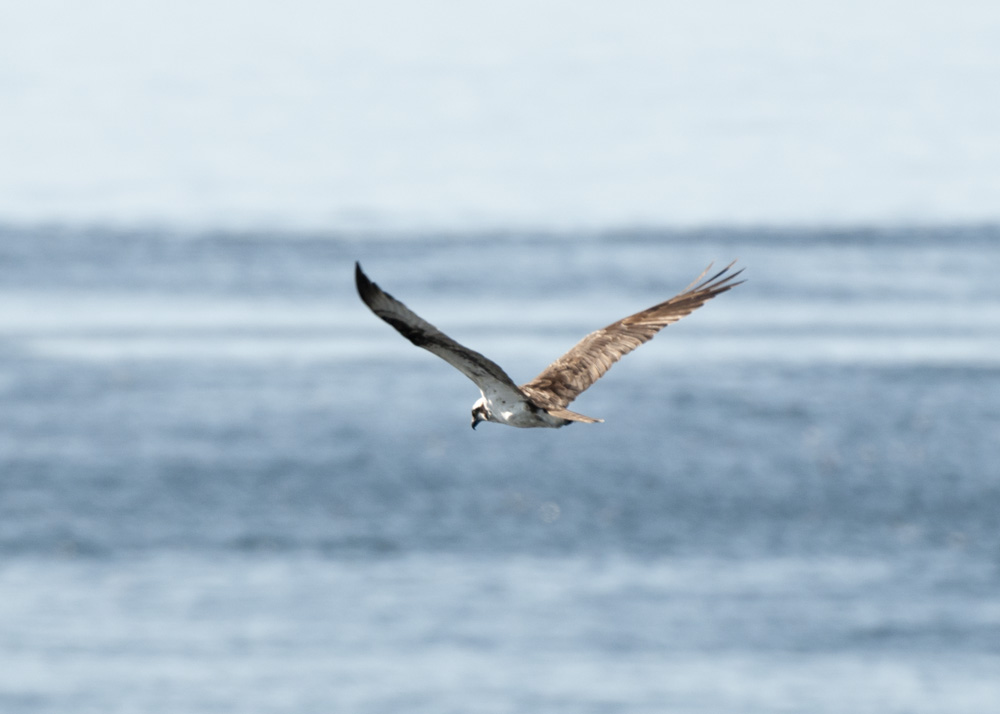 While counting marine mammals from the lighthouse I noticed the sea gulls take flight similar to a bald eagle response. I then saw this osprey flying SE over Great Race about level with the top of the tower. The next day I observed a pair of ospreys hunting in the shallows W of Pedder Bay Marina.
A distinctly different type of person on the water today. As of 13:30 there have been 4 Bayliner-type vessels speed through the reserve. A recreational fishing vessel serial 14K36817 has been illegally fishing the RCA for over an hour now. When hailed on VHF68 an anonymous station twice responded with profanities after which radio communications were obstructed by loud music playing over an open mic. Earlier today a call was put into Pedder Bay Marina to stop their vessels fishing and pulling kelp.
There were 200 visitors to the island today. ( Posted by Ryan)
Pandion haliaetus: Osprey—The Race Rocks Taxonomy
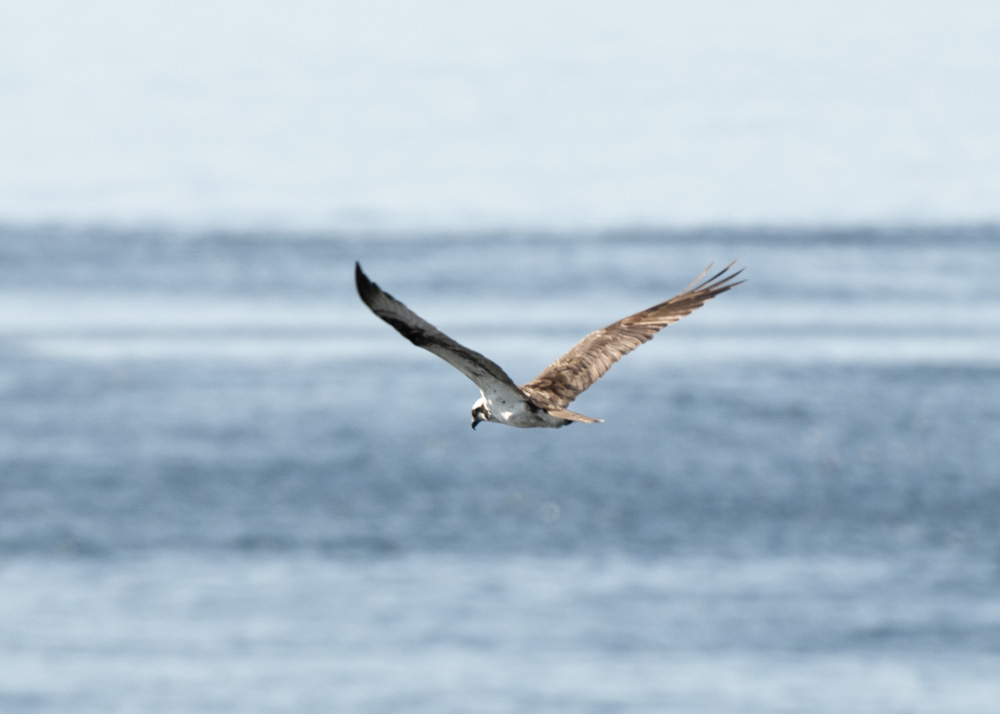
This is the first image taken of this species at Race Rocks. Ryan states: “While counting marine mammals from the lighthouse I noticed the sea gulls take flight similar to a bald eagle response. I then saw this osprey flying SE over Great Race about level with the top of the tower. The next day I observed a pair of ospreys hunting in the shallows West of Pedder Bay Marina.”.We have seen ospreys previously in Pedder bay, where a pair had a nest up until the early-1980’s.
| Image by Ryan Murphy |
| Other Members of the Class Aves at Race Rocks |
 Return to the Race Rocks Taxonomy Return to the Race Rocks Taxonomyand Image File |
 The Race Rocks taxonomy is a collaborative venture originally started with the Biology and Environmental Systems students of Lester Pearson College UWC. It now also has contributions added by Faculty, Staff, Volunteers and Observers on the remote control webcams. The Race Rocks taxonomy is a collaborative venture originally started with the Biology and Environmental Systems students of Lester Pearson College UWC. It now also has contributions added by Faculty, Staff, Volunteers and Observers on the remote control webcams.
Ryan Murphy |
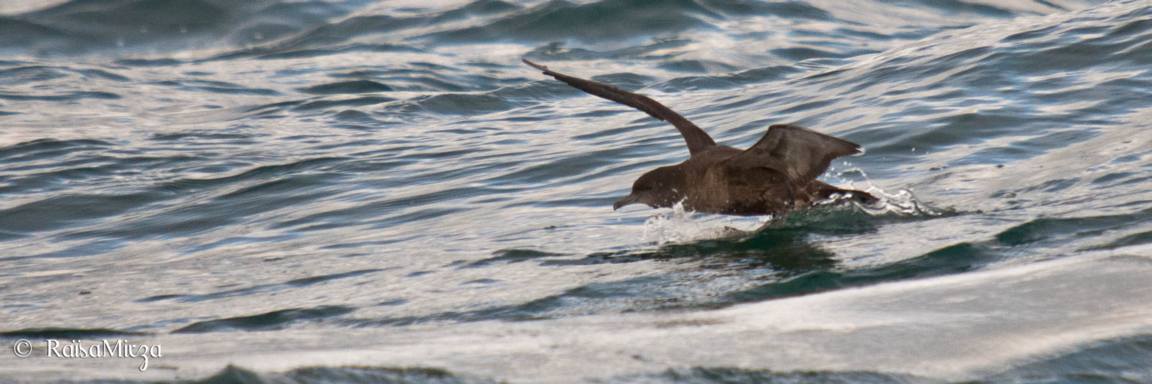
Ardenna tenuirostris : Short-tailed sheerwater- The Race Rocks Taxonomy
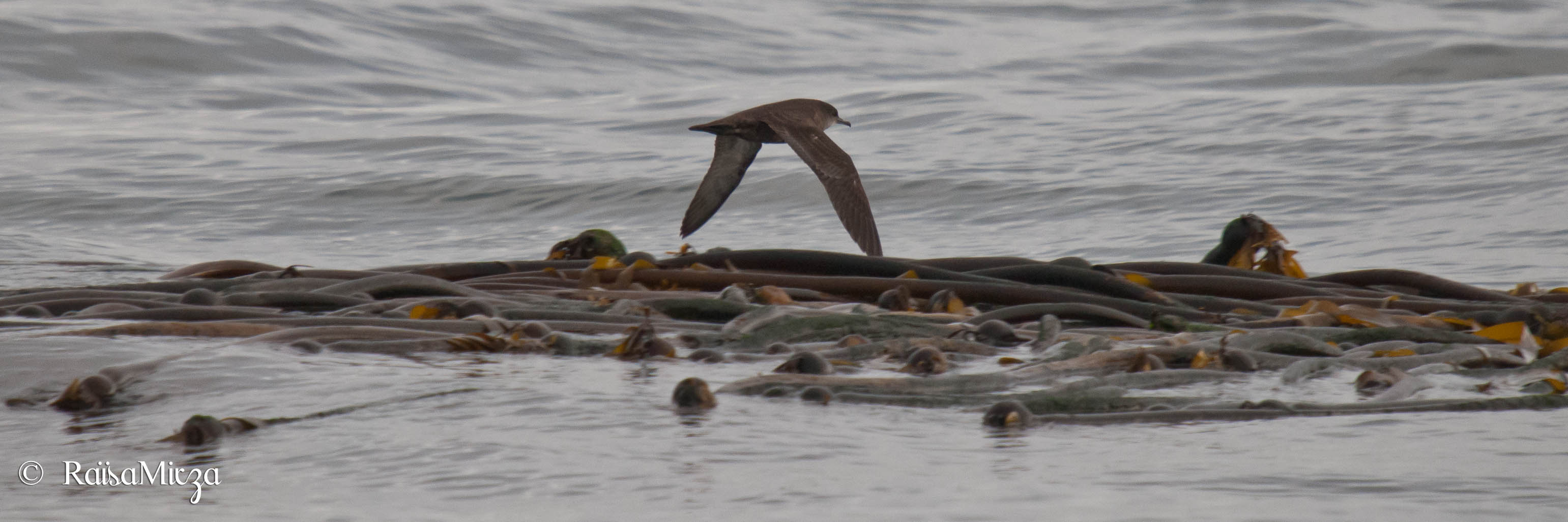
Short-tailed Sheerwater images by Raisa Mira, Ecoguardian
| Images by Raisa Mirza |
| These are the first images taken of this species at Race Rocks. It occurs only rarely around Race Rocks, as it is mainly pelagic. |
| Domain | Eukarya |
| Kingdom | Animalia |
| Phylum | Chordata |
| Subphylum | Vertebrata |
| Class | Aves |
| Subclass | Neomithes |
| Superorder | Neoaves |
| Order | Procellariiformes |
| Family | Procellariidae |
| Genus | Ardena |
| Species | tenuirostris |
| Common Name: | Short-tailed Shearwater |
| Return to the Race Rocks Taxonomy and Image File |
| The Race Rocks taxonomy is a collaborative venture originally started with the Biology and Environmental Systems students of Lester Pearson College UWC. It now also has contributions added by Faculty, Staff, Volunteers and Observers on the remote control webcams. |
Brown pelican
An immature brown pelican landed on Great Race today at sunset. It flew in from the East.
Adam gets a picture of a sanderling
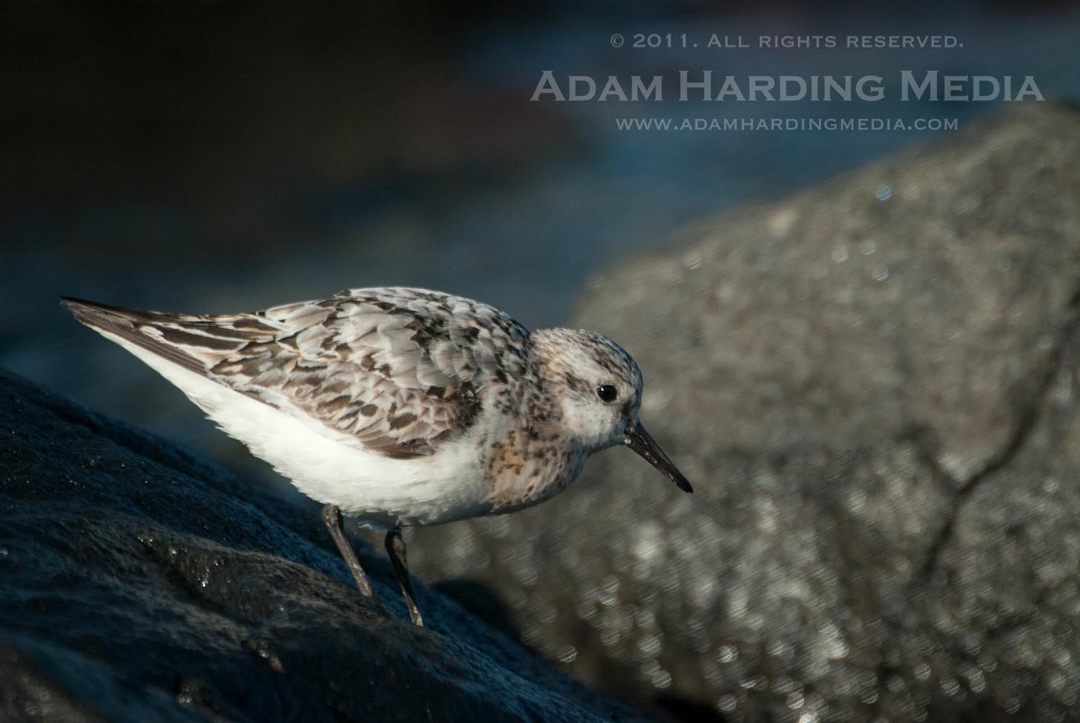 Image by Adam Harding This is the first image taken of this species. It breeds circumpolar and is a long distance migratory species. It must be back on its way down south having made this stopover here at Race Rocks August 11, 2011. Calidris alba, Sanderling
Calidris alba: Sanderling- The Race Rocks Taxonomy
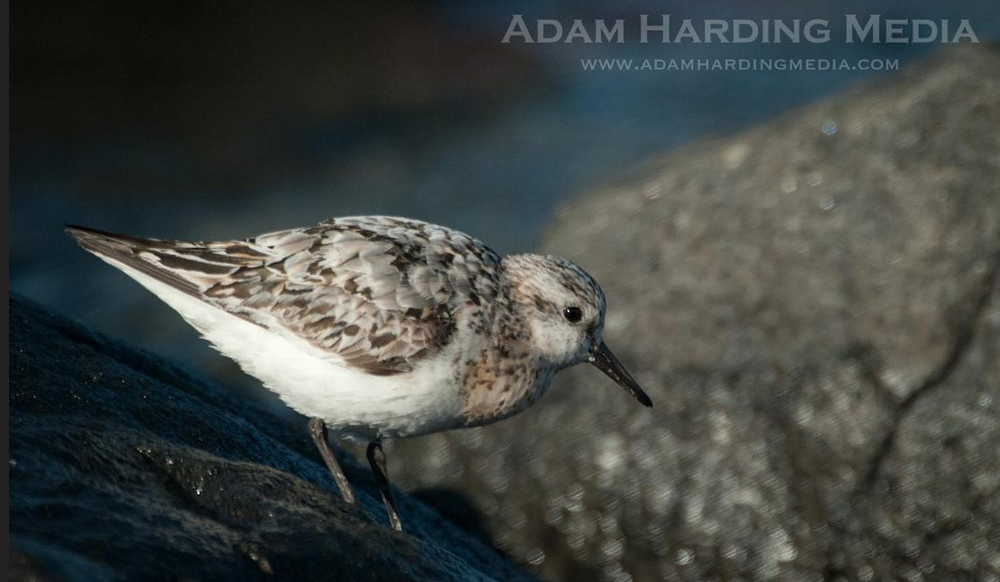
Sanderling photogrepahed by Adam Harding- Ecoguardian at Race Rocks
This is the first image taken of this species. It breeds circumpolar and is a long distance migratory species. It must be back on its way down south having made this stopover here at Race Rocks August 11, 2011
| Domain | Eukarya |
| Kingdom | Animalia |
| Phylum | Chordata |
| Subphylum | Vertebrata |
| Class | Aves |
| Order | Charadriiformes |
| Family | Scolopacidae |
| Genus | Calidris |
| Species | alba Pallas,1764 |
| Common Name: | Sanderling |
| Return to the Race Rocks Taxonomy and Image File |
| The Race Rocks taxonomy is a collaborative venture originally started with the Biology and Environmental Systems students of Lester Pearson College UWC. It now also has contributions added by Faculty, Staff, Volunteers and Observers on the remote control webcams. |
Vessel infractions
A double-crested cormorant was spotted on the rocks on the east side of Great Race at 2040hrs PDT.
Human Interaction:
At ~1400hrs PDT a vessel was spotted fishing on the E side of the South Rocks kelp bed. The station vessel was launched and the vessel was found to be in 106 ft. of water. The four older folks on board proved to be extremely friendly and stated that they had just purchased the boat the week before and it was their very first time on the water! We actually had a great 20 minute conversation about Race Rocks, fishing restrictions, how to distinguish between different types of salmon and general boating practices (how to use a VHF!). The folks were very happy to find out the area was protected and happily moved to deeper waters.
At ~1430hrs PDT a large aluminum vessel entered the W side of the main channel, slowed to look at sea lions on Middle Race, then sped through the main channel to North Race where they approached extremely close to seals hauled out on the rocks.
At ~1445hrs PDT a small aluminum vessel was spotted fishing on the W corner of the North Race kelp bed.
There was 1 visitors to the island today.
Race Rocks (XwaYeN) Proposed Marine Protected Area Ecosystem Overview and Assessment Report
Correct citation for this publication: Backe, N., S. Davies, K. Conley, G. Kosmider, G. Rasmussen, H. Ibey and K. Ladell.2011. Race rocks (XwaYeN) proposed marine protected area ecosystem overview and assessment report. Can. Manuscr. Rep. Fish. Aquat. Sci. 2949: ii + 30
Executive Summary
Background
Race Rocks (XwaYeN), located 17 km southwest of Victoria in the Strait of Juan de Fuca, consists of nine islets, including the large main island, Great Race. Named for its strong tidal currents and rocky reefs, the waters surrounding Race Rocks (XwaYeN) are a showcase for Pacific marine life. This marine life is the result of oceanographic conditions supplying the Race Rocks (XwaYeN) area with a generous stream of nutrients and high levels of dissolved oxygen. These factors contribute to the creation of an ecosystem of high biodiversity and biological productivity.In 1980, the province of British Columbia, under the authority of the provincial Ecological Reserves Act , established the Race Rocks Ecological Reserve. This provided protection of the terrestrial natural and cultural heritage values (nine islets) and of the ocean seabed (to the 20 fathoms/36.6 meter contour line). Ocean dumping, dredging and the extraction of non-renewable resources are not permitted within the boundaries of the Ecological Reserve. However, the Ecological Reserve cannot provide for the conservation and protection of the water column or for the living resources inhabiting the coastal waters surrounding Race Rocks (Xwa YeN) as these resources are under the jurisdiction of Fisheries and Oceans Canada (DFO). The federal government, through the authority of theOceans Act (1997), has established an Oceans Strategy, based on the principles of sustainable development, integrated management and the precautionary approach. Part II of the Oceans Act also provides authority for the development of tools nece ssary to carry out the Oceans Strategy, tools such as the establishment of Marine Protecte d Areas (MPA). This federal authority will complement the previously established protection to the area as an Ecological Reserve, by affording protection and conservation measures to the living marine resources. Under Section 35 of the Oceans Act, the Governor in Council is authorized to designate, by regulation, Marine Protected Areas (MPA) for any of the following reasons:
- (a) the conservation and protection of commercial and non-commercial fishery resources, including marine mammals and their habitats;
- (b) the conservation and protection of endangered or threatened species and their habitats;
- (c) the conservation and protection of unique habitats;
- (d) the conservation and protection of marine areas of high biodiversity or biological productivity; and
- (e) the conservation and protection of any other marine resource or habitat as is necessary to fulfill the mandate of the Minister of Fisheries and Oceans.
In 1998, the Minister of Fisheries and Oceans announced Race Rocks (XwaYeN) as one of four pilot Marine Protected Area (MPA) initiatives on Canada’s Pacific Coast. Race Rocks (XwaYeN) meets the criteria set out in paragraphs 35(1) (a), (b) and (d) above. Establishing a MPA within the Race Rocks (XwaYeN) area will provide for a more comprehensive level of conservation and protection for the ecosystem than can be achieved by an Ecological Reserve on its own. Designating a MPA within the area encompassing the Ecological Reserve will facilitate the integration of conservation, protection and management initiatives under the respective authorities of the two governments.
physical and biological systems of Race Rocks (XwaYeN) was completed by Wright and Pringle (2001). The 2001 report provides an extensive ecological overview describing the geological, physical oceanographic and biological components of
Race Rocks (XwaYeN) and the surrounding waters of the Strait of Juan de Fuca at the time. Natural history observations and some traditional knowledge were also included. The following report is a brief update to summarize new information that has been collected in the Race Rocks (XwaYeN) area since that time and describe any changes
to trends in species distributions and oceanographic conditions. This work is meant to supplement the existing ecological overview (Wright and Pringle 2001).
See the full 32 page PDF Ecosystem overview2011