In January, on a planned dive off West Race Rocks, the divers had to divert to another location because of a large number of eagles on the island. They shot this clip as they went by the island. Carol Slater had counted 43 on the Rocks earlier in the day. This is typical of their peak in numbers every January. The brown juveniles and the white headed adults number fairly equally.
Category Archives: Bird Notes
Ardea herodias: Great Blue Heron–The Race Rocks taxonomy
-
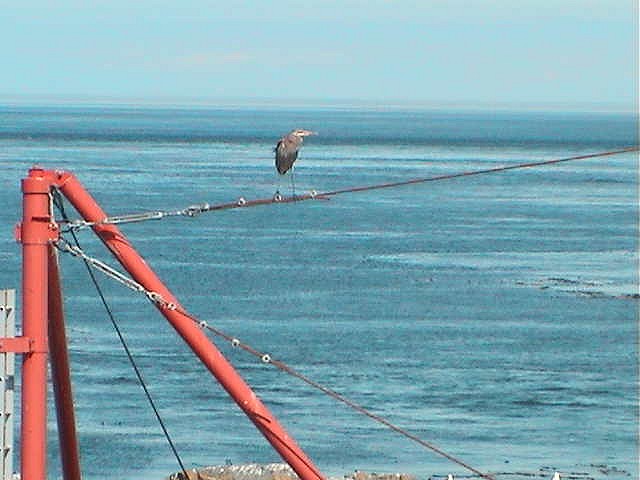
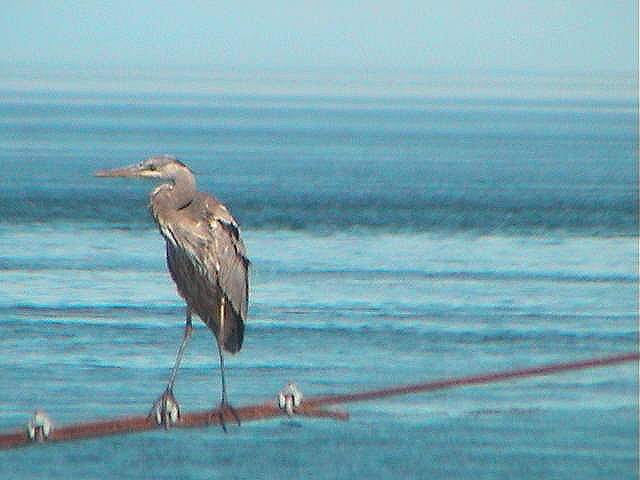
- We don’t often see herons at Race Rocks so we were fortunate to have Mike and Carol there to get this picture of one perched on a winch cable. (2005)
-
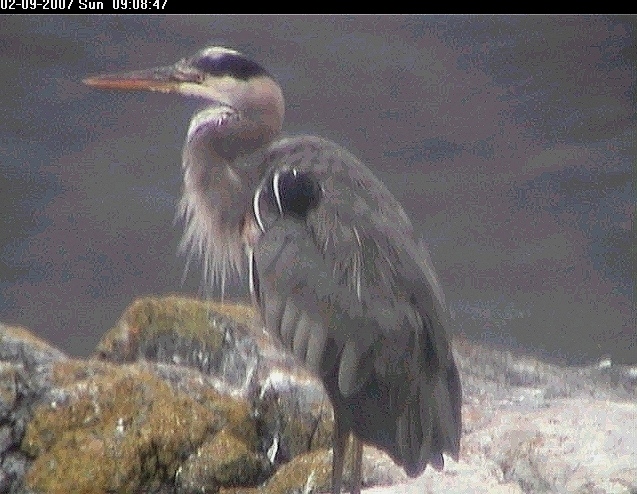
- Note tthe yellow eye.
-
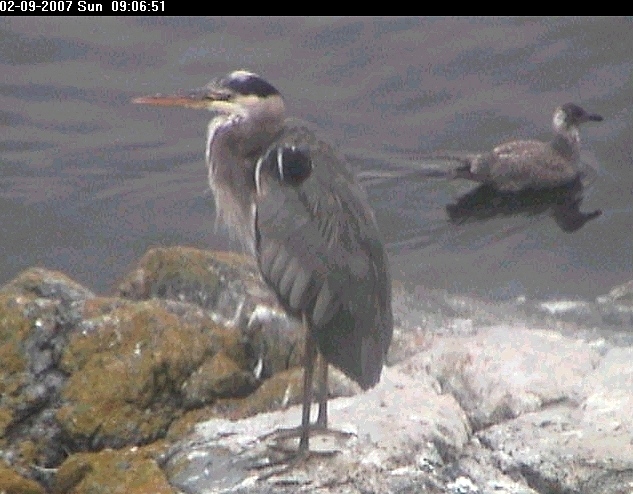
- Finally the Heron roosts close enough to the camera to get a good image. Sept 2, 2007 (Photos by PB.)
-
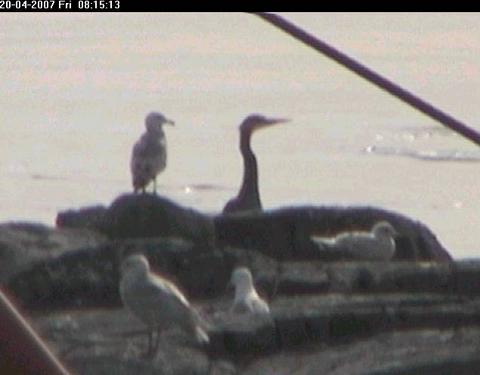
- We don’t often see herons at Race Rocks so we were fortunate to have Mike and Carol there to get this picture of one perched on a winch cable. (2005)
-
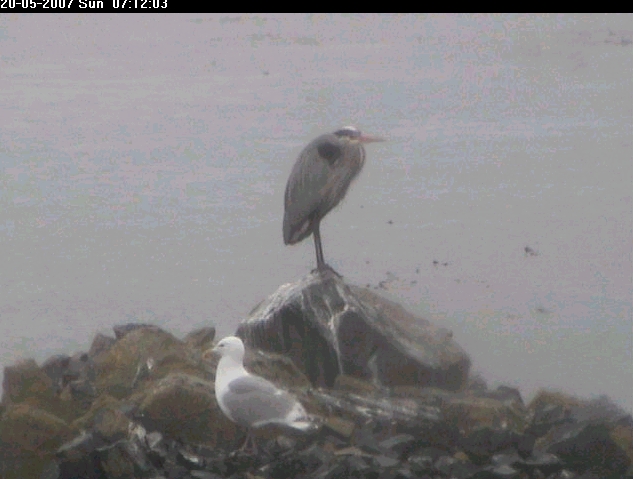
- May 20, 2007. This Heron spent some time on Race Rocks
-
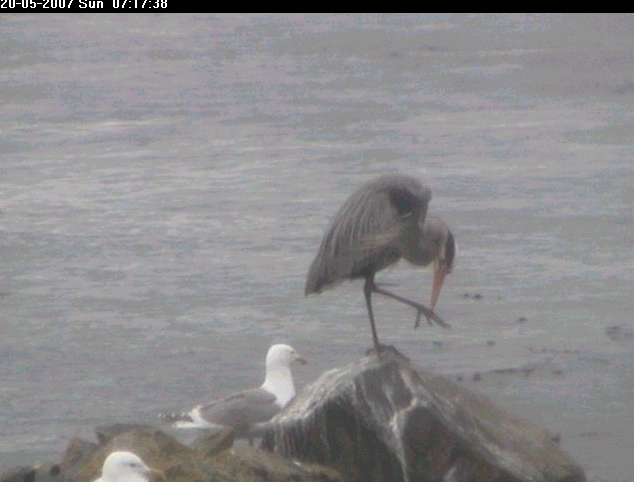
- Itchy bill?? Remote cam 5 photos by PB.
-
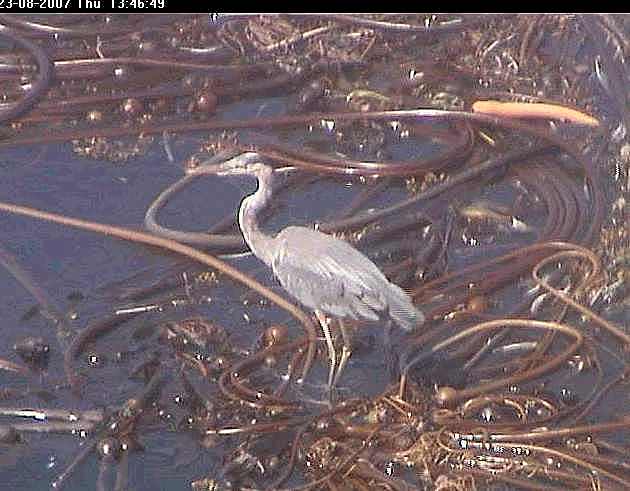
- Heron standing on kelp on the north side of Great Race Rocks August 23, 2007:
Images for this slide show video were taken on the remote camera 5 by PB.
The great blue heron is a very widely spread bird throughout the American continent. During the breeding season it can be found in places such as Alaska and as far south as Mexico or the West Indies. In Winter, most blue herons leave Canada and go to the United States, or even places as Panama, Colombia and Venezuela. However, British Columbia seems to be an exception to this, and blue herons live there during the whole year. On the southern part of Vancouver Island, they are frequent residents in Pedder Bay and are often seen sitting out on the kelp at Rocky Point. Kelp provides shelter for a number of small fish such as herring and anchovie. Occasionally on calm days, we will see a heron standing and spearing fish from the Nereocystis (kelp) beds out at Race Rocks, so they become part of the top of the food web in the ecosystem.
Blue herons are the biggest type of heron. Adults can be over 1 meter tall, and they can have a 2 meter wing span. Their head is white with a black stripe on each side extending back from the eyes. Their back is blue and the breast is white streaked with black. In flight, the neck is doubled back and the head rests against the shoulders. Herons in their first year have grey crowns and grey wings.
Great blue herons feed mainly on very small fish, with no more then 7cm of length. Occasionally, they can feed on shellfish, insects, amphibians, reptiles, small birds and rodents.
Blue herons usually nest in forest areas, within a few kilometres from their main feeding area, in treetops. This is done in order to prevent the nest from being reached by land predators. During the spring, when both males and females arrive for nesting, males occupy old nests or branches and prepare to defend their territory. In the presence of females, they emit very loud shrieks. Two year old males are the most likely to mate immediately. The closest possible nesting area to Race Rocks is Rocky Point.
After mating, males gather construction materials to build a new nest, and together with the female, they build it in about one week. By April, each female then lays three to five eggs, which she incubates during the night, while the male incubates them during the day.
After hatching, young herons are fed by their parents, who regurgitate predigested food. If supplies are not enough. Only the strongest will survive. The weaker offspring end up being pushed out of the nest by the strongest, and they eventually starve. The survivors grow very quickly. Eight weeks after they’re born they can already fly clumsily, and at the age of ten weeks they leave the nest and become independent. An average of two or three chicks results from each breeding cycle of the blue heron
Great blue herons are a very sociable species. They organize in colonies for breeding, feeding and protection from predators.
These birds live as long as 17 years. They have very few natural predators. Draining marshes and destroying common food sites are the greatest threat to the population of great blue herons. However, the mortality among young birds is high. The eggs are often preyed upon by crows, ravens, eagles and raccoons. In ictoria, nesting colonies have moved due to continula predation by bald eagles. Shortage of food is also a common death factor among youngsters. Although contamination by chemicals seems to interfere with the reproductive system, it is not yet proven that it has a direct impact on overall population levels.
Reference: Hinterland Who’s Who?
Domain Eukarya
Kingdom Animalia
Phylum Chordata
SubphylumVertebrata
Class Aves
Order Ciconiiformes
Family Ardeidae
Genus Ardea
Species herodias
Common Name: Great Blue Heron
|
Other Members of the Class Aves at Race Rocks.
|
 Return to the Race Rocks Taxonomy Return to the Race Rocks Taxonomyand Image File |
 The Race Rocks taxonomy is a collaborative venture originally started with the Biology and Environmental Systems students of Lester Pearson College UWC. It now also has contributions added by Faculty, Staff, Volunteers and Observers on the remote control webcams. March 8 2009- Pam Birley The Race Rocks taxonomy is a collaborative venture originally started with the Biology and Environmental Systems students of Lester Pearson College UWC. It now also has contributions added by Faculty, Staff, Volunteers and Observers on the remote control webcams. March 8 2009- Pam Birley |
Branta canadensis: Canada goose ( BC introduced variety)
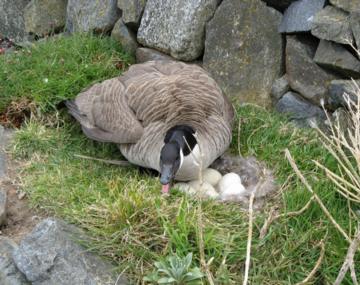
Canada goose protecting her nest, April, 2007
Race Rocks Backgrounder
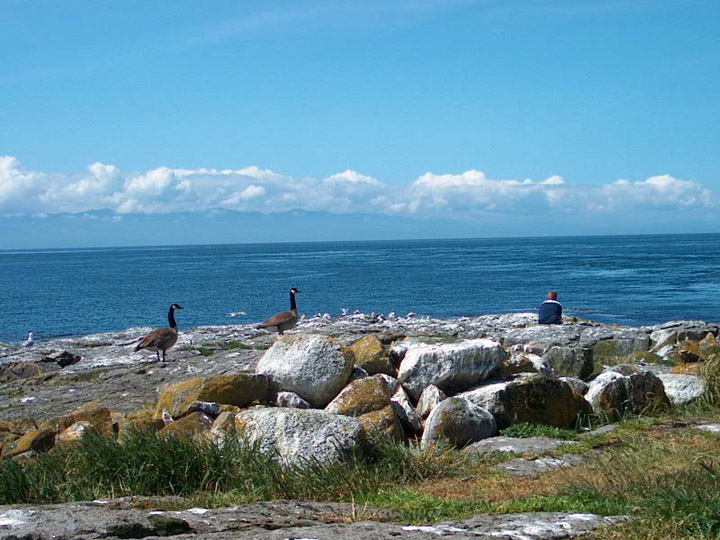
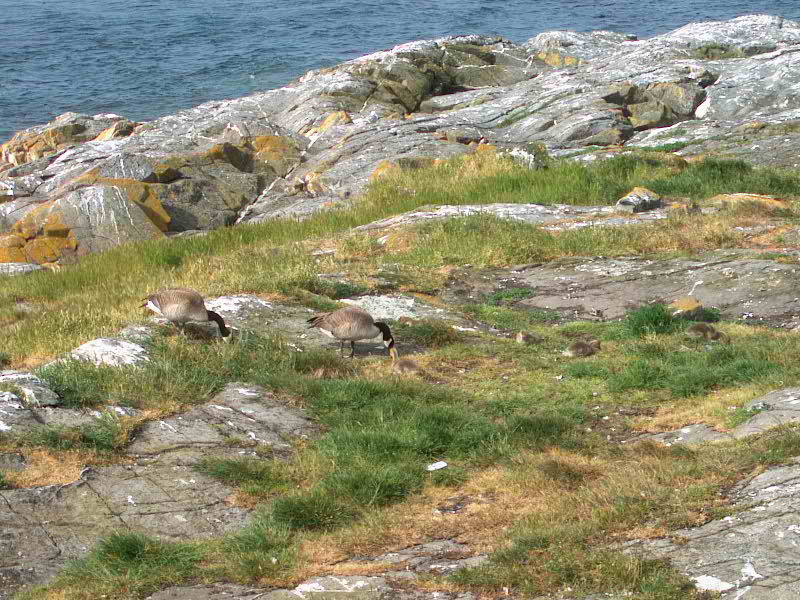
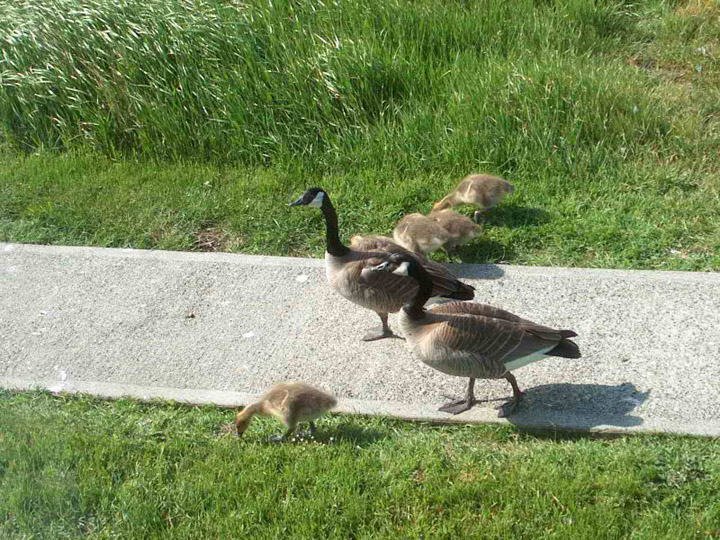
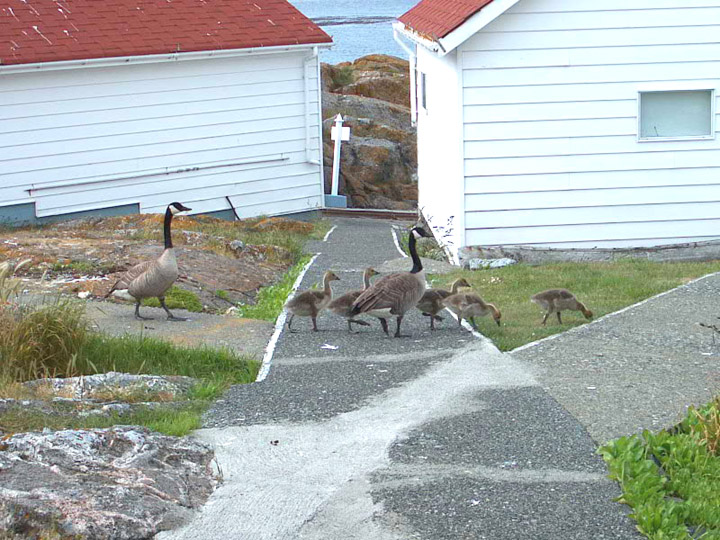
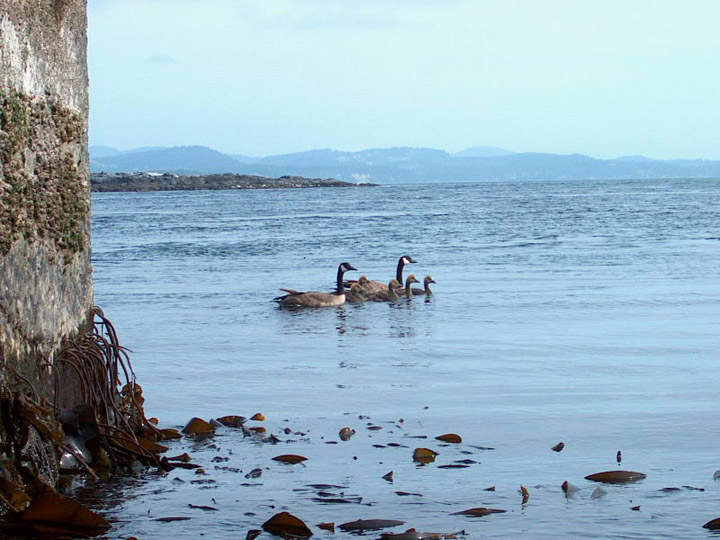
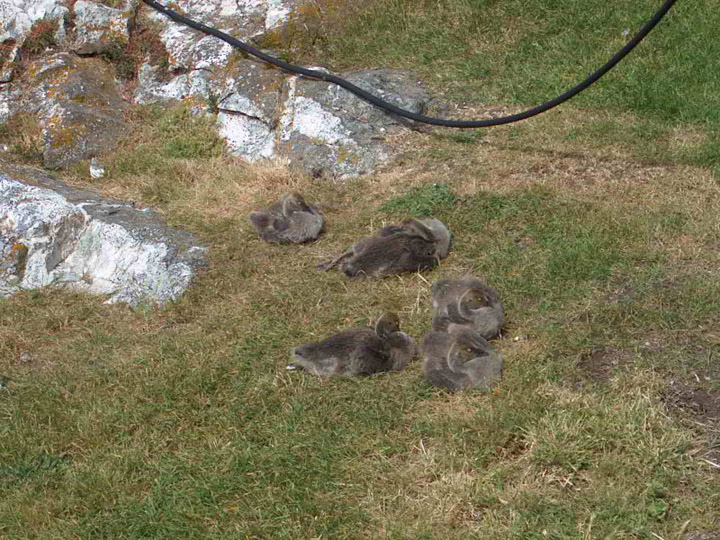
A pair of Canada geese has regularly visited the island in the early spring over the last few years, but until the summer of 2002, they stayed a short time and then moved on. In 2002, Carol noted that two pairs of geese came in the spring and seemed to be staying an extra long time. They were joined by another pair occasionally but had many territorial disputes. In early May the reason was apparent. Five tiny goslings showed up one day with their parents. Carol documented their activities frequently in the Racerocks Log.
-
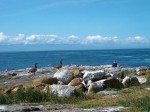
- Parents on the lookout
-
- Grazing time
-
- A mess on the pat
-
- Geese Xing Keep in step Pictures taken June 10/03 by Ryan Murphy

-
- Geese Xing
-
- Out for a swim
-
- Snooze time
-
- Sentinal
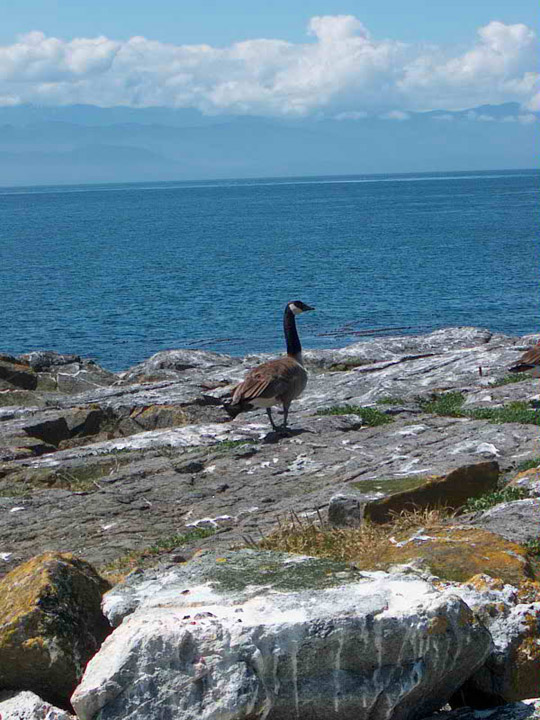
All five goslings made it to maturity that summer, probably assisted by the fresh water fountain which was their daily waterhole during the dry months. From September on, 6 of the original 7 geese frequently returned to the island, and have been seen here as late as January 2003. Update: Successful hatches of 4 nests occurred in 2004. In 2005 at least 4 pairs are nesting. Now when they hatch, the young are immediately taken off the island by their parents since there is no fresh water source on the island.
In the spring of 2008, and addling cull was done on permit from Canadian Wildlife permit arranged through BC Parks. There were no successful hatches that year. This had to be done because of the serious level of overpopulation of geese on the island. The integrity of the vegetation was starting to be impacted.
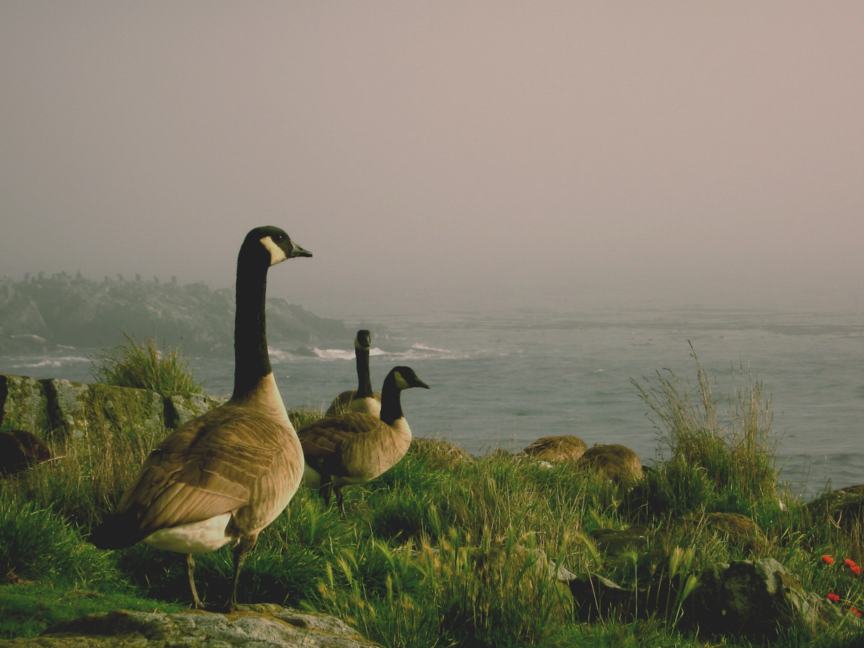
Canada geese photo by Raisa Mirza ( (PC, year 31)
Physical Characteristics: Canada Geese have a black neck, bill and head with pronounced white patches and strip under the chin. The body is usually brownish-grey. During flight the tail shows a white half-circle just above the black tail. These colour patterns are unique to this species. Females are usually somewhat smaller than the males, although both are similar to each other in colour. The mass of the Canada Goose varies in every species ranging from one to four kilograms. Goslings, or baby geese, are yellow with some greenish-grey colourings on the top of the head and back.
Food Habits
When on land, Canada Geese eat mostly grass and wild barley. They are able to grab a hold of each blade and pull it out with their bills by jerking their heads. They also eat wheat, beans, rice, and corn. In the water, the birds stick their head and upper part of their body into the water leaving their tail and back end extending in the air. They stretch their neck out, under the water, and slide their bills across the bottom silt. They also eat a number of aquatic plants such as eel grass and sea lettuce.
Behaviour
-
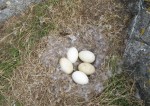
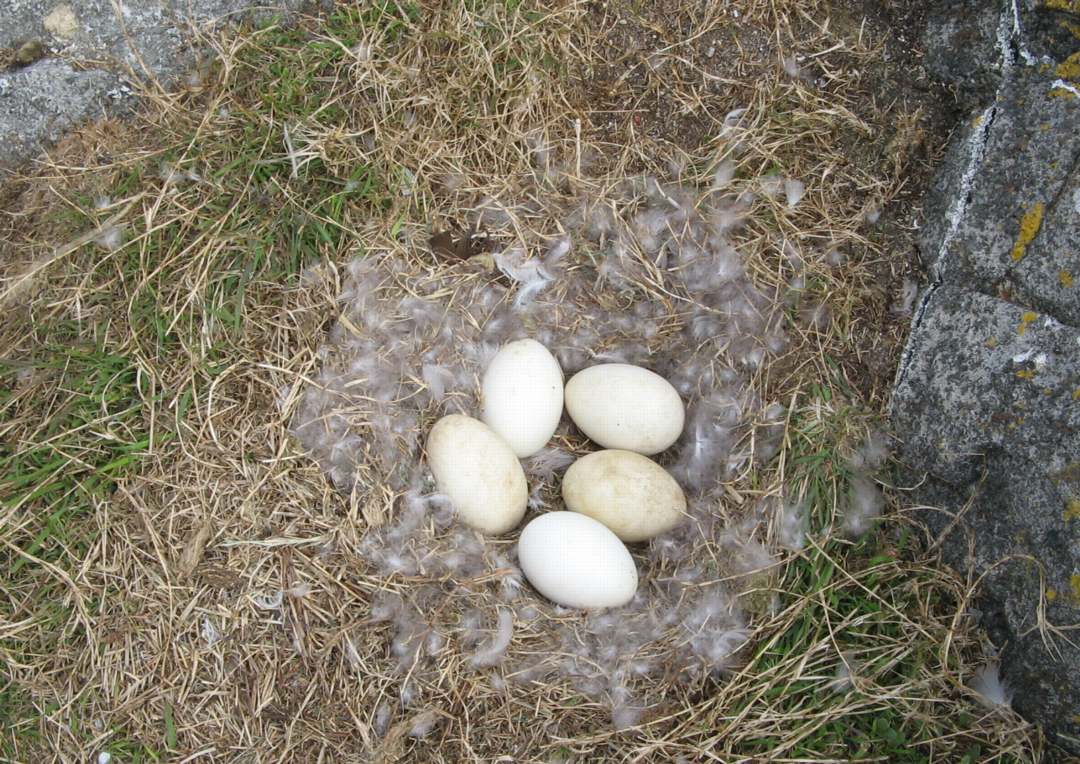
- Eggs, April 2007
-
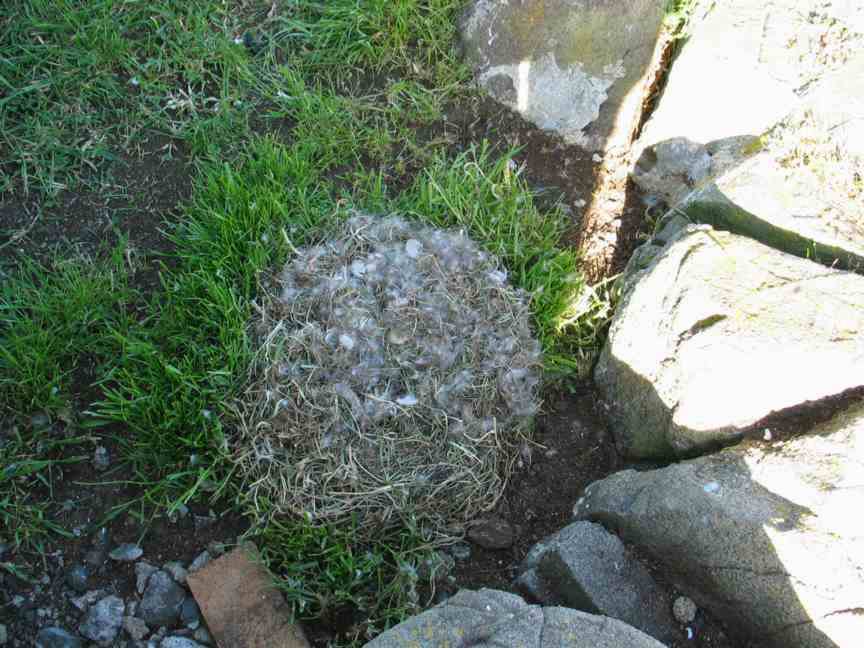
- A nest covered up while the parents are foraging.
-
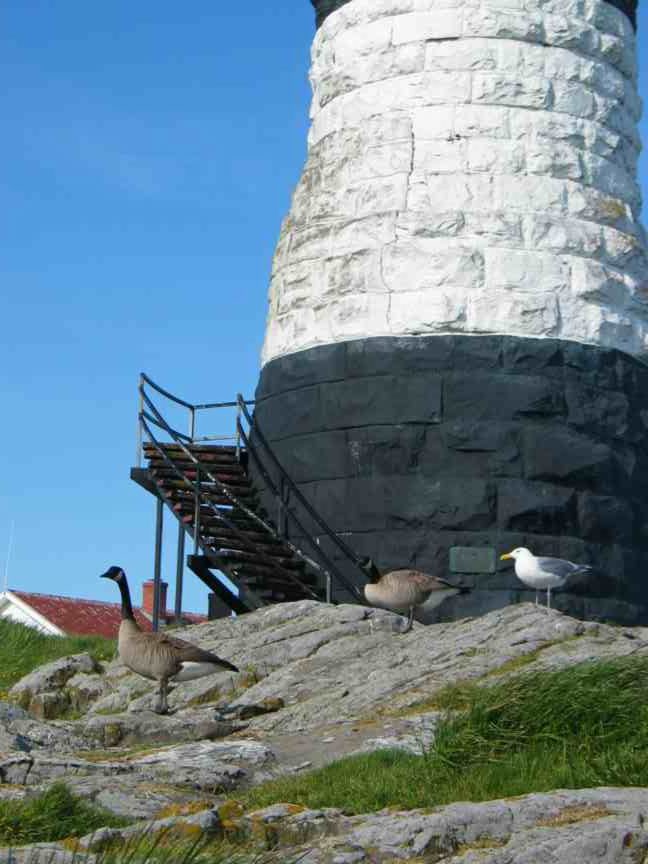
- Sentinel near tower
-
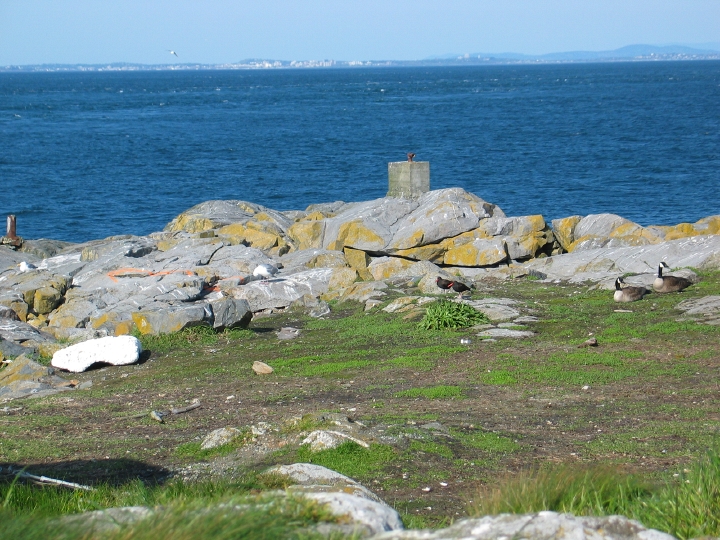
- Sharing a spot in the sun with the Black Oystercatchers, spring, 2005
-
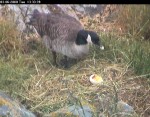
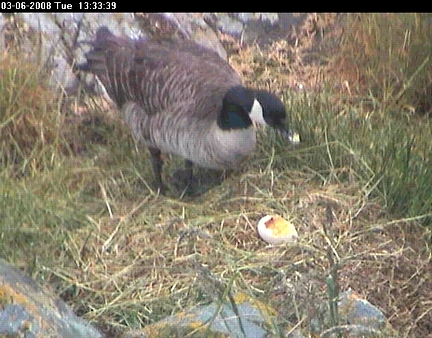
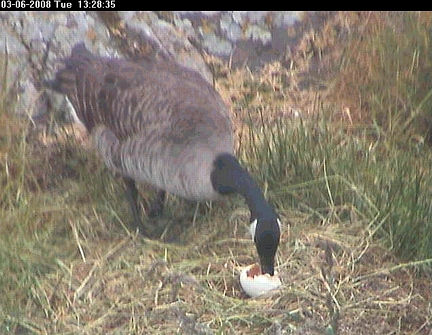
- On June 3/08, PB captured these images of the goose eating her own egg which had not hatched
-
- his goose had only one egg, and had sat on it for at least 40 days
Males in this species are very aggressive. They use their bills not only to eat and groom, but also in attacks. They also lay out flat and still on the ground with their necks stretched out to be less visible to the danger. Most geese mate for life. They form pairs during migration or on wintering grounds. Males fight over females with their wings and bills. The winner approaches the female with his head down and neck undulating. He makes hissing and honking noises. They usually mate either before or after they have found a nesting location. Mating occurs in the spring on the water.
| Domain | Eukarya |
| Kingdom | Animalia |
| Phylum | Chordata |
| Subphylum | Vertebrata |
| Class | Aves |
| Order | Anseriformes |
| Family | Anatidae |
| Genus | Branta |
| Species | canadensis (Linnaues) |
| Common Name: | Canada Goose |
Environmetal Impact : Although we have had a permit to addle eggs for several years, the introduced Canada goose variety has had a serious impact on vegetation through intensive grazing through the winter. By including several grazing exclosures with wire mesh around the island, the difference in turf development is emphasized.
A serious impact also is the increased erosion around the First nations burial cairns.
References:
Canada Goose, http://www.mbr-pwrc.usgs.gov/id/framlst/i1720id.html
Backyard Birding, http://www.slivoski.com/birding/goose3.htm
Canada Goose, Branta Canadensis, http://www.aquatic.uoguelph.ca/birds/speciesacc/accounts/ducks/canadens/account.htm
The Atlas of Breeding Birds of Alberta, Ed. Glen P. Semenchuk. Edmonton: Federation of Alberta Naturalists, 1992.
Return to the Race Rocks taxonomy
| This file is provided as part of a collaborative effort by the students, faculty, staff and volunteerts of Lester B. Pearson College | 12/02 | Bruce Benjamin D’Souza (Yr 29) |
Arenaria melanocephala: Black Turnstone–The Race Rocks Taxonomy
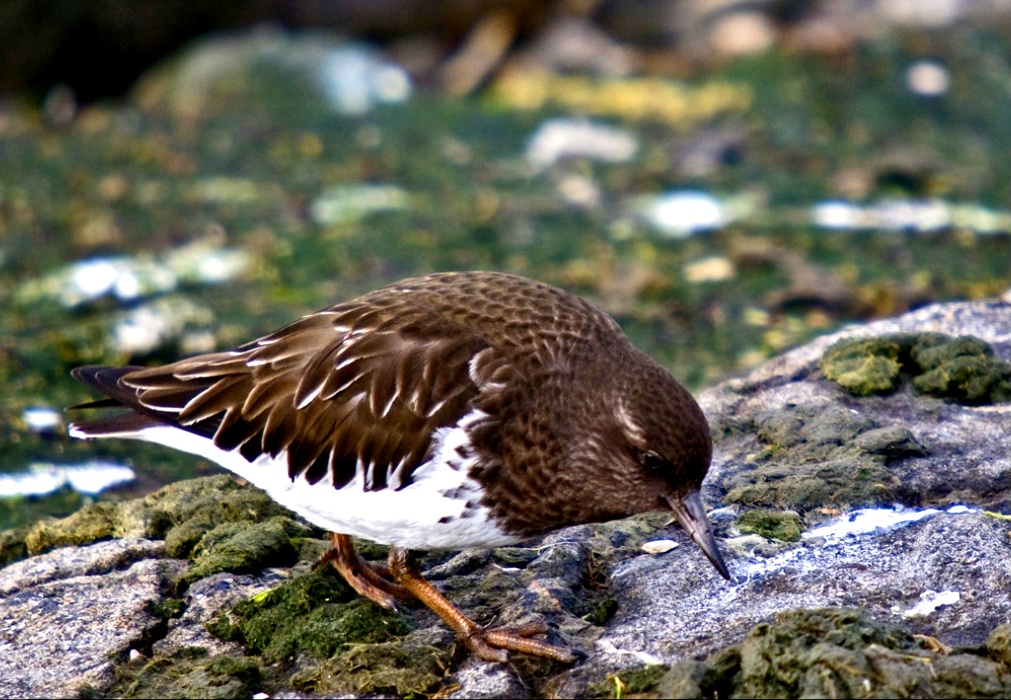
Ryan took this image in January 2009. At that time of year there were over a dozen turnstones foraging across the island.
-
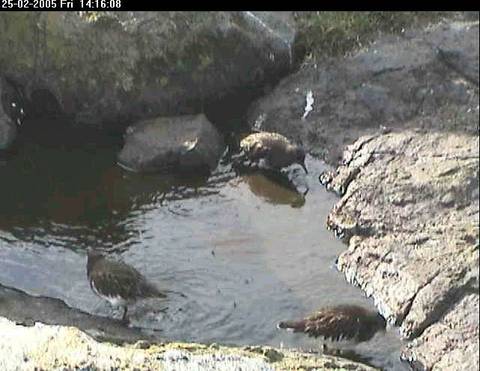
- After a rain it can often be seen as in this photograph, bathing in the freshwater pools in rock depressions. Photos by PB.
The Black Turnstone breeds in Western and Southern Alaska on the coastal plain. It winters only on the Pacific coast, from southeast Alaska to central Mexico. It is the most abundant shorebird of rocky shorelines. Favourite habitats include reefs, rocky beaches, jetties, and gravel bars at the mouths of rivers or along lagoons. It may also forage on adjacent mudflats wet sandy beaches, floating kelp beds, and piles of washed-up seaweed. Black Turnstones have been recorded roosting on dry rocks, jetties, and floating log booms at which time they may gather into extremely dense flocks.
It is widely distributed along the inner and outer coast. Its distribution is largely restricted to rocky coastal shorelines, but it frequents many fiords and protected inlets. It is a vagrant in the interior. The Black Turnstone usually occurs in flocks of 10 to 30 birds at Race Rocks where it overwinters.
This slide show shows the Black Turnstone being part of the Food Web at Race Rocks providing energy for the Peregrine falcon!
Reference used:http://rbcm1.rbcm.gov.bc.ca/nh_papers/gracebell/english/b_turnst.htm
Below are the records for population numbers of Black Turnstones observed in the Christmas Bird Counts.
Domain Eukarya
Kingdom Animalia
Phylum Chordata
Subphylum Vertebrata
Class Aves
Order Charadriiformes
Family Scolopacidae
Genus Arenaria
Species melanocephala
Common Name: Black Turnstone
Other Members of the Class Aves at Race Rocks.
| Return to the Race Rocks Taxonomy and Image File |
| The Race Rocks taxonomy is a collaborative venture originally started with the Biology and Environmental Systems students of Lester Pearson College UWC. It now also has contributions added by Faculty, Staff, Volunteers and Observers on the remote control webcams. Angela Chaisson, PC yr 28 |
Cormorants vs eagle
ood Evening
TEMPERATURE: Max. 9.5 ºC »» Min. 7.8 ºC »» Reset 9.4 ºC »» Rain 6.8 mm
MARINE LIFE: Although the forecasted high winds did not materialize most of the hauled out Sealions along the north shore of Gr. Race have taken to the water or moved farther inland to avoid the high swells coming in from the weather system to the east. This afternoon one mature Bald Eagle spent about an hour on the high point of West Race. The 200 or so Cormorants took to the air as the eagle landed but soon settled back down leaving a good distance between them and the great raptor.
HUMAN INTERACTION: 5 Ecotour boats and 3 pleasurecraft through today.
posted by Carol or Mike S at 6:09 PM
TEMPERATURE: Max. 9.5 ºC »» Min. 7.8 ºC »» Reset 9.4 ºC »» Rain 6.8 mm
MARINE LIFE: Although the forecasted high winds did not materialize most of the hauled out Sealions along the north shore of Gr. Race have taken to the water or moved farther inland to avoid the high swells coming in from the weather system to the east. This afternoon one mature Bald Eagle spent about an hour on the high point of West Race. The 200 or so Cormorants took to the air as the eagle landed but soon settled back down leaving a good distance between them and the great raptor.
HUMAN INTERACTION: 5 Ecotour boats and 3 pleasurecraft through today.
posted by Carol or Mike S at 6:09 PM
Good Morning
WEATHER: Sky Cloudy »» Vis. 15 Miles »» Wind North East 5 Knots »» Sea Rippled
posted by Carol or Mike S at 7:25 AM
WEATHER: Sky Cloudy »» Vis. 15 Miles »» Wind North East 5 Knots »» Sea Rippled
posted by Carol or Mike S at 7:25 AM
Students end project week
Good Evening
TEMPERATURE: Max. 9.1 ºC »» Min. 7.3 ºC »» Reset 8.5 ºC »» Rain 1.9 mm
MARINE LIFE:Still seeing fish balls but they are small and not as frequent as in the past weeks. Daily visitors are the usual gulls, Starlings,Crows,Black Turnstones, Surf Birds, Cormorants,Sparrows, Harlequin Ducks,a group of about 30 Black Oyster Catchers and the geese-usually 6 but every couple of days the 7th joins the group for at least part of the day. The Sealion population is still fairly low for this time of year as many of them have left the area since the last series of blasting on Bentinck Island.
HUMAN INTERACTION: Chris in with 2nd Nature to return Rosie, Ahmad and Jeremias to Campus. Garry out in 2nd Nature with guests also 4 Ecotour boats and 2 pleasurecraft through today.
posted by Carol or Mike S at 6:19 PM
TEMPERATURE: Max. 9.1 ºC »» Min. 7.3 ºC »» Reset 8.5 ºC »» Rain 1.9 mm
MARINE LIFE:Still seeing fish balls but they are small and not as frequent as in the past weeks. Daily visitors are the usual gulls, Starlings,Crows,Black Turnstones, Surf Birds, Cormorants,Sparrows, Harlequin Ducks,a group of about 30 Black Oyster Catchers and the geese-usually 6 but every couple of days the 7th joins the group for at least part of the day. The Sealion population is still fairly low for this time of year as many of them have left the area since the last series of blasting on Bentinck Island.
HUMAN INTERACTION: Chris in with 2nd Nature to return Rosie, Ahmad and Jeremias to Campus. Garry out in 2nd Nature with guests also 4 Ecotour boats and 2 pleasurecraft through today.
posted by Carol or Mike S at 6:19 PM
Good morning
WEATHER: Sky Overcast »» Vis. 10 Miles »» Wind North 11 Knots »» Sea Choppy
Goodbye RR, thanks for our marvellous project week.posted by Race Rocks Relief at 7:48 AM
Good Evening
Temperature: Max. 9.1 ºC »» Min. 7.1 ºC »» Reset 8.0 ºC
Rainfall: 9.0mm
WEATHER: Sky Overcast »» Vis. 10 Miles »» Wind North 11 Knots »» Sea Choppy
Goodbye RR, thanks for our marvellous project week.posted by Race Rocks Relief at 7:48 AM
Good Evening
Temperature: Max. 9.1 ºC »» Min. 7.1 ºC »» Reset 8.0 ºC
Rainfall: 9.0mm
Our last evening on the island has arrived, we’ll spend it editing
the rest of our projects.
posted by Race Rocks Relief at 7:47 AM
Sea Duck Conference attendees to Race Rocks
‘This morning after the students returned to Pearson College, Garry and Mark took out fourteen international visitors from a conference on Sea Ducks in Victoria. They were particularly impressed by the assortment of bird life on the way out, Belted Kingfishers, Great Blue Herons, Double- Crested Cormorants, and Bonaparte”s Gulls were common, Rhinocerous Auklets and a flock of , 6 Ancient Murrelets as well as several flocks of Marbled Murrelets -20+) were an added bonus. A few Western Grebes were also in the Pedder Bay region. Double Crested Cormorants, Western and Thayer”s gulls were the most common around Race Rocks, with a few juvenile Glaucous winged gulls mixed in. ‘, ‘Garry Fletcher’, ’22:05:42 ,
Blue Heron spent several hours fishing
Good Evening
TEMPERATURE: Max. 8.9 ºC »» Min. 5.0 ºC »» Reset 7.7 ºC
MARINE LIFE: Still seeing numerous fish balls mostly in the tidelines outside the MPA boundries but the number of sea birds is down considerably from last week. There were 5 Harlequins in the little bay on the east side of Gr. Race also one Blue Heron spent several hours fishing in the eastern kelp bed then just before sunset flew off toward Bentinck Island. There are 5 California Sealions hauled out along the north shore of Gr. Race that have fresh looking wounds, mostly in the hind flipper area, my guess, evidence of encounters with the transient Orcas that have been in the area quite often lately. There are still about 600 Cormorants in the area, another indication that the food supply is still good.
HUMAN INTERACTION: Second Nature in with Angus, Scott over to work on the the cameras and computers. Station boat out to return Scott to campus and to Pedder Bay. There were 5 Ecotour boats, 1 pleasurecraft through today.posted by Carol or Mike S at 6:05 PM
TEMPERATURE: Max. 8.9 ºC »» Min. 5.0 ºC »» Reset 7.7 ºC
MARINE LIFE: Still seeing numerous fish balls mostly in the tidelines outside the MPA boundries but the number of sea birds is down considerably from last week. There were 5 Harlequins in the little bay on the east side of Gr. Race also one Blue Heron spent several hours fishing in the eastern kelp bed then just before sunset flew off toward Bentinck Island. There are 5 California Sealions hauled out along the north shore of Gr. Race that have fresh looking wounds, mostly in the hind flipper area, my guess, evidence of encounters with the transient Orcas that have been in the area quite often lately. There are still about 600 Cormorants in the area, another indication that the food supply is still good.
HUMAN INTERACTION: Second Nature in with Angus, Scott over to work on the the cameras and computers. Station boat out to return Scott to campus and to Pedder Bay. There were 5 Ecotour boats, 1 pleasurecraft through today.posted by Carol or Mike S at 6:05 PM
Good Morning
WEATHER: Sky Part Cloudy »» Vis. 15 Miles »» Wind North East 21 Knots »» Sea 3 Foot Moderate
posted by Carol or Mike S at 7:25 AM
WEATHER: Sky Part Cloudy »» Vis. 15 Miles »» Wind North East 21 Knots »» Sea 3 Foot Moderate
posted by Carol or Mike S at 7:25 AM
Sea lion population still down
Good Evening
TEMPERATURE: Max. 9.5 ºC »» Min. 4.9 ºC »» Reset 7.9 ºC
MARINE LIFE: The population of Sealions is still down since the last series of blasts so it is fairly quiet,the animals hauled out by the winch house are quite nervous of any activity on or near the dock. With another series of blasts in the coming weeks they may just move away altogether. Saw only 5 small fish balls today and not many birds feeding, seem to have followed the food elsewhere for now. The geese were back, at least 6 of them.
HUMAN INTERACTION: The LGL observers arrived first thing this morning and left at 16:30 and as careful as they were the sealions closest to the dock took to the water.There were 8 Ecotour boats through today.
posted by Carol or Mike S at 6:08 PM
Herring Balls
TEMPERATURE: Max. 11.1 ºC »» Min. 7.7 ºC »» Reset 9.1 ºC »» Rain 0.8 mm
MARINE LIFE: There are fewer birds today, saw only 3 fish balls in the immediate area but could see a lot of activity quite a distance to the east with the scope.Still about 2000 gulls and Cormorants in the MPA.
HUMAN INTERACTION: Angus over in the Hyaku with Scott and Ken working still on the Camera 2 system, also 5 Ecotour boats.
posted by Carol or Mike S at 6:15 PM