In 2002, Taco Niet finished his Masters degree in the Engineering Department’s Institute for Integrated Energy Systems at the University of Victoria (IESVic). In this clip, Garry interviews Taco about his research on renewable energy systems for Race Rocks. Great resources are available out there such as wind, solar and tidal energy. In order to conserve the natural aspect of the island, while reducing the use of Diesel fuel, many challenges arise. Taco considers the project can be integrated nicely with the racerocks.com project in order to be widely accessible on the internet and serve as a model for monitoring and comparing energy generation.
Category Archives: Energy
A UVic study explores renewable energy options at Canada’s newest Marine Protected Area
Going with the flow
A UVic study explores renewable energy options at Canada’s newest Marine Protected Area
by Diane Haughland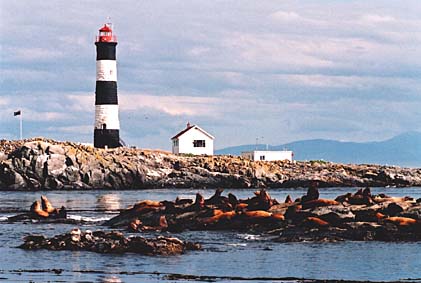
Taco Niet
The essence of Race Rocks is its tides. Tides that feed biodiversity. Tides that have brought ships to their knees upon its rocky shores. And tides that may bring it to the forefront of renewable energy technology.
For his recently completed master’s thesis, UVic mechanical engineering graduate student Taco Niet has created a model that shows tidal power to be the most realistic source of renewable energy for Race Rocks.
A collection of nine tiny islets with a big reputation, Race Rocks is situated 17 km southwest of Victoria at the eastern end of the Strait of Juan de Fuca. Its reefs and strong tidal currents — up to seven knots — support an exceptional diversity of marine life, including invertebrates, fish, seabirds and marine mammals. In 2000 it became Canada’s first Marine Protected Area created under the federal Oceans Act.
Race Rocks hosts a lighthouse, occasional researchers and educators, and two full-time guardians employed by Lester B. Pearson College. The college has also installed a local area network that allows Internet video coverage around the clock, accessible at www.racerocks.com.
While the light tower and foghorn are powered by solar panels, a diesel generator supplies the guardians with the energy required to live full-time at Race Rocks, including energy-costly water desalination. Several times a year, diesel fuel is transported to the island by boat and pumped into storage tanks, an enterprise with plenty of potential environmental hazard.
Garry Fletcher, educational director at Pearson College, initiated the renewable energy project through contact with UVic’s institute for integrated energy systems (IESVic). Institute director Dr. Ged McLean, Niet, and two other students soon began preliminary energy modeling.
Niet later took on the project as a master’s thesis. He modelled the hourly energy flows for an entire year, using information collected by electronic monitors that recorded energy use, wind speed, sun exposure and tidal flow. McLean stresses the importance of Niet’s model.
“It’s the only one we know of that tracks energy production and demand on an hourly basis. Most models use a larger time scale, glossing over the amount of time when energy production is zero.” McLean adds, “Taco also made his system entirely self-contained — there are no traditional back-up systems in the model, making it especially relevant to small, isolated communities.”
In the end, gleaming solar panels and spinning wind turbines were not the best choice; it was the eggbeater-like tidal turbines that came out tops. Niet says it’s not surprising that tidal power emerged ahead of solar and wind.
“Tides arrive every six hours, every day, year-round,” he points out. “They’re reliable.” Tidal ebb and flow result in the most favourable balance between energy production and demand, requiring less energy storage than either of the alternatives.
“We see the Race Rocks model as an alternative energy parable,” Niet muses. “It provides a realistic picture of what we can — and can’t — do with renewable energy.” Seasonal variation in many renewable energy sources requires large investments in energy storage. “Blanketing every inch of an area with solar panels is not exactly environmentally friendly,” Niet explains, “not to mention the environmental and economic costs of making the panels.”
While Niet’s model currently exists only on paper, the Race Rocks energy parable could soon become a reality. Niet is searching for an industrial partner to take the next step. “We need to conduct an environmental assessment,” Niet says, “and if the results are favourable, we’ll require funding to implement the turbines”.
Meanwhile, Niet, McLean, and McLean’s new students forge ahead. Their next project? “North America is the next, logical self-contained unit to model,” enthuse Niet and McLean. “Our goal is to understand what a realistic future looks like,” McLean explains, “and how sustainable energy technology fits in that world.”
Funding for Niet’s work was provided by McLean’s Natural Sciences and Engineering Research Council operating grant.
 Diane Haughland is a participant in the SPARK program (Students Promoting Awareness of Research Knowledge), funded by UVic, NSERC and SSHRC.
From The Ring, Feb 21, 2002
First of the Integrated Energy Talks
Sunday, February 10, 2002
Good Evening
TEMPERATURE: Max. 8.0C Min. 3.0C Reset 5.7C Rain 7.6 mm
MARINE LIFE:The California Sea Lion was still hauled out on the dock but went into the water just before 8:30 a.m. There were 10 mature and 3 immature Bald Eagles in the reserve by 8 a.m. The Bull Northern Elephant Seal is still spending most of the time along the shore of Gr. Race and in the little bay on the east side. Still 6 Geese.
HUMAN INTERACTION: 2nd Nature out about 9a.m. with students to manage things while we spent some quality time with family. While we were away there was quite a fierce weather system through the area and it was still blowing 29-32 knts. when we arrived at the dock, a little cold and damp but glad to be back! Chris picked up the students in 2nd Nature just as we were arriving back about 5p.m.
In the morning, Garry came out with Taco Niet and Ged McLean of ISEVIC. (University of Victoria) with 8 of the members of the alternate energy company “Clean Energy” from Vancouver. Taco presented us with his completed copy of his Masters Thesis in Engineering on the Proposed Energy Systems for Race Rocks. An excellent piece of research, parts of which we will be linking soon on our energy pages. An outline of an intriguing proposal for a current energy turbine system on which they are working was brought forward.- More later on the Race Rocks energy page.
–Garry Fletcher
posted by Carol or Mike S at 6:07 PM
TEMPERATURE: Max. 8.0C Min. 3.0C Reset 5.7C Rain 7.6 mm
MARINE LIFE:The California Sea Lion was still hauled out on the dock but went into the water just before 8:30 a.m. There were 10 mature and 3 immature Bald Eagles in the reserve by 8 a.m. The Bull Northern Elephant Seal is still spending most of the time along the shore of Gr. Race and in the little bay on the east side. Still 6 Geese.
HUMAN INTERACTION: 2nd Nature out about 9a.m. with students to manage things while we spent some quality time with family. While we were away there was quite a fierce weather system through the area and it was still blowing 29-32 knts. when we arrived at the dock, a little cold and damp but glad to be back! Chris picked up the students in 2nd Nature just as we were arriving back about 5p.m.
In the morning, Garry came out with Taco Niet and Ged McLean of ISEVIC. (University of Victoria) with 8 of the members of the alternate energy company “Clean Energy” from Vancouver. Taco presented us with his completed copy of his Masters Thesis in Engineering on the Proposed Energy Systems for Race Rocks. An excellent piece of research, parts of which we will be linking soon on our energy pages. An outline of an intriguing proposal for a current energy turbine system on which they are working was brought forward.- More later on the Race Rocks energy page.
–Garry Fletcher
posted by Carol or Mike S at 6:07 PM
Race Rocks Sustainable Energy System Development
Canadian Hydrogen Conference June 17-21, 2001, Victoria, BC.
RACE ROCKS SUSTAINABLE ENERGY
SYSTEM DEVELOPMENT
Taco Niet, G. McLean
Institute for Integrated Energy Systems, University of Victoria
Victoria, B.C., Canada V8W 3P6
Tel: (250) 721-8936 Fax: (250) 721-6323
Abstract
Race Rocks is a small archipelago located just Southwest of Victoria, British Columbia in the Juan de Fuca Strait. An important Beacon for Coastal Navigation in this busy area is located on Race Rocks, which is also home to a stunning variety of marine mammals and birds. The Race Rocks site has become Canada’s first Marine Protected environment and is now carefully managed by a group of interested partie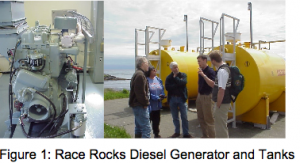 s including Pearson College and The Canadian Coastguard. The environmental integrity of the site is often jeopardised to bring diesel fuel to the site and the noise pollution on the site due to the diesel generators is significant. IESVic has stepped forward to evaluate the potential of renewable energy sources on-site to power a sustainable energy system. A preliminary study was performed as an innovative graduate course at the University of Victoria that exposed students to sustainable energy system design. Our conclusion is that with Tidal currents of up to 3.7 m/s, average winds of 21.6 km/h and large amounts of solar insolation, there are ample renewable resources available on the site to develop a sustainable integrated energy system capable of providing reliable power for the site. Race Rocks is therefore ideally
s including Pearson College and The Canadian Coastguard. The environmental integrity of the site is often jeopardised to bring diesel fuel to the site and the noise pollution on the site due to the diesel generators is significant. IESVic has stepped forward to evaluate the potential of renewable energy sources on-site to power a sustainable energy system. A preliminary study was performed as an innovative graduate course at the University of Victoria that exposed students to sustainable energy system design. Our conclusion is that with Tidal currents of up to 3.7 m/s, average winds of 21.6 km/h and large amounts of solar insolation, there are ample renewable resources available on the site to develop a sustainable integrated energy system capable of providing reliable power for the site. Race Rocks is therefore ideallysuited to become a showcase for renewable energy generation. This paper outlines the results of the feasibility study, discusses the opportunities available at Race Rocks and examines the progress to date. Requirements for the implementation of a sustainable energy system on the site are discussed.
See the full PDF: tacopaper
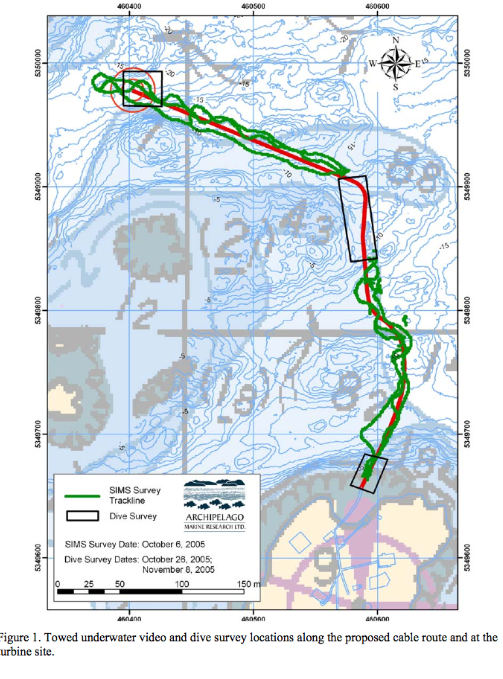
Summary Final Report on the Environmental Monitoring Related to the Tidal Current Energy Project at Race Rocks
ENVIRONMENTAL MONITORING RELATED TO THE PEARSON COLLEGE-ENCANA-CLEAN CURRENT TIDAL POWER DEMONSTRATION PROJECT AT RACE ROCKS ECOLOGICAL RESERVE FINAL REPORT DECEMBER 2006
Prepared for:
Chris Blondeau
Seafront Manager/Operations Manager racerocks.com
Lester B. Pearson College of the Pacific
650 Pearson College Drive
Victoria, BC V9C 4H7
- Prepared by: Pam Thuringer M.Sc., R.P.Bio. and Rhonda Reidy, B.Sc. Archipelago Marine Research Ltd. 525 Head Street Victoria, BC V9A 5S1
See the complete PDF archipel-final-report
Generator replacement by helicopter
For maintenance purposes, the Canadian Coast Guard is replacing one of the generators necessary to power Race Rocks. This piece of equipment is a 25kW Diesel generator located in the engine room situated in the southern part of the island. Hopefully, in the next decade, we will be able to switch to renewable energy to move a step further toward our goal of sustainability for the islands and protection of the environment.
This video was made by Ryan Murphy and Paulina Ponce de Leon in October of 2000.
IESVIC connections
 In March of 2000, Dr. David Scott, (formerly IESVic Director, now Director of Energy Systemics group), Dr. Ged McLean, (IESVic Director) , Dr. Murray MacWhale, ( Assistant Professor) and Mr. Walter Merida, ( former United World College student at the Adriatic College and then a PhD candidate at the University of Victoria) went out to Race Rocks with Garry Fletcher to start a process of idea building on the concept of Alternate Energy Technologies for Race Rocks . After a meeting including a few of the Pearson College students who were staying at Race Rocks while diving over the mid term break, we came away confident that some ideas had been discussed which may lead to a new collaborative arrangement for energy alternatives for the island. In March of 2000, Dr. David Scott, (formerly IESVic Director, now Director of Energy Systemics group), Dr. Ged McLean, (IESVic Director) , Dr. Murray MacWhale, ( Assistant Professor) and Mr. Walter Merida, ( former United World College student at the Adriatic College and then a PhD candidate at the University of Victoria) went out to Race Rocks with Garry Fletcher to start a process of idea building on the concept of Alternate Energy Technologies for Race Rocks . After a meeting including a few of the Pearson College students who were staying at Race Rocks while diving over the mid term break, we came away confident that some ideas had been discussed which may lead to a new collaborative arrangement for energy alternatives for the island. |
| By May of 2000 Dr. Ged McLean arranged to have three students in Engineering at the University of Victoria do a feasibility study on Alternate Energy for Race Rocks in a class in the summer of 2000. As a result of this preliminary study, Taco Niet decided to take this on as a project for his Master ‘s Program. |
| University of Victoria Media Release: Graduate Student creates a renewable energy plan for Race Rocks.Article in the Times Colonist referring to Taco’s research Article in THE RING (UVIC) Going with the Flow |
 Interview with Taco Niet Interview with Taco Niet |
Taco’s Thesis Abstract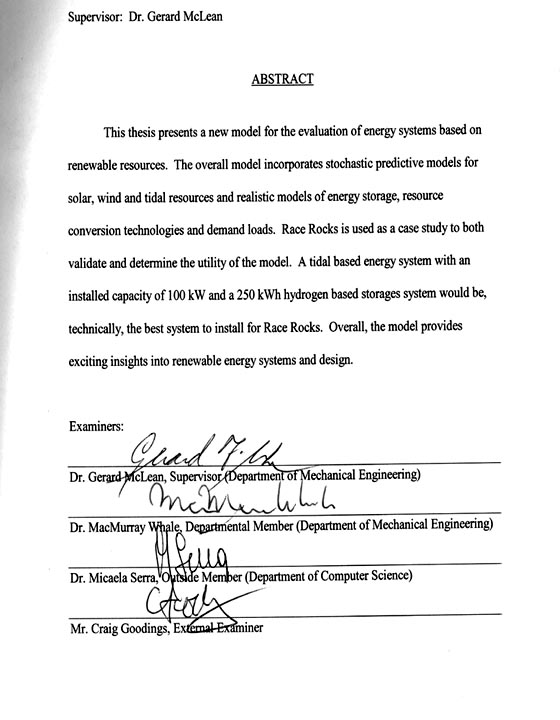 |
|
 See also Niet, T, McLean, G. “Race Rocks Sustainable Energy Development”, Paper presented at 11th Canadian Hydrogen Conference, Victoria, BC, June 2001 See also Niet, T, McLean, G. “Race Rocks Sustainable Energy Development”, Paper presented at 11th Canadian Hydrogen Conference, Victoria, BC, June 2001 |
Proposal by Michael Wheatley to reduce Power Generation Cost and Diesel Fuel Consumption at Race Rocks |
Fuel delivery
From the lightkeepers log I am extracting the amount of gallons of Diesel fuel delivery in order to be able to compare to 2013 amounts being used .
Diesel fuel delivery on this date: 5173 gals.
to see amounts of all deliveries go to: https://www.racerocks.ca/tag/fuel-delivery/