https://racerocks.ca/racerock/rrab2/mparesources1.htm
This file is designed for the use of the Race Rocks Advisory Board in order to make available in one index, the resources that are most relevant to the Marine Protected Area Designation Process.
Category Archives: Facility work
 , the Race Rocks Area
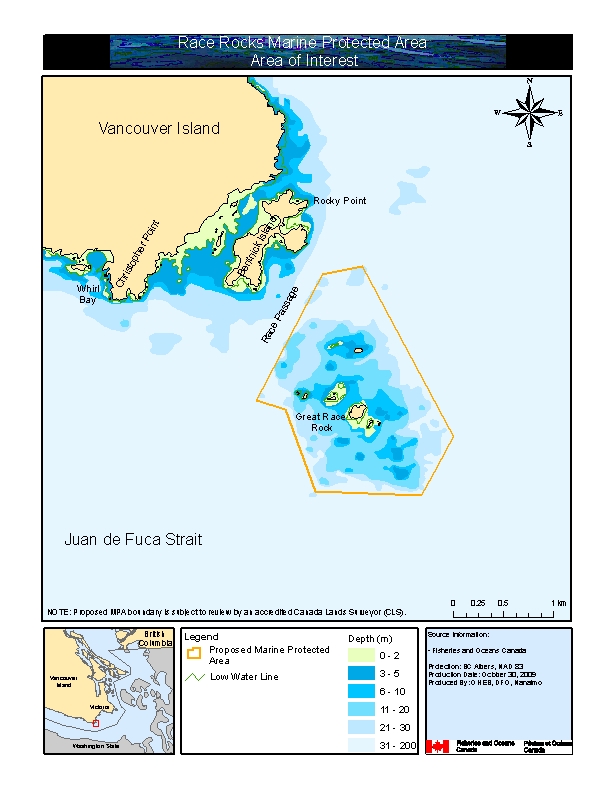 Proposed boundary areas
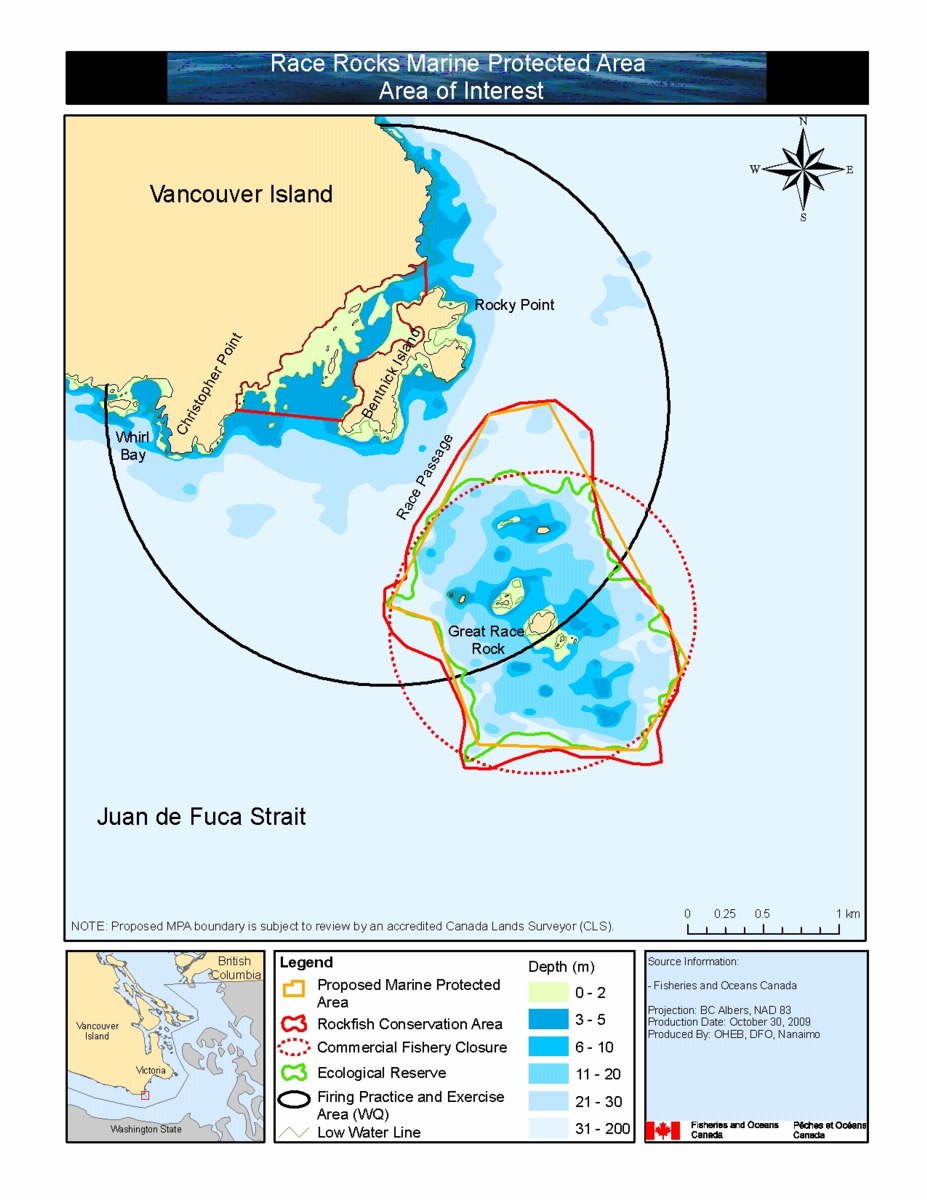 Proposed boundary areas detail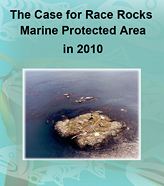
Update: Pacific Region Area of Interest Race Rocks
The following is a PDF of a powerpoint presentation done by DFO staff at the Groundfish Forum at the Nanaimo Convention Centre Sept 28, 2010
Background Information:
·The Race Rocks Pilot Marine Protected Area proposal was approved by the Minister of Fisheries and Oceans in 1998 as one of four Pilot MPA’s on Canada’s Pacific coast.
·See the 13 page pdf at: DFO Presentation 2010-09-29
·The proposal is to formally designate under the Oceans Act the waters surrounding Race Rocks.
Objective is to provide long-term comprehensive protection of the diverse species and to maintain biological productivity of the ecosystem
·The Race Rocks Pilot Marine Protected Area proposal was submitted in 2000 into the regulatory process but was challenged at the Gazette 1 phase for lack of consultation with local First Nations.
·
·This challenge prevented the regulation from going forward and consultations were restarted with First Nations shortly after that in 2003.
Broader public consultations restarted recently in Sept. 2009
·See the 13 page pdf at: DFO Presentation 2010-09-29
Case Study: Race Rocks
This document is a working paper /discussion paper and should be cited as such. “Burrows, D., Murray, G. and McGreer, E. (2010) Aquaculture and the Ecosystem -based Approach (EBA): Concepts, Case Studies and Lessons Learned. Institute for Coastal Research Working Paper #2, Institute for Coastal Research, Vancouver island University.
This excerpt is on Race Rocks as a Case Study:
Dead harbour seal
A dead adult male harbour seal was found washed up today on the rocks beside the derrick. There were no trauma marks from predation or a boat strike and the corpse was still in good condition with no bloating or decomposition. It was removed and taken to Pearson College.
Erik and Al the plumber visited RR today. Ebony departed on the outgoing boat. David H. came later in the afternoon with some guests for a quick tour. There were 5 visitors to the island today. ( Mike Robinson)
maintenance
Human Interaction
Erik, the two winch mechanics and their two guests visited the island today.
There were 5 visitors to the island today.
230 glaucous-winged gulls were counted on the island today, which puts us at around 115 nests, down from 150 last year at this time.
RRAB Agenda and Minutes of Meeting #4 May 28 2010
MEETING NOTES
Race Rocks Public Advisory Board Meeting #4
10:00 – 15:00, 28 May 2010
Pearson College, Victoria, British Columbia
Preliminary Agenda: 2010-05-28
PDF version of this document: 2010-05-28
Meeting Goal:
To receive feedback and input for the Race Rocks Public Advisory Board (the Board) in order to move the designation process forward.
Objectives:
- To review the status of Board operations.
- To finalize a number of designation inputs / instruments.
- To provide an opportunity for DFO senior management to be involved in discussions.
Attendees:
Doug Biffard, BC Ministry of Environment
Chris Blondeau, Pearson College
Kevin Conley, Fisheries & Oceans Canada
James Dale, Wildlife Viewing Community
Mike Fenger, Friends of Ecological Reserves
Garry Fletcher, Race Rocks Ecological Warden
Darcy Gray, University of Victoria
Hilary Ibey, Fisheries & Oceans Canada
Sabine Jessen, Canadian Parks and Wilderness Society, BC
Gabrielle Kosmider, Fisheries & Oceans
Dan Kukat, Wildlife Viewing Community
Kate Ladell, Fisheries & Oceans Canada
Angus Matthews, Shaw Ocean Discovery Centre
Ryan Murphy, Pearson College
Rebecca Reid, Fisheries & Oceans Canada
Aaron Reith, First Nations Liaison
Danielle Smith, Department of Natural Defence
Richard Taggart, Sports Fish Advisory Board and Boating Public
Tomas Tomascik, Parks Canada Agency Canada
Facilitator: Richard Delaney – Delaney and Associates Inc. Items for Discussion
|
1. Welcome
|
|
2. Introductions Round table – refer to list of attendees |
|
3. Meeting #4 Agenda |
|
a. Review |
|
b. Discuss / amend / approve |
4. Meeting #3 Minutes – discuss comments / amend / approve
- – Note that comments pertaining to the DFO response to the addition to the November 2009 meeting minutes were reflected in the March 2010 minutes – this was agreed upon by the Board so that the response would not be reflected as a rebuttal in minutes.
- – Recommendation to have the summary that Dan Kukat provided at the March 2010 meeting of Action Items for Board Members and DFO (an itemized list) added to the March 2010 minutes.Review of Action Items:
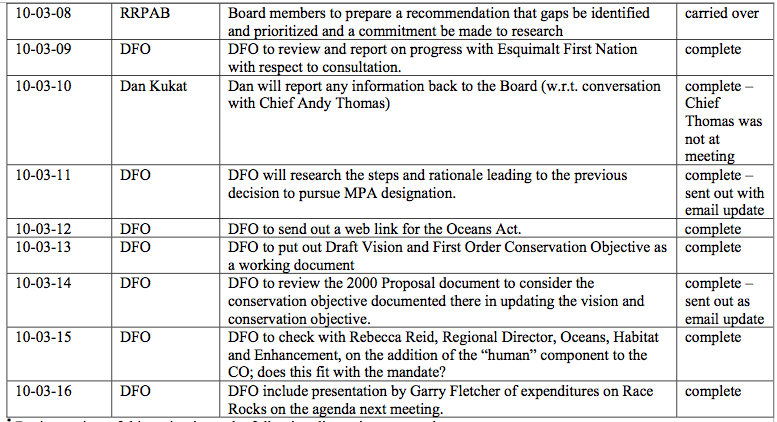
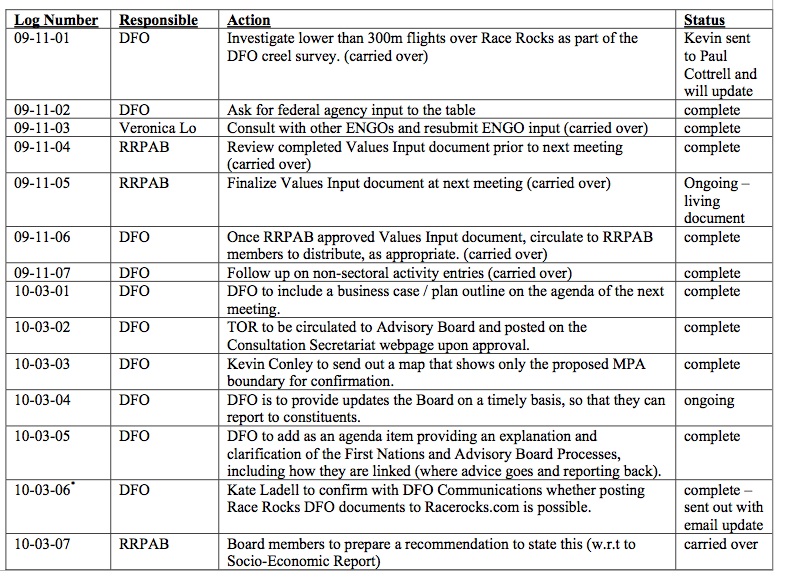
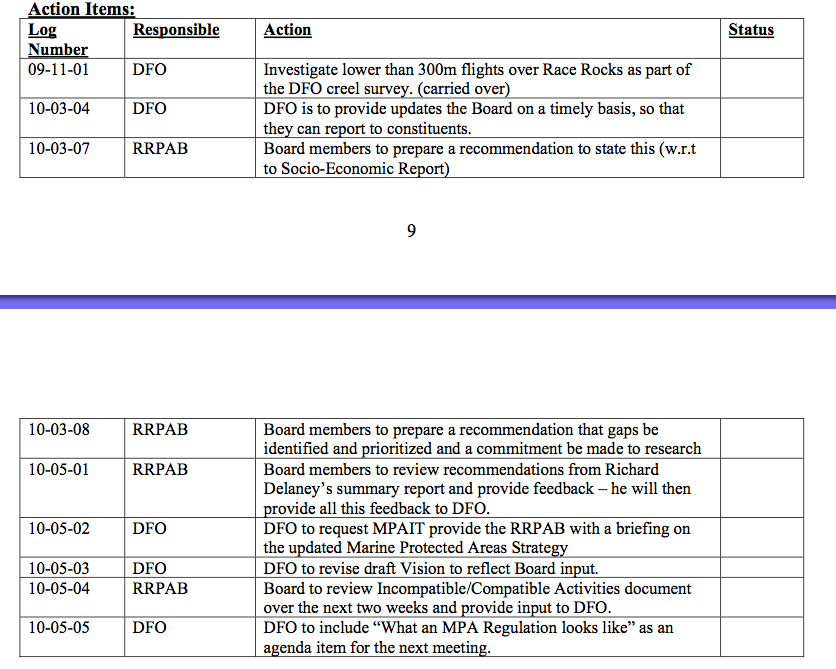
During review of this action item, the following discussion occurred:
- A Board participant expressed concern with the status of DFO’s Oceans website and identified the value of Racerocks.com in providing a complete record for the Race Rocks MPA
- Identified need for public transparency and a means to notify each other when documents are created that might
- affect the designation process.
o Gabrielle Kosmider was identified as a contact for any new/updated documents.
- Identified importance of minimizing confusion around status of documents.
- Board agreement: Drafts must be marked as “draft”, if posted on Racerocks.com.
5. First Nations Update
- – DFO and First Nations Memorandum of Understanding has been signed by Chiefs of T’Sou-ke Nation, Beecher Bay First Nation and Songhees Nation and the Regional Director General of DFO, Pacific Region.
- – Chiefs understand there are concerns from Board regarding the level of commitment of First Nations to process – therefore the MOU will be released to DFO today.
- – DFO is pursuing a meeting with Esquimalt to hear any interests they have with respect to engaging on the Race Rocks MPA process.
5. Meeting #3 Evaluation Review / Status Assessment
- – Evaluation looked at ToR and objectives of Meeting #3 – considered process and whether people were able to participate.
- – A board participant clarified that response to survey came from 6 board members and 1 DFO employee – a slim sample that may not be a true reflection of group.
- – In addition to the evaluation results, facilitator presented 10 process recommendations to help the Board move forward on their mandate. Facilitator will be refining his recommendations as part of the meeting follow up. Facilitator contact for comments (By July 2, 2010):o Richard Delaney – Delaney and Associates Inc. Ottawa: 613-837- 5890/Vancouver: 778-371-4073. Delaney@rmdelaney.com
|
– Facilitator recommended including mechanism for minute structure to concisely reflect Board recommendations, and recommendations on meeting structure, and a meeting cycle. Action Item – 10-05-01: Board members to review recommendations from Richard Delaney’s summary report and provide feedback – he will then provide all this feedback to DFO. |
|
6. Race Rocks Draft Recommendations
|
- DFO not to provide full response to recommendations at this meeting and some recommendations will take longer than others to respond to..DFO identified questions for clarification from Board to ensure does not work off wrong assumptions.
- DFO general comments/clarification points on recommendations:
- – Hear overwhelming interest in moving forward and desire to understand end result; Appreciate effort that has gone into document.
- – Have done a preliminary analysis – recommendations speak to Board’s interest to clarity re: outcomes.
- – DFO’s work plan consistent with this vision which involves getting regulations prepared. Certain pieces of information needed from Board to develop the regulatory intent package. Note the wiring diagram which clarifies those needs.
- – Re: Management Plan drafting – DFO needs to do regulatory piece but can also start drafting management plan. In reviewing recommendations, identified Management Plan recommendations and will put them into an initial draft, pull out others that fit with regulations.
- – Note the Value-Added/ Business Case document – p. 5 Table of Contents for Management Plan. Hope that this provides some comfort and clarity to those that want to see big picture before designation.
- – What is it that Oceans Act MPA designation actually does? Mandate: conservation and protection of key features including fisheries, endangered species, habitats.
- – DFO can’t accomplish a number of these recommendations on our own, and as a Board may not be able to accomplish everything. Will be clear about what we can and cannot do.
- Feedback from Board participants:
- – DND: The MPA Management Plan will lay out operational aspects of the MPA.
- – DFO: The Oceans Act doesn’t impact on the jurisdiction/mandate of any other agency. Will need to work collaboratively and agree on objectives that are consistent with the Board’s views.
- – Board participant: How will the existing ecological reserve Management Plan be modified?o DFO Response: Management plan for a provincial Ecological Reserve is different from a Management Plan for an Oceans Act MPA. Will not be an amendment to the existing plan, although MPA Conservation Objectives should complement those for the ER.
- – Province: The management plan for ER is a statement of provincial interest/intent of management of that area, which goes beyond legislative requirements of the Ecological Reserves Act.
- Three procedural requests from the Board:
1. Recommendation in favour of designation is conditional on reaching understanding on these recommendations. Want to get all issues on table now so Board will be comfortable with management intent, prior to designation.
DFO: DFO will start draft Management Plan and will begin to populate so Board can start to provide input.
2. Education and outreach – ecotourism has a role, and it’s an important concern that Board shares that the MPA mandate include these human values. May not be in conservation mandate but should be in MPA mandate.
Discussion of DFO website and MPA Strategy:
– DFO clarification: DFO website referred to last updated in 2006 –MPA Strategy identified on site was a federal-provincial draft MPA Strategy in the form of a Discussion Paper, not a DFO document, and was never finalized. The Strategy proposed objectives for a MPA strategy for entire coast, some of which went beyond scope of Oceans Act MPAs and include objectives related to the mandates of other federal and provincial agencies (i.e. Parks Canada, Environment Canada, BC Parks, etc.). Old DFO website identified the objectives in this Strategy without clarifying that they were joint objectives – therefore misleading because it was unclear that these were not Oceans Act MPA objectives but objectives inclusive of several agencies’/ ministries’ mandates.
- – New website is clear: Oceans Act MPA objectives are tied to conservation and protection of key features including fisheries, endangered species, and habitat. Purpose of Oceans Act MPAs has not changed. DFO cannot establish Oceans Act MPAs with education/outreach conservation objectives identified in regulations, however, education/outreach are key components to managing and implementing the MPA, and should be identified/expanded upon in the Management Plan.
- – Draft 1998 federal/provincial strategy is currently being updated, with intent to finalize it.
- – Parks Canada proposed briefing for RRPAB on updated MPA Network Strategy by someone from MPAIT.
Action Item – 10-05-02: DFO to request MPAIT provide the RRPAB with a briefing on the updated Marine Protected Areas Strategy.
- Angus Matthews comments:
- – Education and outreach is not identified in Oceans Act as a core regulatory need. DFO says it’s covered somewhere else and we support that.
- – When started work on Race Rocks, David Anderson said that education and outreach was part of MPA and a whole part of our buy-in was around that.
- – Have a desire to see education and outreach formalized.
- – Question whether an NMCA, not an MPA is the better tool.
- DFO – Education and outreach are valuable management tools for Oceans Act MPAs, they just can’t be written as conservation objectives within regulations. Refer to Gully Management Plan.
- Parks Canada: Race Rocks has never been and will not be considered as a National Marine Conservation Area. Education and outreach will be addressed in management.
- Marine Wildlife Viewing – Given the proximity to an urban area, education and outreach meets the bigger picture conservation objectives. Should use MPA as an educational tool internationally to increase awareness for Race Rocks. DFO’s response is extremely helpful, and lays out a timeline that includes starting work on draft Management Plan. Our ability to understand projected outcomes of the MPA is important. Would also like to see a draft MPA Network Strategy.
- DFO – the regional strategy is going up for approval internally and will then go out for external consultation. In the absence of approval, DFO will relay MPAIT briefing request.
3. Seeing final version of the regulations, before they go to Gazette.
- DFO – government is bound by certain constraints – there are restrictions on seeing advice to Ministers, or documents going to Parliament. Board cannot see regulations before published in Canada Gazette I, but can see all the pieces of the Regulatory Intent beforehand.
- Next steps for Recommendations:
– Angus to provide response in writing by Monday, he will discuss with DFO Tuesday, 10 days for other board members to provide further clarification (to Kate and Gabrielle)
|
|
7. MPA Vision/Objectives/Compatible/ Incompatible Activities
|
|
8. Expenditures to date (including budget) G. Fletcher provided background and rationale for report:
|
|
– There has been an ongoing budget since 1999 – was not aware of any work going on since 2001. – Concern with amount of time to achieve MOU, how DFO tracked, reports, and budgets funds available: suggestion that Pearson College’s ongoing expenditures should have been supported during this time period.
|
|
Terms of Reference Discussion There was discussion about how participants are identified in ToR in terms of categories vs. organization names. |
|
– Decision: ToR to be amended to include names of organizations who participate on the Board(under the interest or sector they represent).
Suggestion from Board participant to change wording in ToR re: Provincial interest. -BC Parks response: Fine with wording in ToR as-is. There was a question from the Board re: Board role at end of year.- DFO response: Goal to get regulatory intent in by March 31, 2011. Can’t finalize Management Plan until MPA designated. Once regulatory intent is in, the Board is disbanded. Once the MPA is designated, a post-designation advisory board formed to finalize Management Plan. Understand that post-designation MPAs cost money and it is our intention to have budget for that, barring unforeseen circumstances.
|
|
9. Business Case/Value Added/Wiring Diagram Review / Discussion
|
|
10. Next Meeting / Adjournment
|
Race Rocks Public Advisory Board 2010 Recommendations for DFO
April 24, 2010 (Draft 1)
The Department of Fisheries and Oceans has reactivated a 1999 proposal to establish Race Rocks as a Marine Protected Area (MPA) under the Oceans Act. As a consequence, a new round of community consultations was launched in September of 2009. The RRPAB is composed of community representatives and Race Rocks stakeholders including Pearson College who presently funds and provides the Ecoguardian at Great Race, private businesses, recreational users, the education sector, research interests, the Ecological Reserve Volunteer Warden and several conservation/environmental protection groups. Various government departments and agencies at the federal and provincial levels are also included. Continue reading
Essential Requirements for the Race Rocks MPA
Essential Requirements for the Race Rocks MPA from the Point of View of the Race Rocks Ecological Reserve Warden ( and educational director of racerocks.com) Garry Fletcher.
A prerequisite for Designation of an MPA at Race Rocks must be consideration of the following:
Given that the Precautionary Principle is indicated in the Oceans Act as fundamental to Ecological Sustainability of Marine Protected Areas:
- The emphasis in the Oceans Act on the protection of marine ecosystems including the habitats of the marine organisms must form the core value of the MPA. What is currently achieved by the Ecological Reserve status for Race Rocks must not be diminished, and a unified jurisdiction must be applied to the MPA as well as unified permitting procedures for areas of Jurisdictional overlap.
- Resources must be designated to address some of the gaps in scientific ecological knowledge in the MPA.
- Resources must be designated to continue to allow Lester Pearson College (LBPC) to staff the island and manage the facilities for BC Parks.
- Any further funding of the MPA Process should be applied directly to “on the ground ” operation and research activities of the MPA which bring direct benefit to ecosystem conservation.
- Current work in outreach and education must be continued and allowed to adapt with the times, technology and resources available.
- The efforts to maintain and develop further an integrated energy system for Great Race Island must be continued, in order to reduce operating costs.
- The experience of the management process LBPC have carried out since destaffing by the Coastguard in 1997 must be taken into account in the development of a management plan for the MPA.
- The BC Parks Management Plan for the Ecological reserve must serve as a model for the development of any further management plan.
- The permitting system for research and education must be refined enabling faster turn around time, and the Island management must be consulted in the process.
- Given the nature of the historical site on the island, special consideration must be given to conserve those features along with other aspects of cultural heritage and these should be recognized as part of the protected area.
- Access to all smaller islands for research must remain off limits without a permit..
- Oil and Chemical spill containment plans must be devised for the MPA and resources put in place to handle those eventualities.
- Control for Aircraft overflights must be agreed to and enforced. 1500 meters, the US standard, would be advisable in the absence of data indicating otherwise.
- Access for recreational boaters, including kayakers to the reserve must be regulated and carefully monitored and enforcement by DFO followed up when reports are submitted by the island ecoguardian. Vessel speeds and adequate distances from wildlife on land and water must be enforced.
- Personal watercraft must be banned from the MPA in the same way that ATVs are banned from local Parks.
- A prohibition on anchoring except in the event of emergencies or facility maintenance must be imposed.
- A reasonable ( several kilometre) buffer distance must be established so that commercial fishing, dumping and development does not infringe on the MPA.
- The requirements of the DFO Draft Marine Mammal regulations should be confirmed immediately, if not for all of Canada, then for this reserve specifically.
- Cooperation from DND on the use of adjacent facilities and areas must be carefully regulated so as to avoid compromising the ecological values of the MPA.
- Given that the precautionary principle is so highly recognized in the Ocean’s Act, a moratorium should be placed on any harvesting of resources by any groups or individuals within the reserve until such time that adequate scientific research on the level of ecological sustainability has deemed it to be acceptable.
- The boundaries of the MPA may be modified subject to science-based determinations and consultation with the user groups.
- Race Rocks must be considered as only one part of a network of MPAs in Coastal British Columbia. The current Marine-based Ecological Reserves in BC should serve as a core of areas to be considered for MPA designation..
Pacific Whale Watch Association (PWWA) Specific stakeholder recommendations: Ecotourism & Education
(RRPAB- PWWA Input
Monday April 19,2010
780 Blanshard Street
(2nd floor Boardrom)
A) Pacific Whale Watch Association (PWWA) Specific stakeholder recommendations: Ecotourism & Education
We have included “Education” as part of our mandate because our 32 member companies consider Public Education to be the foundation of support for conservation and stewardship: People will save what they love, and our tours offer them the best opportunity to get to see, know and fall in love with this ecosystem.
In the initial round of meetings from 1998 through 2001, the responsible wildlife viewing community (made up mostly of members of the then Whale Watch Operators Association North West (WWOANW)) was able to convince most other stakeholders that we could operate within the boundary of Race Rocks Ecological Reserve with negligible impact, with special attention to avoiding disturbance of the marine mammals and birds there.
WWOANW worked closely with the Eco Warden, Pearson College and DFO to develop viewing and vessel operation guidelines specific to Race Rocks Ecological Reserve. This adaptation was in addition to and not in place of our other detailed Best Practices Viewing Guidelines for various species. The unique topography and bathymetry of Race Rocks necessitated these changes.
For example, while it has long been our aim to stay 100m away from Marine Mammals, especially pinnipeds that are hauled out, the main channel through which we can navigate at Race Rocks is less than 200m wide. As there are often sea lions on rocks or islets on either side of the main channel, it is only possible to be 75m away from both shores. The agreed upon protocol included (i) Staying in the centre of the channel; (ii) Travelling with the current as a way of minimizing both sound and wave action; (iii) Travelling at a speed that minimized wash; and (iv) Keeping passengers still as movement can disturb both birds and pinnipeds.
“Race Rocks
- Vessels will slow their approach to Race Rocks such that speed at 1/8th mile (220 yards) from any rock or landmass is reduced to minimal wake and wash, when practical. This Go Slow Zone extends 800 yds/m around every rock and landmass in the Race Rocks area.
- Vessels in the Go Slow Zone will remain as close to mid-channel as is practicable between the major rock outcroppings known as North Race Rock, West Race Rock and Helicopter Rock.( ed note: this is Middle Islands)
- While in the Go Slow Zone vessels will transit the area with the current whenever conditions are suitable to do so.
- Vessels will remain outside all of the Go Slow Zone whenever Resident, Transient or Off Shore Killer Whales are present.”
We recommend that access to Race Rocks by wildlife viewing companies operating in a responsible manner be maintained. We seek Federal, Provincial, Regional and Local Governments support and assistance to promote and increase public awareness of the ecological significance of Race Rocks.
Federal, Provincial, Regional and Local Governments can maximize the educational value of and public support for Race Rocks and other MPA’s by showing how much all levels of government care for these precious natural resources. This is a wonderful opportunity to explain and promote Canada’s Federal Marine Protected Areas Strategy.
(B) Pacific Whale Watch Association (PWWA) Shared recommendations
Boundary: As noted in PWWA’s Best Practices Guidelines, we consider what we call the “Go Slow Zone” to be the practical boundary for our operations and it extends out “800 yds/m around every rock and landmass in the Race Rocks area”. PWWA, therefore, gladly accepts the proposed Boundary as long as access in a responsible manner under a set protocol is allowed.
Restrictions and Accepted Uses: PWWA sees no reason that the uses currently allowed cannot continue.
Ongoing Science: The Boundary, Access, Restrictions, etc. must be adaptive, adjusting as new information on biomass, water quality, climate change, etc. becomes available. The first major research project will be a continuation of the cataloguing that Lester B. Pearson College has begun, and the recording of baselines for species populations, water quality, etc.
PWWA, as an association representing commercial ventures, realizes as much as any organization that such changes could have negative financial consequences for our members, but our membership remains committed to education and conservation as our primary missions. But we also understand the effectiveness of our educational and conservation impact would be diminished by any restrictions to access. Where reductions in access are contemplated, mechanisms will have to be put in place to assist in transition of our members.
Relationships with First Nations: Mutual respect and a willingness to learn from each other must always be the hallmarks of our relationship with First Nations. We believe that formal details should be a matter of government to government negotiations.
Role of other government agencies: There are no walls or floodgates around Race Rocks, nor is there a ceiling or roof. We must be careful to get cooperation from all municipal, provincial and federal agencies to monitor and limit impact from all potential man-made events (e.g. Oil Spill, Increased Commercial Fishing in Juan de Fuca Strait, Seismic Testing, Increased airplane traffic, etc.) and natural events (e.g. virus or infection in sea lion population, relocation of prey due to Climate Change, etc.)
Overall profile of the MPA: Clearly there will be a balancing act between singing the praises and raising the profile of Race Rocks, and maintaining its integrity as an untainted ecosystem.
Protection: We foresee that greater education of students and adults will foster even greater respect for Race Rocks. Responsible stakeholders will continue to be strong advocates of Stewardship and Conservation and our presence will continue to be an efficient way to monitor human interaction, animal behaviour and changes.
Finances: This is where the business side of PWWA rears its head. We do not wish to see a major expenditure of government funds or any attempt at recouping those costs if there is no measurable increase in the conservation or stewardship of Race Rocks. A worst case scenario for us would be a massive build up of bureaucracy and expenses but only marginal improvement in how Race Rocks is promoted, operated and protected by the Federal Govenment.
Pearson College has done a magnificent job on a shoestring budget. While that is clearly not sustainable in the long-run, there are lessons in efficiency that Pearson College can provide. We see the long-term financing of Pearson College so that they can continue their work in concert with additional services from the federal and provincial government. Pearson College knows from experience what works and what needs attention. DFO should ask and listen.
Future management: Pearson College working in cooperation with DFO and B.C. Parks
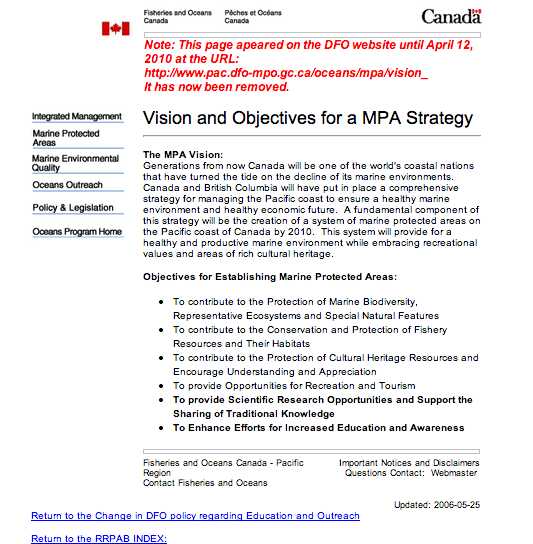
DFO Vision and Objectives for a MPA Strategy
Note: This page appeared on the DFO website until April 12, 2010 at the URL:
http://www.pac.dfo-mpo.gc.ca/oceans/mpa/vision_
It has now been removed.
Vision and Objectives for a MPA Strategy
The MPA Vision:
Generations from now Canada will be one of the world’s coastal nations that have turned the tide on the decline of its marine environments. Canada and British Columbia will have put in place a comprehensive strategy for managing the Pacific coast to ensure a healthy marine environment and healthy economic future. A fundamental component of this strategy will be the creation of a system of marine protected areas on the Pacific coast of Canada by 2010. This system will provide for a healthy and productive marine environment while embracing recreational values and areas of rich cultural heritage. Objectives for Establishing Marine Protected Areas:
- To contribute to the Protection of Marine Biodiversity, Representative Ecosystems and Special Natural Features
- To contribute to the Protection of Cultural Heritage Resources and Encourage Understanding and Appreciation
- To provide Opportunities for Recreation and Tourism
- To provide Scientific Research Opportunities and Support the Sharing of Traditional Knowledge Contact Fisheries and Oceans Important Notices and Disclaimers
- Updated: 2006-05-25
Return to the Change in DFO policy regarding Education and Outreach
Fisheries and Oceans Canada – Pacific Region
Contact Fisheries and Oceans
image of original page below: