| DescriptionCucumaria pseudocurata is a small species with a length averaging between 1.5cm and 3cm. Their dorsal side ranges from brownish black to light brown to yellowish gray, while the ventral side varies from brown to white. Five bands of tube feet can be found in single or zig-zag rows, with the three ventral rows being more robust. C. pseudocurata has 8 equal-sized tentacles, and 2 smaller ventral ones. The tips of the tentacles generally have the darkest pigment. Between two of the dorsal tentacles can be found the genital papilla. The skin ossicles of this particular species are typically oval perforated plates.
This small cucumber can be found intertidally among the Mytillus Californianus (mussel beds) on the Western side of the main island. Domain Eukarya The book Sea Cucumbers of British Columbia, Southeast Alaska, and Puget Sound by Phil Lambert is the best source for identification of most of the 45 species of local sea cucumbers. In it he notes that the habitat of Cucumaria pseudocurata in the Juan de Fuca Strait tends to be ” This page has a copy of the reference to this species and others: See also Taxing Problems by Philip Lambert – Now Curator Emeritus of Invertebrates, Royal BC Museum for a description of the difficulty in classification and the need to classify by the skin ossicles.
|
||||||
Category Archives: Species
Nereocystis luetkeana– Bull Kelp
-
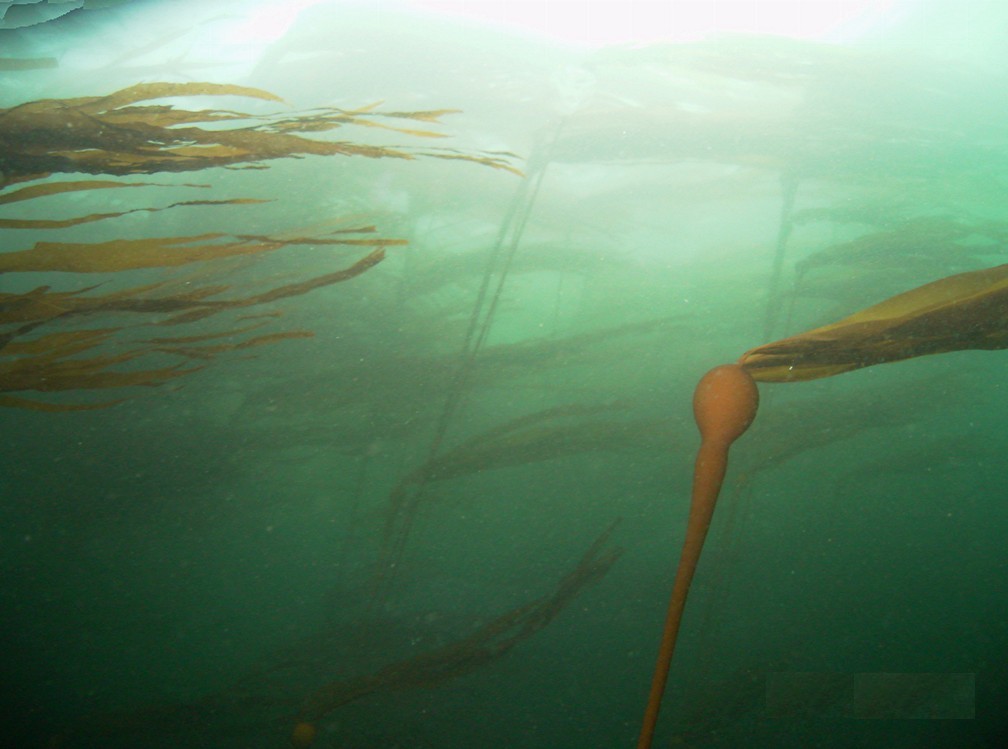
- Photo by Kohei
-
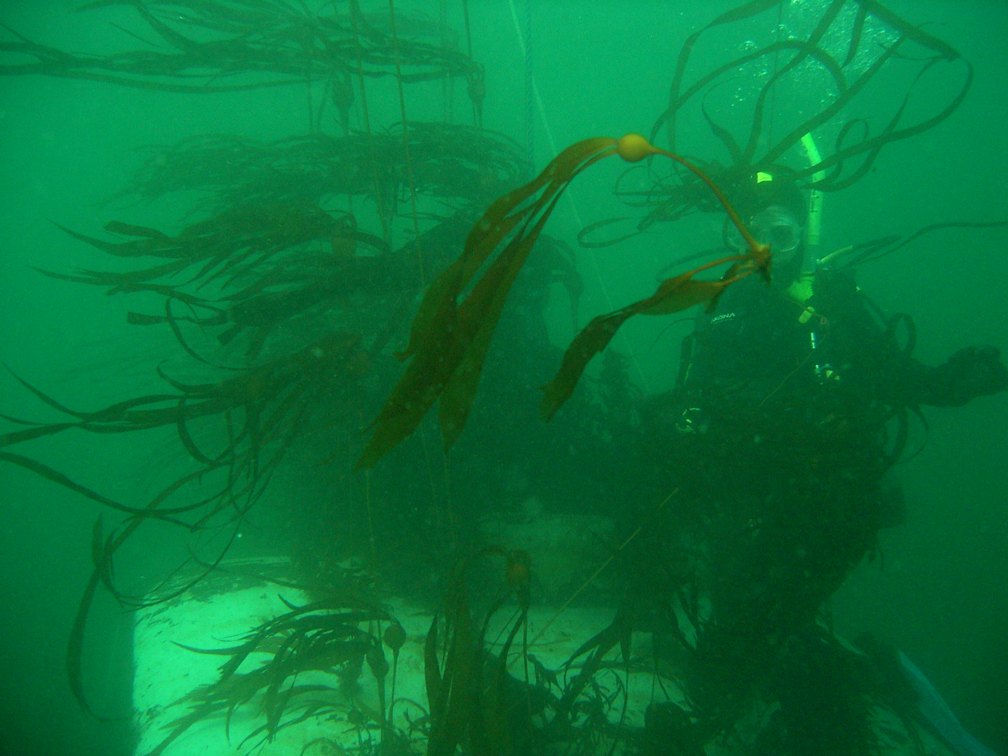
- Growth of this macroalgae starts in March and had already reached several metres in height
-
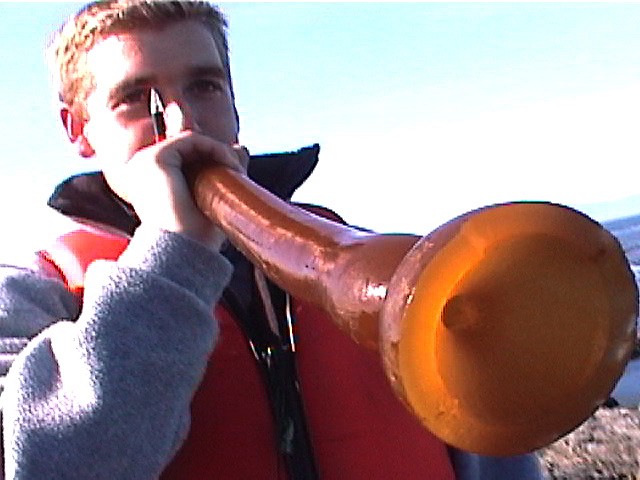
- Ben blows the nereotrumpet
-
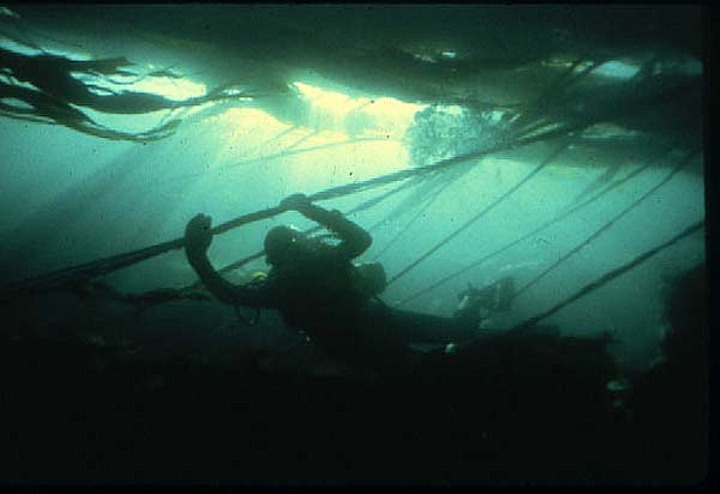
- Johan in the current under canopy
-
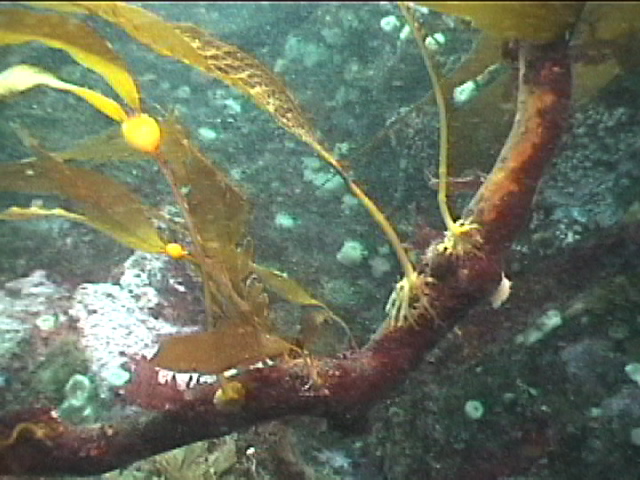
- Nereocystis growing as an epiphyte on the stype of Pterophyga
-
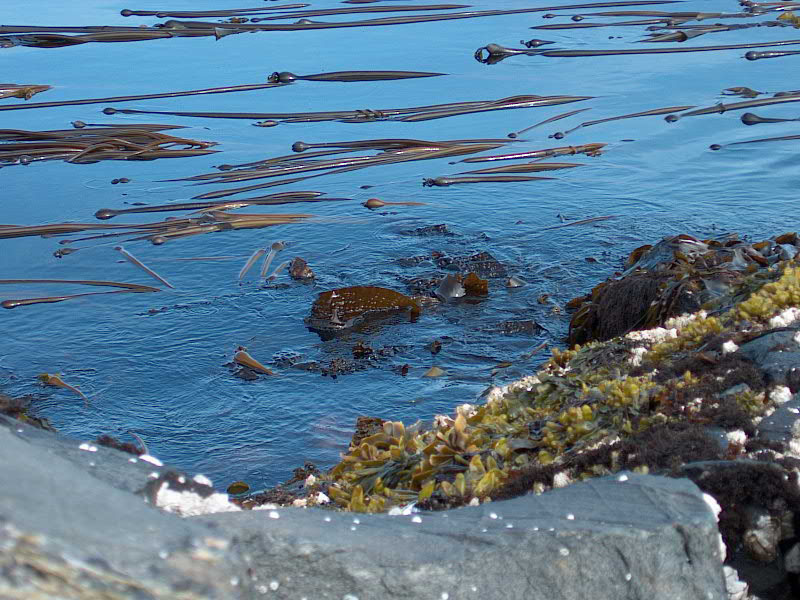
- Bull kelp growing off the North cliff of Race Rocks
-
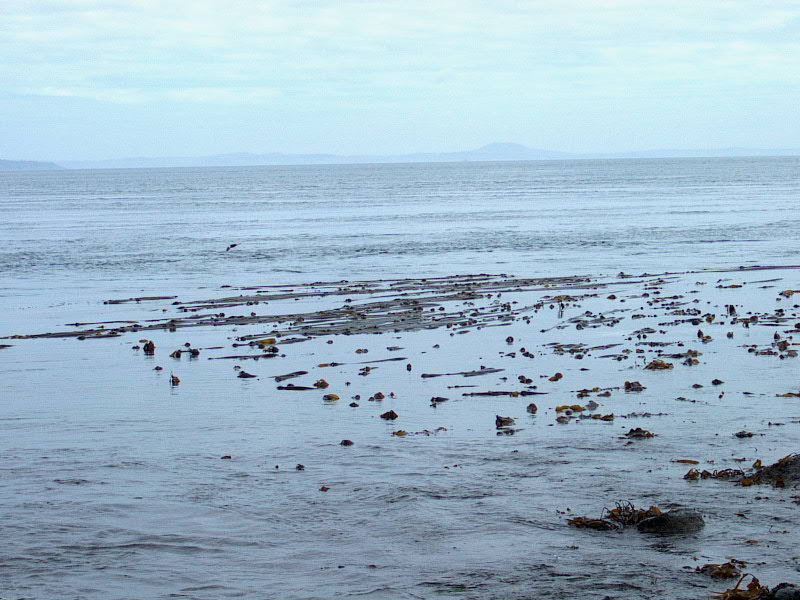
- Bull Kelp growing on the North side of Race Rocks
-
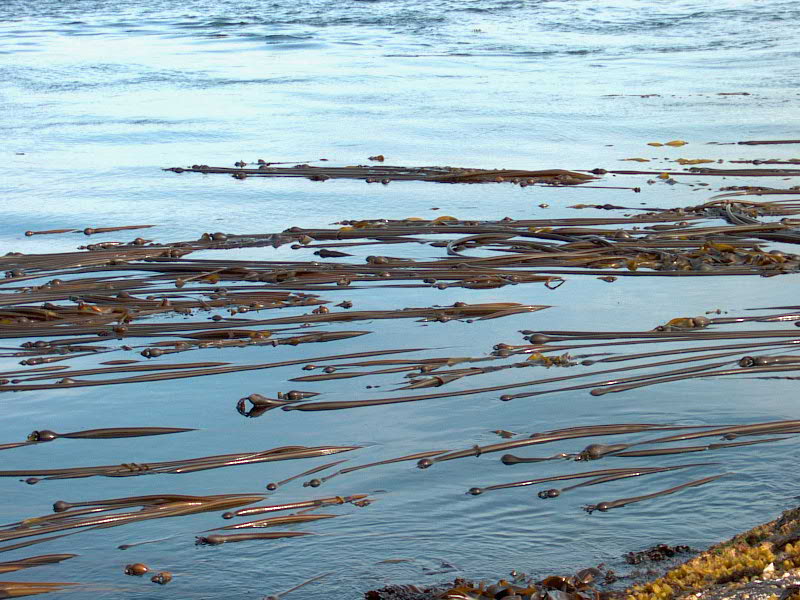
- The direction of the stipe indicates the current flow
-
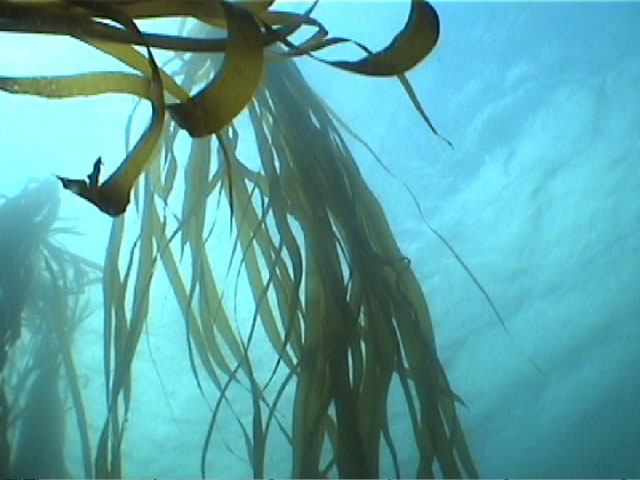
- Viewed from underwater, the canopy is a analogous to a forest canopy
-
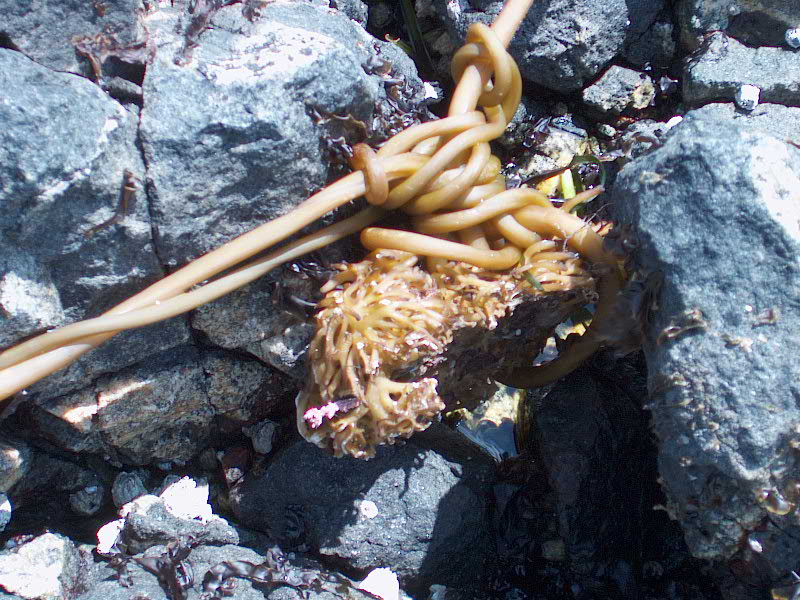
- Holdfast,– analagous to roots of land plants-
-
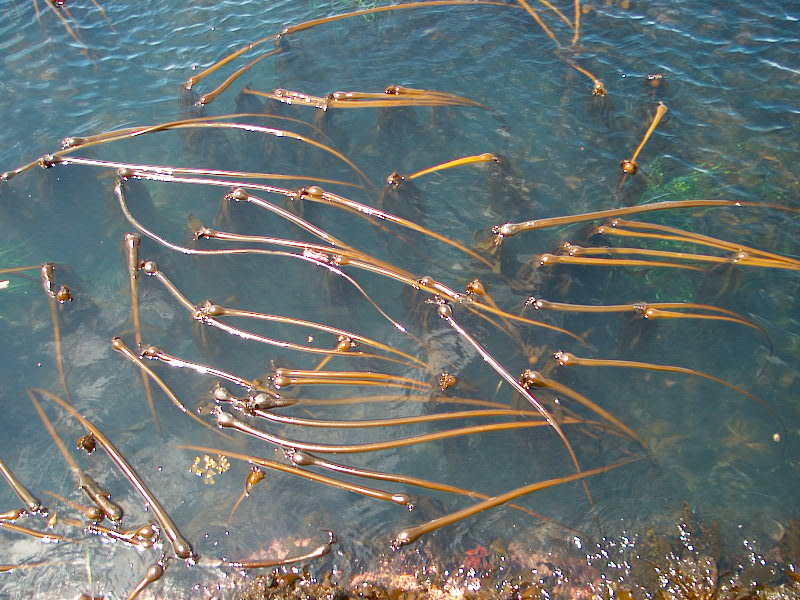
- Pneumatocysts on the surface viewed from above
-
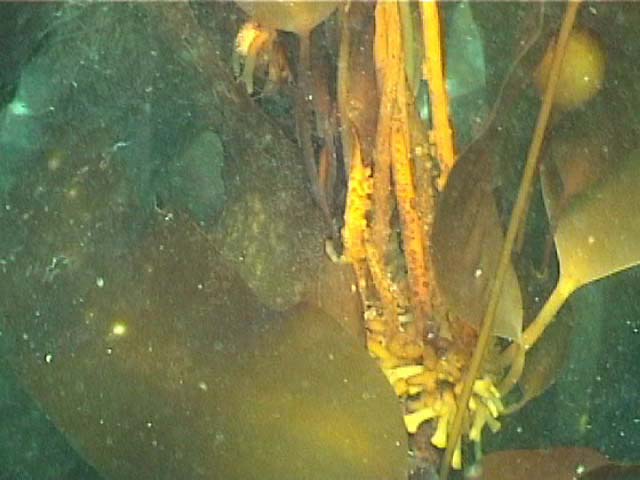
- Baby Nereocystis grow as epiphytes on the perennial Pterophyga
-
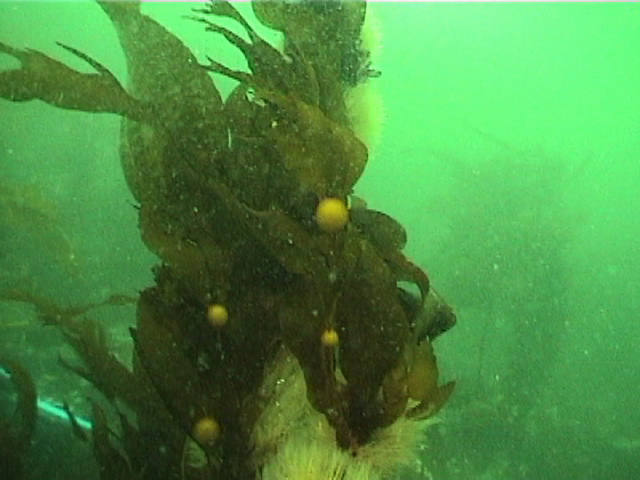
- Photos by Ryan Murphy June 2002
-
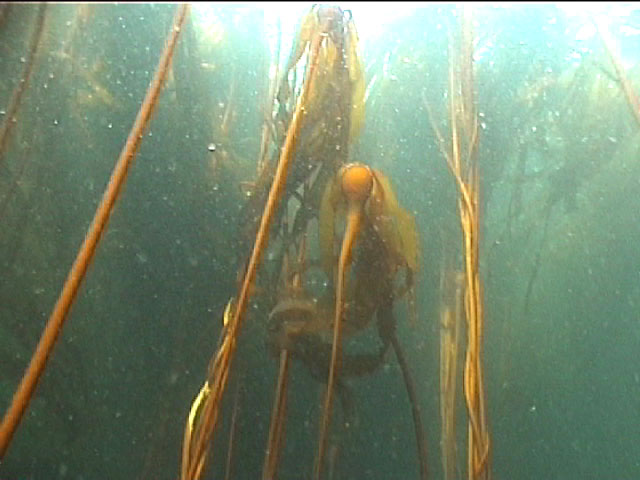
- Young Nereocystis reaching for the surface
-
- They live in up to 12 meters of water.
-
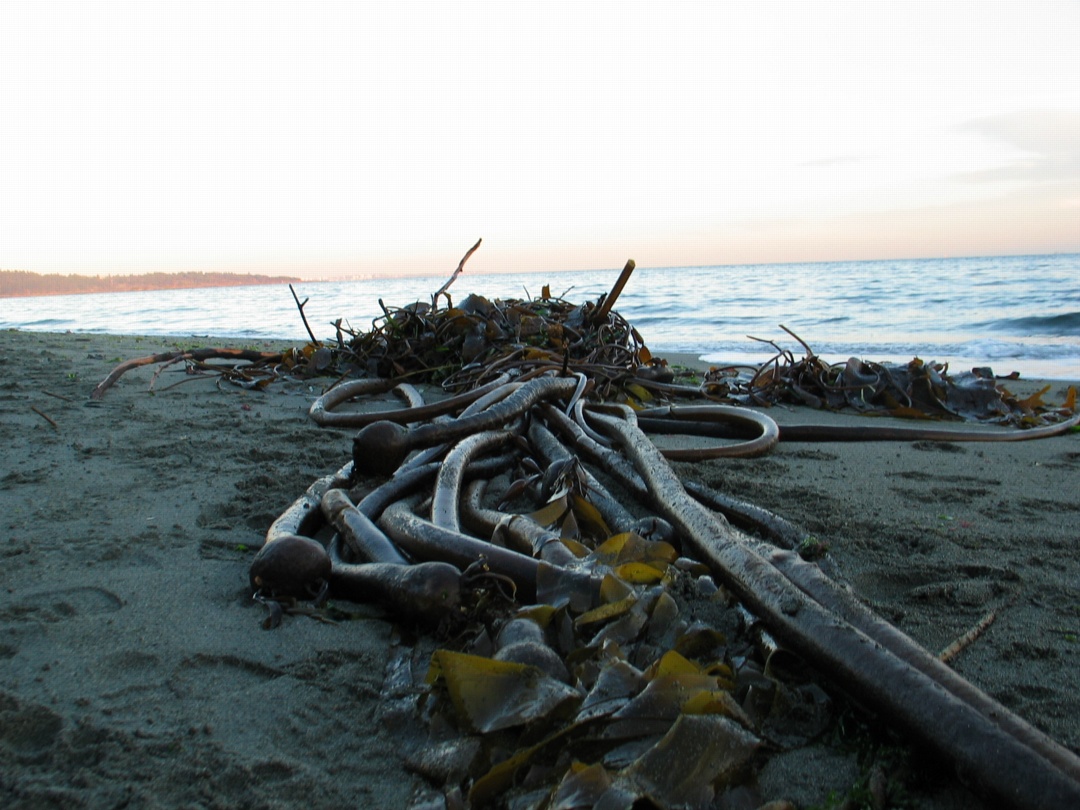
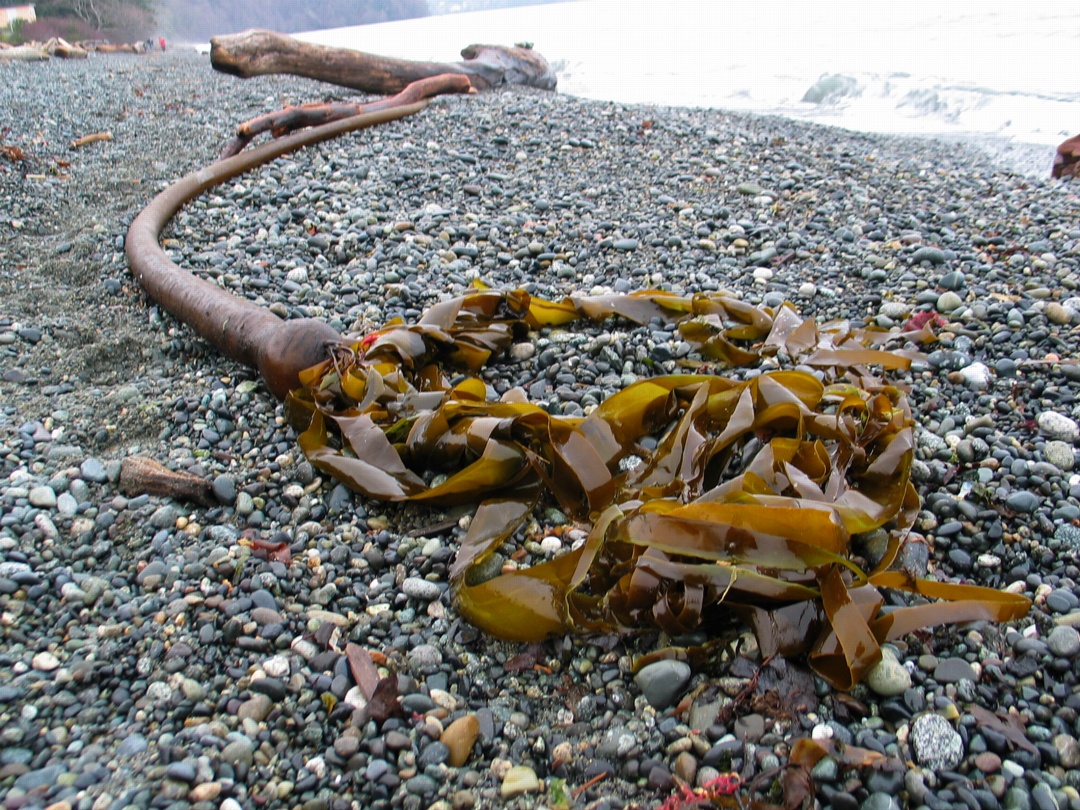
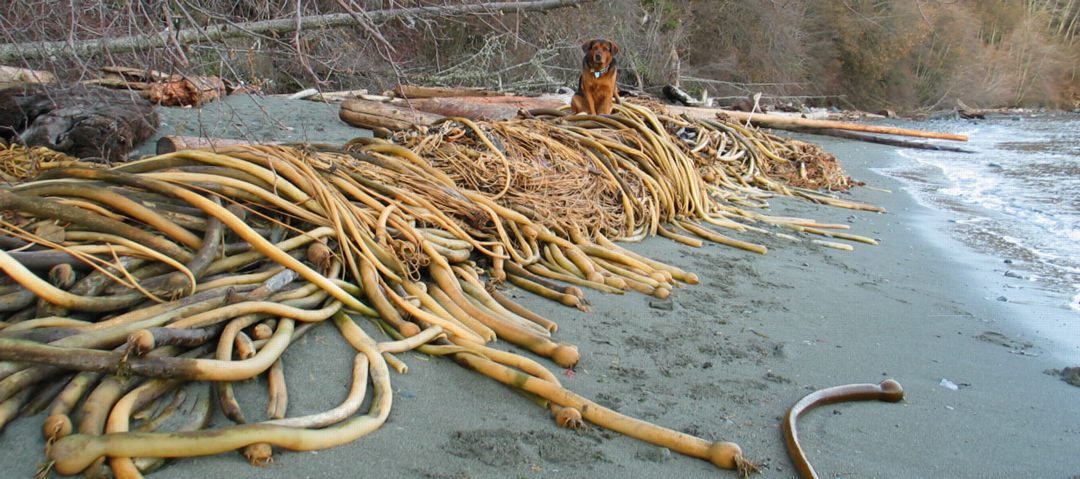
- pile on the beach after a storm
-
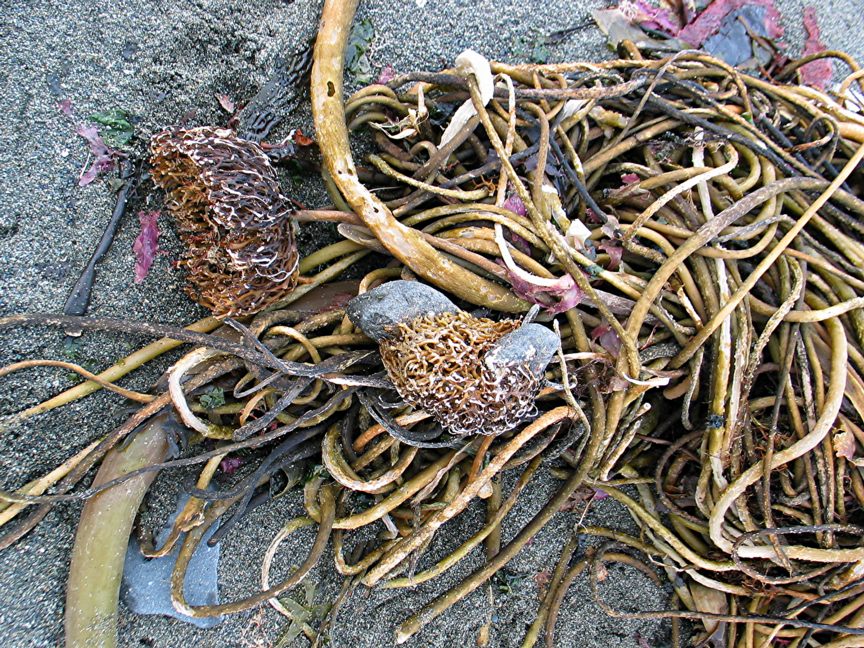
- The biomass from subtidal ecosystems in areas located far away end up as input into the energy flow of beaches and other intertidal ecosystems
-
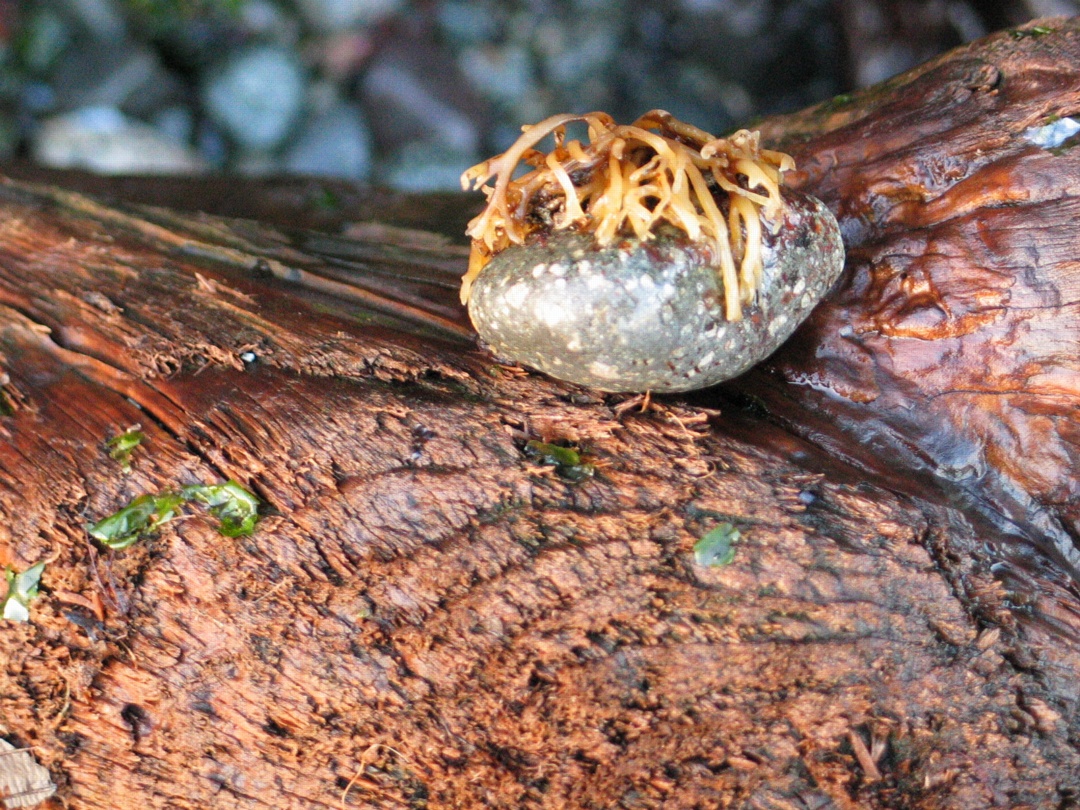
- Holdfasts often carry up rocks or attached invertebrates to the beach. See file linked above–G.Fletcher photos
| Video Saltwater
Domain: Eukarya Plants consist of a long stipe (up to 36 m/118′) attached to the ocean floor by a holdfast composed of numerous haptera (finger-like projections) and terminated above, on the ocean surface, by a single float from which a cluster of tightly branched smooth blades arise. The blades are long (up to 4 m/13′) and narrow (usually less than 20 cm/8″ wide). Overall, this species reminds us of a very large gothic brown onion of extraterrestrial origin. This form, commonly referred to as bull kelp, is attached subtidally but forms surface canopies throughout its distribution from Alaska to central California. At Race Rocks, all the islands are fringed by this species during the summer months. Several features make this species unique. It grows as an annual although some members persist into a second year. Most plants gets torn off by winter storms, landing on beaches to be decomposed, releasing the nutrients back into the ocean through a saprophytic food web. The following pictures illustrate the tangled masses which end up on beaches near the reserve. This means that the plant achieves its significant length in one growing season (most growth occurs between March and September). To reach the maximum stipe lengthof 36 m (118′), the plant must grow an average of 17 cm per day over the approximate 210 day period. Nereocystis has a logistic problem in completing its life cycle. The spores are produced on the blades at the ocean surface, often several metres above the ocean floor, but a critical concentration of spores is required near where the parent plant is successfully established to assure re-occupation of this optimal space once the annual plant is lost. So the sorus (spore patch) drops from the blade and delivers its concentrated spores to the bottom before releasing the spores. This is the only kelp to release spore patches.Ronald E. Foreman in pursuit of his PhD discovered that the float, which may have a volume of up to 3 liters, has carbon monoxide, an infamous poison as one of his buoyancy gases. Foreman has studied the commercial cultivation of red seaweeds.
See other posts on this website about Nereocystis sp.Other Phaeophytes or Brown Algae at Race Rocks
|
Hedophyllum sessile: sea cabbage–The Race Rocks Taxonomy

Hedophyllum sessile : All Photos by Ryan Murphy
Description: This plant is an ovate blade with a short stipe when young, but the stipitate region soon disappears and subsequently the profusely branched root-like holdfast arises from the base of the blade. The blade becomes markedly furled and often deeply dissected (especially in surf-swept regions). The plant is 30-150 cm. long and up to 80 cm. wide. The surface of the blade is densely bullate, except near the base, where it is smooth (in surf-swept regions it may be completely smooth)
-

- Growth on the concrete beside the docks.
-

- When exposed to warmer temperastures in the late spring the leaves bleach and become frayed
-

- A typical low intertidal location.

-

- It occupies the intertidal zone just above the surf grass.
-

- This algae is very slippery.
-

- Be sure not to step on it. It is probably the most dangerous brown algae in the intertidal zone!
-

- Here it is exposed hydrocoral in a shaded location on the north side of the island.
Domain: Eukarya
Kingdom: Protochtista
Division: Phaeophyta
Class: Phaeophyacea
Order: Laminariales
Family: Laminariaceae
Genus: Hedophyllum
Species: sessile
Common Name: stipless kelp, sea cabbage
Habitat: On rocks in the middle and lower intertidal and upper subtidal zones.
Hedophyllum is a brown algae. It has no stipe (that is the origin of its common name- stipe-less kelp). Its holdfast is usually very developed and the blades vary between bright and dark brown according to site of habitation.
It lives and grows in mid and lower intertidal zones of Race Rocks. Found in both wave exposed and sheltered sites. in the wave exposed areas, the blades are generally smooth and shreaded to thiner blades, while in the protected areas, the blades have wavy surface and they are generally longer. The length of the blades vary between 20 cm and 40 cm.
Pacific Coast Distribution: Alaska to California.Robert Scagel, 1972
Other Phaeophytes or Brown Algae at Race Rocks
 Return to the Race Rocks Taxonomy and Image File |
 The Race Rocks taxonomy is a collaborative venture originally started with the Biology and Environmental Systems students of Lester Pearson College UWC. It now also has contributions added by Faculty, Staff, Volunteers and Observers on the remote control webcams. , 8/12/02 Oriya Barzel –2002 |
Hippasteria spinosa:The Spiny Sea star–The Race Rocks taxonomy
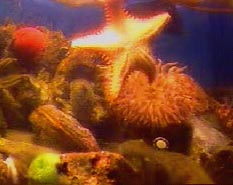
Spiny Stars are rarely seen by divers at Race Rocks. Ryan demonstrates one to the Colwood Elementary a school class
Description:
The Hippasteria spinosa is an uncommon, 5 armed, aboral surfaced sea star. Its most marginal plates have 2 spines and it has some conspicuous bivalved pedicellariae.
Its colour is orange to vermillion, which intensifies at the short, stalky arms (R/r=1.7 to 2.6) and becomes whiter near the mouth. Usually in the subtidal region at depths of 100 to 500 metres, it can sometimes be found on the beach. It is characterized by having all its plates covered with granules, giving it a spiny, STELLATE look.The mouth has 4 or 5 marginal spines and a slightly wider than high mouth (elipsis shape).
Habitat and region
Can be found from Kodiak Island to Southern of California and the Sea of Okhotsk and is more common around the west coast of Vancouver Island and other exposed coastal parts. It prefers muddy, shallow environments and can also be found in shell and rock.
References:
Taxonomy: Marine Invertebrates of the Pacific Northwest; Kozloff, Eugene, University of Washington Press, 1996 Edition, USA
Phascolosoma agassizii: Peanut worms–The Race Rocks Taxonomy
This video was made when the diivers collected specimens underwater at Beecher Bay and then when the peanut worms were being used for a lab in the classroom.
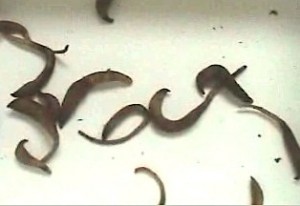
Sipunculans, normally called peanut worms are sea animals which live under the rocks and in tight crevices between rocks, especially where is muddy or sand accumulated. They feed on detritus and microscopic organisms. They collect these with the tentacles placed encircling their mouth. They are particularly abundant in Beecher Bay, and also occur in the intertidal, under mussels on the shoreline.Peanut worms are bilaterally symmetrical and unsegmented. The body is divided into two not very distinguished regions. A mobile anterior body section called introvert which can be retracted into the body by a special set of muscles called retractor muscles and a posterior part. At the anterior tip of the body is the mouth surrounded by tentacles. These are usually bushy but sometimes inconspicuous and unbranched. The body cavity, called a coelom, is filled with fluid. Because of this the sipunculans have no respiratory or circulatory system. The coelomic fluid takes care of this functions by transporting both, nutrients and oxygen. In this fluid can also be found free floating cells , hemerytrocytes, and free floating clusters of cells known as ciliary urns. Because the digestive tracts of sipunculans are almost U shaped, the intestine forms a twisted loop, with the anus on the side of the body. Peanut worms are really firm due to to their strong, muscular body wall. Its firmness it’s also increased by the high hydrostatic pressure inside the coelom.
Domain Eukarya
Kingdom Animalia
Phylum Sipuncula
Class Phascolosomatidae
Order Phascolosomatida
Family Phascollosomatidae
Genus Phascolosoma
Species agassizii (Henri Marie Ducrotay de Blainville, 1827)
Common Name:Peanut worm
The length of a large Peanut worm, when stretched out, is about 6 or 7 cm. The posterior part of the body is basically paler or greenish paler while the introvert anterior section is basically paler but with a number of black lines and blotches.
There is some sipuncula fossil evidence proving their existence at least in the Paleozoic. A group of shells called hyoliths were found in rocks through much of the Paleozoic. These hyoliths are conical shells bearing a hinged operculum covering the opening. These shells seem to resemble molluscan shells. However, some trace of intestine has been found in a few hyoliths fossils. This intestine resembles a lot to living sipunculans as it’s looped and coiled. This is more evident as a few living sipunculans secrete calcified cuticular plate, the anal shield. So it is not impossible that past relatives of the sipunculans secreted more extensive shells.
References:
Seashore life of the Puget Sound, the Strait of Georgia, and the Juan Archipelago-Eugene N. Kozloff (1996)
http://www.ldeo.columbia.edu/dees/ees/life/slides/phyla/sipuncula.html
http://www.ucmp.berkeley.edu/sipuncula/sipuncula.html
| Other Members of the Phylum Arthropoda at Race Rocks |
| Return to the Race Rocks Taxonomy and Image File |
| The Race Rocks taxonomy is a collaborative venture originally started with the Biology and Environmental Systems students of Lester Pearson College UWC. It now also has contributions added by Faculty, Staff, Volunteers and Observers on the remote control webcams.
Dec. 2002-Ramiro Nandez (PC yr29) |
Parasabella media: Parasol Feather worm
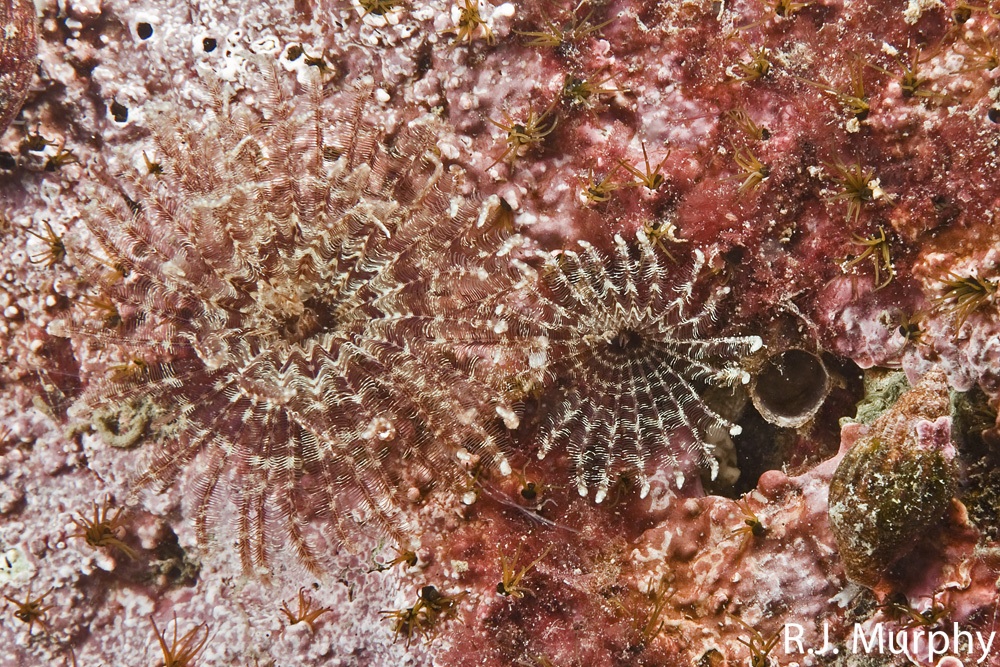
The diver’s finger points to the feathery tentacles-
Parasabella media , a slime tube worm is one of the Polychaetes in the Phylum Annelida. It is fairly common among the vast array of other invertebrates living sub-tidally at Race Rocks.
| Domain | Eukarya |
| Kingdom | Animalia |
| Phylum | Annelida |
| Class | Polychaeta |
| Order | Sabellida |
| Family | Sabellide |
| Genus Parasabella | |
| Species medi | |
| Common Name: | Parasol Feather duster |
| This file is provided as part of a collaborative effort by the students, staff, faculty and volunteers of: Lester B. Pearson College |
Dec. 2002 | Garry Fletcher |
Myxicola infundibulum: jelly tube worm– The Race Rocks Taxonomy
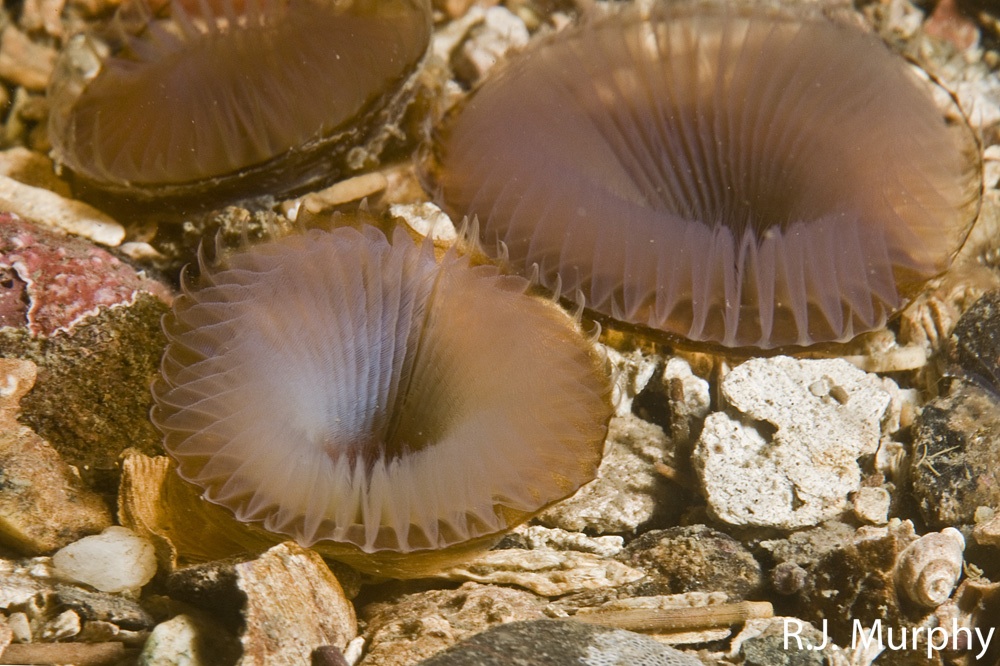
Ryan took this underater picture in April of 2009. It captures the transparency well.
Myxicola infundibulum , a slime tube worm is one of the Polychaetes in the Phylum Annelida. It is fairly common among the vast array of other invertebrates living subtidally at Race Rocks.
| Domain | Eukarya |
| Kingdom | Animalia |
| Phylum | Annelida |
| Class | Polychaeta |
| Order | sabellida |
| Family | sabellide |
| Genus | Myxicola |
| Species | infundibulum |
| Common Name: | jelly tube worm |
| Other Members of the Phylum Annelida at Race Rocks |
| Return to the Race Rocks Taxonomy and Image File |
| The Race Rocks taxonomy is a collaborative venture originally started with the Biology and Environmental Systems students of Lester Pearson College UWC. It now also has contributions added by Faculty, Staff, Volunteers and Observers on the remote control webcams.
December, 2002- Ryan MurphyPC) |
Balanus nubilus:Giant barnacle–The Race Rocks Taxonomy
-
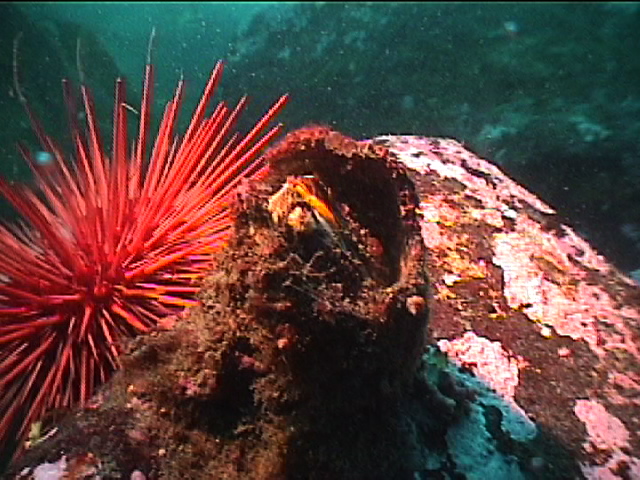
- Balanus : size comparison with a 25 cm sea urchin
-
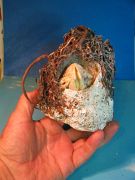
- This dead Balanus was found on the beach with the holdfasts of two kelps attached.
-
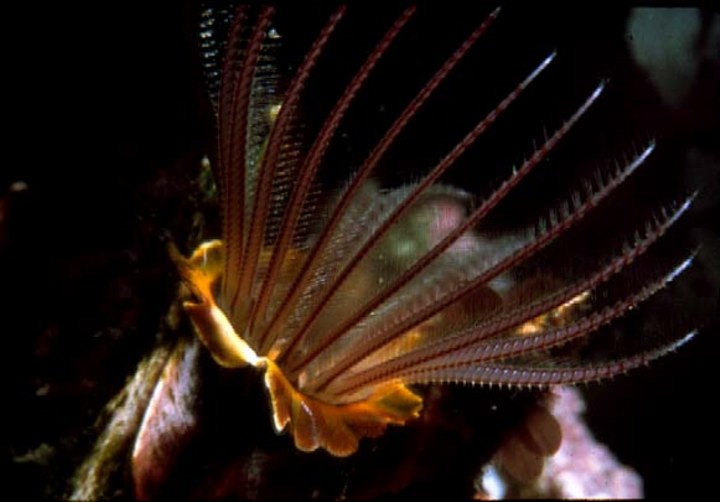
- The “feet” of the barnacle sweep the water for plankton
-
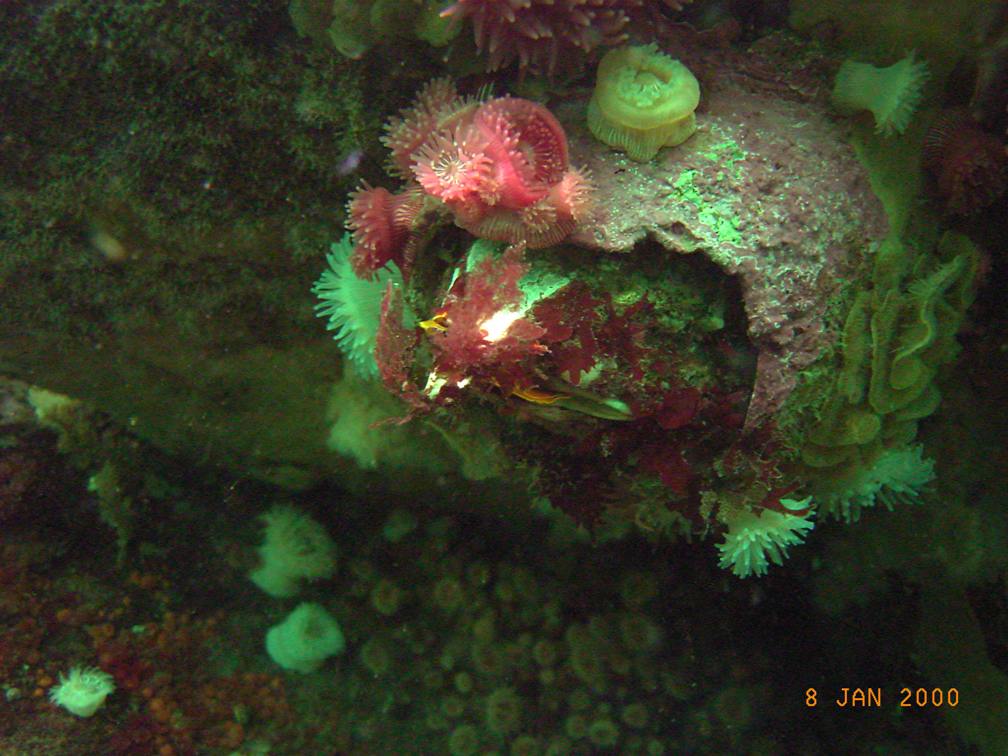
- Kohei Noda (PC year 32) captured this image of brooding anemones associated with the giant barnacle.
-
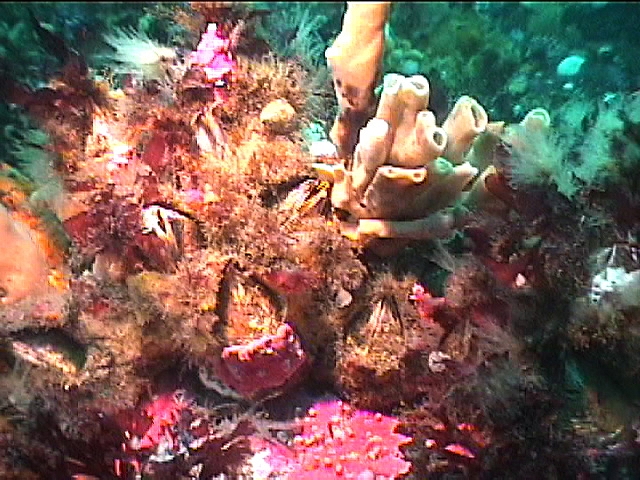
- We often find the giant barnacles in clusters which provides habitats for many other species.We often find the giant barnacles in clusters which provides habitats for many other species.
-
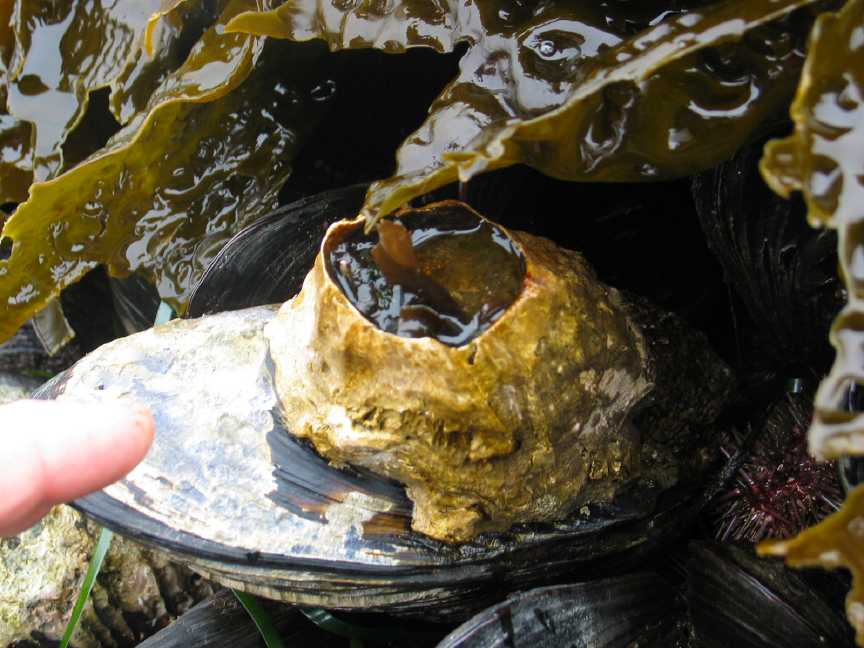
- Barnacles are not usually parasites, but the weight of this one could eventually impact negatively on the mussel.
The video is of a juvenile barnacle feeding. It was taken by Sylvia Roach through a microscope camera in the marine lab at Pearson College. The size of the barnacle can be estimated by the small skeleton shrimp which is active in the background. That amphipod is less than 1 cm in length.
Research on the associations of hydroids that live on them has been done at Race Rocks by Dr. Anita Brinckmann-Voss. In her publication on the new species Rhysia fletcheri she has included a photograph of hydroids on the valves of this animal.
Domain: Eukarya
Kingdom:Animalia
Phylum: Arthropoda
Class:Crustacea
Subclass: Cirripedia
Order: Thoracica
Suborder: Balanomorpha
Superfamily: Balanoidea
Family: Balanidae
Genus: Balanus
Species nubilus
Common Name: Giant Barnacle
Giant barnacles are commonly found on rocks, pier pilings, and hard-shelled animals in low tidal zones to 90 meters depth.
They are up to 110 mm in diameter and are not easily confused with any other species. A feature unique to the giant barnacle is the lack of longitudinal striation on the scuta. They also contain the largest individual muscle fibres known to science.
There has also been an extended essay done on this association by a student from the college. They are often encrusted with the holdfasts of kelp. Occasionally a storm tearing at the kelp will uproot a mass of barnacles and they may end up on a beach in the masses of tangled kelp. One of the reasons we have a ban on anchoring in the reserve is that these barnacles are easily broken away from their locations on rock outcrops by a dragging anchor.
Barnacles are not usually parasites, but the weight of this one could eventually impact negatively on the mussel.
| Other Members of the Phylum Arthropoda at Race Rocks |
| Return to the Race Rocks Taxonomy and Image File |
| The Race Rocks taxonomy is a collaborative venture originally started with the Biology and Environmental Systems students of Lester Pearson College UWC. It now also has contributions added by Faculty, Staff, Volunteers and Observers on the remote control webcams.
March October 2003- Aven Crawshay (PC) |
Halosaccion glandiforme: Sea sac –The Race Rocks Taxonomy
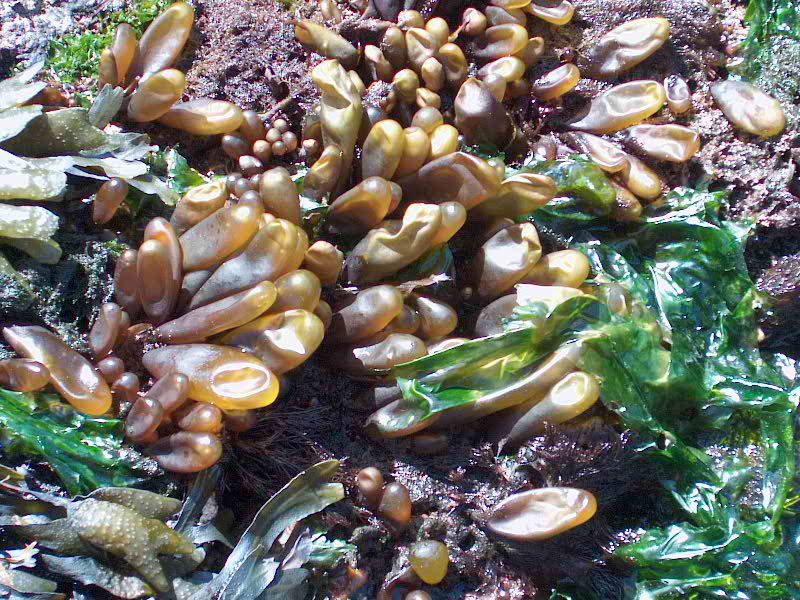
Distinguishing Characteristics :
Typical descriptions of Halosaccion glandiforme depict the plant as a thin-walled elongated sausage-shaped sac found in the mid-intertidal region of rock dominated shores. The plant is identifiable by its rounded head and short stipe anchored by a small circular holdfast. It ranges in colour from yellow/brown to red/purple. Also, because of the water it contains, applying pressure to the plant produces fine sprays of water emitted from the pores. In Common Seaweeds of the Pacific Coast (by J. Robert Waaland) it is stated that “Halosaccion glandiforme may reach lengths up to 25 cm and 3 to 4 cm in diameter; typical sizes are about 15 cm long by 2 to 3 cm in diameter.”
The following pictures were taken by Ryan Murphy, 2005
-
- Another dense field of H. glandiforme

-
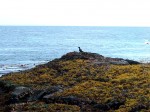
- Pigeon Guillemont on field of H. glandiforme

-
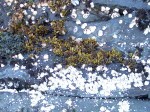
- H. glandiforme showing banding growth patterns

-
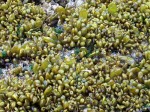
- A dense H. glandiforme field

-
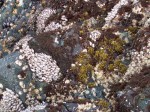
- H. glandiforme with E. muricata and barnacles

-
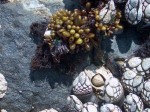
- H. glandiforme growing on gooseneck barnacles

-
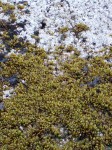
- H. glandiforme’s range overlapping with barnacles

-
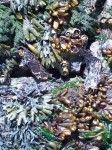
- H. glandiforme shown with Ulva lactuosa

Domain: Eukarya
Kingdom: Protoctista
Division: Rhodophyta
Class: Rhodophyceae
Subclass: Florideophycidae
Order: Palmriales
Family: Palmariaceae
Genus: Halosaccion
Species: glandiforme (Gmelin) Ruprecht 1851
Common Name: sea sac
Biotic Associations:
Being an intertidal species Halosaccion glandiforme shares its ecological niche with several other intertidal dwelling species. Acrochaetium vagum, a different red algae, is an epiphyte to Halosaccion. Also such species as mussels, barnacles, and species from other algal divisions including Poryphera lancelota, and Fucus gardneri grow in the same vacinity of the intertidal zone as Halosaccion. Predation on the Halosaccion is limited, the most common source of predation is from molluscan grazers like the sea snail Tegula funebralis.
In a study done on Halosaccion at Bamfield Marine Station in 1983, Garry Fletcher found an association of microscopic nematodes dwelling inside the sac of intact Halosaccion. Also noted were the special aggregation of cells that formed the “holes” on the walls of the algae.These are not random pin holes but very specialized regions of the matrix of the water reservoir wall.
References and Sources of More Information:
Fletcher, Alex, INTERTIDAL ZONATION OF HALOSACCION GLANDIFORME: A FOCUS ON HEIGHT AND SLOPE AS FACTORS OF ZONATION, extended essay in Biology, 2002
Johnson, L.E. 1992. Potential and peril of field experimentation: the use
of copper to manipulate molluscan herbivores. Journal of Experimental Marine
Biology & Ecology, v160 n2, pp251-262.
| Return to the Race Rocks Taxonomy and Image File |
| The Race Rocks taxonomy is a collaborative venture originally started with the Biology and Environmental Systems students of Lester Pearson College UWC. It now also has contributions added by Faculty, Staff, Volunteers and Observers on the remote control webcams. Dec 2001–Alex Fletcher PC. |
Arenaria melanocephala: Black Turnstone–The Race Rocks Taxonomy
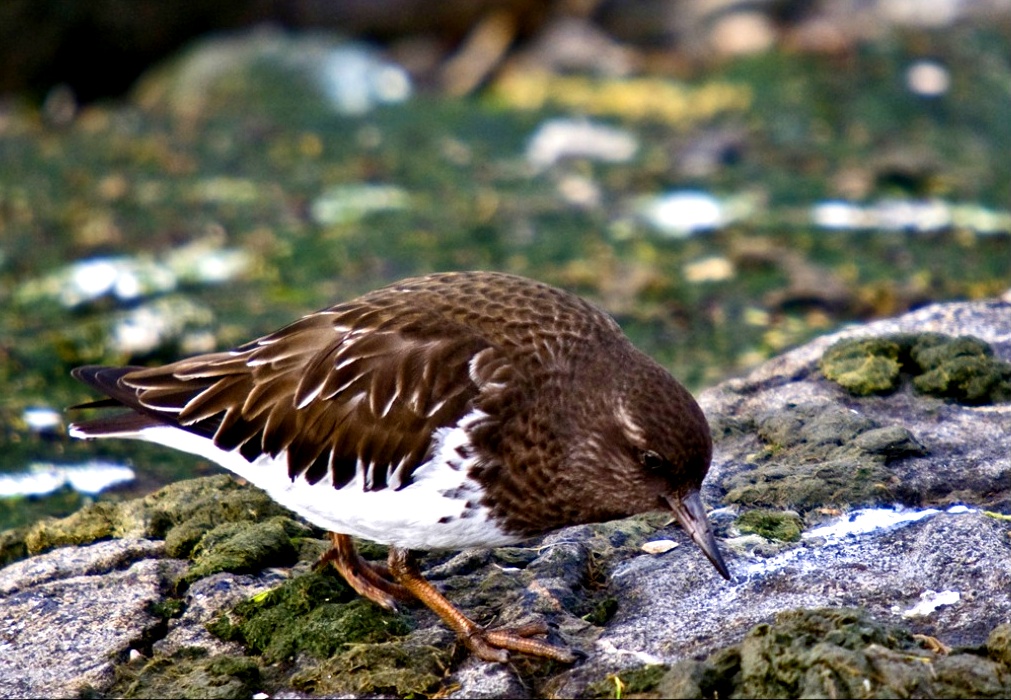
Ryan took this image in January 2009. At that time of year there were over a dozen turnstones foraging across the island.
-
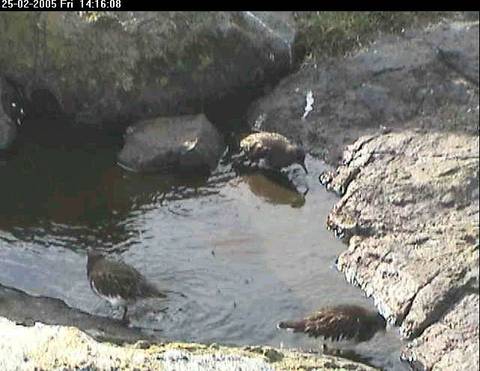
- After a rain it can often be seen as in this photograph, bathing in the freshwater pools in rock depressions. Photos by PB.
The Black Turnstone breeds in Western and Southern Alaska on the coastal plain. It winters only on the Pacific coast, from southeast Alaska to central Mexico. It is the most abundant shorebird of rocky shorelines. Favourite habitats include reefs, rocky beaches, jetties, and gravel bars at the mouths of rivers or along lagoons. It may also forage on adjacent mudflats wet sandy beaches, floating kelp beds, and piles of washed-up seaweed. Black Turnstones have been recorded roosting on dry rocks, jetties, and floating log booms at which time they may gather into extremely dense flocks.
It is widely distributed along the inner and outer coast. Its distribution is largely restricted to rocky coastal shorelines, but it frequents many fiords and protected inlets. It is a vagrant in the interior. The Black Turnstone usually occurs in flocks of 10 to 30 birds at Race Rocks where it overwinters.
This slide show shows the Black Turnstone being part of the Food Web at Race Rocks providing energy for the Peregrine falcon!
Reference used:http://rbcm1.rbcm.gov.bc.ca/nh_papers/gracebell/english/b_turnst.htm
Below are the records for population numbers of Black Turnstones observed in the Christmas Bird Counts.
Domain Eukarya
Kingdom Animalia
Phylum Chordata
Subphylum Vertebrata
Class Aves
Order Charadriiformes
Family Scolopacidae
Genus Arenaria
Species melanocephala
Common Name: Black Turnstone
Other Members of the Class Aves at Race Rocks.
| Return to the Race Rocks Taxonomy and Image File |
| The Race Rocks taxonomy is a collaborative venture originally started with the Biology and Environmental Systems students of Lester Pearson College UWC. It now also has contributions added by Faculty, Staff, Volunteers and Observers on the remote control webcams. Angela Chaisson, PC yr 28 |