Navy and Victoria Whale-watchers hit more rough sea -TC Sept 2017

This article is from the Times Colonist of September 2, 2017 by Richard Watts and Katherine Dedyna
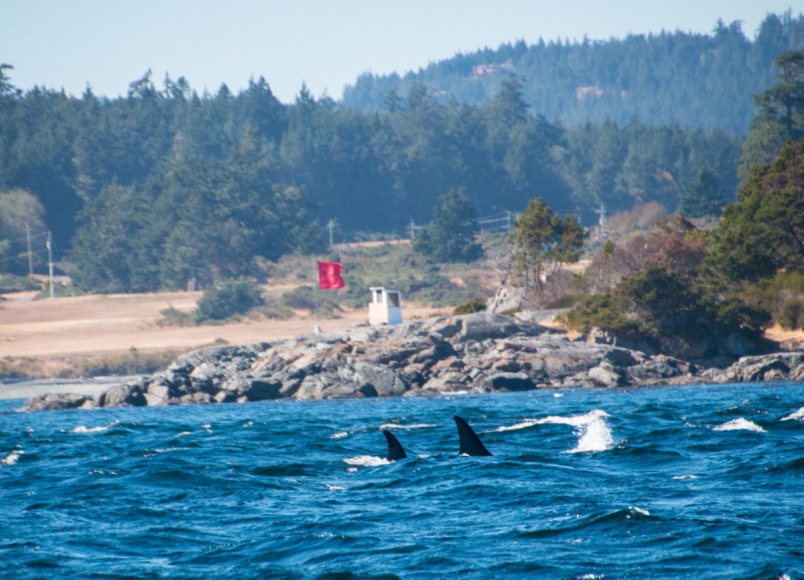
Warnings of orcas showing up near a navy dry-land blasting site on Bentinck Island came too late to stop explosions on Thursday, the navy said. Mark D Williams, SpringTide Whale Watching & Eco Tours Photograph By Mark D Williams

Relations between Victoria whale watchers and the Royal Canadian Navy appear to be frayed over the navy’s use of a blasting range near Race Rocks.

On Friday, the relationship appeared to be working. Whales showed up near a navy dry-land blasting site on Bentinck Island. Whale watchers informed the navy, and the blasting range was shut down.

On Thursday, however, two explosions were set off while killer whales were in the area. According to whale watchers, the animals fled in a panic, porpoising as they left.

Whale watchers and the navy have committed themselves for at least 15 years to a Marine Mammal Mitigation Procedure. It includes one provision under which the navy agrees not to set off explosions within 1,000 metres of a marine mammal that happens by.

Also, during explosions or live firing, the navy always has two sentry boats on the water. They sit just outside the 1,000-metre safety zone, ready to alert the range safety officer if a boat or whale appears to be getting close.

“It’s been a very smooth 15 years,” said Dan Kukat, owner of SpringTide Whale Watching and navy liaison for the Pacific Whale Watching Association. “It’s just in the last 12 months something seems to have changed.”

The navy contends it followed, as closely as possible, the Marine Mammal Mitigation Procedure. But in Thursday’s explosions, four in total, the warnings of orca proximity were received too late for two blasts.

Navy spokesman Lt. Tony Wright said the explosions are set off with a five-minute fuse.

Once they are set to fire, they can’t be stopped.

“You push a button and once you do that, you can’t turn it off,” said Wright.

He said the four explosions were part of a training exercise to practise clearing a beach of debris to make it passable for something like an amphibious landing to follow.

But whale watchers said the navy had good warnings of the approaching orcas and didn’t need to allow the explosions to occur.

Also, their complaint comes about two weeks after Kukat met at CFB Esquimalt with navy officials to streamline communications, resulting in an agreement that Kukat would alert the navy immediately when whales are spotted in blasting areas.

The meeting was in response to an incident Aug. 3 in which an Eagle Wings Tour skipper drove his boat and 50 passengers into a restricted zone to stop the firing of explosives near a pod of orcas.

Kukat said he had placed five phone calls about noon Thursday to various naval officials trying to let them know orcas were in the blasting area. He also made an additional four phone calls about 2:30 p.m.

“Our information seemed to fall on deaf ears,” Kukat said.

Also, he said he has been told at least two whale-watching boats informed the navy sailors on a sentry boat between 3 and 3:30 that there were orcas in the immediate vicinity.

But the two explosions still went off shortly after.

The whale watchers are concerned noise and vibration can damage the echo-location system that orcas use to hunt and to find their way under water.

Kukat said he is appealing to Prime Minister Justin Trudeau to step in and help out.

“I understand and respect the vital role our navy plays protecting the interests of our nation Canada,” he said.

“But the way we are living today, the marine environment is also very high on the agenda and in certain circumstances it should receive priority. Thursday, that didn’t happen.”
rwatts@timescolonist.com

kdedyna@timescolonist.com

Census August 31st

The island has began a shift in population recently, with the adolescent gulls beginning to take flight and hunting on their own the population itself seems to be thinning out. We have some new visitors out this way with some canadian geese calling race rocks there home or maybe just a short term vacation spot. Lately the #’s of sea lions have been increasing steadily in the previous week, with the lions taking advantage of the grassy sections farther inland from the rocky coast.

Stellar Sea Lions – 175

Californian Sea Lions- 73

Elephant Seals- 3

200 Gulls

50 Adolescent gulls

30 Canadian Geese

20 Oyster Catchers

New keeper amongst old visitors

Current tenants on race rocks include stellar sea lions, harbour seals mostly on the rocky coastline as well as our well represented group of californian sea lions up from the south, Enjoying some Canadian hospitality. Weather conditions around the lighthouse have been anything from consistent ranging from dense fog and prevailing winds to calm swells and sunshine. As always loads of marine traffic from both sides of the coast, bigger vessels from the states are all braving the heavy currents to catch a glimpse of the wide variety of sea life we are currently housing. Most importantly the Elephant seals are really taking advantage of the well maintained landscape as they always find a nice place to snooze and are very reluctant to give it up to any competing deep sleeper. Shifting to the upcoming weather forecast, Predictably the strong wind warning will relinquish late this evening with wind conditions improving to 10-20 the rest of the week.

Dan over and out

August 17th Census

Sea Lions in the vicinity of the lighthouse are in the 200 range mostly on the outer islands with some still around the jetty.

3 Elephant seals have been spotted with a smaller pup and 2 larger specimens

The Gulls have thinned out a bit recently, still giving flying lessons to their offspring.

around 400 gulls various varieties and about 150 adolescent still taking flying lessons around the island.

I spotted 3 or 4 oyster catchers working the rocks as of late

No predatory birds or whales of any kind spotted in the reserve

Dangers of a Humpback Comeback

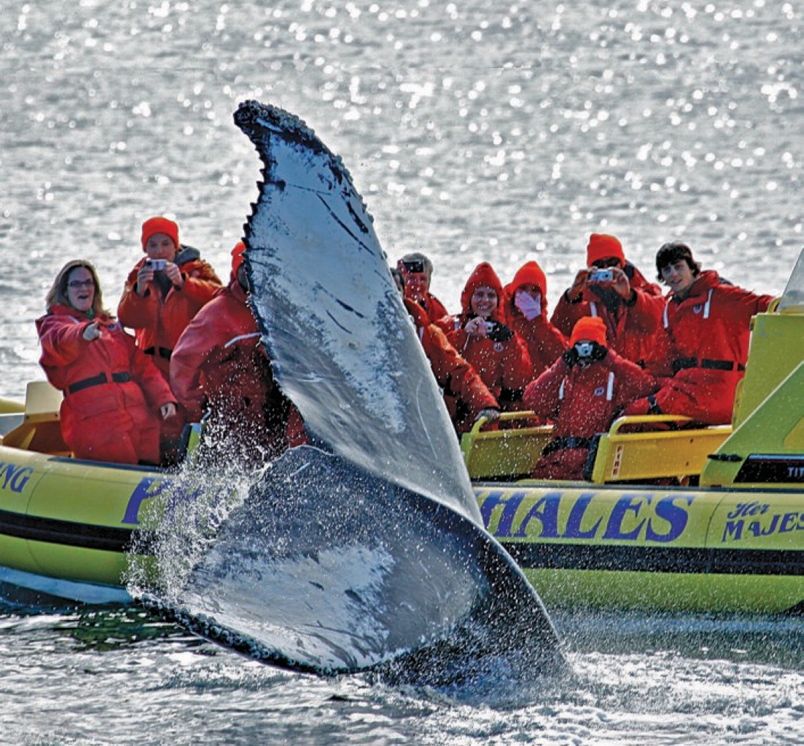
A humpback dives next to a whale-watching Zodiac. The mammals’ unpredictable surfacing sometimes leads to unintended close encounters. Photograph By Prince of Whales Whale Watching

This article is from the Times Colonist newspaper of August 27, 2017

A recent collision between a Victoria whale-watching vessel and a humpback near Race Rocks was “anything but a freak accident,” says researcher Jackie Hildering.
Hildering, a director of the Port McNeill Marine Education and Research Society, isn’t being judgmental or critical. The comeback of humpbacks has been so remarkable on the West Coast that they catch even professionals by surprise.
Last summer, the Pacific Whale Watch Association, which represents whale-watching companies in B.C. and Washington state, reported that humpbacks have made a major comeback. An estimated 21,000 whales are in Pacific Northwest waters, compared with just 1,600 when the whaling industry, which included Vancouver Island, closed in the mid-1960s.

Their behaviour is different from the orca behaviours boaters are accustomed to — which contributes to the problem.

A Zodiac vessel operated by the Prince of Whales company struck a humpback near Race Rocks on Aug. 7. Two people were taken to hospital with injuries.

“The very fact that a whale-watch captain, who knows the behaviour of the whales, can have such an unfortunate accident proves how very real the risk of collision is to boaters i.e., this is anything but a freak accident,” Hildering said in an email to the Times Colonist.

As for ordinary boaters, she said, they are “not aware that the humpbacks are back.” The lack of awareness can lead to interactions that are dangerous for both humans and humpbacks, which can be “astoundingly oblivious of boats, especially when they are feeding.”

Vilifying boaters or whale-watchers for striking or almost striking humpbacks is “not part of the solution” to minimizing the risk of such incidents, she said.

Hildering does not believe that humpback strikes are isolated incidents. She’s concerned that boaters who feel guilty about making contact or nearly hitting humpbacks are reluctant to report what has happened, which reinforces the incorrect idea that such occurrences are rare.

That kind of misunderstanding can lead to dangerous outcomes for both humans and humpbacks, she said. She wants to encourage anyone in a vessel to report any incidents so that the humpback involved can be identified and the nature of their injury recorded.

The non-profit society has been part of a federally funded campaign to increase boater awareness of whales for years, she said. She asks that boaters report any incidents to 1-800-465-4336, the Department of Fisheries and Oceans Incident Reporting Line.

“The risk is very real to both the whales and boaters,” she said, citing three more known humpback strikes this summer, off Kitimat on July 2, in Haida Gwaii at the end of June, in which three people were injured and one of them airlifted to hospital and in July off Campbell River, leading to a shoulder injury for a boater.

In the same way that an elk can jump onto a highway, humpbacks can emerge suddenly from the depths, she said. On June 25, the Haida Gwaii Observer reported that two men were airlifted to hospital with serious injuries when a guided fishing boat hit a humpback just outside Naden Harbour.

“It did not breach — it surfaced to take air, a couple of inches showing above the water,” said Sgt. Steve Vince of the Masset RCMP.

Responders saw what appeared to be whale tissue lodged on the hull of the boat, which had been travelling at about 20 knots.

On July 2, a humpback collided with a boat on Bishop Bay near Kitimat. According to MERS, one of the occupants contacted the report line to say: “We were on the lookout and did not see any signs of whales being present. The humpback surfaced out of nowhere right in front of the boat. We could not get out of the way of the whale. The boat slammed the whale and became airborne and we were thrown around the boat. It was terrifying. We want [the collision] to count so that others are more aware of the risk.”

“Simply put, the return of humpbacks from the brink of extinction is a game changer for boaters,” Hildering said and the society is trying to get the word out through presentations, coast-wide signage reading “see a blow go slow” and the media.

There are about 50 signs already posted that illustrate the potential impact between humpbacks and boaters placed on the West Coast.

“They are up in many locations in Victoria. And we are always looking for more sponsors for them,” she said.

The presence of a lot of birds is a sign that whales might be underwater, seeking the same kind of food, krill and herring that baleen whales such as humpbacks eat. Humpback blows can be two metres high, but are hard to see in windy conditions.

Among the differences she cites: Humpbacks do not have bio-sonor as do toothed whales, such as orcas. They do not travel in one direction, are not as easy to see because they spend less time on the surface of the water and just because they dive deep doesn’t mean they’ve gone away. Humpback generally dive for five to eight minutes, but can stay down as long as 20 minutes. “It’s most often impossible to predict where they will surface as they’re travelling in random patterns as they look for food.” in contrast, orcas spend more time on the surface and travel in a predictable direction.

Humpbacks are “extremely unpredictable” and also very acrobatic and prone to random moves especially when they feed. “Sometimes, they’re socializing and they can end up approaching boats,” she said. That would likely prompt boaters to start their engines, “potentially chopping up the whales.”

Anyone who sights a humpback should not approach within 100 metres.

“If a whale surfaces within 100 metres of your vessel, place engine in neutral (or, ideally, shut off the engine) until the whales are beyond 100 metres,” the MERS website states. “Slow down. Speed should not be more than seven knots when 100 to 400 metres from a whale.”
To sponsor a sign (for about $70), contact info@mersociety.org.

Foggy week and dead gull chicks

Weather

These first days of August were pretty foggy:Everyday the fog was around Race Rocks from 3:00 AM to 9-10 AM and for the 2 last days it was all day long. One day was warm but the others not so much because of the wind. On the 6th the fog around the rock  was just like a thick wall…

Ecological

No more Elephant Seals and slowly the Sea lions are coming back .We saw the first one on the jetty and 2 big stellers on middle were pretty noisy like usual.The 3 last days many dead gull chicks around and gulls are really aggressive (they attack you)…I saw an amazing show:2 eagles and 4 vultures hunting the chicks together (the 2 eagles going to a dive and the vultures staying at the same level in the air). Many pigeons guillemots . 2 beautiful and big cormorants spend a full day on the same rock. and 2 times we had orcas in Race Passage around 11:00 AM followed by so many boats!The second time some were almost on them (10 to 30 meters) …disgusting!

Maintenance

The sea water pump has been repaired and is working well now. Cleaning days before the shift.

Other

Shift over done on the  6th in the afternoon. James got a full tour of the rock and has been introduced.


Very strong currents

Weather

We have an alternating mode of days with no wind and some very windy days, raising to more than 40 knots (actually 44 knots on the 28th in the evening). Generally speaking the wind gets stronger almost every afternoon. We can also see some very strong currents around 12 knots  with the tides…very impressive even when you are used to… Some fog but not very often .

Ecological

The most interesting fact at the end  of July is the number of harbor seal babies . they are everywhere on the rocks and very nice to look at.Early one morning the number of Pigeons guillemots closed to the jetty, their camp base on the rock,was impressive.The elephants seals are not so numerous now, between 1 and 5 at the most.One huge sea lions(a Steeler) was fishing alone closed to the jetty and the rest of the colony is on Middle rock.

Other

Many, many whale watchers …it ‘s getting a problem when the huge ones with more than 100 people aboard, come very close to the jetty (I would say 30 meters ) and move the waters  to the point that is white everywhere because of the turbines…

4 helicopters came,  all at the same time on the 28th. They stayed for at least 3mn all around the tower. I guess for a control

Maintenance

The solar panels need attention everyday . I have to pump sea water with the high tide and sometimes in the night. The soft water pump broke …needs to be replace quickly.

Visitor

Mr Tyrone Pile came with the Vice – Admiral of the Victoria Naval Base for a short visit

Flying practice time for the first born chicks

Weather

West light winds most of the time but we had some wind coming from North East  for the 1st time this Summer.last Friday I got a lot of fog with no visibility at all and again two nights ago for a few hours.We have some very low tides .

Ecological

I have been attacked by the gulls getting very nasty. I had a helmet!There are chicks everywhere and the eagles and vultures are hunting almost every morning and I found already 3 bodies and 2 of the small ones  had been recently killed. Territory fight! Many oyster catchers(not true last year). Only 4 elephant seals and 12 sea lions on Middle Rocks. Early a morning I found a very small harbor seal on the railway; 50cm not more with a lot of fur!

Maintenance

The solar panels ,the house windows are getting so dirty!The house entrance too… I pumped more sea water for the underground reserve …This week I had a training everyday at Pedder bay (Navigation and radio operator license Training) So I was gone a big part of the days with some challenge for launching the boat (Low tides). I had to do it around 4AM

Vessels

The number of whale watchers around the rocks is insane . On Saturday I counted that at least 1000 people were around ! It’s a number really!