The Tie That Binds

It was another northeast day, with really not much happening weather wise. It blew NE about ten knots, was mostly overcast in the morning, with some sun in the afternoon. The barometer rose gradually all morning and then started to slowly slide after noon. It is expected that tomorrow’s southeast will bring rain, starting late tonight.

The whale watching boats were busy in the afternoon with Humpback Whales to the southeast of Race Rocks and more activity out to the west. A total of eight tour boats were seen in the Ecological Reserve.

Today was mega-fauna census day and these are the results:
Steller Sealion 298
California Sealion 508
Harbour Seal 79
Northern Elephant Seal 9
River Otter 2
Canada Goose 22
Greater White-fronted Goose 1
Harlequin Duck 5
Double-crested Cormorant 61
Pelagic Cormorant 15
Black Turnstone 9
Surfbird 5
Black Oystercatcher 38
Glaucous-winged Gull 145
Thayer’s Gull 1482
California Gull 3
Western Gull 7
Heermann’s Gull 35
Gull sp. 52
Common Murre 1
Common Raven 2
Fox Sparrow 2
Savannah Sparrow 15

Here are a couple of shots of Surfbirds, alone and with Black Turnstones.
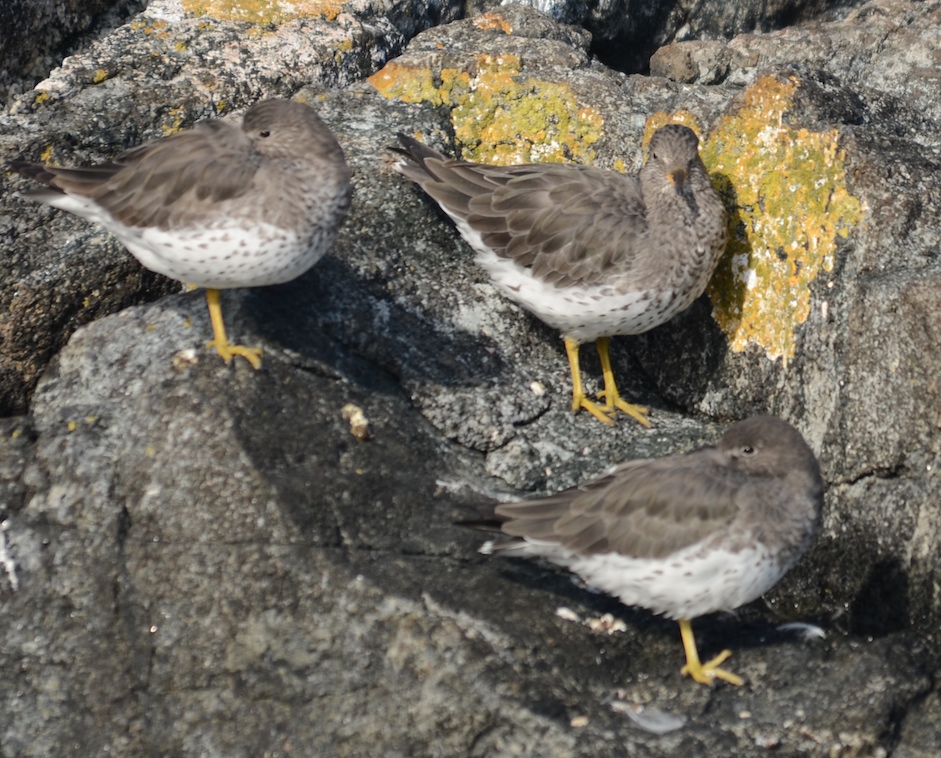
Surfbirds resting in the Jetty Bay.
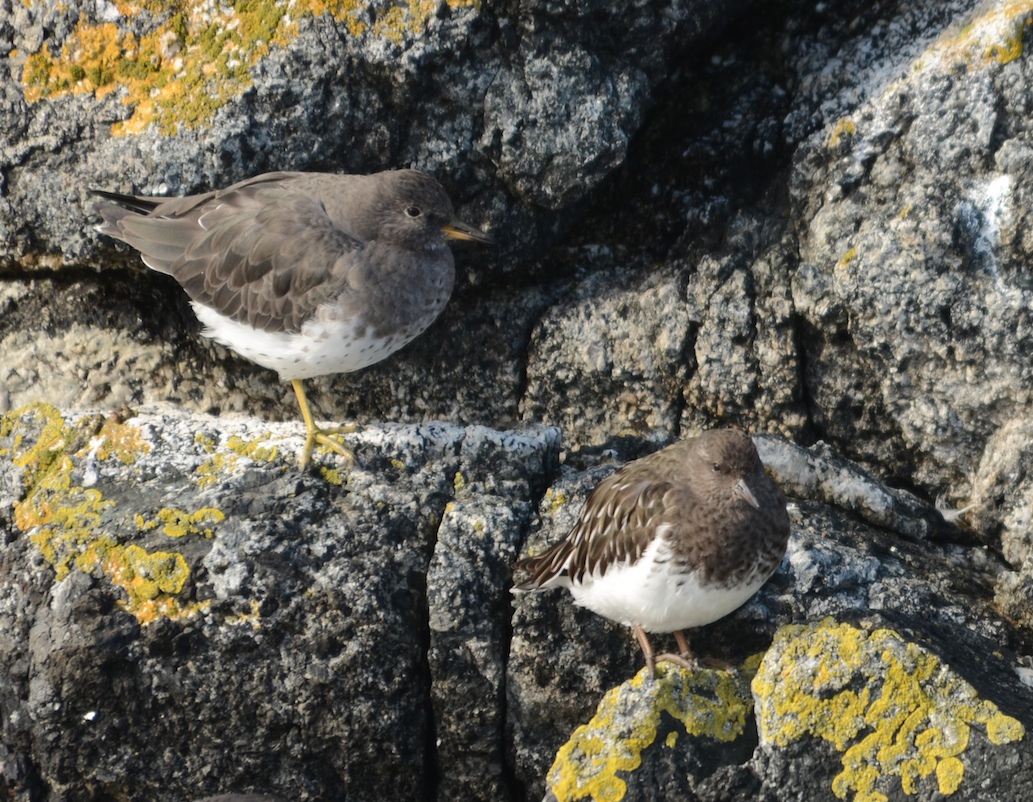
Surfbirds resting in the Jetty Bay.

Subi & Bltu
The census was challenging due to the numbers and species of gulls and the fact that both Steller Sealion and Harbour Seal numbers were lower than expected during the morning count, so they were re-counted in the early evening. I generally like to count Harbour Seals on the morning low tide but the tide wasn’t really doing much today. The evening counts were higher for both the Steller and the Harbour Seals. Two new Elephant Seals arrived today. They are both moulting, the smaller one hung out with the dual tagged three year-old, which appears to be staying on. The bigger animals may have gone back to Middle Rock as there were still six animals visible there.

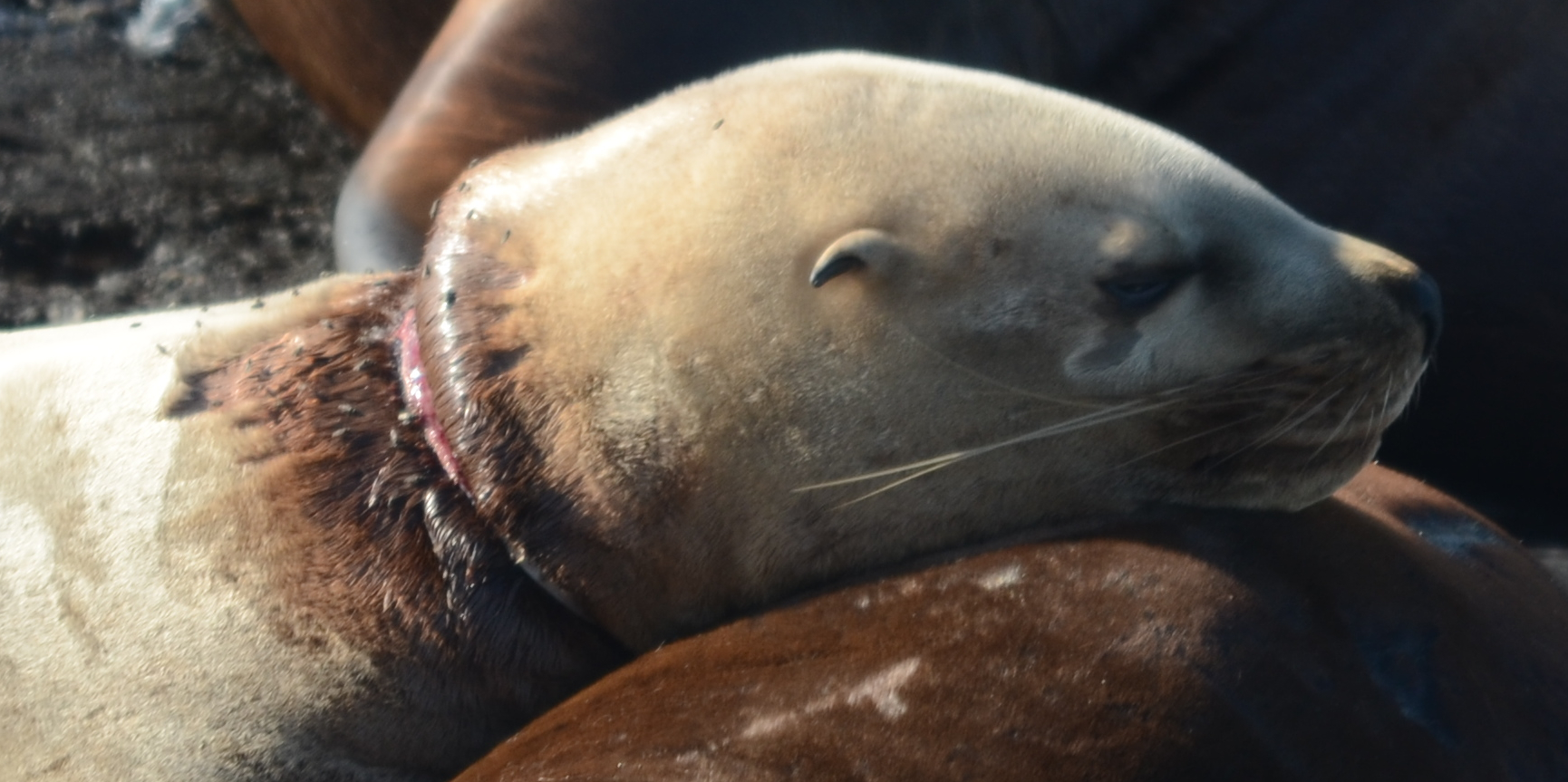
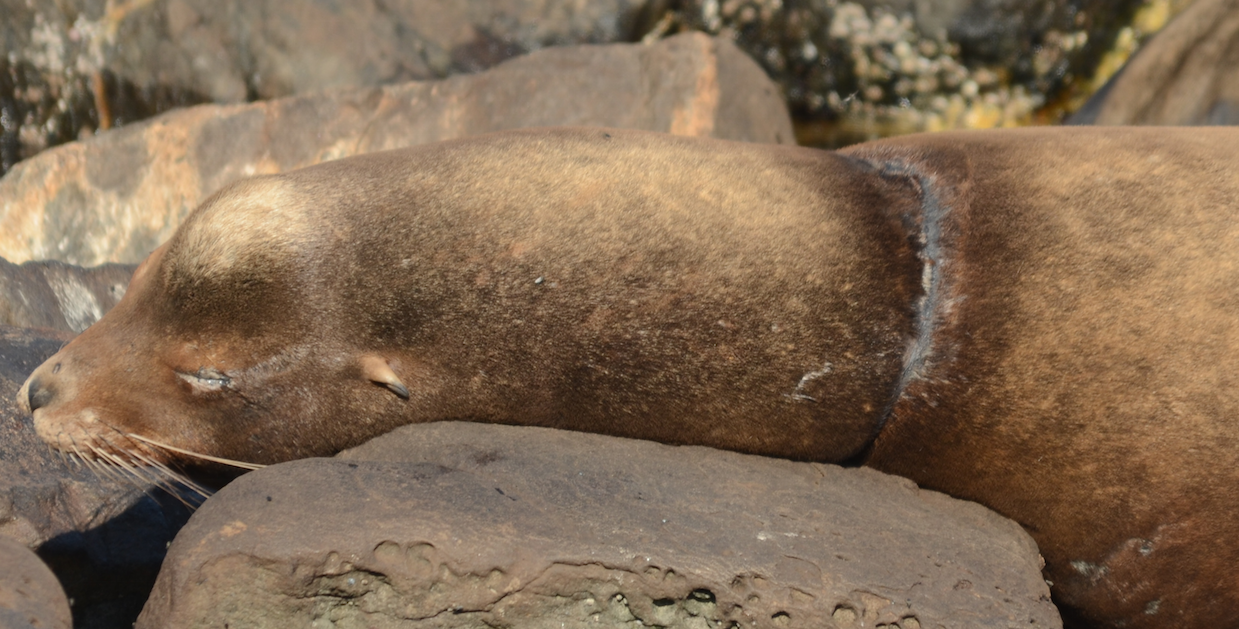
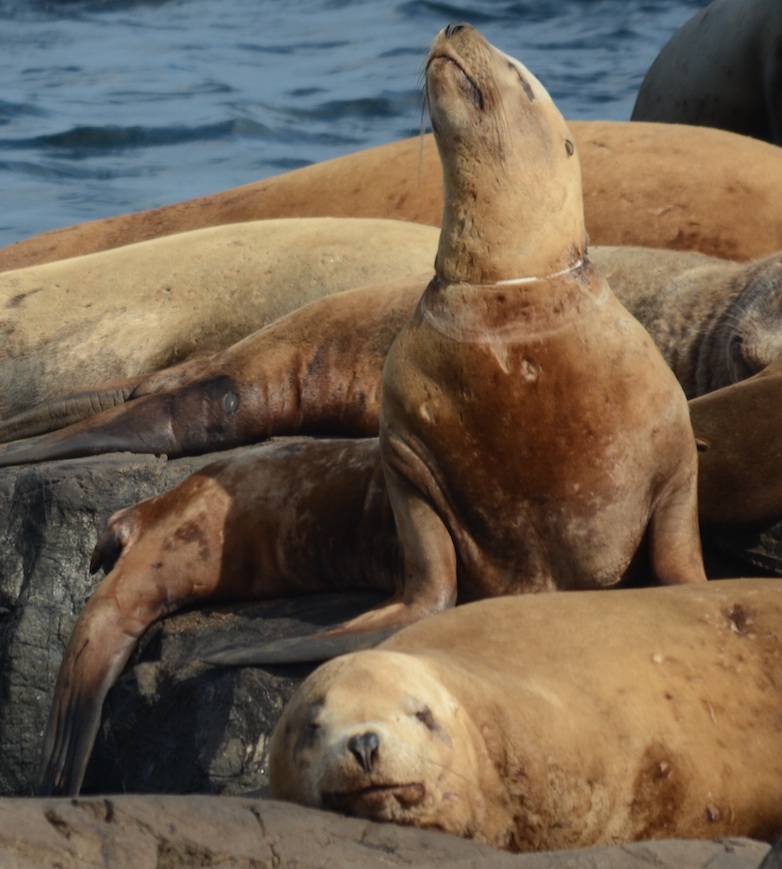
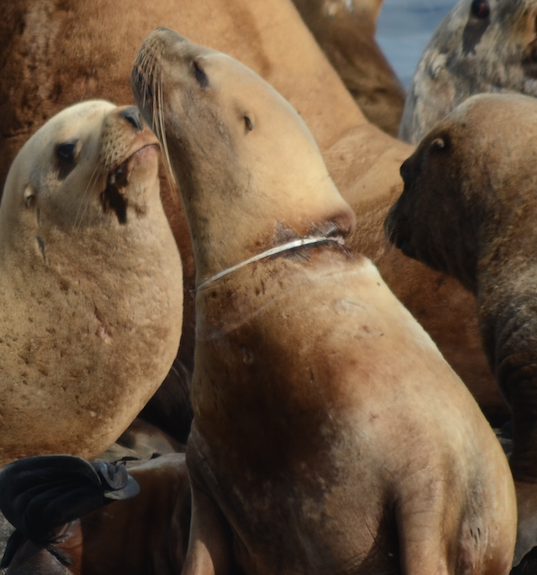
Ring-necked animals as well as tagged and branded animals were also re-surveyed today. I am still working on the branding data from a month ago. Two of the ring-necked Steller Sealions that have been observed since August are still here and languishing as the plastic straps cut into the backs of their necks. I am putting out an appeal to the disentanglement crew again.
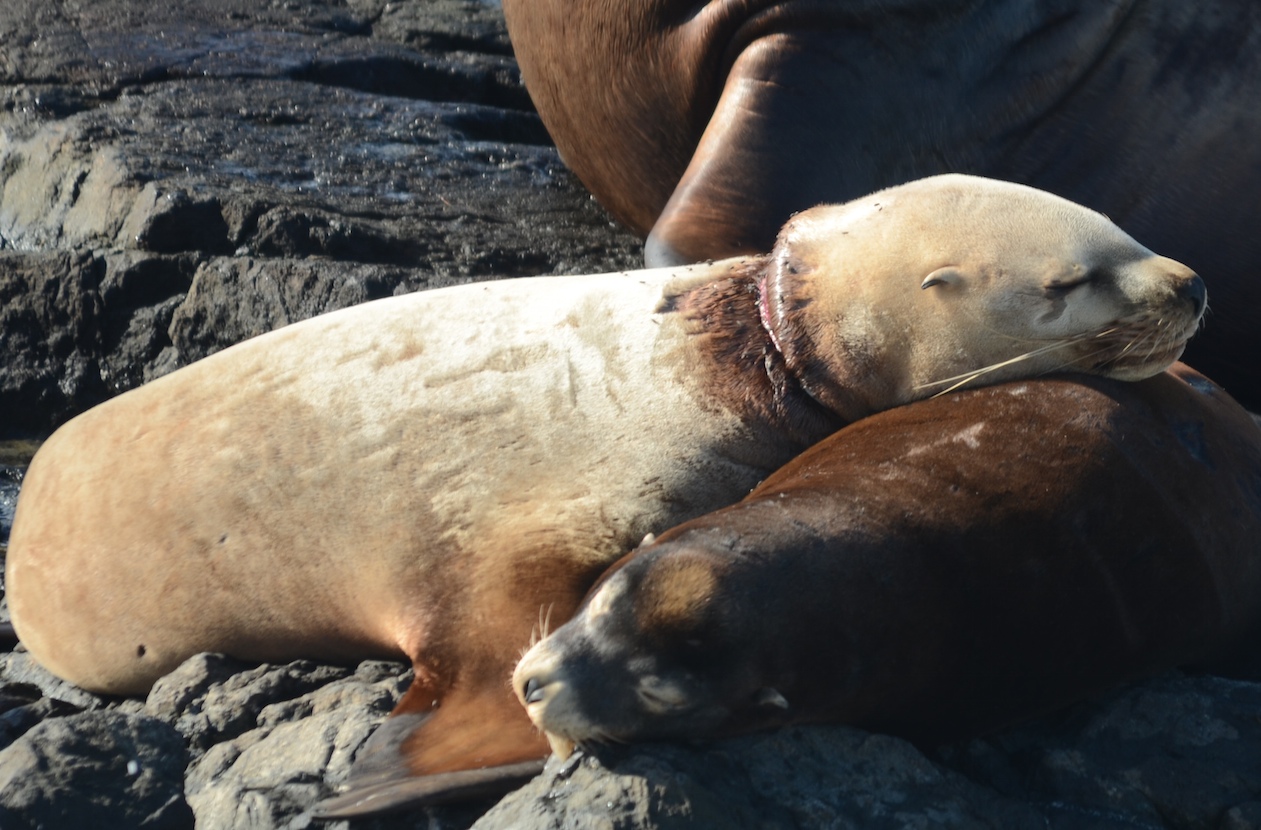
Euju plastic_strap Oct16
Euju oct 16 close-up
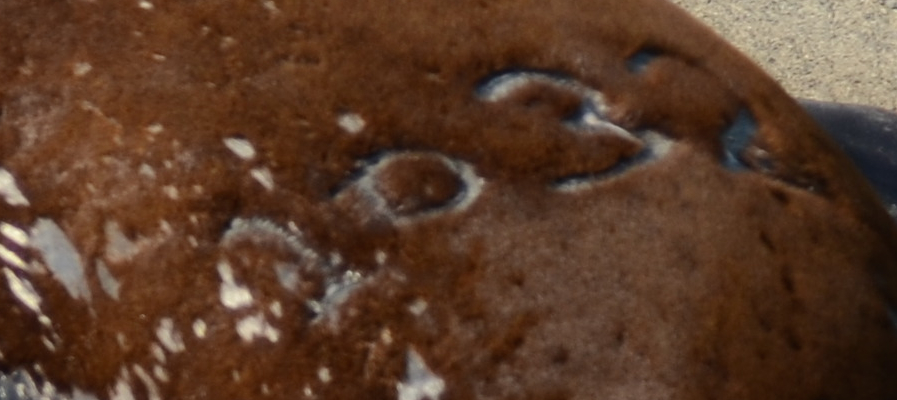
The second ring-necked animal ‘highlighted’ here is also branded on its’ left side 946R. I believe that it was branded at its’ natal colony which from the R should be Rogue Reef in southern Oregon. From the number it was branded after 2009 but I will find out more.
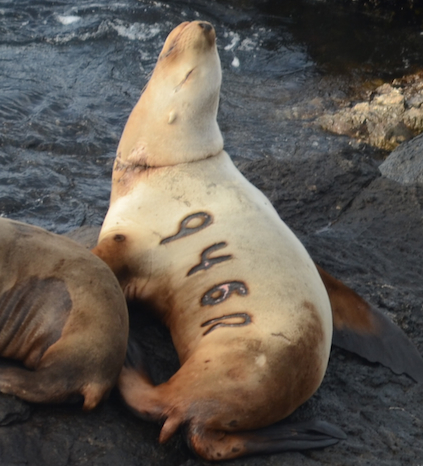
If it is not lying on its' left side this ring-necked Steller's Sealion is easy to tell apart from the others.

If it is not lying on its’ left side this ring-necked Steller’s Sealion is easy to tell apart from the others.
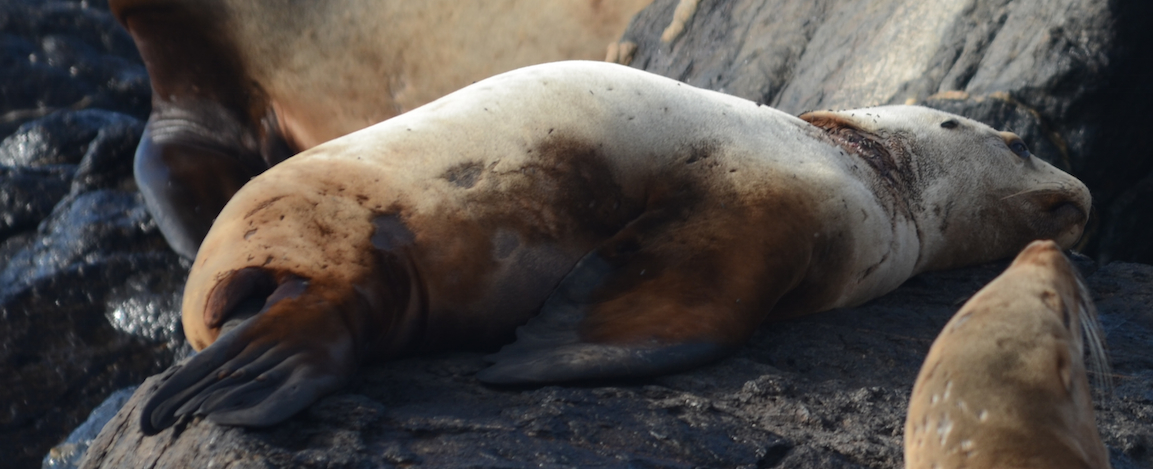
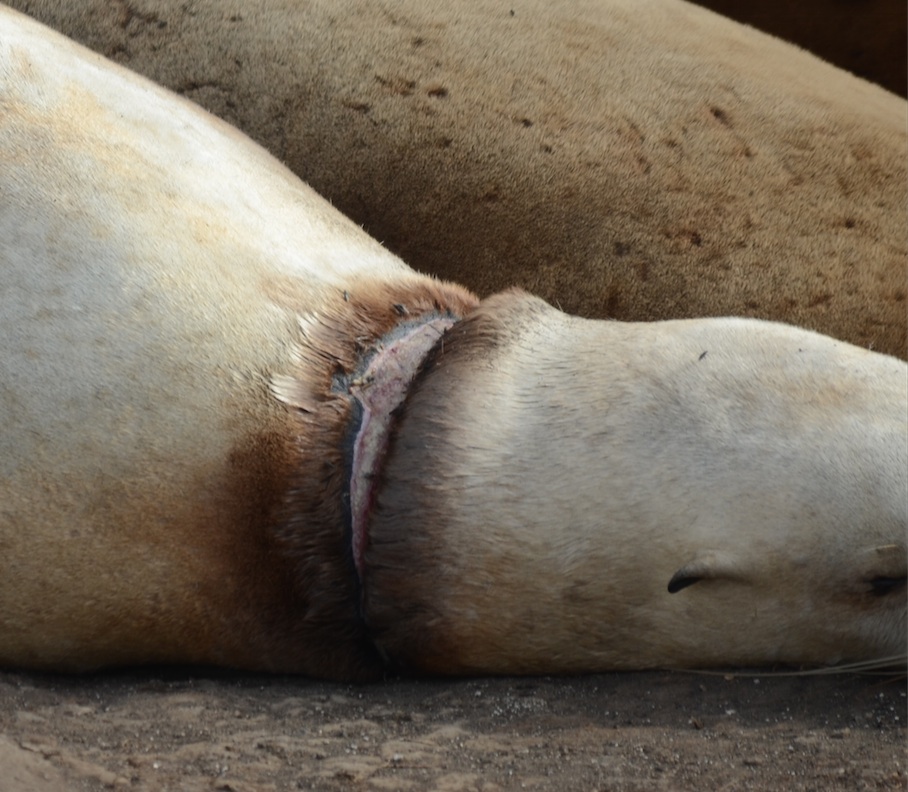
Like the other Steller it has plastic strapping, which is visible on the ventral surface.
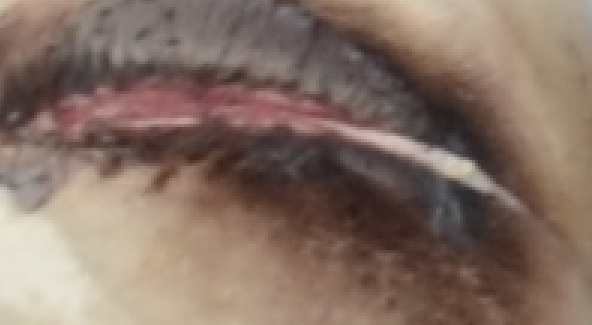
Like the other Steller it has plastic strapping, which is visible on the ventral surface.

This is a bit gory but I hope it will inspire the disentanglement team to come to Race Rocks.
This is a bit gory but I hope it will inspire the disentanglement team to come to Race Rocks.

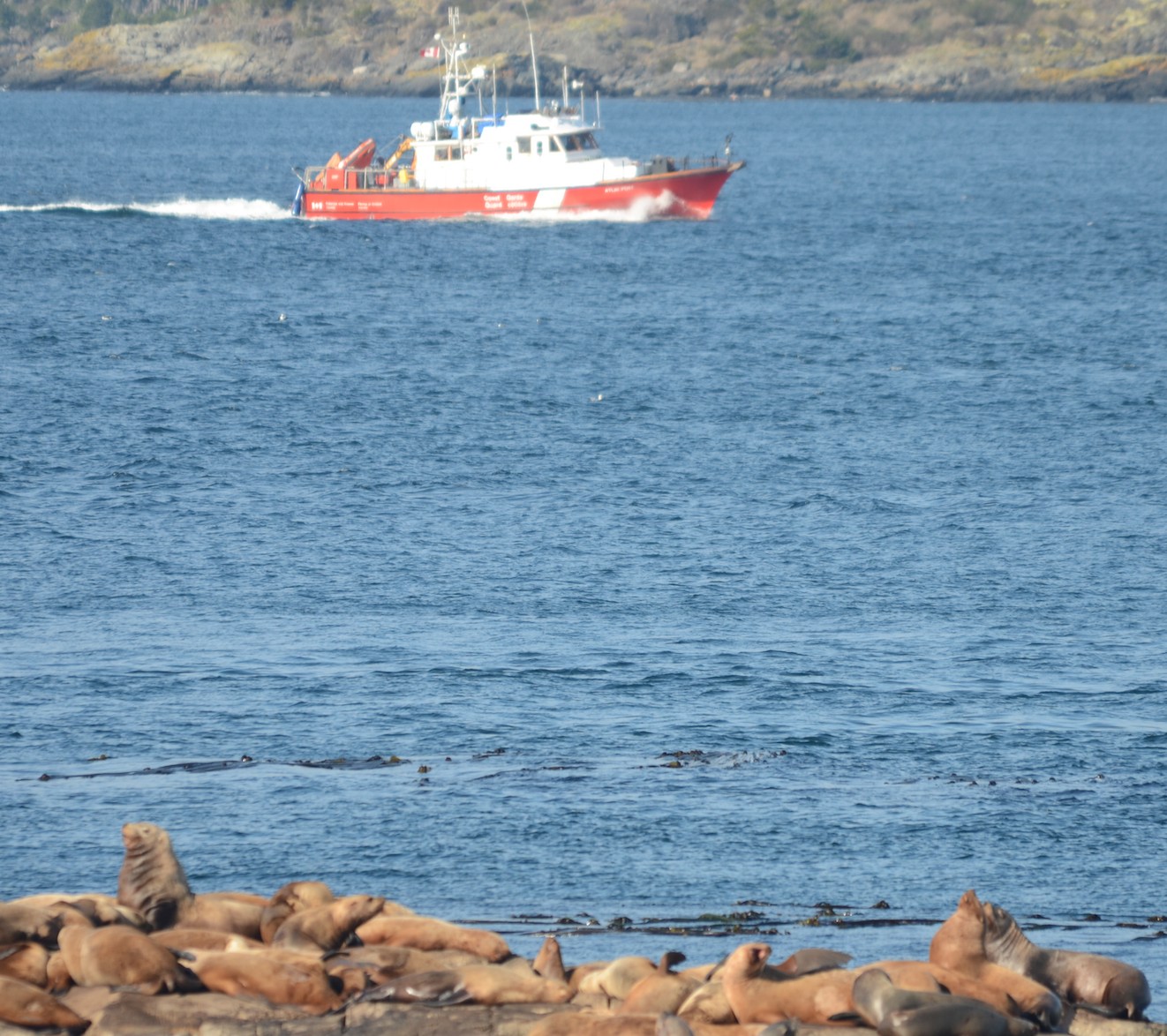
The Atlin Post passed by Race Rocks today but did not slow. Must have been in a hurry.

The Atlin Post passed by Race Rocks today but did not slow. Must have been in a hurry.

Did not do much maintenance today other than the basic cleaning, making water with the desalinator and electricity with the generator.
Pea Soup

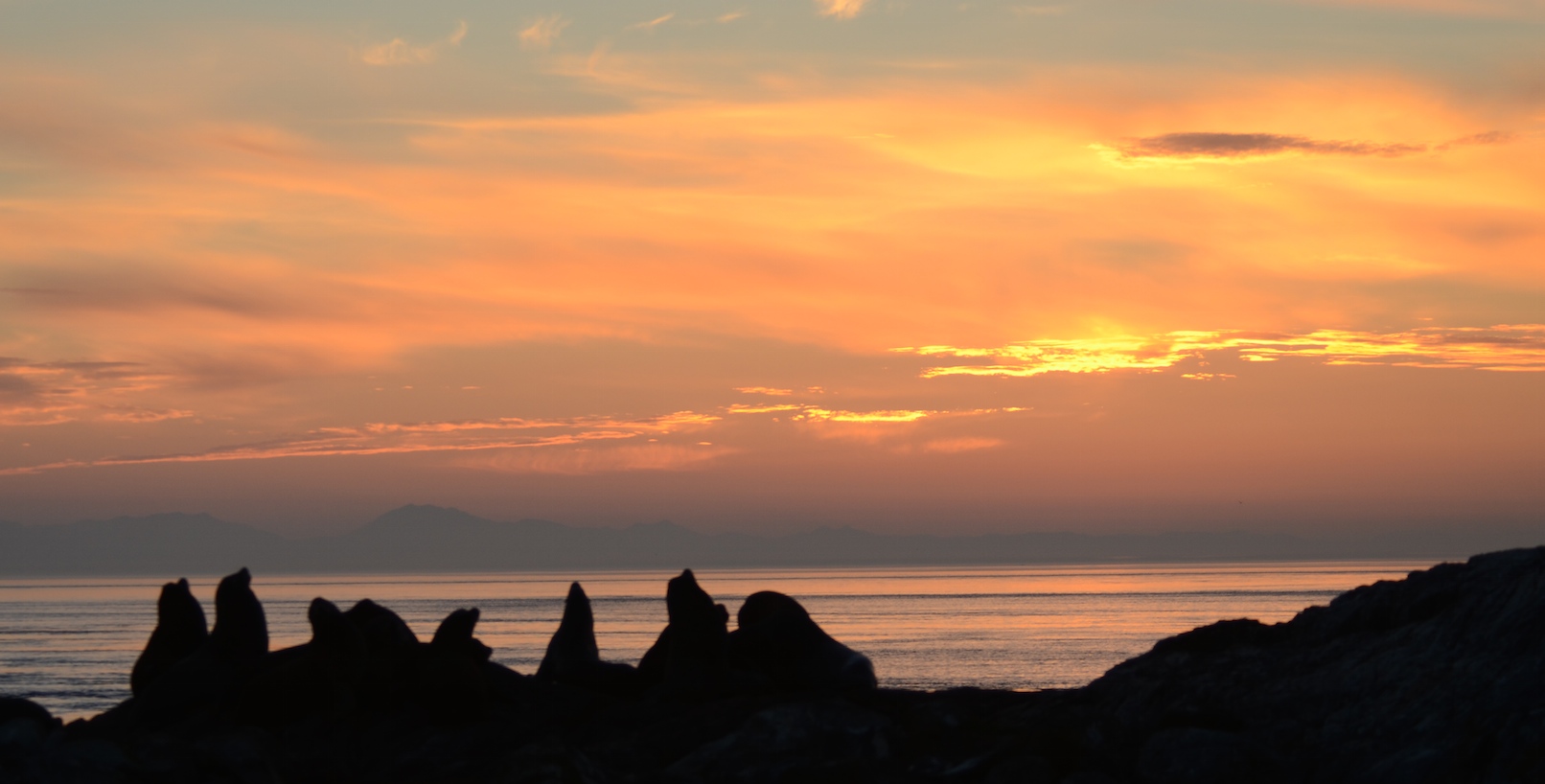
It was socked in with fog as thick as pea soup today. It cleared off this evening just before six and well in time for a fantastic sunset and my realization that it was probably a beautiful day, just about everywhere else in the region.

California Sea Lions silhouetted by setting sun.

California Sea Lions silhouetted by setting sun.

There was not much wind today, the high was 5 knots out of the east-northeast and everything is damp almost as if it had rained. Most of the day the flag hung limp and a bit sodden. The barometer continued yesterday’s gradual rise until about noon when it started to slowly decline, ending up at about the same place it started. The forecast looks like rain for at least a week but it probably just means showers. I keep forgetting that rain here and rain in Bamfield are just not the same thing.

There were no whale-watching boats observed although one commercial sports fishing boat stopped by to have a look at the sea lions.

The results of this weeks’ large animal census follows:

Steller’s Sea Lion 173
California Sea Lion 412
Harbour Seal 136
Elephant Seal 12
River Otter 1
Canada Goose 20
Greater White-fronted Goose 5
Harlequin Ducks 8
Double-crested Cormorant46
Pelagic Cormorant 5
Black Oystercatchers 20
Black Turnstones 6
Killdeer 4
Glaucous-winged Gull 88
Glaucous-winged x Western Gull Hybrid
Thayer’s Gull 303
Heerman’s Gull 17
California Gull 12
Western Gull 2
Ring-billed Gull 2
Gull sp, 260
Bald Eagle (adult) 1
Fox Sparrow 1
Song Sparrow 1
Savannah Sparrow 17

Most of the sea lions have moved over to the west side of the island and are hauling out on Middle Island and some of the smaller rocks. They are seem to be spending much more time in the water instead of sleeping on land and salmon kills are visible all over the Ecological Reserve when the visibility is good enough to see.

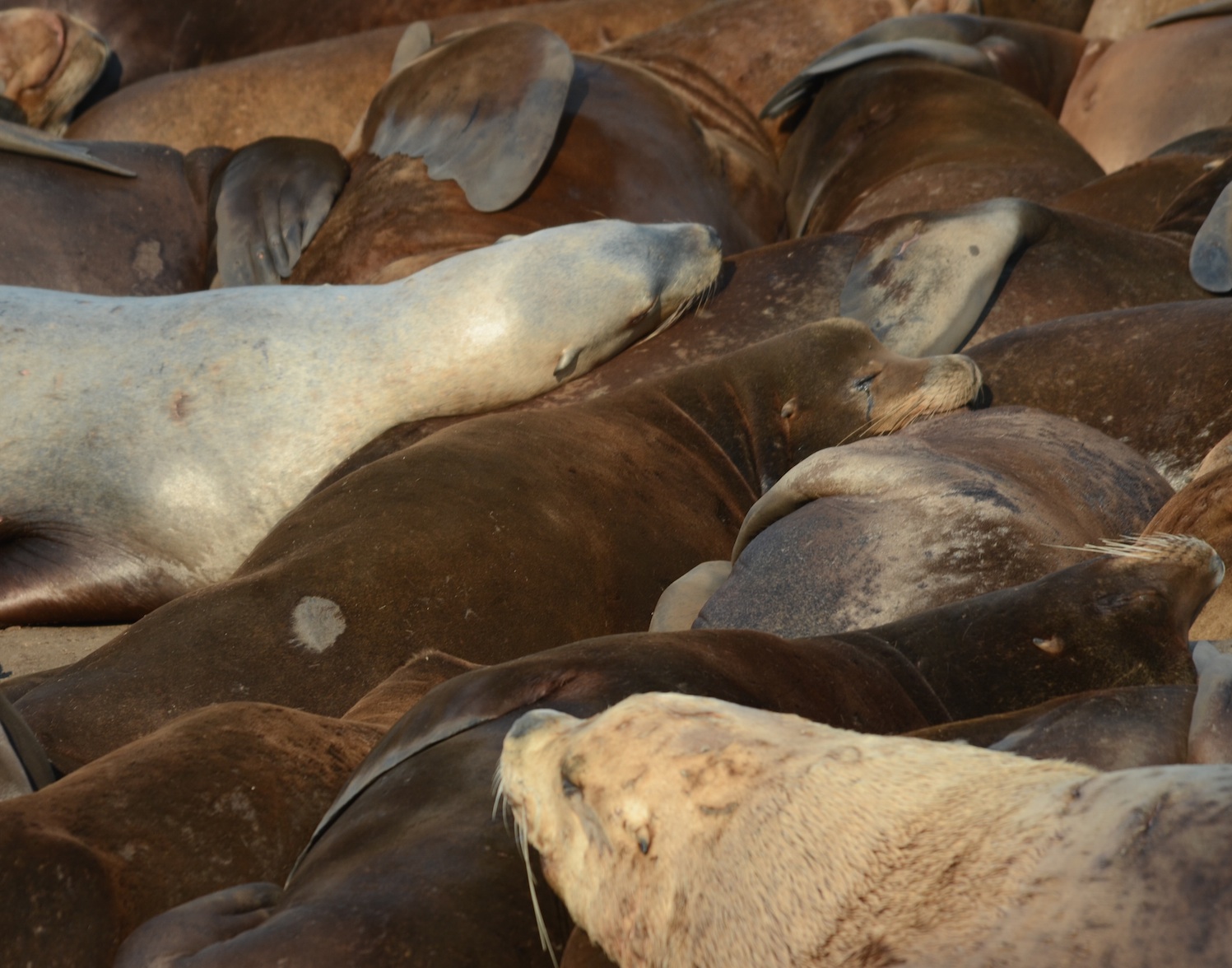
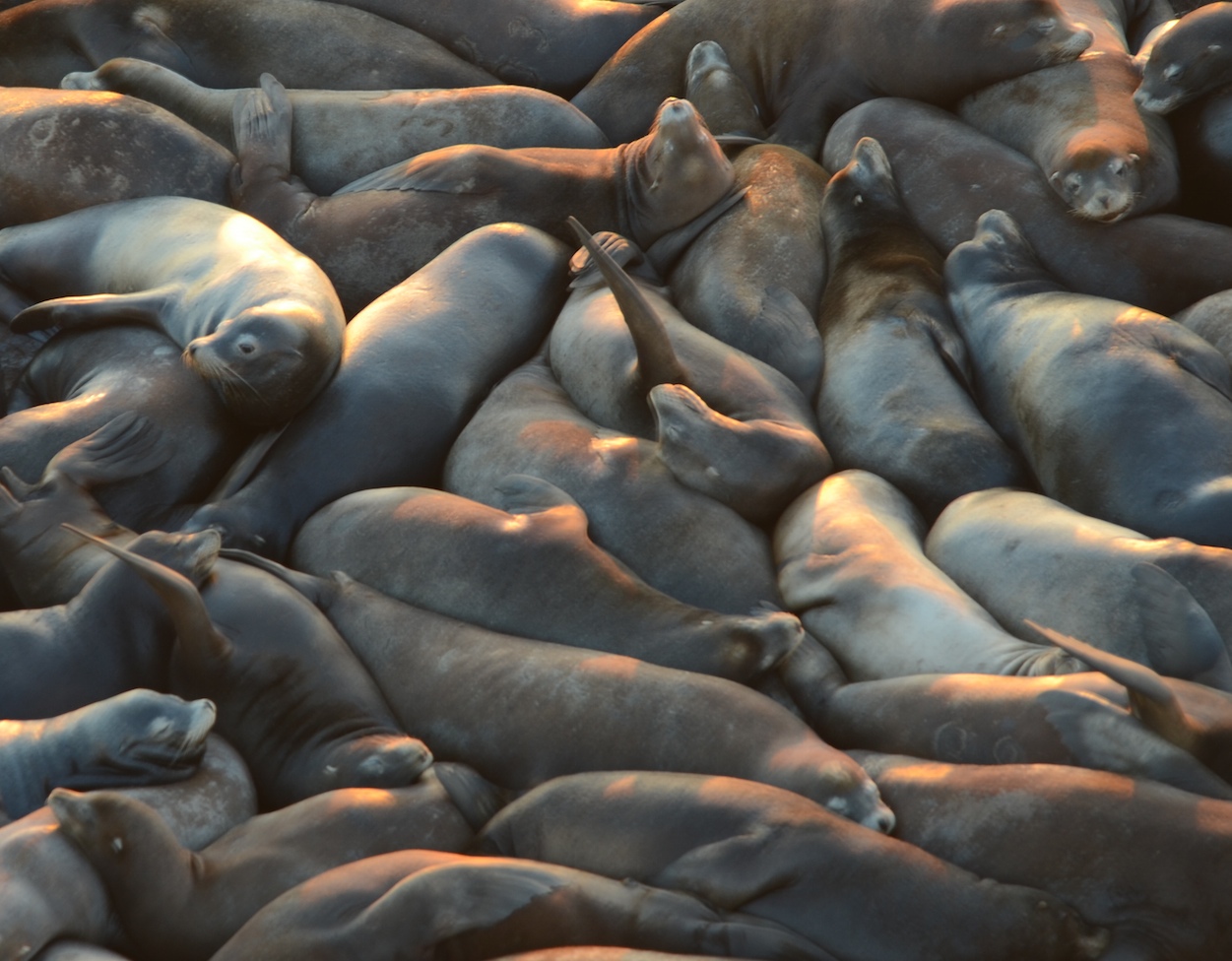
Wall-to-wall California Sea Lions catch a nap in a pile.

Wall-to-wall California Sea Lions catch a nap in a pile.

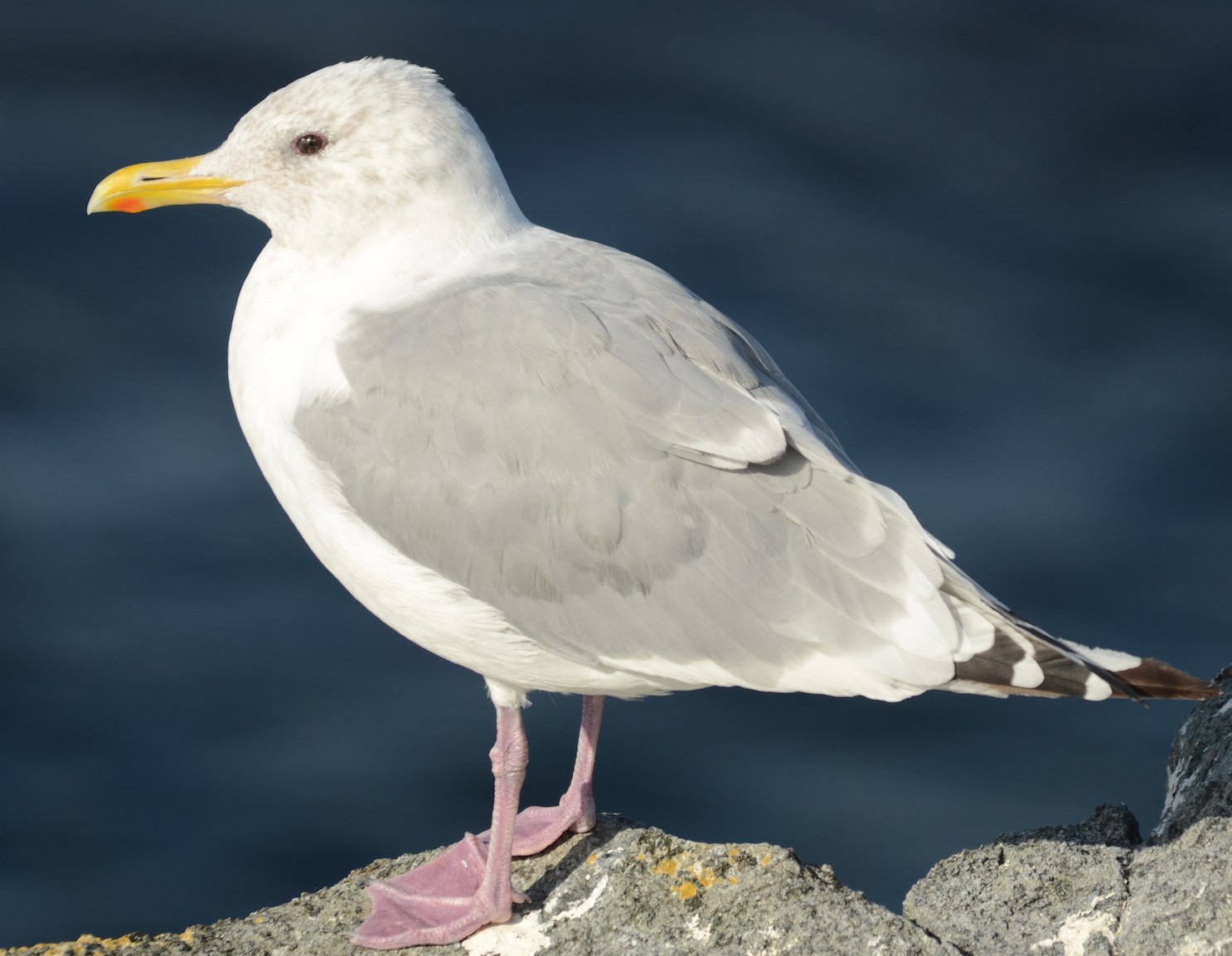
Thayer’s Gulls are the dominant gull now in terms of numbers and they seem to spend a lot of their day resting and grooming. All the gulls seem to take advantage of the sea lion feeding events as bits of salmon are flying. I double-checked my Thayer’s Gull identification with Dick Cannings and his super-birder son, Russell and they concur that this is a Thayer’s Gull.

Race Rocks is an important resting, roosting and feeding place for Thayer's Gulls recovering from a busy summer in the Arctic.

Race Rocks is an important resting, roosting and feeding place for Thayer’s Gulls recovering from a busy summer in the high Arctic.

My biggest task today was attempting to muck out the roof of the energy building where the solar panels are installed. It reminded me of a stable job I had when I was a kid. I actually used a snow shovel to scoop out the organic crud that had built up under the last of the panels to be raised by the electrician yesterday. The rest of the day’s maintenance-type activities were the regular jobs entailed in living here; making fresh water, topping up the batteries with the generator (even the solar panels had a hard time keeping up in the thick fog), doing the seawater sampling and sweeping a few walkways.

Fogimatrix.

The weather here was dominated by fog today. It lifted in an interesting way this morning so that you could see out and under the fog for several miles yet there was thick fog above, at very low elevation. The rising sun shone through this clear layer, creating a weird and wonderful lighting effect from below. By mid-day the fog had burned off and sunshine prevailed at sea level. There was still fog in the shipping lane and the tops of the Olympic mountains were visible. The fog flowed back in by mid-afternoon and thickened steadily after that, pushed in by a westerly fog wind. During the day there wasn’t much wind until late afternoon/early evening when it picked up to 15 to 20 knots from the west. The barometer continued its slow trend downward that started a few days ago and the forecast looks relatively good until rain on Friday.

There was a fairly steady parade of whale watching boats in the Ecological Reserve today. They were looking at Humpback Whales, Harbour Porpoise and of course the Sea Lions. Sixteen tour boats were noted although I may have missed some in the fog. One of the tour operators had the chance to see a really big (tyee) spring salmon swimming through the kelp forest.

There were sports fishers catching Coho, Spring and Chum Salmon to the south and west of Race Rocks and many sea lions were also busy catching salmon while at the same time helping to feed the gulls with their scraps, not out of any benevolence, just because they are messy eaters.

There are many gulls here now including Glaucous-winged, Glaucous-winged hybrids and Thayer’s gull which are challenging to distinguish. I look forward to doing the census first thing tomorrow to try and figure out how many of which species. The Heerman’s Gulls continue to benefit from sea lion salmon treats which they certainly can’t do where they breed in Mexico. I like watching them. They are very beautiful and have a interesting feeding behaviours that they may have learned from birds like skimmers where they live rest of the year. They fly with their lower bill hanging down just above the water and occasional skim the water with it, catching small prey.
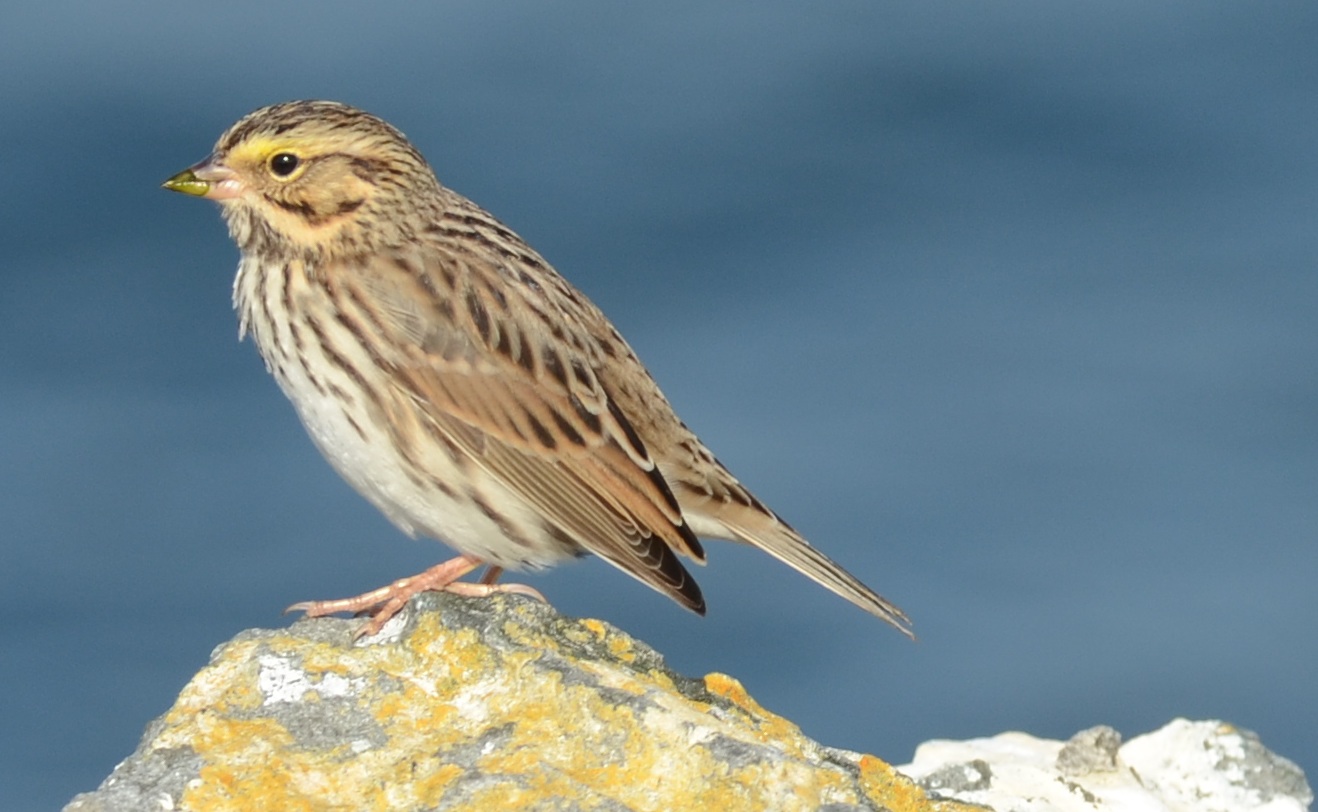
There are many sea lions on the west side of the island now and the westerly wind carries the dusty grime from them onto everything in its path. The Savannah Sparrows feed in and around the sea lions.

These little Savannah Sparrows forage through the sea lion waste picking up morsels and probably a few parasites.

These little Savannah Sparrows forage through the sea lion waste picking up morsels and probably a few parasites.

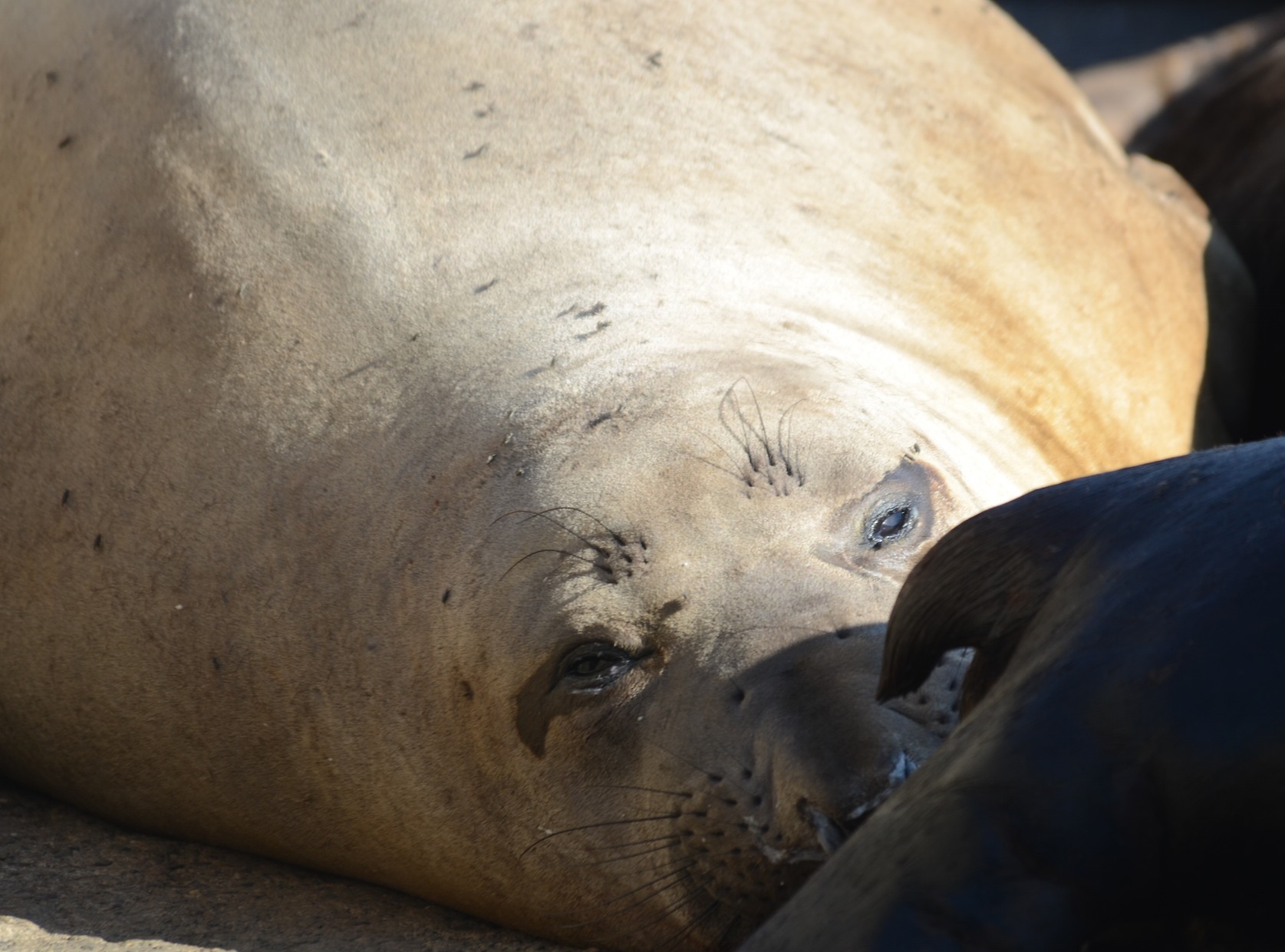
Elephant Seals have been hauling out on Middle Rock for over a month and now some are back on Great Race again. There was a small one hauled out on the northeastern side and a bigger one on the railway with the sea lions.

This Elephant Seal is napping with California Sea Lions on the marine railway.

This Elephant Seal is napping with California Sea Lions on the marine railway.

Washing the solar panels took a long time this morning. They were really dirty. I will do them after the census and it will probably take even longer, tomorrow as I want to shovel off the organic stuff that has accumulated before the electrician arrives to work on the panels. Today I readjusted to life on Race Rocks, finished the month-end report for September, did the seawater sample, made freshwater with the desalinator, ran the Lister generator and sorted photos as well as sea lion brand and entanglement data.

This entangled California Sea Lion has been spotted repeatedly since the end of August.

This entangled California Sea Lion has been spotted repeatedly since the end of August.

Out of the Fog

I returned to Race Rocks today after attending the Trans-Atlantic workshop on Ocean Literacy and the European Marine Science Educator’s conference last week, in Gothenburg, Sweden. I am refreshed and inspired to finish off my shift at Race Rocks.
It was warm and sunny when Courtney and I left Pearson College in Pedder Bay this morning but as we drove southeast towards Race Rocks, we were soon enveloped in the cool, damp fog. As the sunny peaks of the Olympic Mountains slid out of view, obscured by fog, the dark shape of North Islet emerged and behind it came Great Race and the light-tower, out of the fog. It is great to be back and was just as great for Jeff, who was filling in, to leave.
It was foggy on and off all day with a few periods of sunshine with visibility of over a nautical mile. Throughout the day, the foghorn blew and I could hear ships signaling as they navigated the Strait of Juan de Fuca in the fog. There was no wind for most of the day but it has been consistently blowing about ten knots out of the west for the past several hours and the fog is thickening.
The fog did not deter the whale watching boats as there were Humpback Whales feeding in the area today and the last cruise ship of the season in port. One smaller Humpback was diving and presumably feeding right in the Ecological Reserve diving against the flooding tide. I wonder if they can use the flow to their advantage in feeding more efficiently with less effort? Natural history speculation aside, the count of observed whale watching boats from 11:00 to 19:00 (dusk) was thirteen with some vessels visiting more than once.
The Chum Salmon run started in earnest while I was away and there appears to be fewer sea lions hauled out than there were before. There are many in the water however. Sea lions of both species are very busy eating Chum Salmon with most of the kills I observed, happening right in or at the edge of the tidal flows. They thrash the fish and rip it apart at the surface and swallow large chunks tail last at the surface as well. This source of scraps, of course attracts gulls. Several species of gull were seen in these sea lion driven feeding flocks today; Glaucous-winged, Hermann’s, Thayer’s and Ring-billed Gulls. There were three or four fairly hefty Elephant Seals hanging around the marine railway today. They have such huge eyes and such clean looking pink mouths. Many of the Sea Lions have serious tooth decay and oral disease.

While I was away there were several a visits to the island. The Victoria Natural History Society made it part of their birding trip on September 27, sixteen friends of the Royal BC Museum made a visit October 4th and a family visit was made by by Mike and Carol Slater, one of their daughters and several grand-children. Mike and Carol were the last light-keepers at Race Rocks and the first Eco-Guardians. They survived some epic storms and I am sure they have some great stories to tell. If you are interested in the “contemporary” history of Race Rocks, there is a lot of information on this web-site, including ancient videos, images and even historic weather events.

My main tasks today were to get moved back into the house, to do the seawater sampling, fix the pier fence and run the generator for a few hours in order to top up the batteries. There is new clean oil in the Lister gen-set and new filters etc. thanks to Jeff. The old Lister seems to run better than ever tonight a I finish my last task, posting this blog..

Gray on gray.

It was a bit of a gray day with some thick fog and even a few patches of sunlight, which made fog-bows. This is my made up word for the colourless, rainbow-like arches made by the sun in the fog. Winds were light and swung around out of the north, northeast and over to the east, with the northeast predominating, at about 5 knots. The barometer was fairly steady today and the forecast for tomorrow is for more of the same only more southeast, also with showers.

There were Dall’s Porpoise and Humpback Whales nearby late in the afternoon, which brought a few whale watching boats with a total of nine noted in the Ecological Reserve. The operator of the vessel King Salmon, of Great Pacific Adventures needs to review the regulations for operation in the Ecological Reserve.

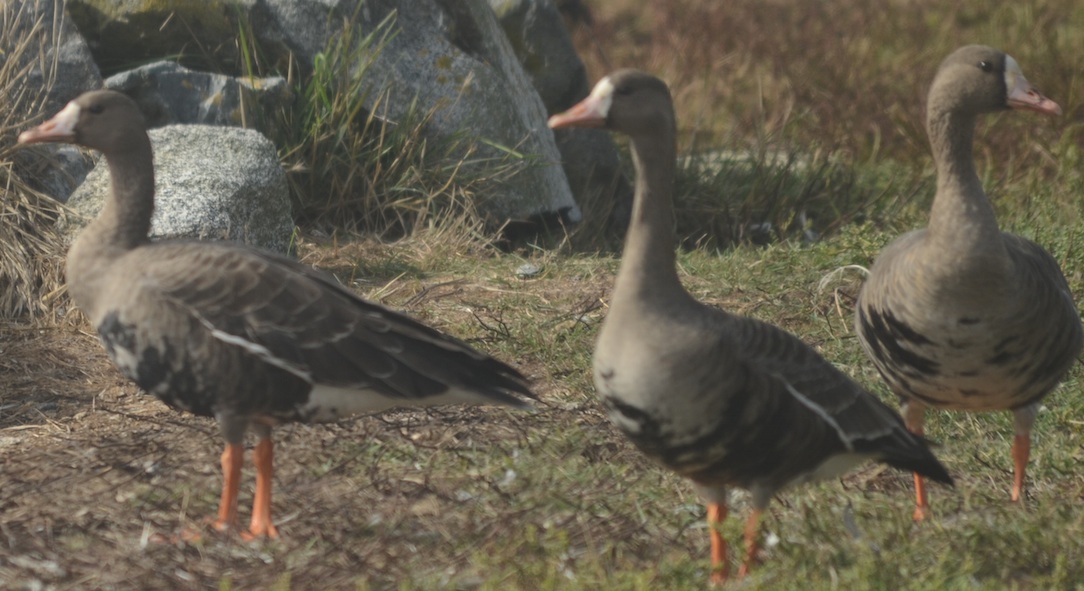
The newcomers today were four Greater White-fronted Geese. This species nests in the arctic west of Hudson’s Bay and the western populations winter from here down to Mexico.

Greater White-fronted Geese were resting and recovering here today.

Greater White-fronted Geese were resting and recovering here today.

Today was the day, for the weekly census of megafauna and these are the results:
Steller’s Sea Lion 176
California Sea Lion 406
Elephant Seal 6
Harbour Seal 168
River Otter 2
Canada Goose 4
Greater White-fronted Goose 4
Double-Crested Cormorant 18
Pelagic Cormorant 8
Cormorant sp. 2
Black Oystercatcher 8
Black Turnstone 11,
Killdeer 2
Surfbird 28
Common Murre 4
Thayer’s Gull 113
Glaucous-winged Gull 22
Heerman’s Gull 6
California Gull 1
Western Gull 1
Gull spp. 256 (probably in similar proportions to above, unable to tell due to distance and fogged glass in the tower)

Fence maintenance takes quite a bit of time right now as new sea lions arrive for the winter and learn to stay away from the houses and off the jetty. They would probably prefer to be right here in the kitchen but that is a trade-off with having a guardian here. Fresh-water production and electrical generation continue to be a priority. Today was also the day for month-end report, house cleaning and packing. I am off to Scandinavia to share and learn more about Ocean Literacy. Thanks to all the PC Marine Science students who were willing to share their thoughts with the participants of the gathering at the University of Gothenberg.

Marine Science Students Visit Race Rocks

Coming from Bamfield, I expect large volumes of water when the barometer drops and it starts to blow southeast. It was grey and wet today but the wheelbarrow I left out to collect rainwater only has about 500ml of water in it at the end of the day. The barometer is still sliding so maybe I should be careful what I say. The wind did turn around to westerly for a while as it cleared in the late afternoon and is now flowing out from the northeast with more drizzle approaching real rain. From Environment Canada’s forecast it looks like the trend for this week.

Although there are still plenty of recreational fishers around, only one was noted in the reserve today and they were looking at sea lions. There was only one whale watching boat noted in the reserve.

Laura brought the first of her three marine science classes, from Pearson College to Race Rocks today. Courtney masterfully landed Second Nature at the very unforgiving pier and we had a wonderful field trip with a student:teacher ratio of 4:1. The students were really good at moving with stealth so as to not startle the sea lions. This allowed for good sea lion observations, which were noted in their journals. They saw all four species of Pinnipeds and added to their growing species lists with Black Oystercatchers, Black Turnstones, Glaucous-winged, Heerman’s and Thayer’s Gulls. They spotted new (to me) branded California Sea Lions including three branded in the Channel Islands. All of the students had a bird’s eye view from the top of the light-tower thanks to Courtney and we finished off with warm cinnamon buns at the keeper’s house.

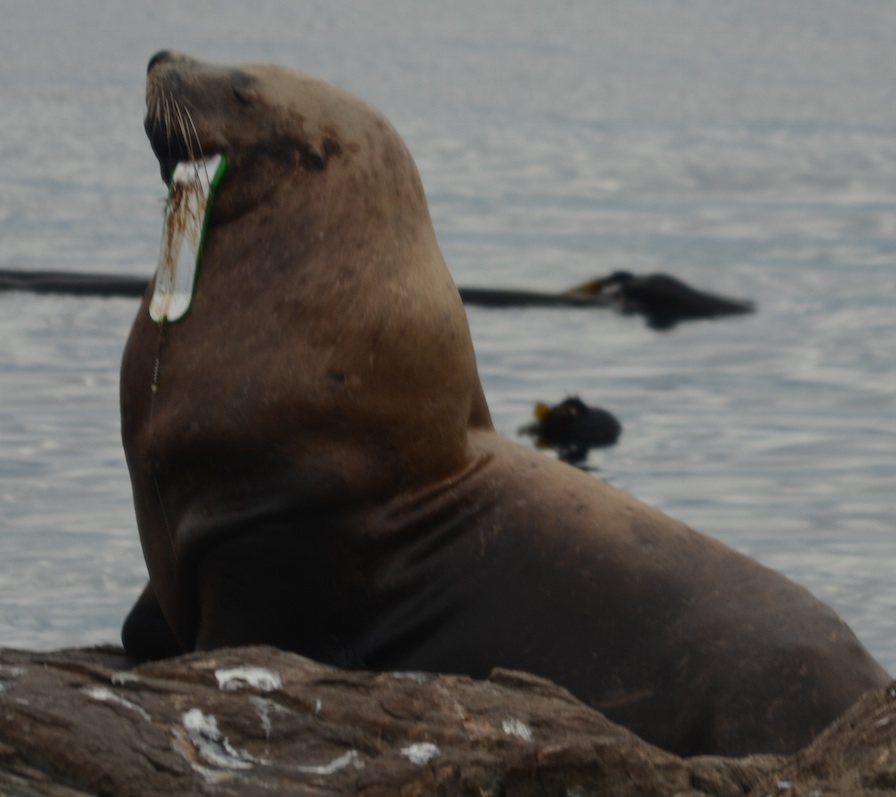
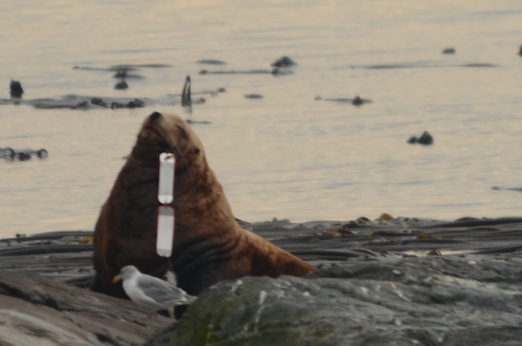
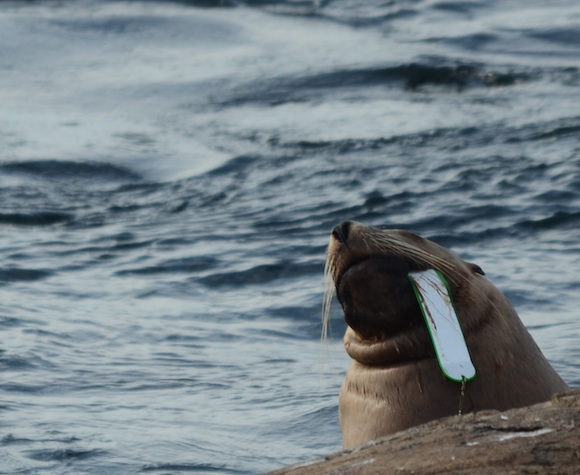
After the visitors left, I caught a glimpse of these two Steller’s Sea Lions entangled in sports fishing gear. Those are salmon flashers hanging out of their mouths, which is not good news, as these cannot be disentangled the way the neck-rings can. The individual with one flasher has been hauling out at this same spot for a few weeks now. The one with two flashers, has not seen before today.

I will be watching out for  this animal over the next month.

I will be watching out for this animal over the next month.


Today was the first time this animal with two flashes was seen here. It will be easy to distinguish it from the one with only one flasher.

Today was the first time this animal with two flashes was seen here. It will be easy to distinguish it from the one with only one flasher.

Last Blast of Summer

Tomorrow is the equinox and it was a glorious last day of summer today on Race Rocks. In the morning, outflow northeasterly winds soon gave way to westerlies, which gained momentum creating whitecaps and active seas in the afternoon. Both yesterday and today there was also an ocean swell, indicating a storm out at sea. Some of the surges created large, standing waves in the tidal flows. The barometer continued slide today and a change is on the way with showers forecast to start by tomorrow evening.

There were only a few whale-watching boats today, four observed in total. The Ogden Point Dive Centre’s charter boat ran a dive right off the jetty today. A few recreational boats stopped to watch the sea lions and three were speeding in the reserve, as they came into and left the area. A Pedder Bay, Oak Bay Marine Group rental boat didn’t bother to slow at all and sped through the area packed with sea lions.

After picking up calipers at the floating lab, I was able to almost complete meristic data collection for the Glaucous-wing Gull mortality study. Measurements were made of over 50 gulls in order to determine the age range and location at death. It has been so dry for so long, that the birds were basically mummified, not nearly as gross as standing up-wind of the living sea lions.

Several opportunistic brand photos were taken today and census photos were taken to validate against the more traditional census technique.

Sometimes the brands are easier to read with binoculars than in the photo. This one is 1032.

Sometimes the brands are easier to read with binoculars than in the photo. This one is 1032.

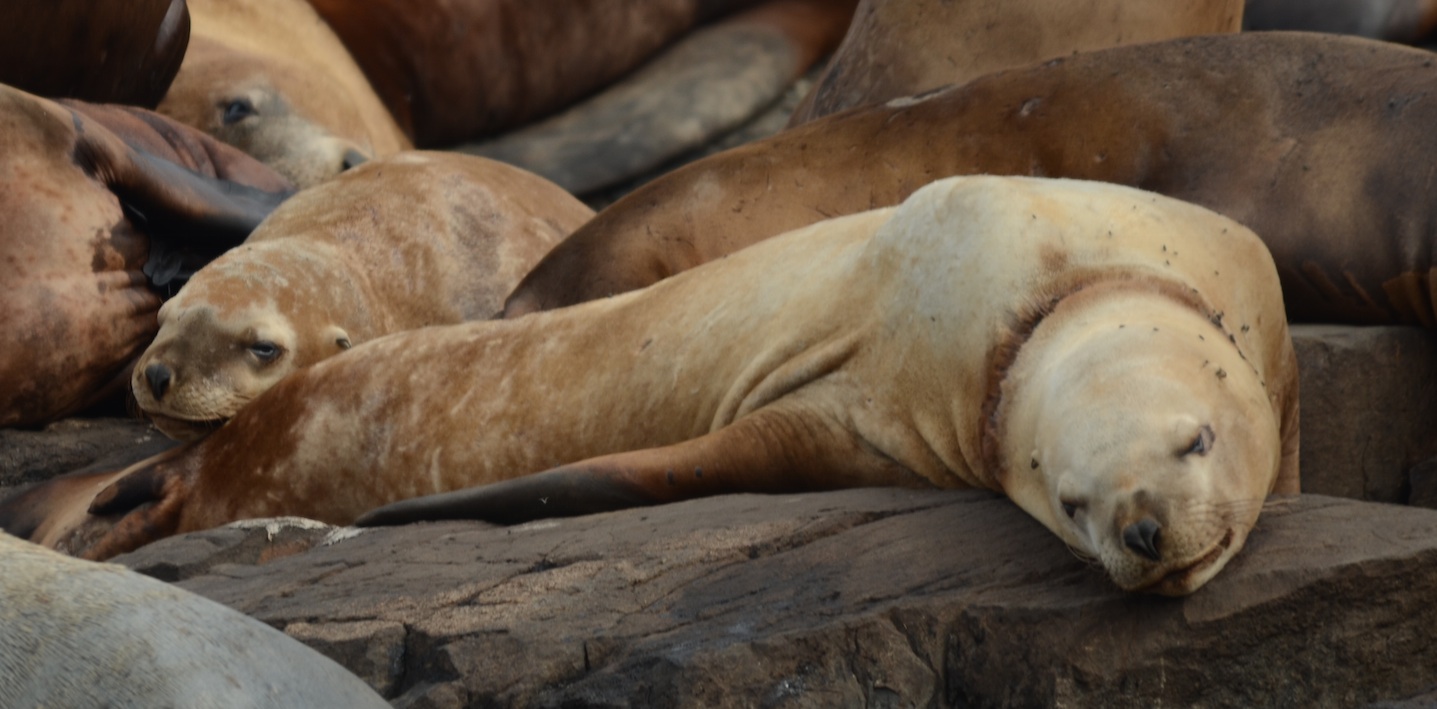
It seems that more Steller’s Sea Lions, Thayer’s Gulls and Double-crested Cormorants are arriving daily As you can see from this photograph of one the main California Sea Lion sleeping areas they are packed in tightly and not strictly segregated by species.

Sea lions pack into sleeping areas. This big Steller's Sea Lion caused a ruckus by walking over the Californians.

Sea lions pack into sleeping areas. This big Steller’s Sea Lion caused a ruckus by walking over the Californians.

The more mundane tasks of washing the solar panels, building up the compost, washing windows and mending the fences were done in the morning and it was actually hot, hmmm, just like summer. The seawater data was collected in the afternoon as the sunshine powered the solar panels which in turn powered the desalinator to make fresh water out of salt water. As the sun set south of Cape Flattery now, the classic Lister generator topped up the batteries for the overnight period.

Wetter, cooler weather arrives.

There were definite autumn overtones to the weather today in spite of the westerly winds, which shifted over to the southwest a few times. First thing this morning a heavy fog came in and soaked everything. At dark there were ominous looking rainclouds to the west but the forecast actually looks like it is improving. After a week of sliding downhill, the barometric pressure actually rose today and that is a really good indicator of an improving trend.

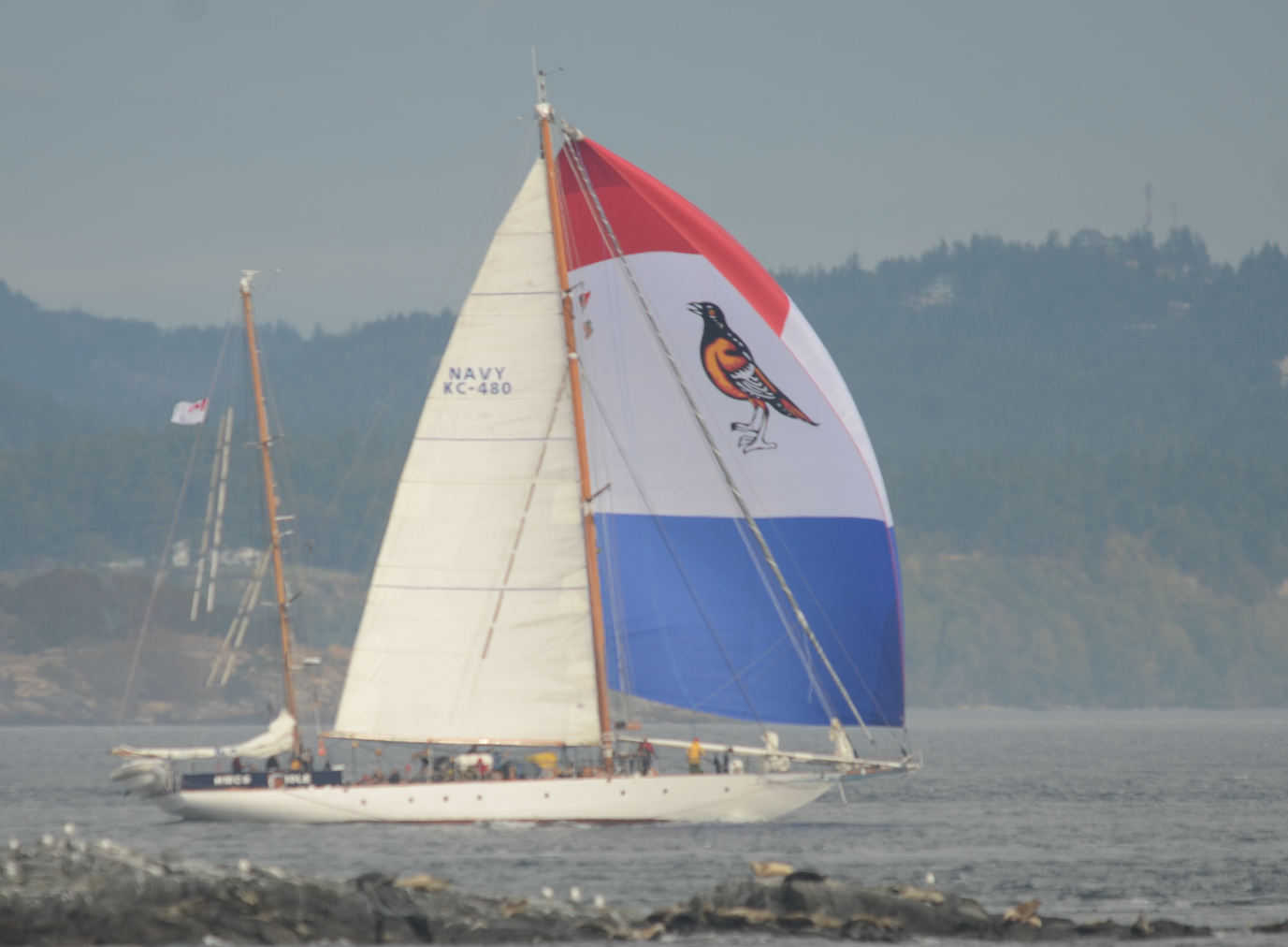
There were only six whale watching boats noted in the reserve today and I couldn’t see any whales (for a change). The few recreational boaters left on the water stayed out of the reserve. The Oriole sailed past through Race Passage today, flying with the wind and tide.

A series of large military explosions rocked the island mid-day.

Oriole

Two Steller’s Sea Lions with Ring-necks were photographed today as was a Steller’s with a green flasher hanging out of its mouth. One of the ring-necked Steller’s is not yet badly wounded by the plastic strap, the other (see photos) has the strap cutting into the back of its neck but not yet the front. This animal likes to sleep about ten meters from my house and would be a good candidate for disentanglement.
ring-neck Steller's

ring-neck Steller's sep18

This plastic packing strap is digging into the back of this animals neck.

This plastic packing strap is digging into the back of this animals neck.

ring-neck Steller's sept 18 3

EuJu flasher

Today was animal census day and these are the counts.
Harbour Seal 179
Elephant Seal 8
Steller’s Sea Lion 184
California Sea Lion 287
Canada Goose 4
Brown Pelican 1
Double-crested Cormorant 22
Pelagic Cormorant 3
Cormorant sp. 2
Black Turnstone 7
Black Oystercatcher 4
Glaucous-winged Gull 76
Thayer’s Gull 75
Heerman’s Gull 21
California Gull 16
Mew Gull 21
Gull sp. 152
Common Murre 1
Common Raven 2
Savannah Sparrow 6

There were no visitors today. Maintenance chores, other than making fresh water and electricity included cleaning in the boat shed, mending both houses’ fences, and keeping the weed-eater going. The weed-eater makes really good compost mulch.

Standing Waves

The fine weather continued today with light outflow winds and clear skies. The barometric pressure rose to almost 1020 hPa by mid–morning and then started to slowly slide back down. This pattern is forecast again for tomorrow.

I counted 32 tour boats in the reserve today and may have a missed a few as I was busy. I talked to the Garry Fletcher, Ecological Reserve Guardian and learned a great deal.
There were Biggs Killer Whales out to the west again so many of the boats broke up their trips coming or going with a stop at Race Rocks. A few recreational fishers went through at low speed but no poaching today. The only transgression noted was a Grady White speeding. The man with the white hat and red rubber boat was back but stayed just outside the line.

Just before sunset, an enormous aircraft carrier headed past and on out to sea. Ahead of it was a container ship and behind a schooner. The volume of goods and people coming and going in Juan de Fuca Strait is really amazing and it all passes by Race Rocks. Port Metro Vancouver alone trades $184 billion in goods and then there is Seattle, Victoria, Bellingham, Spokane etc..

Corrections to yesterday’s log: 1. There are still at least two Pigeon Guillemots feeding young. 2. I forgot to count in the four Canada Geese that are here daily. 3. I got a good look at the Black Turnstones from the tower today and counted 23.

I did some research today, starting with reading a few papers on Steller’s and California Sea Lions and looking at a paper on Glaucous-winged Gull chick mortality. I talked to Race Rocks Ecological Reserve Guardian, Garry Fletcher, learning a great deal. I started a Glaucous-winged gull survey today and found 30 so far. It is important to get this done before it starts getting too damp.

The practical side of the day involved more cleaning and starting a perimeter fence for the science house. The doors of the house are no match for a 2200 pound sea lion.
I watched the creation of large, breaking standing waves today, right in front of the house/jetty. The tide was flooding in and there was no wind so there must have been some ebb pushing out against it. Pretty spectacular for a few minutes then it calmed down.

Killer Whales and Sport-fishers to the West

Another glorious day on the rock with good visibility, calm waters and a clear sky. The barometer rose gradually until noon and then dropped slightly. Barely perceptible outflow winds kept the fog out at sea and it looks like a similar forecast for Friday.

There was a lot of activity in the Reserve today with whale watching boats stopping by to see the sea lions en-route, back and forth between Victoria and the two pods of transient (aka Bigg’s) Killer Whales off to the west. The smaller pod had four individuals and passed close to the reserve heading west spending the day between Becher Bay and Beachy Head. A second larger pod was reported from further west near Otter Point by days’ end. A total of 37 tour boats were noted in the reserve and many more passed by at speed outside of the boundaries. They keep constant contact with the whales during the day and pass off to each other, on leaving the area.

A couple of recreational boats spent time in the reserve today, one photographing sea lions for several hours and the other jigging. The conservation area is bounded by the 40 meter contour, and no jigging is allowed. Jigging targets territorial fish such as rockfish and lingcod although you can catch coho that way too. The Conservation Area is enforced by DFO and is there to protect long-lived, territorial fish like rockfish and lingcod, so that their offspring can disperse to other areas with the currents. A Marine Protected area like Race Rocks becomes a source of recruitment of young fish to nearby areas that don’t have protection and this ultimately makes the fishing more sustainable.

It was census day today.
Biggs’ Killer Whales 4
Steller’s Sea Lions 243 (7 brands noted)
California Sea Lions 334 (7 completed brands noted, 1 incomplete)
Total sea lions both species = 577
Harbour Seals 142
Elephant Seal 1 (pup)
Savannah Sparrows 8 (seemed to fly off to the south across the Strait after visiting)
Double-crested Cormorants 11
Pelagic Cormorants 4
Black Turnstones 7
Sandpipers 5
Sharp-shinned Hawk 1
Glaucous-winged Gulls 99 (4 chicks still begging)
Heerman’s Gulls 5
California Gull 1
Black Oystercatchers 7
The Pigeon Guillemots were not spotted today so I assume that the chicks finally fledged and have headed off to sea. I will miss them. It is fun to watch them ride the currents and carry crazy-looking fish to their young.

There were no visitors today, although both Second Nature and Hyaku made multiple trips within a stone’s throw of the jetty, as part of student orientation week.