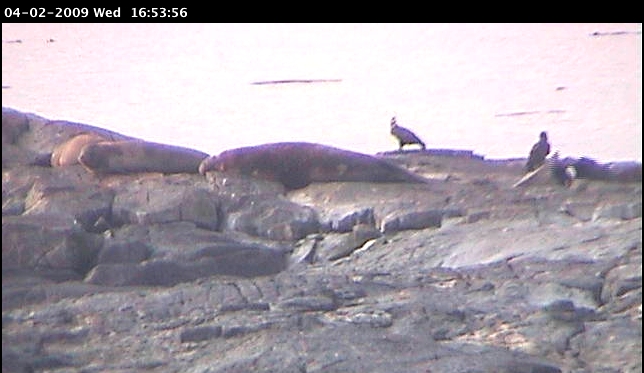
| The information below has been extracted from records ,videos and photographs by Pearson College personnel in the Daily Log (not continuous) 2001-2008, and the monthly photo albums of Pam Birley, Sept 2001 to November 2008.It is not a complete observational record, but it does give evidence through several years of the times of the year that this species are present at Race Rocks. Records concentrate mainly on what elephant seals were visible on Great Race Rocks.Some specific dates recorded :Winter , 1997: Throughout the winter of 1997, two female elephant seals stayed just south of the tower on Great Race Rock. In February, these four females and at times three others hauled out on the middle island, north of Great Race Rock. In 2001, two and sometimes three large males were on the island along with three or four females. They occupied this position on the middle island through the summer and into the fall of 2001 and did the same in 2002 and 2003.June 2001 video of female e at docks
http://www.racerocks.com/racerock/archives/videlseal2a.htm
Nov1 2001: The two juvenile elephant seals that were hauled out in the little bay with a group of about 20 harbour seals, swam out into the large kelp bed along the east side of Gr. Race just before 14:00 and had not returned before dark.Have not seen the large bull elephant seal that spends a good portion of the year stretched out atop West Rock.
Nov. 2 2001. The 4 Northern Elephant Seals regularly hauling out in various areas of Gr. Race spent several hours on the boat ramp enjoying the sun.
2 Elephant Seals that have been hauled out all day. The Harbour seals are hauling out as the tide ebbs and unless disturbed will stay ‘high and dry’ until the tide comes in again.
Dec 15 2001: –Today is the first day we have seen the large male elephant seal back on middle rock
Dec 16th 2001: As we watched for the whales to come back a 3-4 metre bull Elephant Seal drifted by and came into the small east bay.I did get some video as he floated around with just his head and unmistakable nose above the surface.He stayed in the bay only 12-15 minutes,arched his back,flared his great nostrils,dove into a wave and was gone! We often hear the elephant Seals vocalizing at night, it sounds like a calf bellowing in a tin can, but not lately, and from the sound of the roaring 45+ knt. not tonight either!
Dec 15 2002:
Another 15 California Sea Lions lined the dock. Middle rock was quite populated with another 200 or so Sea Lions mostly Northern, and one very large Elephant Seal.
Jan3, 2002:It is so quiet with the light wind that we have heard Elephant Seals vocalizing tonight.
Jan 7 2002: The bull Elephant Seal is still hauling out on the rocks below the engine room and for a few hours, usually in the morning, floats leisurely along the shore, upright with his head and snout just above the surface. With the fairly light winds we are able to hear his distinctive ‘bellow’ mostly at night.
Mar 12 2002: The largest bull elephant seal and the juvenile spent the day on the grass in front of the house, the large bull did make one trip to the ramp and back but the juvenile was quite still except for the occasional stretch and yawn.
April1, 2002:
he two elephant seals have inched their way up the ramp to within 8 inches of the boat house door and show no signs of leaving.
April 11, 2002: We now have 4 Elephant Seals on Gr. Race, two bulls, 1 fair sized female and the small juvenile from the ‘incident’ yesterday. The 2 bulls and the juvenile are stretched out on the grass between the winch house and our front porch. The juvenile seems non the worse for violent encounter yesterday but has stayed close to the house. In the 13 years that we have been here we have often had elephant seals haul out on the boat ramp and even as far as the grass around the houses but they were always the smaller juveniles up to 2 metres.
June25, 2002: One of the large Elephant Seals spent several hours floating with his head just above the water near the east tip of Middle Rock.
Aug 2, 2002: The elephant seal hauled out on the boat ramp early this morning for a couple of hours then returned to the area near Middle Rock.The east bay was a favourite today with about 15 harbour seals and their pups. The mothers and pups that frequent the dock area did not show up until around noon, I think they avoid the elephant seals especially with the pups still quite small.
Dec 4 2002: Juvenile Elephant Seal has hauled out on the boat ramp and as usual with these mammals is not bothered by our presence
Jan 2 2003: A large elephant seal came ashore this morning on the boat ramp but did not stay long as the swells were tossing 5-10 lb. rocks almost to the door of the boat house, a dangerous place to stretch out for a nap. The Elephant Seal has been spending part of the night near the dock the past week and vocalizing quite a bit. There is a Northern Sea Lion hauled out about 3 metres from the front porch, he looks a little thin and has several small wounds on his head,he spent the whole day there, hardly moving at all.
Jam 3 2003: Today the swells were not so big and the huge Elephant Seal spent most of the day floating about by the dock, he hauled out on the ramp for about 4 hours and is now back in the water snorting and bellowing. The Northern Sea Lion hauled out by the porch has not moved very much all day.
Jan4 2003: The elephant seal spends a lot of the day floating about close to shore and periodically hauls out on the boat ramp for an hour or so.
Jan 8, 2003: The Elephant Seal spent some time leisurely floating in the east bay and along the south shore below the engine room but did not haul out on Gr. Race.
Jan 9, 2003: 1 small Elephant Seal is hauled out halfway down the western slope of the largest of the southeast rocks. Also there is a rather thin looking Northern Sea Lion that could be the one with the head wounds that spent several days hauled out by himself near the house, just too far away to get a good look.
Jan 10, 2003: The Juvenile Elephant Seal and the lone Northern Sea Lion are still hauled out on the west slope of the south east rocks.
Jan 13, 2003: The juvenile elephant and the skinny looking Northern Sea Lion have left the haul out on the slope of the southeast rocks. There is a wide range in size in the Northern Sealion population hauled out just now -quite a few in fact in the 300/500 lbs., about 1/4 seem to be the really mature fellows some as big as 2000lbs. Usually there are mostly males but some of the smaller animals look very much like the females which appear more cylindrical in shape and colour more uniformly brown.Very easy to tell the Northern Sea Lions even at night by their growling which they seem to do a lot of as they tend to feed at night.The California Sea Lions sound like a pack of large dogs. Mostly what we hear these nights are the Northern Sea Lions and the snorting, bellowing Elephant Seals.
Jan 14, 2003: The large Elephant Seal floated along the south shore of Gr. Race until near noon then hauled out on the rocks just below the fog horn tower where he remained the rest of the day.
Jan 16, 2003: The large Elephant Seal continues to spend the night and early morning floating around Gr. Race then hauling out for the rest of the day, lately on the south side below the engine room.
Jan 18, 2003: The Elephant Seal floated leisurely in the dock area all morning and in fact we had to wait around for nearly half an hour for him to move away so we could launch the boat for a quick trip to Pedder Bay
Jan 19 2003: We have a very disturbing and sad situation here with one of the Elephant Seals. In the late morning an elephant seal hauled out by the boat house, it was immediately apparent that this poor animal has had a run in with a boat prop. There are several deep gashes in the fore head just above his eyes. One eye is very bloodshot and the other eye seems to be getting red. There are other wounds or slashes from the head down to below the front flippers. The wounds are curved slices like a series of long parallel ‘slashes on both sides.The deepest gashes are on the head and right side cheek area. We checked on him all during the day, just before dark he moved into the water. The other much larger elephant seal is still around and happy to say he has no marks on him. He has hung around by the dock all afternoon and at times quite loud. I do wonder if there is any communication between these two great creatures. They are really quite placid most of the time and we can get as close as a foot if we approach from the front. Hopefully the one fellow’s wounds are not fatal. People must take extra care moving boats through the area to avoid hitting seals and sealions and causing what must be very painful injuries. See http://www.racerocks.com/racerock/archives/vidinjureseal.htm for a video of the elephant seal.
Jan 22 , 2003: The big Elephant Seal spends a good deal of the day in the dock area vocalizing often enough to let us know he’s still here,when he really bellows he is loud enough we can hear him over the roar of the wind and the sea!
Jan 23 2003: The large Elephant Seal continues to circle Gr. Race all day and all night. As for the wounded fellow (SLASH) there have not be any sightings today.
Jan 26, 2003: The Elephant Seal hauled out on the boat ramp out of the wind and spent the day,not always quietly soaking up a little sun.
Jan 29 2003: The Elephant Seal continues to divide his time between the boat ramp and the water by the dock.
Feb. 3 2003: The large male Elephant Seal is still hauling out on the boat ramp for several hours at a time then returning to the water to leisurely circle the island just off shore.He is not as vocal as he has been but do hear him snorting every half hour or so.
Feb 4 2003: The large Elephant Seal has not returned to the boat ramp but we do now have a juvenile that appears to be going through it’s ‘molt’.
Feb. 5,2003:. The young Elephant Seal seems settled in for an extended stay in front of the boat house and except for rolling from one side to the other a couple of times has not moved much.Unlike the big males this juvenile ‘growls’ if anyone approaches within 8-10 feet,we keep our distance anyway, don’t want to add stress to an already stressed animal.
Feb. 11, 2003: The molting juvenile Elephant Seal is still hauled out next to the boat house and just likes to be left alone.The Elephant Seal that was injured has returned! He has moved inland about half way across Gr. Race near the Science building. The wounds look like they are healing very well, his eyes are clear and healthy looking. The other male Elephant Seal still around but did not come ashore today.
Feb. 21, 2003:Still hear the Elephant Seals at night,sounds like they are going into the water to feed about 1 a.m. and returning a couple hours later. The one that hauls out by the boat house is the more vocal one.The smaller one roams the island but usually ends up behind the boat house,seems to like the grass.We are careful to take a flashlight at night, never know where he will be stretched out in the dark!
Feb. 12 2003: The injured Elephant Seal has moved over near the engine room, he seems to like the long grass. We haven’t heard him vocalize but the other big fellow is quite noisey. The molting juvenile Elephant Seal left sometime during the night.
Feb. 17, 2003: The Elephant Seal still spends most of the day near the end of the dock with 2 or 3 ‘haul outs’ by the boat house usually in the early morning and mid afternoon and since he often floats just below the surface boaters should take special caution in the area.
Feb. 23
Feb. 20, 2003: he 2 big Elephant Seals both spent the day hauled out,one on the boat ramp and the recovering one in the long grass between the Science centre and the boat house. We can get quite close without disturbing them but for some reason they react to people wearing red jackets.
Feb. 23,2003: The recovering Elephant Seal was very restless,spent most of they day moving around the island trying to find the best spot.He finally settled near the south end of the boat house.The other Elephant Seal spent the day in his usual spot just below the door to the boat house.
Feb. 26, 2003: The recovered Elephant Seal still spending a good part of the day roaming about then usually settles down behind the boat house. The recovered Elephant Seal still spending a good part of the day roaming about then usually settles down behind the boat house.
Feb26: 2003: The 2 Elephant Seals hauled out most of the day. The one by the boat ramp is not bothered at all with our coming and going in the boat, even the noise from the winch for the boat dolly does not bother him,he does turn his head to use his good eye to watch the boat move up the rails and we are careful to give him lots of time to back out of the way. Once the boat is put away he usually stretches back across the rails in his favourite spot!
March2, 2003: The 2 Elephant Seals still spending most of the day hauled out on Gr. Race,the one that had been injured prefers an inland spot while the other one favours the boat ramp.We hear them after midnight,they can be quite noisy going and returning from feeding.
March5,2003: The 2 Elephant Seals are still hauled out, the ‘roamer has stayed tucked in behind the boat house out of the wind.The other has become a fixture by the boat house door.
March 6, 2003: They tied their boat at the outer end of the dock, maybe a little intimidated by the Elephant Seal stretched out on the ramp,but most likely they didn’t want to disturb him. He is actually very docile especially if you approach him slowly and carefully.
March 7,2003: Both Elephant Seals still hauled out most of the day,one on the ramp and the other a bit restless today moving from place to place,ended up behind the boat house.
March 8, 2003: The Elephant Seals took to the water which at 7.4? would be warmer than the air at 0? with the blowing snow and NE wind at 30+ knts.
March 10, 2003: The 2 Elephant Seals hauled out all day in their usual spots.
March 13, 2003: he one Elephant Seal we call the roamer did not haul out today but the other big fellow moved up out of the way of the swells on the ramp and spent the whole day with his nose literally pressed against the boat house door
March 17, 2003: The larger Elephant Seal in his favoured spot but the ‘recovered’ one spent quite some time trying to plan a route to the water-he moved down to the ramp but seemed reluctant to get too close to the other which had spread himself across the tracks, so he went overland! 3/4 of the distance was fairly soft grass but the last 20 ft. was a rough and rocky descent just east of the winch house.
March 20, 2003: The Elephant Seal that seemed a permanent fixture on the ramp slipped into the water early this morning and has not returned-miss seeing and hearing.
Mar 26, 2003: Just the one Elephant Seal today in his usual spot on the boat ramp
March 27, 2003: The Elephant Seal took to the water just after 7 this morning and had not returned by dark, did not hear him at all, he may have hauled out on one of the other rocks.
April 3, 2003: Did a boat trip around West Race and the Middle rocks and counted 11 Elephant Seals hauled out.There were 3 fairly large males and the rest assorted smaller males and females.The one big fellow that has been hauled out near the boat house for the last few weeks was floating about just off the south tip of the middle rock.There were 5 Northern and 14 California Sea Lions also hauled out with the Elephant seals
April 6, 2003: There were 13 Elephant Seals,12 hauled out on Middle Rock and the one large male floating about close to the shore this afternoon.The Elephant Seals have been joined by about 20 California and 9 Northern Sea Lions
April 14, 2003: There were about 35 California and 9 Northern Sea Lions hauled out on Middle rock with the Elephant Seals.
July 22, 2003: The 2 smallish elephant seals still hauled out and staying close to each other.The big fellow continues to haul out behind the boat house for a time each day.The three do not interact, infact the 2 smaller ones do their best to move out of the big fellow’s way as he ambles along the sidewalk to ‘his’ spot.
Dec 25, 2003: Pinniped census in the reserve: (Animals hauled out) —North Rock :0 Middle Rocks : Northern Sealions:65, California Sealions:1 —–Great Race Rocks : Northern Sealions: 8, California Sealions: 4 Harbour seals:7, Elephant seal :1(Male) West Race Rocks California Sealiion: 1 ( About one third of the animals observed were very young ) . Weather conditions: Wind West 32 , Sea 3′- Heavy Swell. Other noteworthy sightings : We estimated approximately 2500-3000 Herring Gulls on the island today.
Jan 3 2004: I see today that Mike has camera3 aimed at an elephant seal – This adult male must have moved up on the lawn behind the boathouse to get out of the northern gale today. This is probably the one who recovered from the encounter with the boat last year. ( see in the marine mammals video archive.) On camera 1 today there is a male and several females out on the middle rock . Precipitation is snow 5.5 cm
Jan 9, 2004: Over 250 Northern Sea Lions ( many juveniles) on middle rock only today- One large male elephant seal there also and one on Great Race – ( On the lawn near helipad- check on the robotic camera ) Several bald eagles on the rocks.
Jan 24 2004: Two elephant seals haul out on the lawn and provide evidence of mating behaviour. See http://www.racerocks.com/racerock/marmam/elseal/elsealmate.htm The female has a large cut around her neck indicating an old injury.
Feb 27, 2005: (PB photo).. adult male
http://www.flickr.com/photos/66339356@N00/1793151876/in/set-7215760277115 8045/
Feb. 13, 2006,( PB video) mating on middle rock http://www.racerocks.com/racerock/video_3/elsealsex1.mov
Feb,26, 2006 (PB photo)(not slash)
http://www.flickr.com/photos/66339356@N00/1793559936/in/set-72157602768459534/
April 14, 2006: Census photo taken of middle rock at least 8 elephant seals are included.
Jan 2007 :(PB photo) Two individuals, possible Slash and a female?
http://www.flickr.com/photos/66339356@N00/1793395765/in/set-72157602771188891/
Jan 14 2007: (From Census file video)At least one large male on Middle rock
May 28, 2007: A young male and female at the boat ramp (picture in PB DIARY)
http://www.flickr.com/photos/66339356@N00/1793559743/in/set-72157602768481458/
June 28, 2007: Slash on boat ramp(picture in PB DIARY)
http://www.flickr.com/photos/66339356@N00/1793618307/in/set-72157602768483920/
August 2007: (PB photo) two new elephant seals on lawn, perhaps one very young male.http://www.flickr.com/photos/66339356@N00/1793677311/in/set-72157602768487684/
December 2007: Slash returns,, (PB photo)
http://www.flickr.com/photos/66339356@N00/2144129986/in/set-72157603564537908/
Jan 17,2008: PB photo” http://www.flickr.com/photos/66339356@N00/2201777700/in/set-72157603715095611/
February 26 2008: (PB photo) Female on dock.
http://www.flickr.com/photos/66339356@N00/2297209880/in/set-72157603839644139/
February 29, 2008: female on lawn
http://www.flickr.com/photos/66339356@N00/2301780973/in/set-72157603839644139/
March 2, 2008:PB photo of a female on the lawn. http://www.flickr.com/photos/66339356@N00/2312433894/in/set-72157604021972398/
March 16,2008: PB photo of female elephant seal.
http://www.flickr.com/photos/66339356@N00/2341013333/in/set-72157604021972398/
May 4 2008: photo in census file showing at least 3 elephant seals on Middle rock.
June 3 2008 Three male elephant seals were observed on middle rock. Two California and 1 Northern sealion are all that are left on the islands.
June 10, 2008 No Sea lions were seen. Very few harbour seals are around today. Estimated 10.
Two elephant seals on middle island, old Slash and one juvenile male ( dark colored)
June 12, 2008: Erik and Garry checked out and photographed the reported entangled elephant seal on Middle Rock. File opened at http://www.racerocks.com/racerock/eco/taxalab/miroungaa/roped.htm
June 17, 2008 One elephant seal on Middle island, and Slash, our favourite old elephant seal hauled out on Great Race again this morning, but he had moved over to middle island in the afternoon. The entangled one we saw last week was not around this afternoon.
July 12, 2008 Slash moulting (PB photo)
http://www.flickr.com/photos/66339356@N00/2672749236/in/set-72157605939335337/
July 21 2008. Slash on Great Race behind boathouse.
July 23, 2008: Elephant seal changed location; now behind boat house.
Slash spent from 5:00PM to 8:00 PM in the sea, otherwise up behind boathouse. ( preset 1 on cam 1) He has 3/4 of his old hair moulted off, new light gray color beneath. The old hair was light brown.
July 24, 2008 Slash moved down again to the shade of the Workshop as it is very hot at noon.
July 25, 2008 Slash now moved up to his spot on the lawn west of the Science house. (Can be seen on camera2)
One other male elephant seal and one smaller female remain out on the Middle rock.
July 28 2008 Blasting by the DND sent the 5 newly returned sea lions into water. Slash hits the water to cruise by the dock. 18 Ecotour boats sited in channel close to sea lions (also later main dock where Slash was lying by boat house).
Aug 20. 2008: Three males, slash absent.
Sept. 23, 2008 One juvenile male elephant seal was up on the lawn by the science house.. Slash has not been around for some time now.
Oct. 27, 2008: possibly one male out on middle rock.
http://www.flickr.com/photos/66339356@N00/2965657528/in/set-72157607795979132/
For November of 2008 they have been absent. We expect them back in mid December.
Data Compiled by Garry Fletcher, Nov. 29, 2008 |



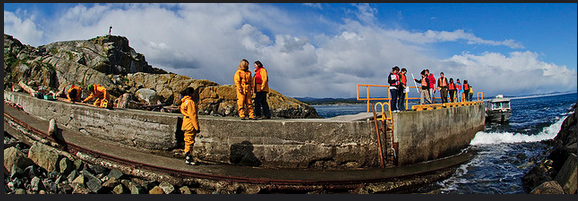
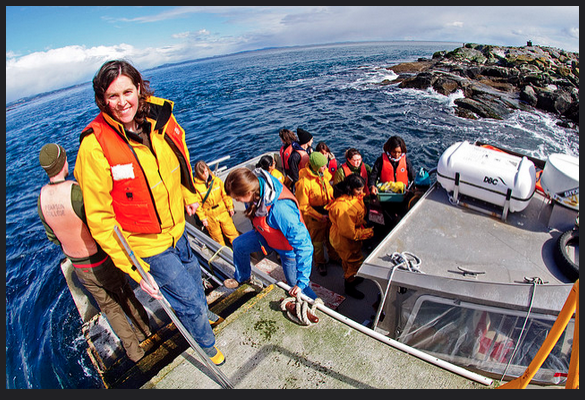 Click to enlarge panoramas below:
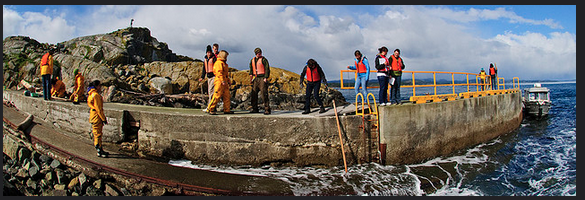
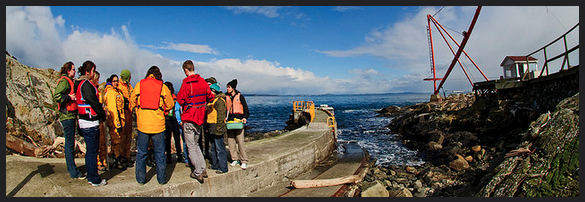
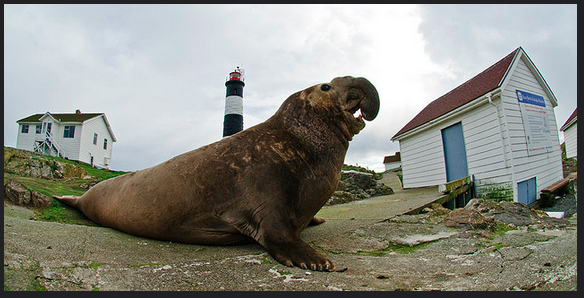
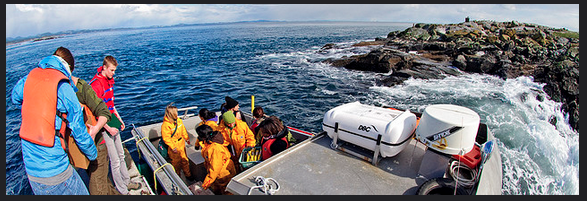 Also that day, Ryan got some pictures of Slash, the male elephant seal down by the docks.




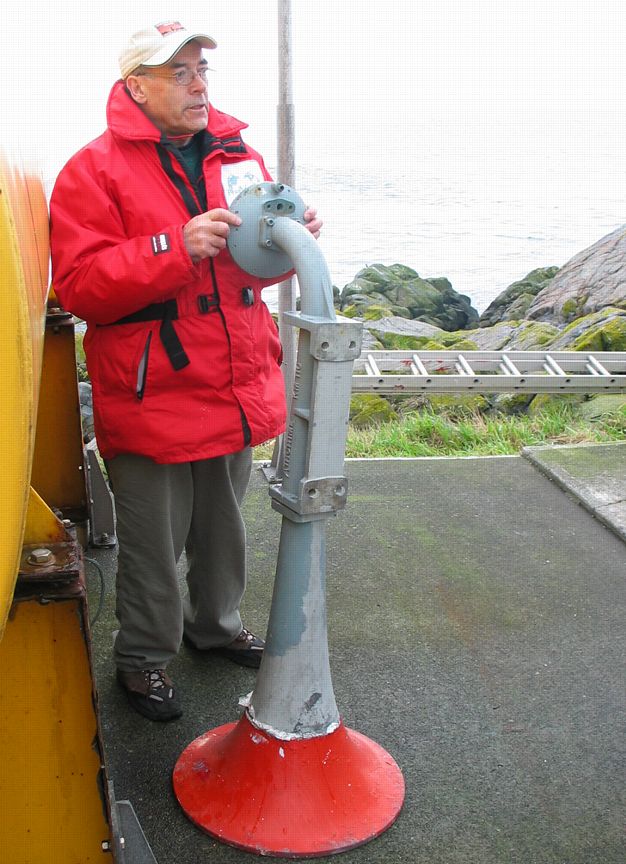 Barry MacDonald, President of the Nova Scotia Lighthouse Preservation Society went out to Race Rocks with Garry today. Barry has been instrumental in getting the Lighthouse Heritage Protection Bill through parliament and working for the protection of the Atlantic Coast Lighthouses: http://www.racerocks.com/racerock/history/heritagetower.htm#Anchor-Pat-11481 . In this picture, he tells us about how the Air Chime Fog horns were once used across North America, but are now all discontinued.The one he is examining was removed for the installation of solar panels and has since been replaced, preserving the look of the four air chimes on the energy building.