The Myth of the Oil Spill Clean-Up: Why Our Winds Leave Us Defenseless Nearly Half the Year
By Shamseddin Alsesheikh and Garry Fletcher, with research assistance by Gemini AI
Given the new political push to increase tanker traffic past Race Rocks in may be appropriate to visit an inconvenient truth.
As oil tankers carrying heavy crude transit the narrow corridor of the Strait of Juan de Fuca, coastal communities along southern Vancouver Island are routinely assured that a “world-class” marine spill response regime stands ready to protect our shores. With the Trans Mountain expansion elevating tanker traffic to as many as 34 vessels per month, these assurances form the foundation of public safety promises.
However, five years of meteorological data from Environment and Climate Change Canada’s weather station at Race Rocks reveal a major flaw in this safety net: the mechanical equipment meant to contain and skim spilled oil is rendered unusable nearly half the time.
Under Transport Canada’s TP 14909 Environmental Response Standards, standard mechanical recovery equipment—such as oil containment booms and floating skimmers—loses effectiveness when sustained winds reach 28 km/h (15 knots). Beyond this threshold, wind-driven waves shear oil underneath containment skirts, splash slicks over barriers, and create dangerous working conditions for small response vessels.
An analysis of hourly climate records from 2021 through 2025 demonstrates that wind speeds at Race Rocks reached or exceeded 28 km/h for 43.1% of all recorded hours across the five-year period.
Far from being an occasional winter storm issue, this operational blackout is actually most severe during the summer. Driven by intense thermal pressure gradients between the hot interior and the cool ocean, gap winds funneling through the Strait cause cleanup equipment to be inoperable for an astonishing 79.1% of all hours in July.
Annual Response Inoperability at Race Rocks (2021–2025)
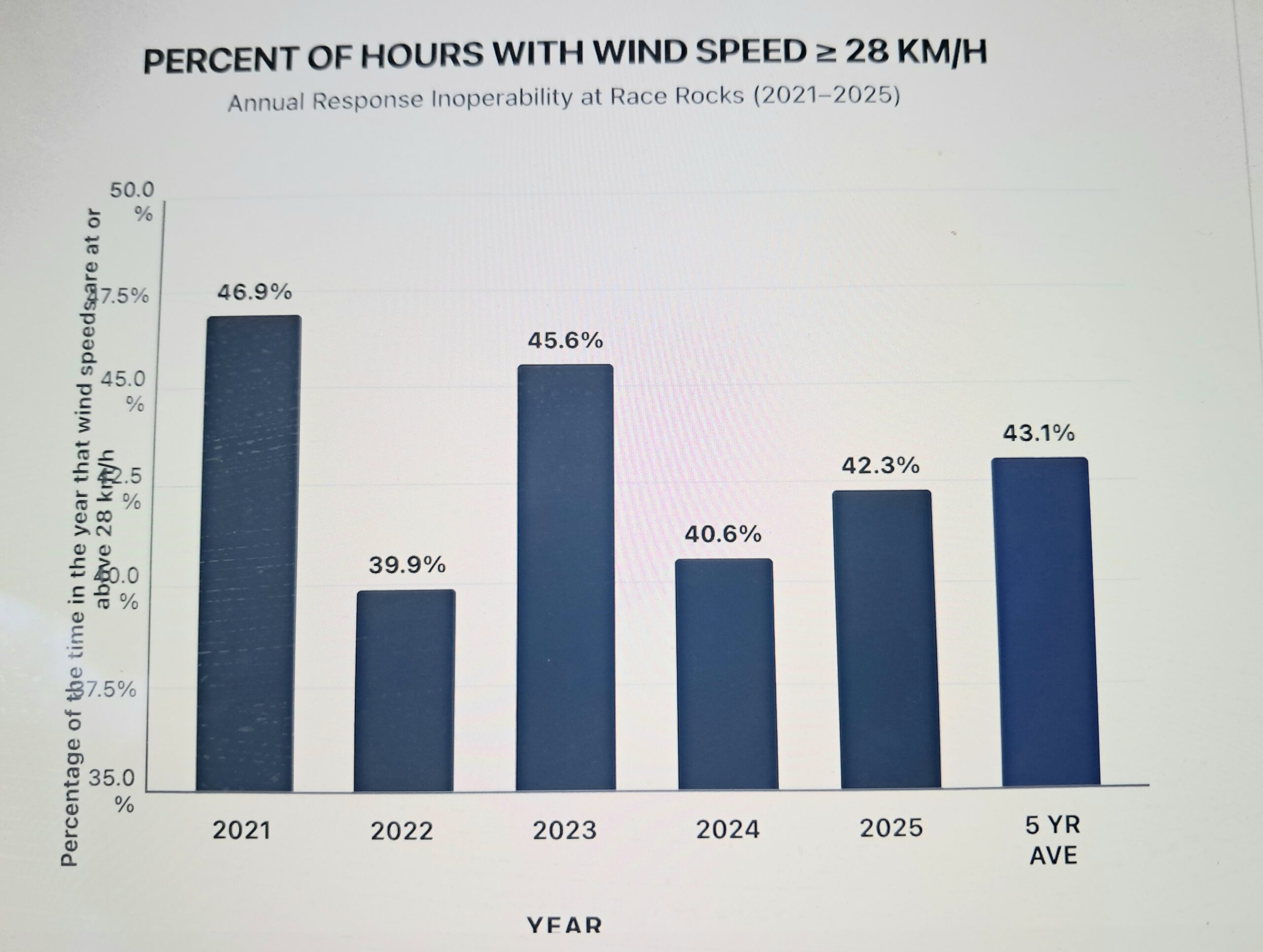
(Source: Environment and Climate Change Canada, Race Rocks Station 10943, 2021–2025)
When mechanical containment fails, surface oil spreads rapidly with wind and tidal currents, threatening ecological reserves, migratory bird habitats, kelp forests, and endangered marine life like the Southern Resident killer whales.
If cleaning up an oil spill on the water is physically unfeasible 43% of the year—and nearly 80% of the time in mid-summer—policy makers cannot rely on post-spill skimming as a primary line of defense. Transport Canada and the Pacific Pilotage Authority must prioritize strict preventive measures. This includes establishing mandatory transit pauses for laden tankers during high-wind events and enforcing high-capacity tethered escort tug requirements along the entire transit corridor.
We cannot control the weather in the Strait of Juan de Fuca, but regulators can—and must—control when and how crude oil tankers navigate it.