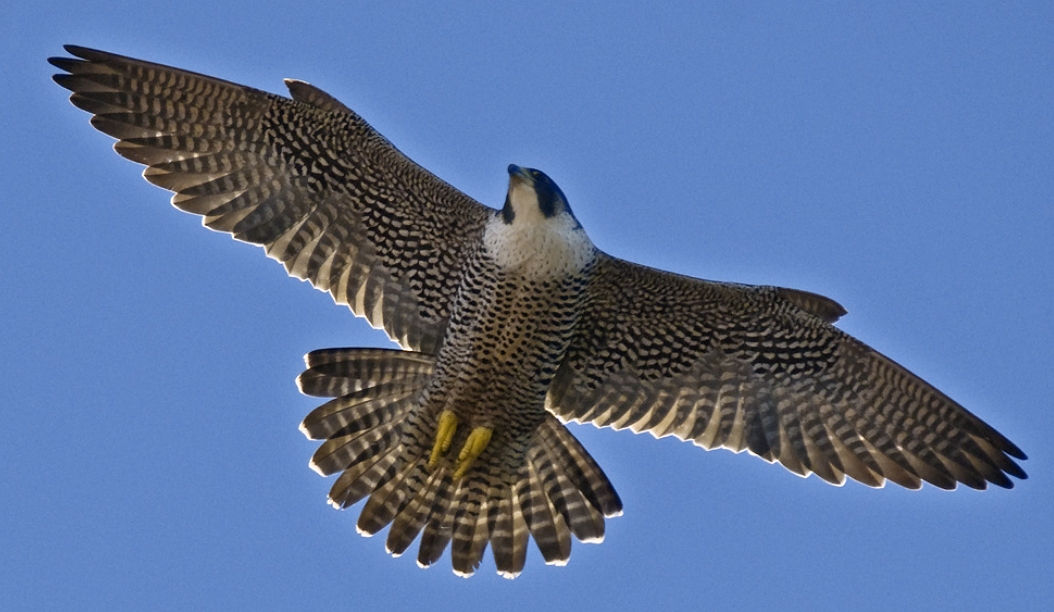
Falco peregrinus: Peregrine falcon –The Race Rocks Taxonomy

ryanperegrine

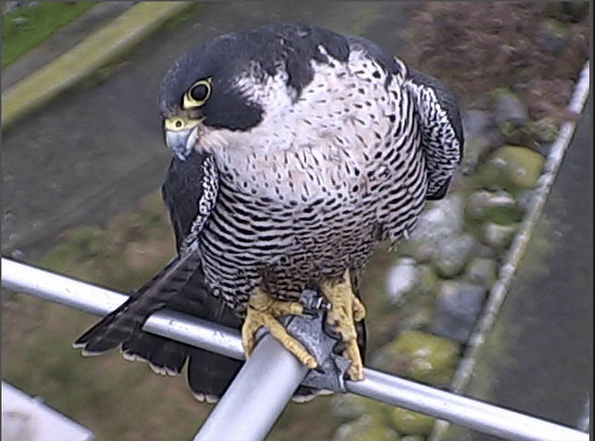
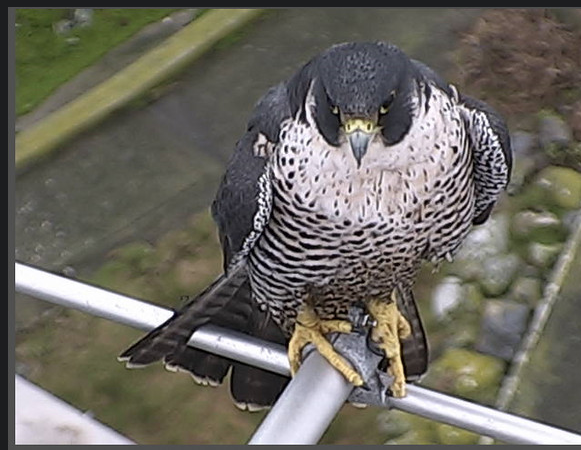
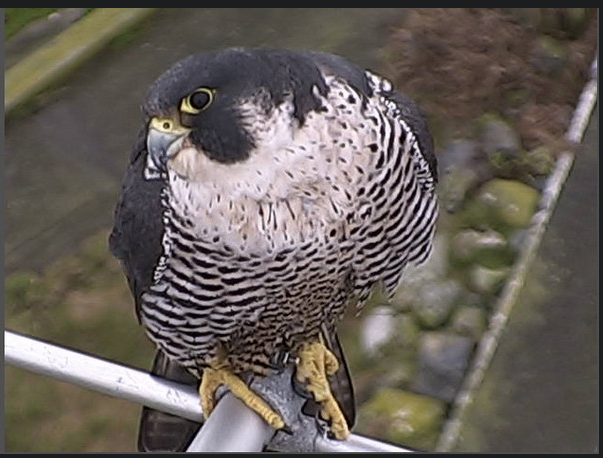
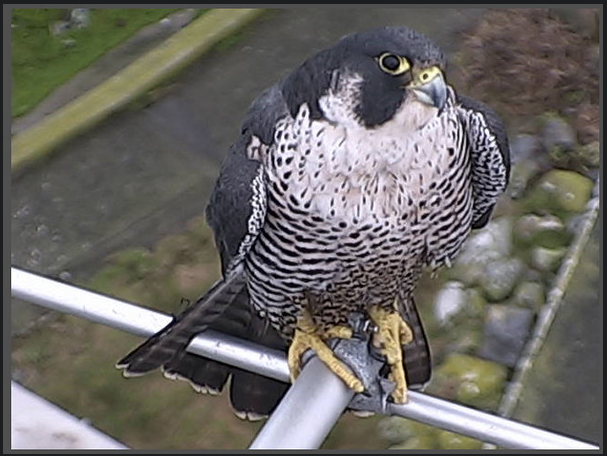
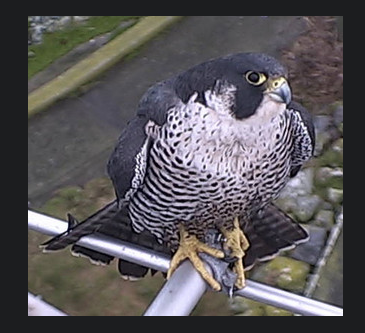
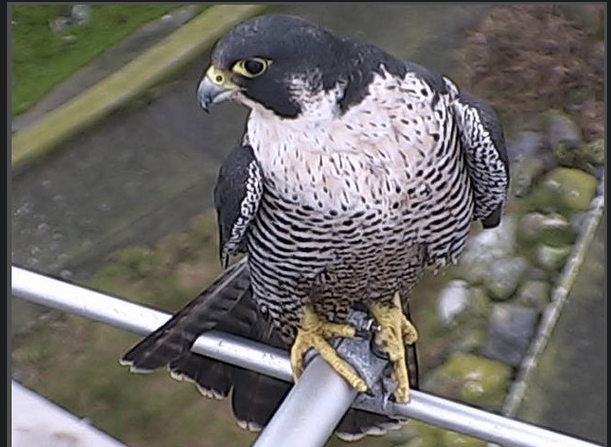
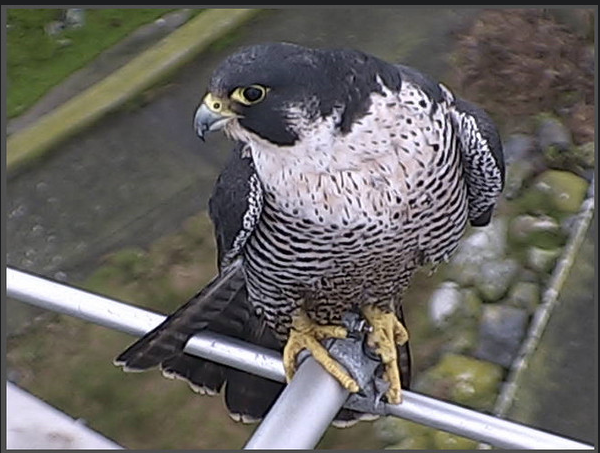
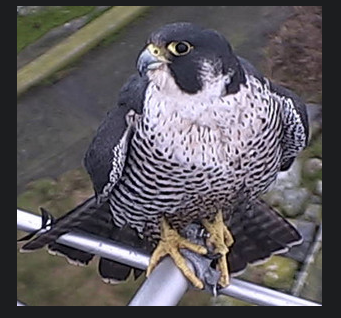
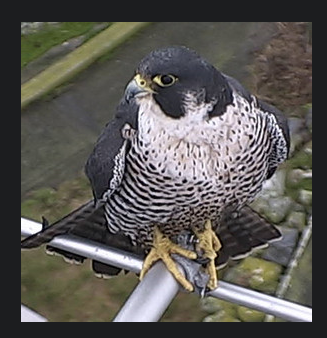
This photo was taken on Race Rocks by Ryan Murphy in December of 2008.

See all the posts on this website with observations of Peregrines

Domain: Eukarya
Kingdom: Animalia
Phylum: Chordata
Subphylum: Vertebrata
Class: Aves
Order: Falconiformes
Family: Falconidae
Genus: Falco
Species: peregrinus
Common Name: Peregrine falcon

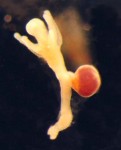
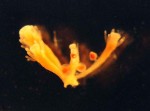
Unusual footage taken by Pam Birley using the remote camera 5 of a falcon eating a seabird. Also see similar sequence on right below..


The Peregrine falcon, Falco peregrinus, is a bird of prey (or raptor) which has captured the attention and imagination of ornithologists and bird-watchers alike for several thousand years. With a body length of 15-20 inches and a body weight of 1.25-3.75 lbs, the falcon is built specifically for travelling at high speeds (up to 180 m.p.h.) in order to catch its prey. The name Falco peregrinus is derived from the Latin falx, or sickle-shaped, and peregrinus, meaning wandering. It is unclear whether the former is derived from the shape of the bird’s silhouette in the sky or from the shape of its beak, but the latter name comes undoubtedly from its propensity to migrate great distances.In the picture of a Peregrine Falcon and Bald Eagle from his Flickr site, Ryan Murphy said
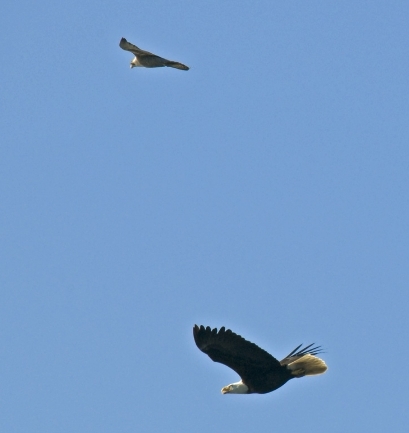
“This was amazing to witness in person, I regret not having been able to capture it better than this! Just before this the eagle rolled backwards towards the chasing falcon… awesome aerial battle!”
Predation
Two sequences of pictures from Race Rocks below have been taken by Pam Birley showing the peregrine eating a shorebird.and a sea gull. Though peregrine falcons, like other birds of prey, are considered to be near the top of the food web, they are not completely free from predators. Great horned owls and golden eagles have been known to attack them. Humans have also been known to take their eggs in hopes to raise the falcons for hunting purposes.
As top predators, peregrine falcons play an important ecosystem role in regulating the populations of their prey.
Habitat
Peregrine Falcons prefer open habitats such as grasslands, tundra, and meadows. They nest on cliff faces and crevices. They have recently begun to colonize urban areas because tall buildings are suitable for nesting in this species, and because of the abundance of pigeons as prey items.
Peregrine falcons prey almost exclusively on birds, including mourning doves, pigeons, shorebirds, (see slide shows above) waterfowl, and smaller songbirds. They will also eat small reptiles and mammals. Although peregrine falcons capture their prey with their claws, they generally kill prey with their beak.The photos for this slide show and video were taken on the remote camera 5 at Race Rocks, by Pam Birley operating the camera from Great Britain. Pam had observed the peregrine falcon on various perches around the island in the mornings for several weeks in October and November. Her persistence paid off on November 17, 2005. Pam wrote in her e-mail ….”Today we had just returned home .. I just came up to the computer, switched it on and there was Perry with his breakfast….I really caught him in the act of devouring his prey today! “You may see other pictures that Pam has taken using the remote camera at Race Rocks by clicking here to go to her photo album .
CLICK ON THE BLANK SPACE

PEREGRINE FALCONS AT RACEROCKS: OCTOBER, 2004

Pam Birley of Leicester England captured some of the pictures remotely on robotic camera 5 and Mike Slater, our reserve guardian took the pictures of the antenna perch on the towerPam was interviewed recently about her wildlife viewing on racerocks.com
ref: Anderson, Charlie, “Live Wildlife for your Living Room “,
The Province (newspaper) , Vancouver, B.C. ( Sunday, Nov.21, 2004)

Conservation Status
Peregrine falcons have suffered due to their dangerous position atop the food chain. Pesticides accumulate in small (not lethal) quantities in the tissues of small birds and mammals, but become concentrated enough in predatory birds, such as falcons, to kill them or render them incapable of producing offspring. Organochlorine pesticides (DDT and dieldrin) have been proven to reduce the birds’ ability to produce eggshells with sufficient calcium content, making the egg shells thin and more likely to break. Peregrine falcon populations dropped greatly in the middle of the 20th century, they were threatened worldwide by the increasing use of pesticides. All breeding pairs vanished in the Eastern United States. A successful captive breeding/reintroduction program, combined with restrictions in pesticide use, has been the basis of an amazing recovery by peregrine falcons. Now the use of many of the chemicals most harmful to these birds is restricted. It is not yet restricted in the areas of Central and South American where many subspecies spend the winter. After having been on the endangered list since 1969, the incredible recovery of Peregrine Falcons has become a perfect example of how effective human conservation can be. In the 1990’s they were taken off the lists of endangered species in the United States.

Jan 25, 2010 Brian Mury sent this link to a set of images he took from Camera 1 on the top of the tower. The falcon is perched on the FM antenna which is used by Environment Canada to transmit anemometer readings from the top of the tower.


Other Members of the Class Aves at Race Rocks.
taxonomyiconReturn to the Race Rocks Taxonomy
and Image File
pearsonlogo2_f2The Race Rocks taxonomy is a collaborative venture originally started with the Biology and Environmental Systems students of Lester Pearson College UWC. It now also has contributions added by Faculty, Staff, Volunteers and Observers on the remote control webcams.

Chiara Ravetti PC yr 31


Lopholithodes mandtii : The Puget Sound King Crab–The Race Rocks Taxonomy

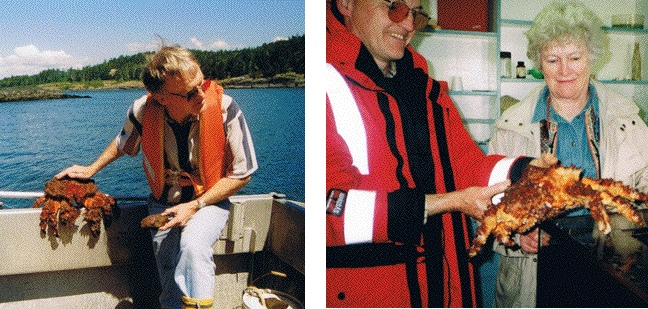
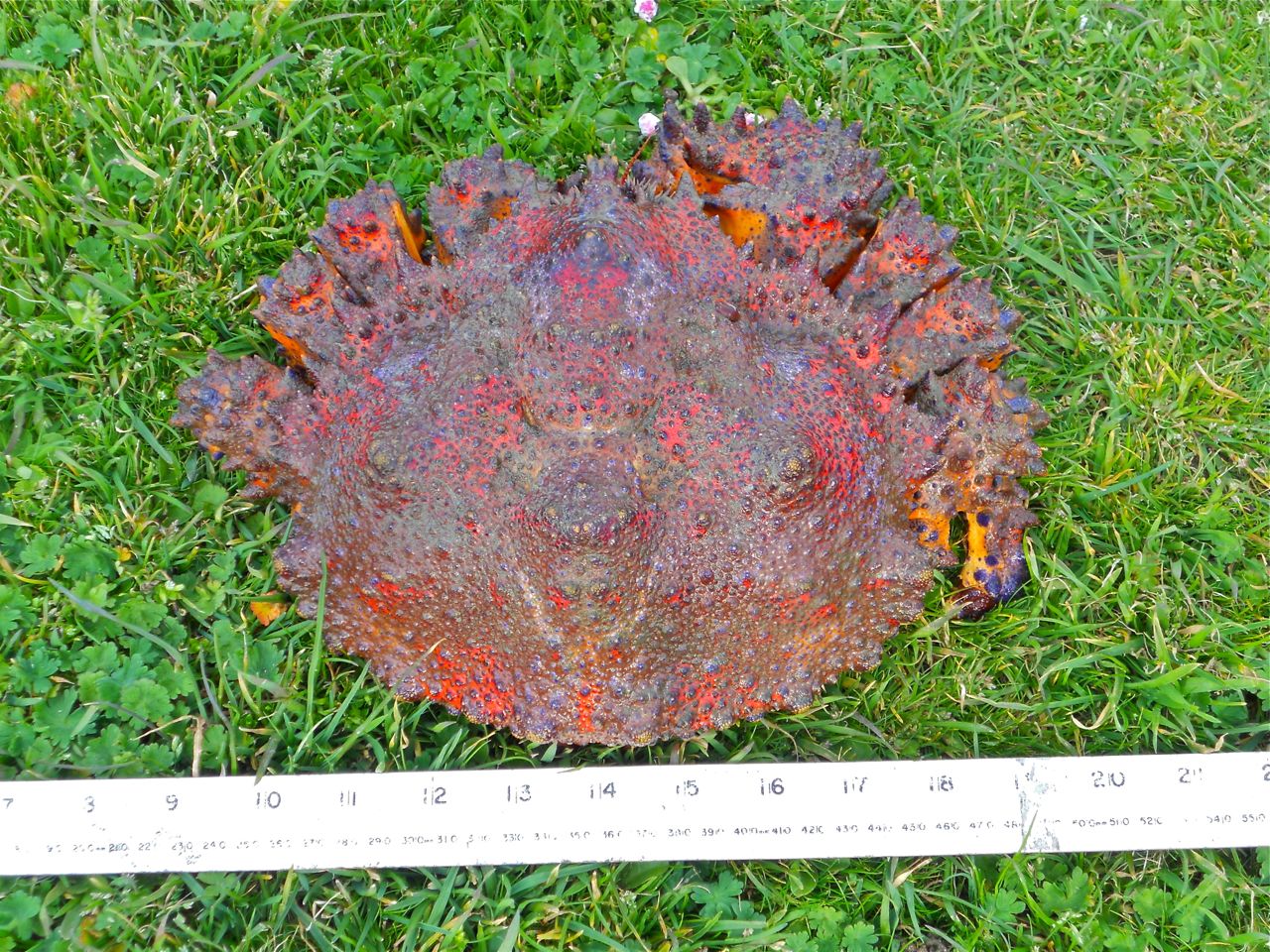
We often encounter these very large Puget Sound King Crabs in the calm backwaters of Race Rocks. Juveniles may be found among the cobble. Sea urchins and other echinoderms form their diet.


Paul Michaluk a fomer PC student from New Zealand, captured this picture on the left of Garry holding a  a Lopholithodes brought up by the divers who were back for a PC alumni reunion

Another former student, Barb Holman, took the picture on the right of Garry demonstrating the size of a Puget Sound King crab at Race Rocks to Trish Holman in April, 1998
Domain Eukarya
Kingdom Animalia
Phylum Arthropoda
Subphylum Crustacea
Class Malacostraca
Order Decapoda
Family Lithodidae
Genus Lopholithodes
Species mandtii

Common Name: Puget Sound King Crab

See a post by our ecoguardian Mike Robinson in 2012

pearsonlogo2_f2The Race Rocks taxonomy is a collaborative venture originally started with the Biology and Environmental Systems students of Lester Pearson College UWC. It now also has contributions added by Faculty, Staff, Volunteers and Observers on the remote control webcams. 


Eudistylia vancouveri: Northern Feather Duster worm–The Race Rocks Taxonomy

0708tubeworm

Eudistylia vancouveri: photo by G.Fletcher

The Feather Duster Tube worm is often associated with floating docks on the southern part of Vancouver Island. At Race Rocks, there are no floating docks but Eudistylia inhabits the protected rock crevasses of the lower intertidal zone. It can not withstand drying out too long so being in this tidal level will provide a maximum of an hour exposure at the lowest tides. While exposed in the air, their feather like gills are retracted, and the leathery parchment-like tubes are pinched closed at the opening. Underwater, the gills when released, are often banded a deep red and purple colour.

Domain Eukarya
Kingdom Animalia
Phylum Annelida
Class Polychaeta
Order Canalipalpata
Suborder Sabellida
Family Sabellidae
Genus Eudistylia
Species vancouveri
Common Name: Northern Feather Duster Worm
This file is provided as part of a collaborative effort by the students, faculty, staff, and volunteers of
Lester B. Pearson College
2005
Garry Fletcher

Phoxichilidium femoratum: Sea spider– The Race Rocks Taxonomy


pycnogonidLaura Verhegge in October 2005, collected two of these specimens while taking samples of invertebrates in the area where the tidal current turbine generator is to be installed. The diameter including legs is about 1cm. Note the short stubb as it should have 8 legs.  This video was taken with a microphotography apparatus. They were both found at 20 metres depth in association with the hydroids and the club tunicates.

Kingdom:Animalia
Phylum: Arthropoda
Subphylum:Chelicerata
Class: Pycnogonida
Latreille, 1810
Order: Pantopoda
Gerstaecker, 1863
Genus:Phoxichilidium
species:femoratum

Pyramimonas sp. The Race Rocks Taxonomy

pyrampool

On the east side of the island is the largest pool with Pyramimonas.

Pyramimonas is a green micro-algae, that is a type of phytoplankton.

Phytoplankton refers to the autotrophic component of the plankton that drifts in the water column.

pyram2

Samples taken from the green water in the upper tidepools

greenalgae

Here it is photographed at 400X under the microscope.

Most phytoplankton are too small to be individually seen with the unaided eye. However, when present in high numbers, their presence may appear as discoloration of the water (the color of which may vary with the phytoplankton present). This is certainly the case in the high intertidal tide pools at Race Rocks

In the high intertidal areas of Race Rocks, there are tidepools with wide fluctuations of abiotic factors. The organisms inhabiting these pools are well adapted to these extremes. Garry talks to a biology class about some of the variables influencing these high tide pools, and the flagellated green algae living within them.

The intense green color of the pools, swirly coloration of the water and a frothy covering early in the day indicate high photosynthetic capability. These plankton have an interesting response to changing salinity referred to in the video above.

Phytoplankton, like other plants, obtain energy through photosynthesis, and so must live in the well-lit surface layer (termed the euphotic zone) of an ocean, sea, or lake. Through photosynthesis, phytoplankton (and terrestrial plants) are responsible for much of the oxygen present in the Earth’s atmosphere.

pyramdiagPhytoplankton is consumed by microscopic animals called zooplankton (these are the second level in the food chain).
Zooplankton is consumed by Crustaceans (the third level in the food chain).
Fish that eat crustaceans could constitute the fourth trophic level, while seals consuming the fishes are the fifth.
A major reference work on this species may be found at :http://megasun.bch.umontreal.ca/protists/pyram/appearance.html

Domain:  Eukarya
Kingdom:  Protoctista
Division:  Chlorophyta
Class:  Prasinophyceae
Order:  Pyramimonadales
Family:  Pyramimomonadacea

Genus Pyramidomonas or Pyramimonas
Species unspecified

Photos below by Garry FLetcher of Laura Verhegge’s class.

taxonomyiconReturn to the Race Rocks Taxonomy and Image File
pearsonlogo2_f2The Race Rocks taxonomy is a collaborative venture originally started with the Biology and Environmental Systems students of Lester Pearson College UWC. It now also has contributions added by Faculty, Staff, Volunteers and Observers on the remote control webcams. Oct.2005Astrid Raquel Argueta PC yr 31


Membranipora serrilamella: Kelp-encrusting Bryozoa

The colonial marine bryozoan Membranipora serrilamella, formerly referred to as Membranipora membranacea. produces a planktonic larva that is encased by a triangular bivalved shell. Following a relatively long free-swimming phase, the larva settles as an epizootic colony on the blade of laminarians and other subtidal marine algae. It then undergoes a metamorphosis to become the sessile progenitor of the colony, referred to as the ancestrula”.

Encrusting colonies are typically found on marine algae on the lower shore to shallow water. Found encrustating in kelps and other large seaweeds, especially common on the brown algae Laminaria, but can also be found growing in rocks, glass, floats or other.
Description: This epiphiytic bryozoan forms encrusting lacy matlike colonies of very small, rectangular aurozooids 0.42 x 0.13 mm. with tubercules or short spines in the corners. Each zooid has lateral calcified walls that contain ventral incalcified bands providing flexibility; A frontal membrane completely roofs the space between the supporting side walls with a lophophore (feeding tentacles) visible within. Tower zooids may also be present, where the frontal membrane projects upwards in a columnar way. Forms white, disc-like colonies, approx. 1 mm high and up to and over 100 mm wide. Zooids are rectangular and for together neatly in radially arranged rows that grow outward and branch into new rows as the pattern frows wider.
Additional information: Colonies may vary in size. Membranipora membranecea grows quickly (several mm/ day) in response to predation from sea slugs and in order to maintain its position on the kelp frond. Prolific growth is favoured by fast flowing water which provides food and oxygen. Egg production occurs once a year in the spring; the larva (cyphonautes) is planktotrophic and is the most abundant and largest coastal larva in Britain between June and August. The larva settles in late simmer-early autumn.
Natural history: Colonies are made up of hundreds or thousands of individual zooids, which are not much larger than a pond head. Their eight week growing season falls between late spring and early autumn. During this time, how they grow is dependent upon their success in the competition for space. The interaction between colonies can be cooperative to aggressive depending upon their size. Small colonies communicate by using electrical signals. Large colonies use runners called stolons from which new zooids bud from to mediate aggressive behaviors.

Domain- Eukaryota
Superphylum Prostomia
Phylum Bryozoa
Class  Gymnolaemata
Order Cheilostomatida
Suborder: Malacostegina •
Family:  Membraniporidae •
Genus: Membranipora de Blainville, 1830
species: M. serriamella

taxonomyiconReturn to the Race Rocks Taxonomy
and Image File
pearsonlogo2_f2The Race Rocks taxonomy is a collaborative venture originally started with the Biology and Environmental Systems students of Lester Pearson College UWC. It now also has contributions added by Faculty, Staff, Volunteers and Observers on the remote control webcams. March 8 2005- Fredy ( PC 32)


Nematode species–The Race Rocks Taxonomy

Nematodes are abundant in decomposing material and are common as parasites in a number of animals.

This specimen was found in a collection of live material, hydroids, sponges and colonial ascidians that Laura collected at a depth of 15 meters, near the turbine site.

Domain Eukarya
Kingdom Animalia
Phylum Nematoda
Class
Order
Family
Genus
Species  sp.
Common Name: roundworm
This file is provided as part of a collaborative effort by the students, faculty, Staff, and volunteers of Lester B. Pearson College

2005
Sylvia Roach

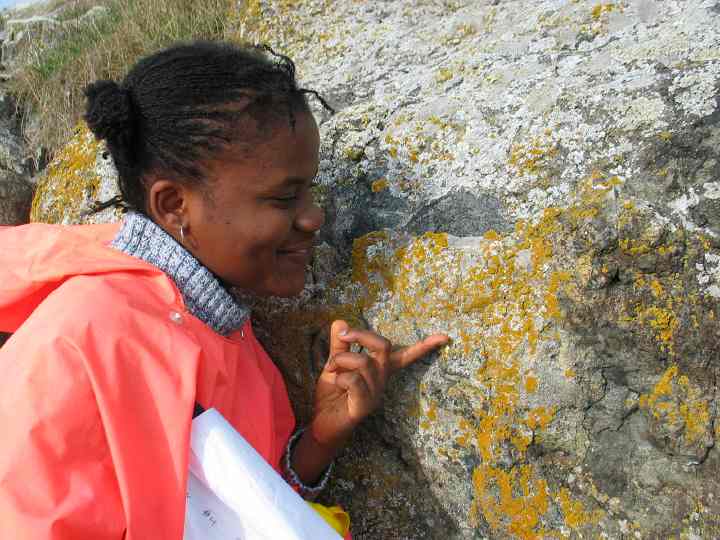
Caloplaca sp: orange/yellow Lichens – The Race Rocks Taxonomy

Caloplaca sp.

A symbiotic phenotype of lichen-forming fungi. The lichen observed here is thought to be a combination of Caloplaca flavogranulosa and/or C. citrina

Appearance: The tissue of this species is yellow-orange and often found in small yellow patches (colonies), and it is difficult to discern separate individuals. It has a very brittle appearance. In general, colonies may form a distinct narrow band on rocks and walls just above high water level, so that they are moistened by the water.

The body has a checkered cracked look with a finely frayed, whitish or pale yellow edge that is composed of the lichens (fungal) hyphae. The fruiting structure has a dark orange disc that is surrounded by a lighter edge.

Structure:
Structure of the common which grows on many types of surface, including concrete, roofs of buildings, and rocks subjected to sea spray. The orange colour of this lichen is due to production of the pigment parietin at the lichen surface.
Habitat:

They grow is soiless habitats such as on rocks, on trees, on walls, or on poorly developed soils. Although found in all biomes, lichens are particularly abundant in high altitudes like the Sub-Antarctic, the Arctic, the Antarctic.

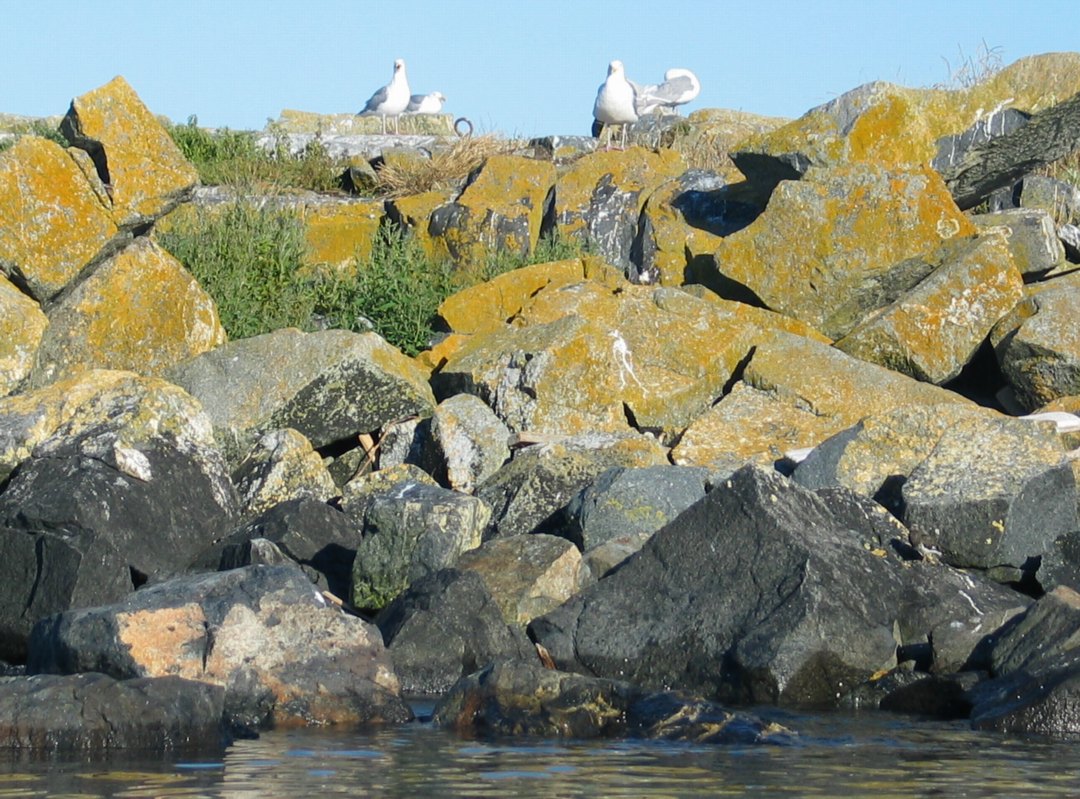
In this observation it was found that the species was very high up on the rocks of the island. They were found in vast patches, at a position where the waves only reach as surf spray..

This lichen can build small yellow patches amongst the darker belts of salt lichen nearer to the shoreline, but is more common higher up and can build widespread yellow-orange colonies on the shorelines middle zone. Orange lichen is perennial and colonies grow slowly.

-Common on nutrient rich areas such as beneath bird perching areas.

-appears in areas that have limited water spray , and salt concentration is high.

Niche:

The lichen is a photosynthetic organism. Lichens are remarkable for their ability to withstand prolonged drying and to resume activity rapidly after re-wetting. Most lichens that contain green algae can recover from drought by absorbing water from humid air and then begin to photosynthesise. In this habitat there are not many grazers on lichen.

Limiting Factors:

-excess amounts of water, oil spills, or coverage by animal (bird, sea lion) faeces may lessen rate of photosynthesis

-trampling, erosion by water spray, may kill some of the population

References:

Natural Resource Conservation Service,

http://plants.usda.gov/cgi_bin/topics.cgi?earl=plant_profile.cgi&symbol=XANTH9, Information last updated: 12/07/2002

Domain Eukarya
Kingdom Fungi
Division Ascomycota
Class Lecanoromycetes
Order Teloschistales
Family Teloschistaceae
Genus Caloplaca
species  sp
Common Name Lichen ?

pearsonlogo2_f2The Race Rocks taxonomy is a collaborative venture originally started with the Biology and Environmental Systems students of Lester Pearson College UWC. It now also has contributions added by Faculty, Staff, Volunteers and Observers on the remote control webcams. Dec 2005- Imani Brown PC yr 31


Clavactinia sp. Photomicrography of Dr. Anita Brinckmann-Voss

Classification: Biota Checked: verified by a taxonomic editorAnimalia (Kingdom) > Checked: verified by a taxonomic editorCnidaria (Phylum) > Checked: verified by a taxonomic editorHydrozoa (Class) > Checked: verified by a taxonomic editorHydroidolina (Subclass) > Checked: verified by a taxonomic editorAnthoathecata (Order) > Checked: verified by a taxonomic editorFilifera (Suborder) > Checked: verified by a taxonomic editorHydractiniidae (Family) > Checked: verified by a taxonomic editorClavactinia (Genus) sp. (species not identified)

These images were scanned from 35 mm.slides taken by photomicrography of samples collected on permit at Race Rocks by Dr. Anita Brinckmann-Voss* with the assistance of students and faculty of Lester B. Pearson College. Scanning and preparation for html was done by Garry Fletcher.

Copyrighted 1999–All Images on this page are the property of: Dr. Anita Brinckmann- Voss They can not be used or modified without her written permission.

see this link for other hydroids:  https://www.racerocks.ca/tag/hydroid/

* All hydroid species shown on this website have been reported in :Brinckmann-Voss, A. 1996.- Seasonality of hydroids (Hydrozoa, Cnidaria) from an intertidal pool and adjacent subtidal habitats at Race Rocks, off Vancouver Island, Canada. Scientia Marina 60 (1):89-97.

Mycale toparoki: yellow sponge–The Race Rocks taxonomy


In the work of Dr. Gitai Yahel on filter feeders at Race Rocks, this was one of the species of sponge he submitted for further identification.

yellowsponge

In the area where the tidal current turbine is to be placed, this species is abundant.

mycale1

taxonomy work by Prof. H.M. Reiswig,

mycale2

Microscopic drawings of the spicules

Domain Eukarya
Kingdom Animalia
Phylum Porifera
Class Demospongia
Order Poeciloscierida
Family Mycalidae
Genus Mycale
Species toparoki Koltun, 1958
Common Name: yellow sponge?
This file is provided as part of a collaborative effort by students, volunteers, faculty, staff and researchers of Lester Pearson College
Date: 2005 Dr.Gitai Yahel

Link to other sponge specimens from Race Rocks

Return to the Race Rocks TaxonomyÂ