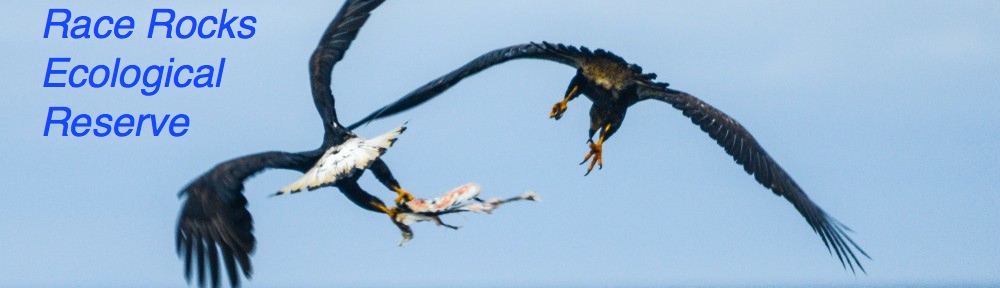
I am getting used to my new island home, unpacking, and learning the daily routines. Yesterday saw 15 juvenile eagles in the reserve, along with near 16 black oystercatchers and about 20 turnstones. Seven pairs of Canada geese are mowing the lawn, and the small female elephant seal remains up by the light-tower.
Tag Archives: Canada goose
Visit to island- eco-reserve warden update
Julien and I went out to the island to go over the various mechanical and recording systems on the island with Alex for the purpose of possibly developing an improved electronic data-logging system.
Many large blasts were noted throughout the morning from the DND ordinance disposal pit on Rocky Point. Gulls on South west corner were dispersed on one of the blasts.
 Material to be sent back for recycling was loaded by winch on the boat and Erik and Jake brought us back to the college. They picked us up in the afternoon bringing back the station whaler having undergone repairs over the last few weeks. Erik drove Julien and I in a rather rough return ride in the rigid hull inflatable which has been the substitute boat at the island.
Jake stayed out with Alex to work on the refitting of angle brackets on the solar panels on the roof of the energy building over the next few days. These are intended to increase efficiency by giving more of an angled tilt to the south.
Camera 1 panorama picture was redone to give better ability to click on the panorama image for control of camera.
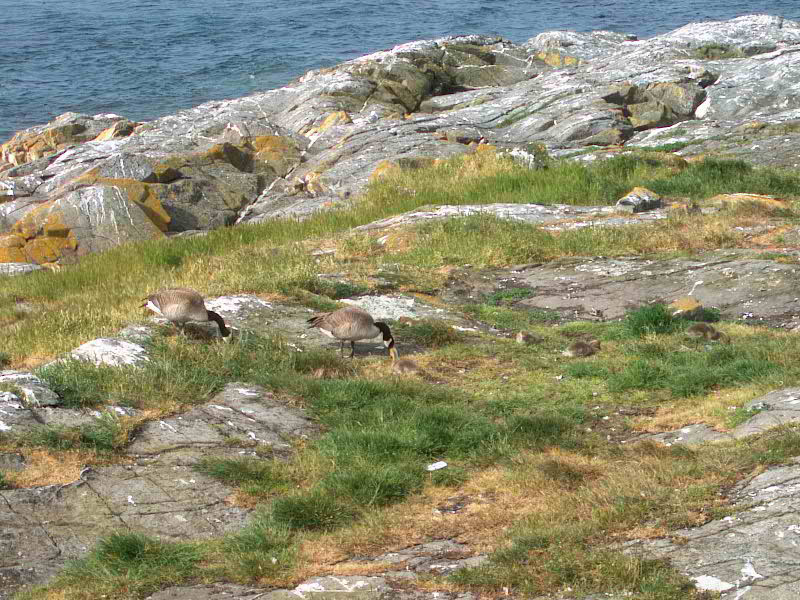
I noted that a dozen or more of the introduced (non-migratory) strain of Canada geese still persist on the island. Their grazing in the area of the first nations burial cairns remains to be a problem as soil erosion is obvious. I have suggested that we might put up several netted enclosures to document the impact of their grazing.
5 dead immature glaucous -winged gulls were noted on various parts of the island, A full count is pending. This is probably from normal; fall mortality of new birds. On top of the south rocks today, 100 cormorants, probably double crested lined the ridge.
 Garry Fletcher- ecological reserve warden
Oystercatcher chicks
‘The painters today spotted twelve orcas including babies swimming through the reserve. A possibly dead elephant seal was noticed washed up in the intertidal -but still partially submerged) this morning. Black oystercatchers have chicks! In the S surge channel beneath the science house, two chicks were noticed with a parent. They are still very small. The three baby geese are growing still. Every day they are growing stronger and venturing further and further from their parents. There is an old goose on the SE side of the keeper”s house that is looking very frail -this has been going on for a while now). I would expect that it is on its last legs.’, ‘Adam’, ’12:29:50 ,
Branta canadensis: Canada goose ( BC introduced variety)
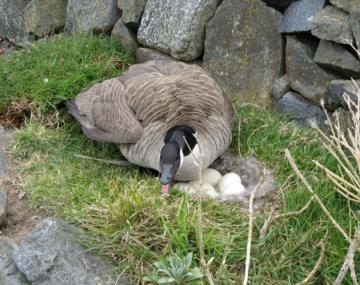
Canada goose protecting her nest, April, 2007
Race Rocks Backgrounder
A pair of Canada geese has regularly visited the island in the early spring over the last few years, but until the summer of 2002, they stayed a short time and then moved on. In 2002, Carol noted that two pairs of geese came in the spring and seemed to be staying an extra long time. They were joined by another pair occasionally but had many territorial disputes. In early May the reason was apparent. Five tiny goslings showed up one day with their parents. Carol documented their activities frequently in the Racerocks Log.
-
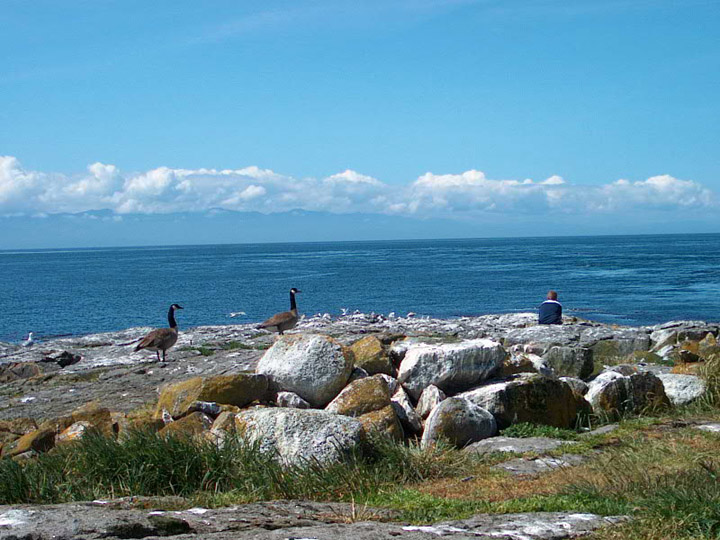
- Parents on the lookout
-
- Grazing time
-
- A mess on the pat
-
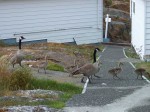
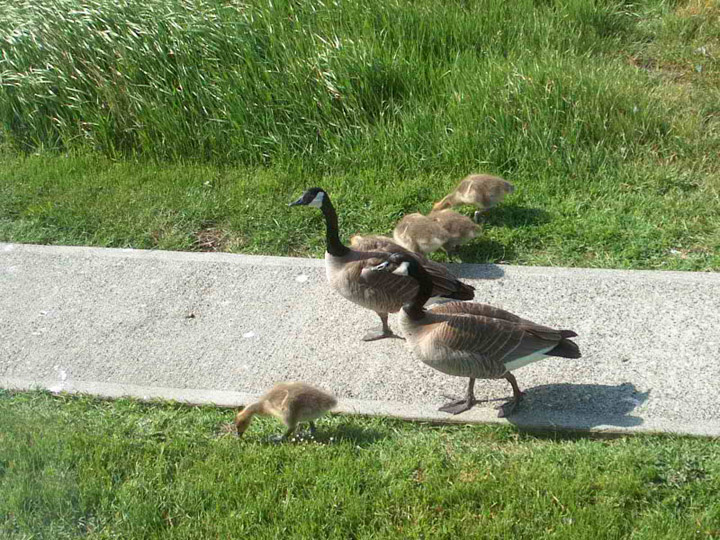
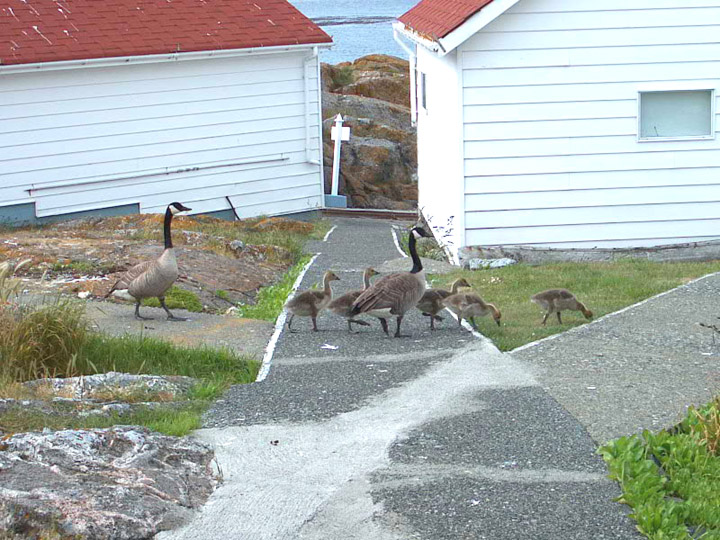
- Geese Xing Keep in step Pictures taken June 10/03 by Ryan Murphy

-
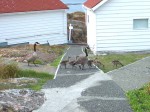
- Geese Xing
-
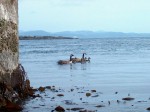
- Out for a swim
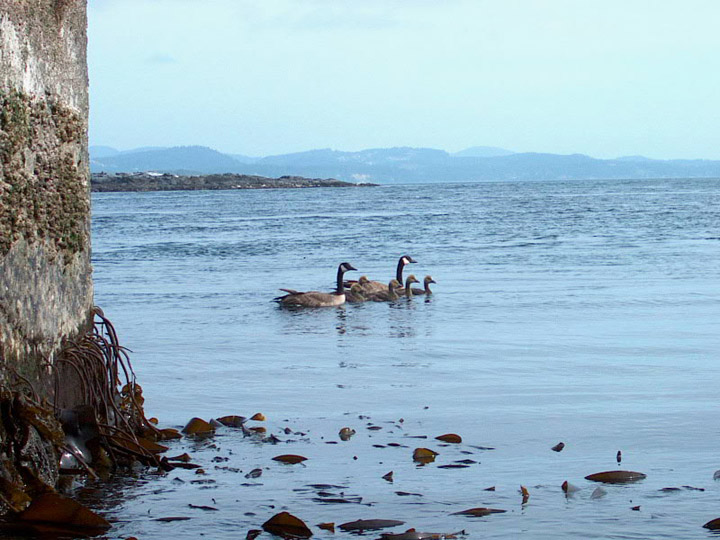
-
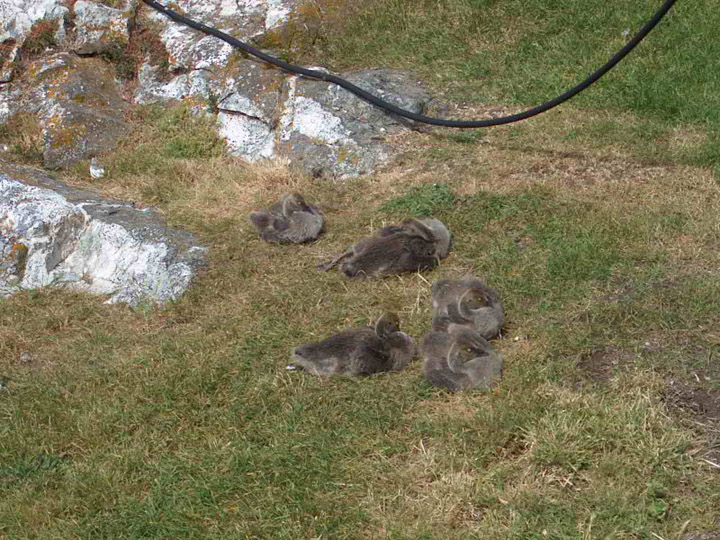
- Snooze time
-
- Sentinal
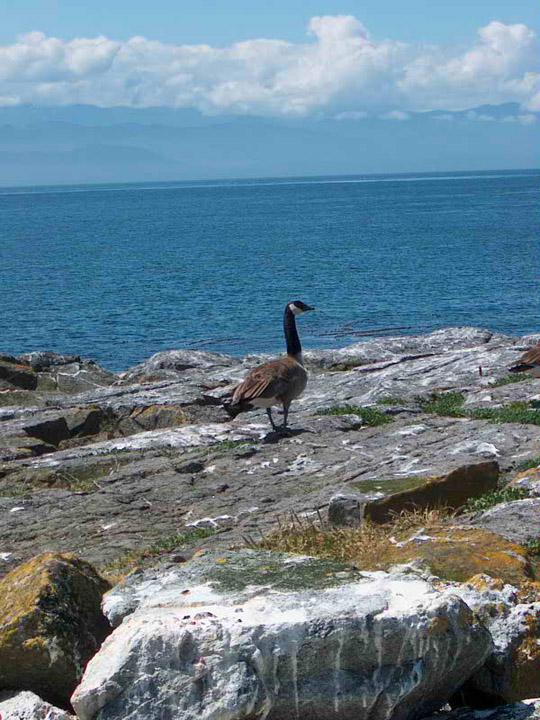
All five goslings made it to maturity that summer, probably assisted by the fresh water fountain which was their daily waterhole during the dry months. From September on, 6 of the original 7 geese frequently returned to the island, and have been seen here as late as January 2003. Update: Successful hatches of 4 nests occurred in 2004. In 2005 at least 4 pairs are nesting. Now when they hatch, the young are immediately taken off the island by their parents since there is no fresh water source on the island.
In the spring of 2008, and addling cull was done on permit from Canadian Wildlife permit arranged through BC Parks. There were no successful hatches that year. This had to be done because of the serious level of overpopulation of geese on the island. The integrity of the vegetation was starting to be impacted.
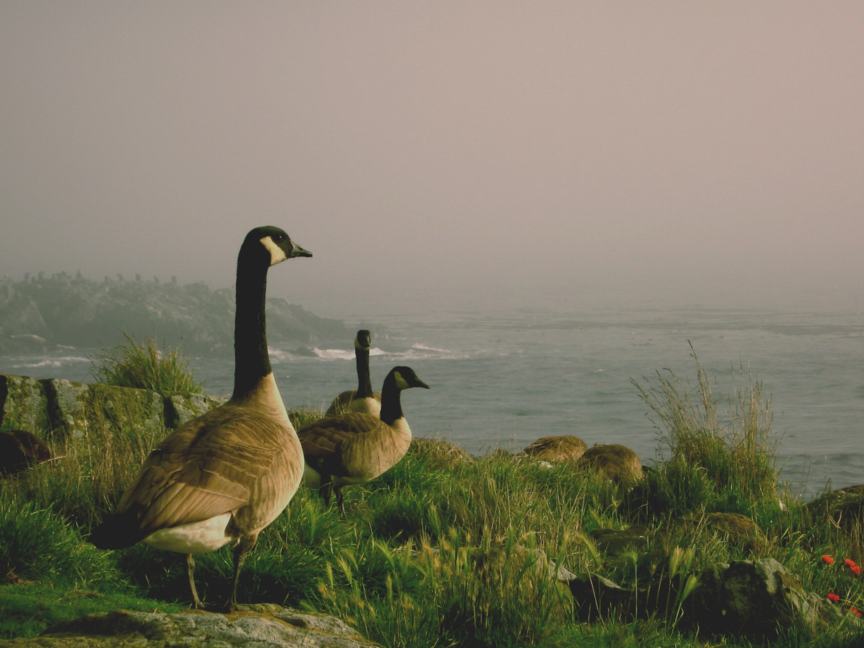
Canada geese photo by Raisa Mirza ( (PC, year 31)
Physical Characteristics: Canada Geese have a black neck, bill and head with pronounced white patches and strip under the chin. The body is usually brownish-grey. During flight the tail shows a white half-circle just above the black tail. These colour patterns are unique to this species. Females are usually somewhat smaller than the males, although both are similar to each other in colour. The mass of the Canada Goose varies in every species ranging from one to four kilograms. Goslings, or baby geese, are yellow with some greenish-grey colourings on the top of the head and back.
Food Habits
When on land, Canada Geese eat mostly grass and wild barley. They are able to grab a hold of each blade and pull it out with their bills by jerking their heads. They also eat wheat, beans, rice, and corn. In the water, the birds stick their head and upper part of their body into the water leaving their tail and back end extending in the air. They stretch their neck out, under the water, and slide their bills across the bottom silt. They also eat a number of aquatic plants such as eel grass and sea lettuce.
Behaviour
-
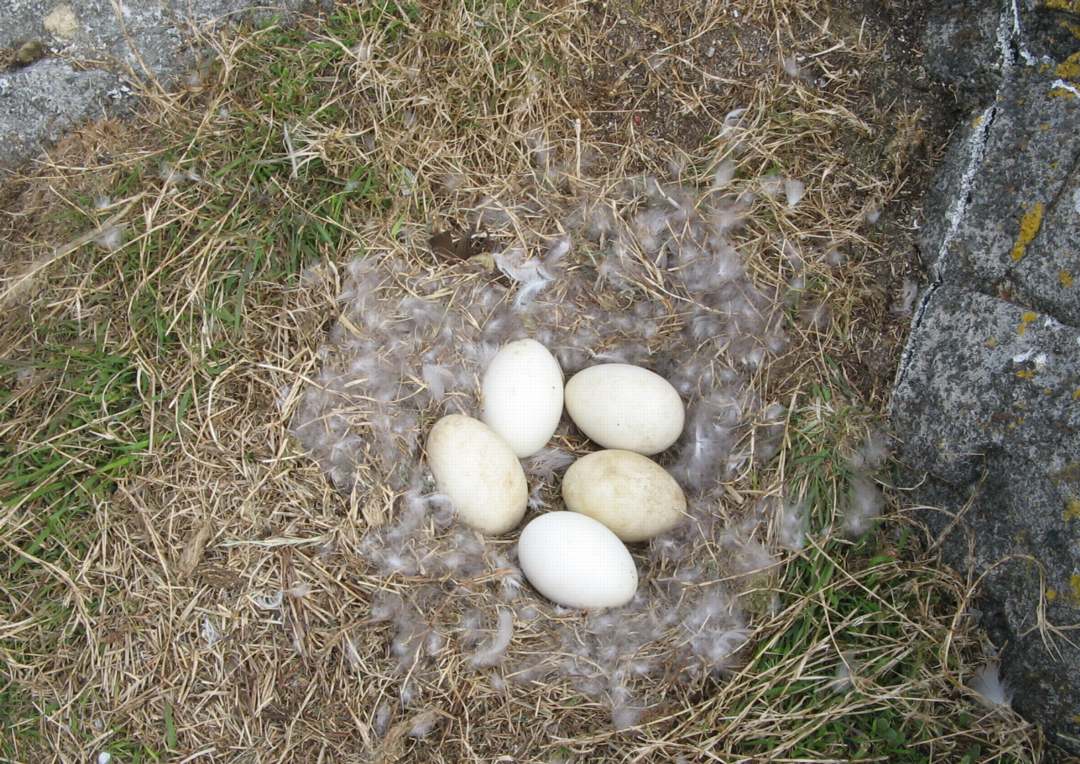
- Eggs, April 2007
-
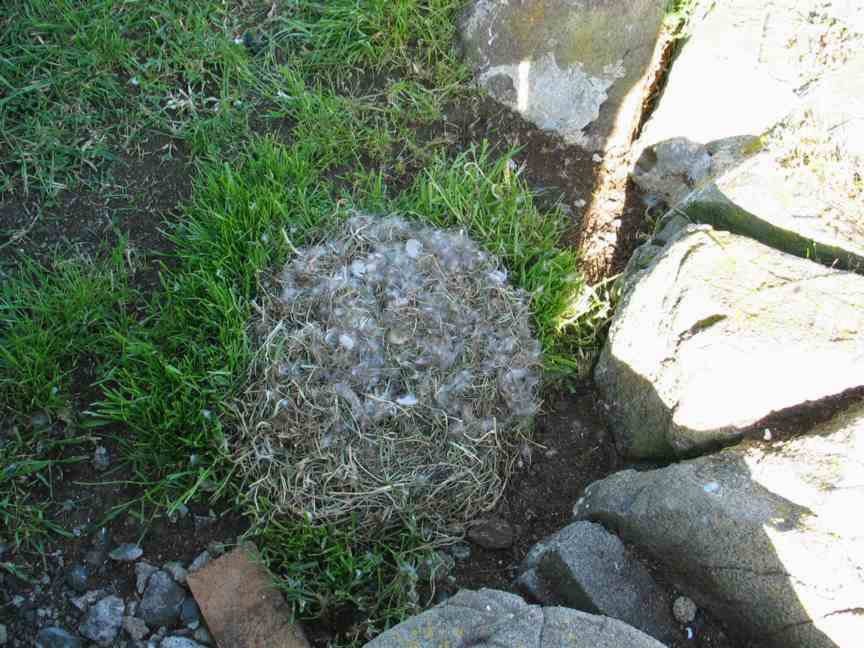
- A nest covered up while the parents are foraging.
-
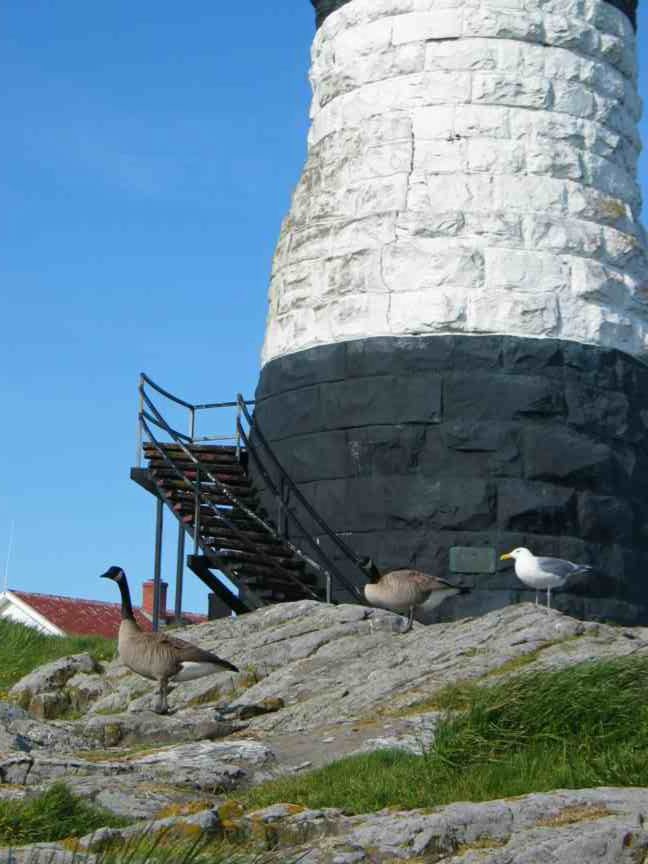
- Sentinel near tower
-
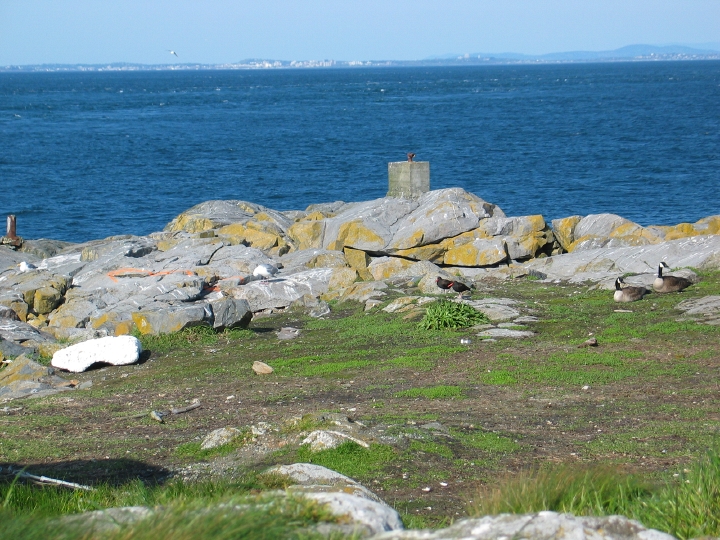
- Sharing a spot in the sun with the Black Oystercatchers, spring, 2005
-
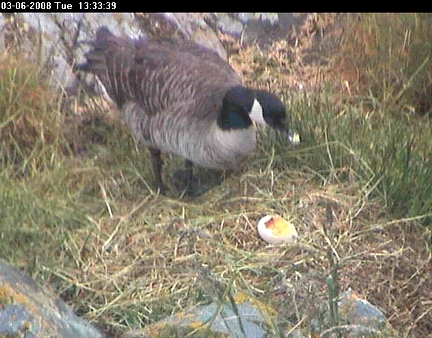
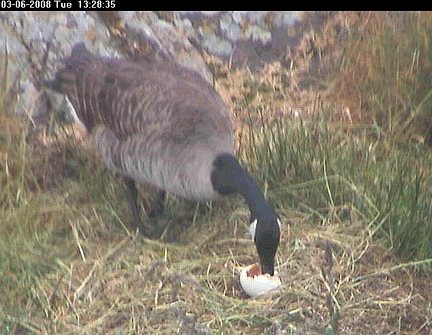
- On June 3/08, PB captured these images of the goose eating her own egg which had not hatched
-
- his goose had only one egg, and had sat on it for at least 40 days
Males in this species are very aggressive. They use their bills not only to eat and groom, but also in attacks. They also lay out flat and still on the ground with their necks stretched out to be less visible to the danger. Most geese mate for life. They form pairs during migration or on wintering grounds. Males fight over females with their wings and bills. The winner approaches the female with his head down and neck undulating. He makes hissing and honking noises. They usually mate either before or after they have found a nesting location. Mating occurs in the spring on the water.
| Domain | Eukarya |
| Kingdom | Animalia |
| Phylum | Chordata |
| Subphylum | Vertebrata |
| Class | Aves |
| Order | Anseriformes |
| Family | Anatidae |
| Genus | Branta |
| Species | canadensis (Linnaues) |
| Common Name: | Canada Goose |
Environmetal Impact : Although we have had a permit to addle eggs for several years, the introduced Canada goose variety has had a serious impact on vegetation through intensive grazing through the winter. By including several grazing exclosures with wire mesh around the island, the difference in turf development is emphasized.
A serious impact also is the increased erosion around the First nations burial cairns.
References:
Canada Goose, http://www.mbr-pwrc.usgs.gov/id/framlst/i1720id.html
Backyard Birding, http://www.slivoski.com/birding/goose3.htm
Canada Goose, Branta Canadensis, http://www.aquatic.uoguelph.ca/birds/speciesacc/accounts/ducks/canadens/account.htm
The Atlas of Breeding Birds of Alberta, Ed. Glen P. Semenchuk. Edmonton: Federation of Alberta Naturalists, 1992.
Return to the Race Rocks taxonomy
| This file is provided as part of a collaborative effort by the students, faculty, staff and volunteerts of Lester B. Pearson College | 12/02 | Bruce Benjamin D’Souza (Yr 29) |
Sea lion population still down
Good Evening
TEMPERATURE: Max. 9.5 ºC »» Min. 4.9 ºC »» Reset 7.9 ºC
MARINE LIFE: The population of Sealions is still down since the last series of blasts so it is fairly quiet,the animals hauled out by the winch house are quite nervous of any activity on or near the dock. With another series of blasts in the coming weeks they may just move away altogether. Saw only 5 small fish balls today and not many birds feeding, seem to have followed the food elsewhere for now. The geese were back, at least 6 of them.
HUMAN INTERACTION: The LGL observers arrived first thing this morning and left at 16:30 and as careful as they were the sealions closest to the dock took to the water.There were 8 Ecotour boats through today.
posted by Carol or Mike S at 6:08 PM
Counted over 500 Cormorants just on North Rocks
Good Evening
TEMPERATURE: Max. 10.2 ºC »» Min. 7.0 ºC »» Reset 8.1 ºC
MARINE LIFE: Another good day for sea birds feeding, thousands of birds from Whirl Bay and as far as you can see to the east , every rock including Gr. Race ‘covered’ in birds. Counted over 500 Cormorants just on North Rocks and the rocks to the Southeast and most likely at least that many in the kelp beds. Not many Sea Lions have hauled out, only 15 along the north shoreline of Gr. Race, a group of 11 Northern are bunched together on the high point just east of the house but are very edgy.Most of the animals hauled out are on the middle rock.The injured California Sea Lion was gone at first light and we have not seen him all day. There were 7 geese today.There is no standing fresh water but they do enjoy the greens. A small group – 5 or 6 – Transient Orca were hunting in the entrance to Pedder Bay and took at least one seal. There were several pleasurecraft and 7 Ecotour boats watching the kill. After the boats left the Orca moved west along the shoreline quite slowly and at times rested on the surface for 5 minutes at a time. It took them a good hour to go from the east tip of Bentinck Island to Whirl Bay, I guess they continued west but did not see them again.
HUMAN INTERACTION: There was 1 dive charter in the West Race area, 13 Ecotour boats and 7 pleasurecraft through today.
posted by Carol or Mike S at 5:59 PM
Orca sighted
Good Evening
TEMPERATURE: Max. 14.1 ºC »» Min. 8.5 ºC »» Reset 11.8 ºC
MARINE LIFE: There are thousands of sea birds busy feeding in the many fish balls, a few inside the MPA but most of the action in about 1/2 to 1 mile past the boundaries. Many of the birds come into the reserve to rest ashore and in the kelp so there is a constant flow of birds back and forth. A small group of Orca were sighted southeast of Gr. Race travelling westsouthwest.1 Canada goose came ashore up over the rocks by the winch house causing a stampeed of sea lions. The gulls and other birds move among the sea lions all the time but for some reason, the goose rising up out of the water waving it’s neck and moving towards them was somewhat of a threat.The goose seems to have an injured left wing and moved into a protected area among some large boulders and except to pop it’s heard up every once in a while for a look around has stayed put all day. Cannot get close to the goose to assess it’s condition as any movement would disturb the 60 or so sea lions hauled out all along the shore.
HUMAN INTERACTION: There were 11 Eco tour boats and 7 pleasure craft through the reserve today.
posted by Carol or Mike S at 6:25 PM
Good Morning
WEATHER: Sky Clear »» Vis. 15 Miles »» Wind East 11 Knots »» Sea Rippled
posted by Carol or Mike S at 7:07 AM
WEATHER: Sky Clear »» Vis. 15 Miles »» Wind East 11 Knots »» Sea Rippled
posted by Carol or Mike S at 7:07 AM
Tour boats stiill out to the reserve
Good Evening
TEMPERATURE: Max. 15.0 ºC »» Min. 8.2 ºC »» Reset 13.7 ºC
MARINE LIFE: 1 pair of Black Oyster Catchers spent several hours in the east bay area mostly preening and sleeping, heard no vocalizing at all.The geese flew in just after 10 am but stayed only about an hour before heading off towards Pedder Bay.
HUMAN INTERACTION: There were 26 Ecotour boats, 3 dive boats, 1 sail boat, 9 pleasure craft and the DFO 3M boat in the reserve.The Station boat made a trip to Pedder Bay and back.
posted by Carol or Mike S at 6:03 PM
Geese arrive
TEMPERATURE: ax. 16.5 ºC »» Min. 10.3 ºC »» Reset 12.9 ºC »» Rain 0.6 mm
MARINE LIFE: This morning the geese, all 7 flew in with much honking and spent most of the day grazing on the few patches of grass that have sprouted up thanks to the recent showers.
posted by Carol or Mike S at 6:42 PM
Several chicks have been blown into unfriendly territory
Thursday, August 08, 2002
Good Evening
TEMPERATURE: Max. 15.9 C Min. 10.8 C Reset 13.9 C
MARINE LIFE: The gull chicks are growing rapidly, a lot of wing flapping, unfortunately getting airbourne has it’s risks.Several chicks have been blown into unfriendly territory ie- a neighbouring nest, been attacked and have died. Most of the wounds were around the head and neck. The chicks still unable to fly in any organized way, run but in a panic just get farther from the safety of their nesting area. The adults treat a chick from a neighbouring nest as they would any other threat to the safety of their own young, they chase and peck at it and of course the squawking attracts other gulls and so there is the helpless chick set upon by 20 or so adult gulls. Fortunately most of the time the chick is able to get to neutral territory and by trial and error make it’s way back to the relative safety of it’s own nesting area.Six of the geese were back this morning, one of the adults was missing – we know the missing one is an adult because the five young are still making the ‘peeping’ sounds and do not show the ‘threat’ behavior of neck waving and hissing. Just before 20:00 they flew off towards Pedder Bay, wonder what happened to the ‘missing’ goose? There was another group of California sealions in the area last night just after 2 a.m. – sounded like a larger group, maybe 15 or so judging from the barking
which woke me up but this morning counted only 6 floating about in the kelp.
HUMAN INTERACTION: There were 23 Ecotour boats and 4 pleasure craft in the reserve today.
posted by Carol or Mike S at 6:40 PM