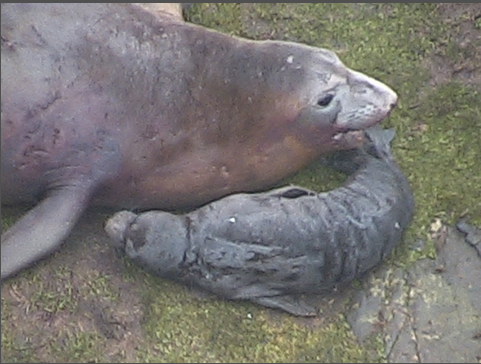
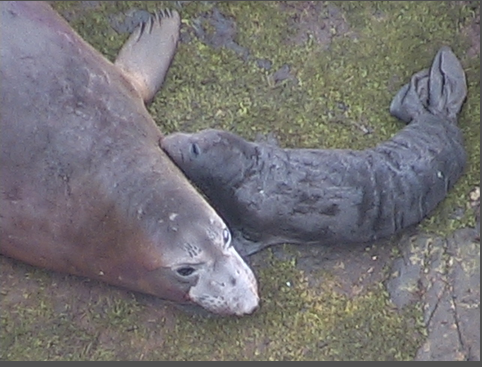
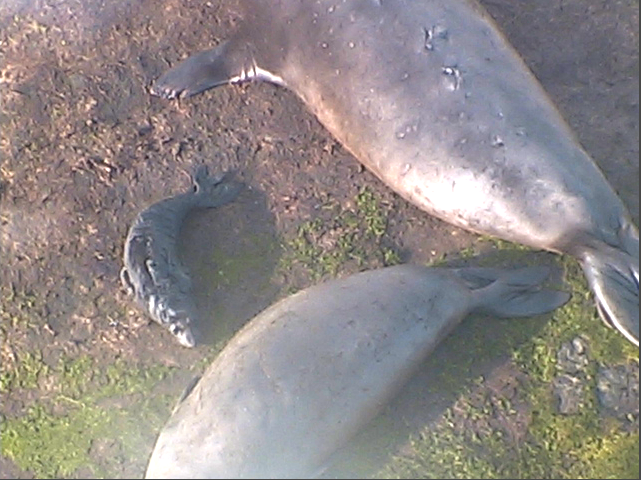
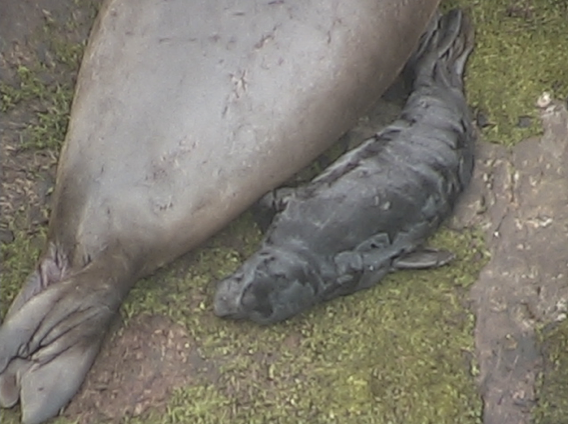
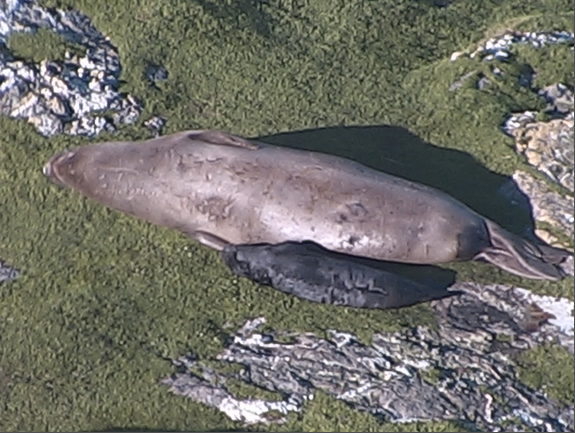
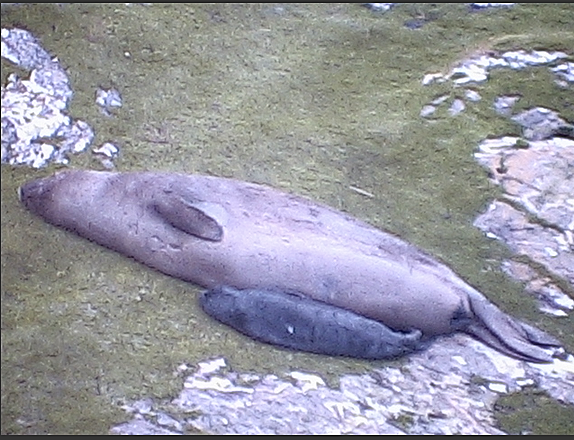
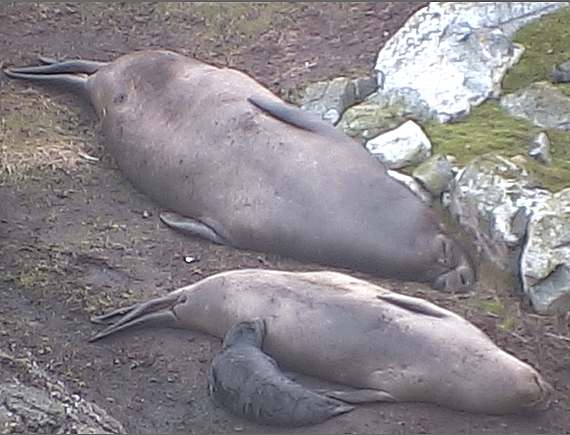
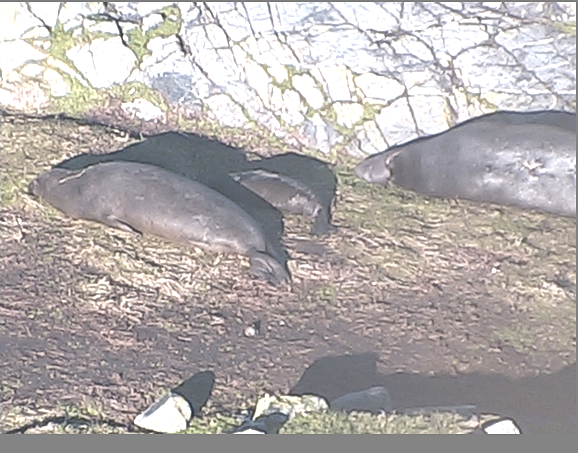
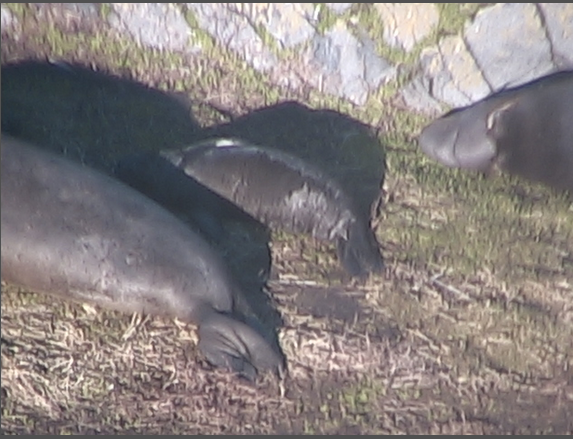
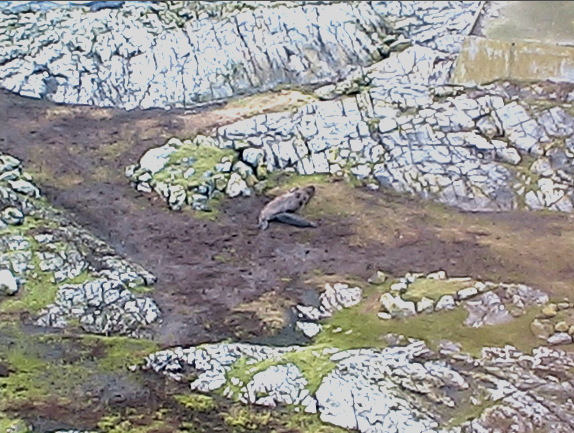
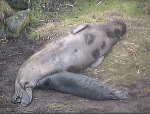
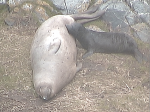
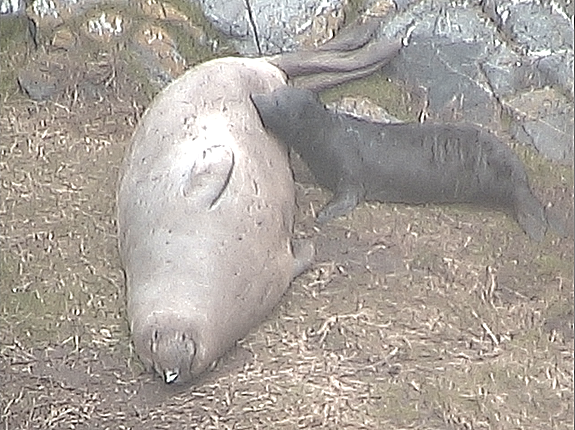
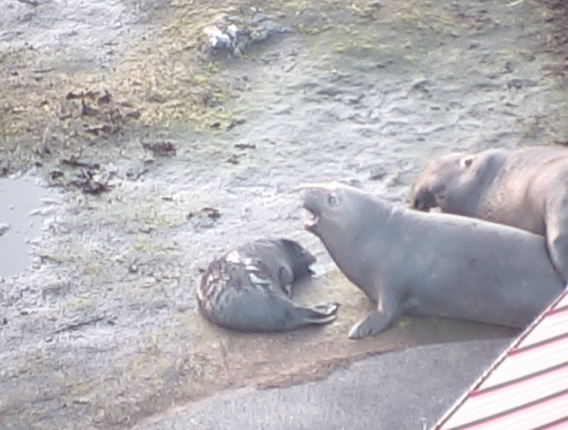
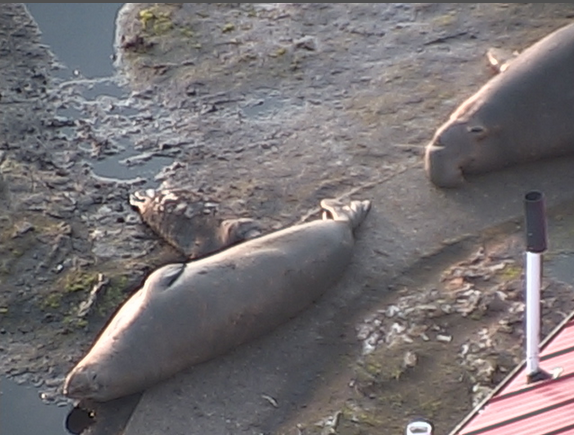
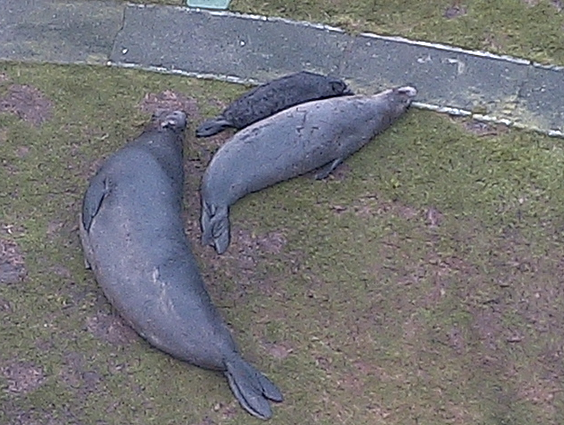
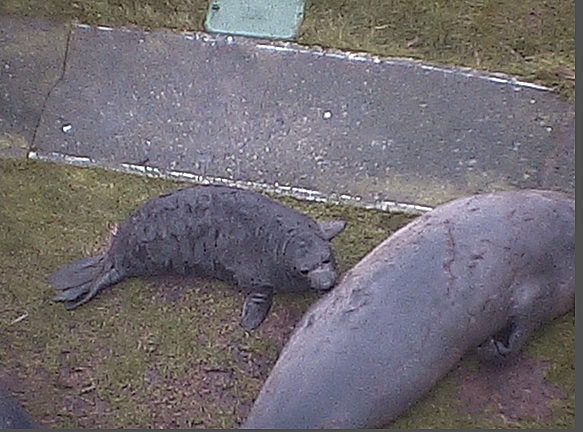
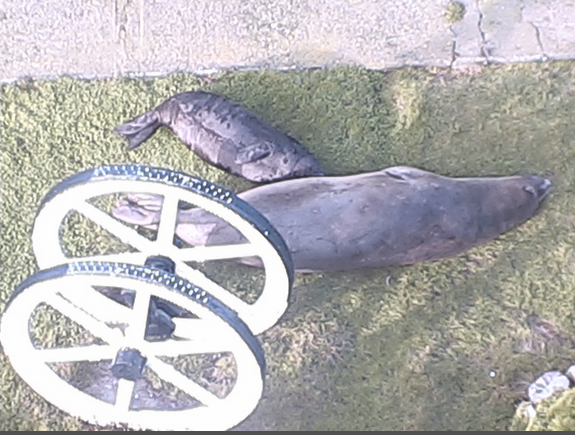
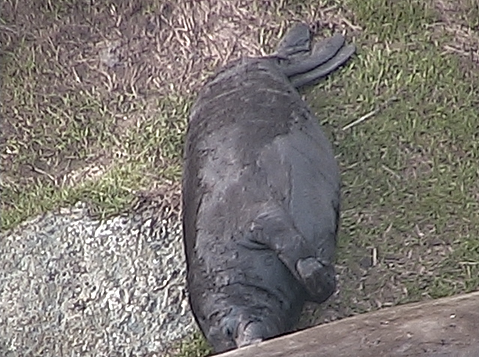
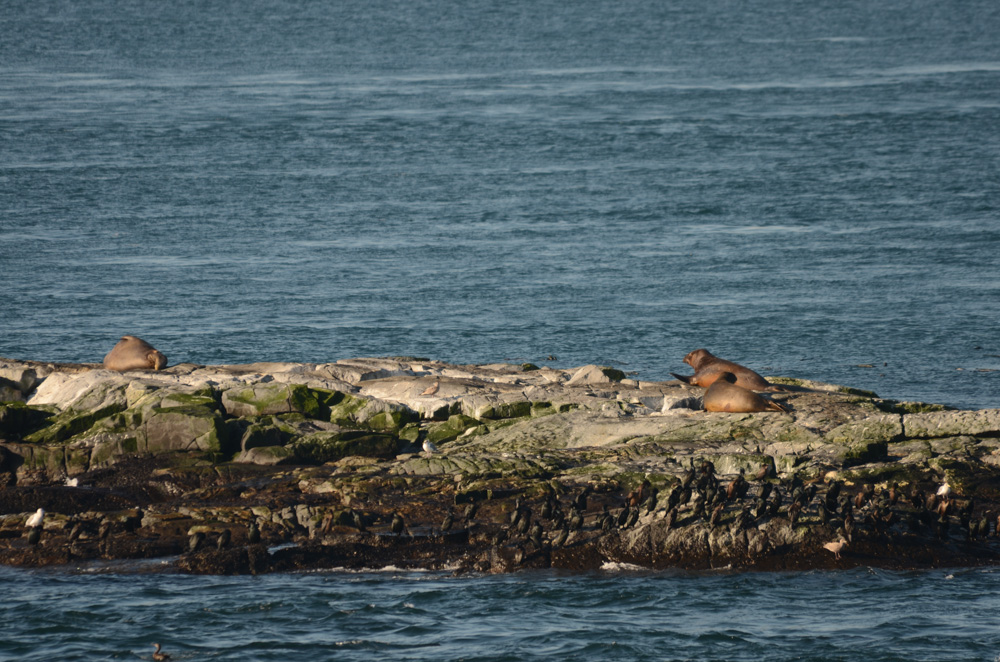
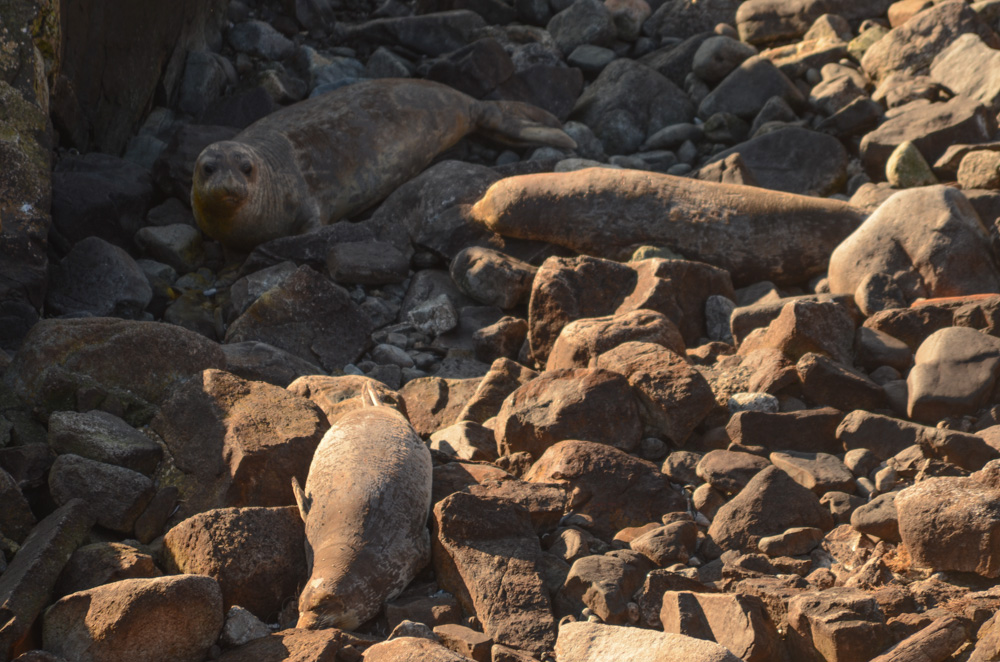
Pictures taken from birth on January 14 to February 1 from the Remote Camera 1
- Jan 14-11:00 AM
- 9:45 AM Jan 14
- jan 15
- Jan16
- Jan 20
- Jan 20
- Jan 23
- Jan 24
- Jan 24
- Jan 26
- Jan 26
- Jan 27
- Jan 29
- Jan 29
- Jan 30
- jan 30
- Jan 31
- Feb 1
- Feb 1
- Feb 1
Pictures taken from birth on January 14 to February 1 from the Remote Camera 1
It has been very foggy yesterday so missed seeing the elephant seal pup. I was surprised to see this morning the size he has attained. At 13 days old, gaining 4.5 kg or 10 lbs per day , the pup would have gained 58.5kg or 130 lbs since birth.
At birth pups weigh 75 pounds (35 kg) or more and are about four feet (1.25 m) in length. This figure comes from research done in California. No one has yet done research for recording the growth rates for elephant seal pups at Race Rocks Ecological Reserve.
The pups nurse for about 28 days, generally gaining about 10 lbs (4.5 kg) a day.

Every morning they are in a different location because the pursues the female the previous night.
I took the following pictures from the Remote Camera 1:
A good source of scientific data on Elephant seal growth rates and survivorship can be found in a 1994 publication : Le Boeuf, Burney J., and Richard M. Laws, editors Elephant Seals: Population Ecology, Behavior, and Physiology. Berkeley: University of California Press, c1994 1994. http://ark.cdlib.org/ark:/13030/ft7b69p131/
Nothing goes wasted in an ecological system. A few hours after the birth of the baby elephant seal, Thayer’s Gulls, Ravens and Black Turnstones came by to get a bit of rich protein for the placenta.
In the early morning just after the birth of the Elephant seal pup, Alex was able to record behaviours of the mother and Pup. Gulls started to go after the placenta, opposed by the mother.
This video was made from clips taken between 0814 hours and 0830 hours.
Sky cleared up yesterday, mostly cloudy today. NE wind less than 15 NMPH becoming W this afternoon.
Counted 16 bald eagles in reserve today, they have started feeding on the deceased sea lion.
Chunk has started spending more time off the main island, he was away all day today and back this evening. I was able to get a better view of Middle Rock yesterday. In the picture below you can see Chunk on the left and a good sized female on the right with a young male behind her.

Middle rock: Chunk, younger male and female ( i think the one that had a pup out there earlier this month)
The number of moulting female elephant seals on the main island has increased to a total of 4: 3 in south bay (including one with green tag) and 1 in South East beach (pink tag). They all look pretty rough, as usual.
DND blasting: 1 blast yesterday, 3 blasts today. Looked like some small military vessels doing exercises near the reserve midday today and yesterday.
1 eco tour vessel, 1 charter rental from Pedder Bay (I called the marina as they were in the reserve and it was chartered by Shaw to get footage of race rocks).
-following up on wood stove
-cut, chopped, stacked wood
-topped up fresh water
-did some training/refreshing with relief guardian
-checked on battery water levels
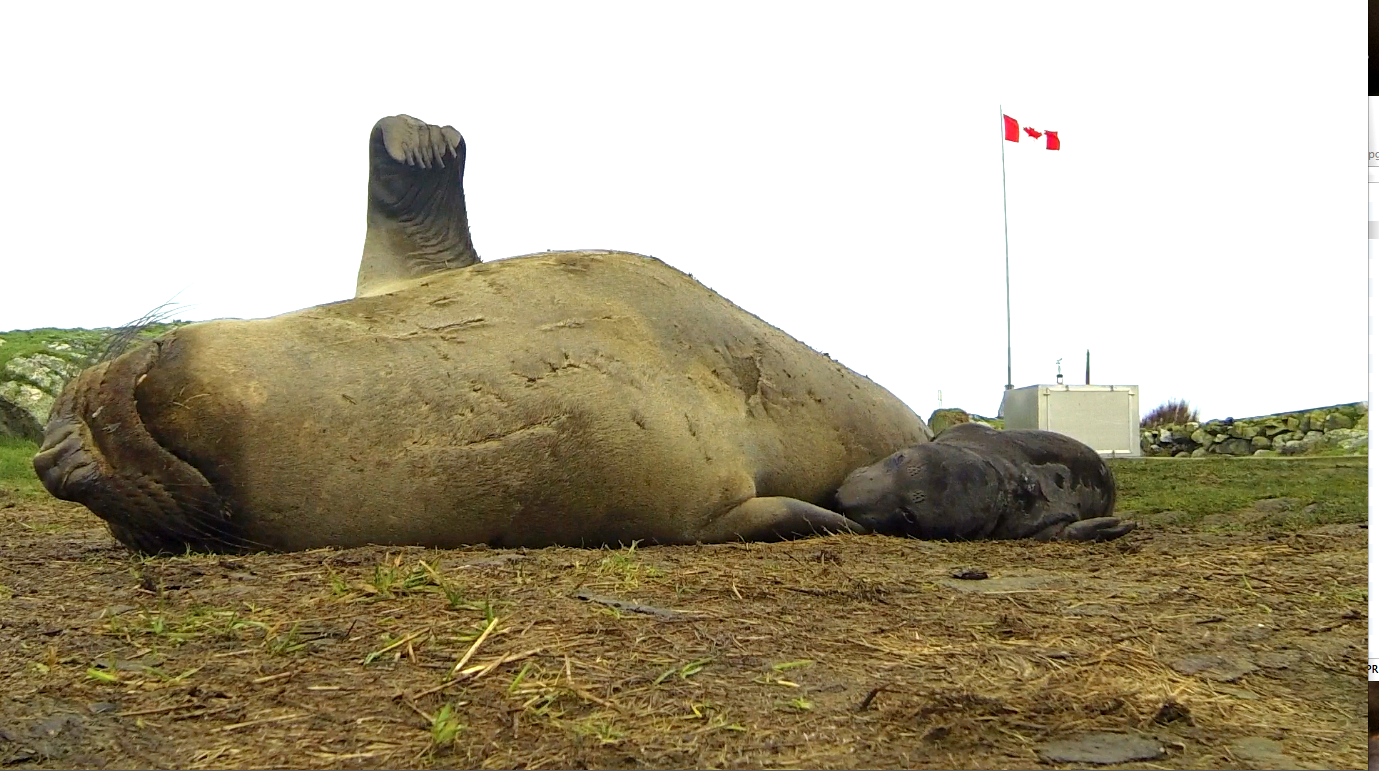
Alex uses a Pro-cam video camera at Race Rocks to take video and some still images of the Elephant seals close up. In this sequence, taken on the day after the birth of the elephant seal. He places the camera and then leaves, capturing an interesting sequence as the pup tries to find milk and the Male “Chunk” starts to get aggressive. Click on the small icon in the lower right for a full screen image
A short sequence showing the pup is certainly assertive!
Bertha has certainly been cooperating this year in remaining in view on at least one of the cameras at Race Rocks. On this bright sunny day she is on the rocks over behind the boathouse with the Pup.
Vocalization of mother and pup are essential shortly after the birth of an elephant seal to establish a bond and for recognition of each other if separated in the pupping colony. The first video was taken on the afternoon of January 14, day 1 the pup can be seen looking for food, but she had not started to nurse yet., The second video was taken on the evening of January 14, 2014 the day the elephant seal was born at Race Rocks.
Videos by the Ecoguardian, Alex Fletcher.

A goodbye wave?? Female elephant seal and pup born at Race Rocks , January 14, 2014 : Alex Fletcher photo
British Columbians can take great satisfaction in the fact that an Elephant seal colony is being slowly established in British Columbia, and we can see an elephant seal pup being nursed via a webcam on an island within site of Victoria. The reality is that the risks these animals face in the Strait of Juan de Fuca if they are to maintain a population increase are now becoming even more challenging.
Currently about 6,000 large commercial vessels transit Canadian and U.S. waters toward Vancouver or Washington ports each year. Each month about five large oil tankers ply the waters down the international border within a few kilometres of the Race Rocks Ecological Reserve.
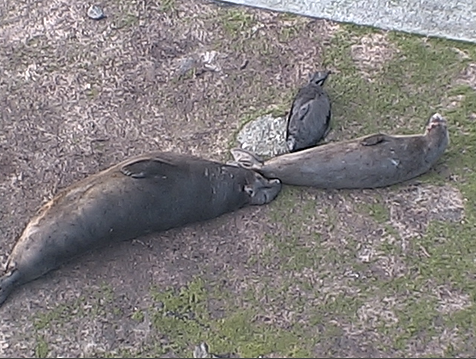
Under the Kinder Morgan Pipeline Proposal, up to 34 tankers a month would be loaded with oil at a terminal outside Vancouver, then travel through Haro Strait and the Strait of Juan de Fuca for export to markets in Asia and the U.S. These are tankers in excess of 200 metres in length.
The $5.4 billion expansion project would nearly triple pipeline capacity from about 300,000 to 890,000 barrels of crude oil a day to meet customer demand. Much of that future cargo will likely be diluted bitumen from Canada’s tar sands. If approved, the expansion is expected to be operational in late 2017. The pipeline is operated by Kinder Morgan Canada and owned by Houston-based Kinder Morgan Energy Partners LP.
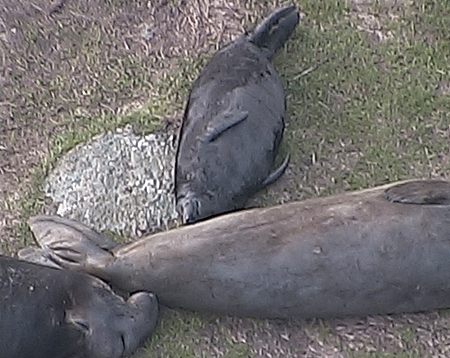
The potential of collision and oil spills is unparalleled, and you can’t’ clean oil off a two ton marine mammal very easily let alone the volumes of marine life it consumes daily for survival. It would be a miracle indeed if we still have elephant seals at Race Rocks in 2020, the 40th anniversary of the Ecological Reserve.
G.Fletcher
Link to other posts on the Race Rocks website about the Risks we face with Increased Tanker Traffic
References we could all consider seriously:
“Residents of the Salish Sea region—Vancouver, Victoria, the Gulf Islands and Washington State—could see a four-fold increase in the number of oil tankers traveling from the Port of Metro Vancouver through Juan de Fuca Strait, if Kinder Morgan is permitted to build a new pipeline to carry oil from the tar sands to markets in Asia. Such a dramatic increase signals exponentially higher risk of oil spills and raises many questions about what is at risk, how the oil is “cleaned up”, and who pays for oil spill response. “