A Biography of Misery

I believe it was Mike Slater who named Misery, since he was a juvenile male elphant seal with an attitude. After being at the lightstation for many years Mike got to know which elephant seals gave him a rough time when he was trying to move about on the pathways. Misery turned up in about 2007. He was known to growl and advance toward one if they got too close, and this happened often since the elephant seals usually come onto the main island via the boat ramp. One has to take a light at night as they are often sprawled across the pathways, Going down to take seawater samples for salinity and temperature when the sample time is at night can prove to be a bit of a hazard. Misery’s behaviour was in stark contrast to that of Slash ,who was very docile after spending a year on the island recuperating from his collision with a boat in January of 2003. Misery elephant sealThe story of Misery took a strange twist in the spring of 2009. At the end of January he was seen by Ryan to be hanging around the helicopter pad with an unknown female ( later named Bertha!).


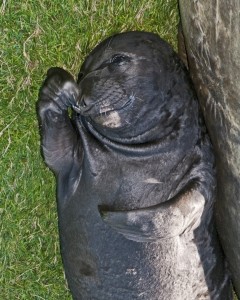
When Bertha had a birth (Ninene) , Misery swung into action.   Heelephant seal bite was relentless in his pursuit of the baby as he was being rejected in mating by the female Bertha.   We believe that Bertha had been impregnated previously by Slash. This part of the story is told in the file on NInene. It shows video and images of the difficult beating she took from Misery. We are quite sure he was not the father, since in previous years it was Slash who seemed to be the male interacting with the females in January. When Ninene’s mother left the island, he kept attacking her relentlessly for several days andNinene was close to death. Misery, juvenile elephant sealWe believe she was saved only by Slash encountering Misery one night and giving him three sets of deep wounds on his back. From then on Misery stopped attacking the pup and when Slash moved back onto the island again, Misery departed.. Slash had been staying during the time of Ninene’s birth out on Middle Island with three other females. We believe that at least two of these had pups, one was photographed but probably because of the small space and exposed location, neither survived.
rmfeb10pup


On February 7 of 2010, Ollie was born and in the second week he too became the object of aggression by Misery. Eventually, after three weeks, Ollie was dead and the bite marks on the back and the loud cries heard at night suggested that Misery was to blame.


Elephant seal injury from fighting It turns out that the same behaviour was repeated in March of 2010 and Misery again sustained some more serious wounds.  
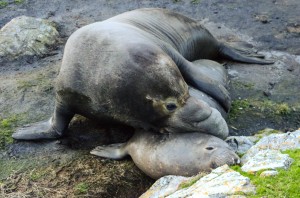


matingIn February 2013, Bertha returned to the island but did not have a pup, the first time in four years. Misery however was there to mate with her, This post by  Alex ipresents the images!


January 2014: we were expecting Misery back to harass the female elephant seals again as we come into breeding season. However, we have not seen Misery since he was seen sparring with Chunk back earlier in July 2013. His role has now been taken over by Chunk.


See all the postings on Misery in the Race Rocks log

 

See the Elephant seal index and gallery file

Elephant Seal Moulting

Race Rocks is at the northern limit of distribution of the Elephant Seal. They often number from 2 to 3 large males and 4 or 5 females. Arriving in January, they usually stay through the summer on the middle island and then leave for several months in the winter. Elephant seals often undergo a juvenile moult on the local beaches of Victoria when several years old. This individual may be at the end of such a moult as it still has a few sore spots on it’s coat. They end up on beaches where they wallow in the sand to keep the flies off. Members of the public often report them to the “authorities” as being diseased in appearance as their skin is blistered and raw. There has even been an example in the past few years in the local Victoria area when an animal in such condition was reported to the authorities as sick and due to ignorance, the animal was shot by an animal control officer. Of course this outraged some of some local residents who had been observing it for weeks as it was going through the moult, but the mistake had been made. So humans — leave well enough alone. Misguided intervention is not helpful for this rather rare pinniped

The video of this female elephant was videoed off the South side of Race Rocks. It was done in hi 8 – before we had SONY cameras that would record in Digital. One can see the patchy skin typical of the moulting stage just behind the head. This seal had probably already gone through the most serious part of the juvenile moult, which may have occurred on one of the sandy beaches over near Metchosin. The barking in the background is from California sealions. 

Slash, a year and a half after recovery

Slash, the elephant seal was struck by a motor boat at Race Rocks in January of 2003. Fortunately he has recovered well in the past year and a half as can be seen here in two videos taken by Mike Slater in July and August of 2004.

There is also a second video showing Slash undergoing a moult in August of 2004.

See the footage taken of his original injuries here.recovereed


Return to the Elephant seal taxonomy file:

The Rock was Ours! Race Rocks Weekend

“The Rock was ours.” Race Rocks Weekend

article and photos by Jeremias Prassl with group Naja, Angie, Ahmad, Josh, Roberto

It was after a week of painful Mock exams (or Group IV projects…), that we made our way out to Race Rocks on a beautiful Friday afternoon. Mike and Carrol, the light house guardians, had gone to town for the weekend, and so The Rock was ours. Second Nature was packed up high with our bags, food and dive gear as we left Pearson with Garry. The task list for the weekend included digging a trench for a new camera, fulfilling all island duties, and doing underwater camera work during our dives.

Saturday started with a surprise visit: A military Zodiac pulled up the docks, and two commandos informed us that they were looking for “the explosive”.

As we soon figured out, a grey cylinder the Navy had lost off one of their vessels had been washed ashore at Race Rocks – and it was still active! But with their gear, the soldiers took care of it within a few minutes. For the rest of the morning we were busy with digging a trench in the rocky ground – we definitely earned the big lunch that followed. In the afternoon we strolled around the intertidal zone with our learned guide Josh, before we got ready for a dive. We were treated to the usual beauty of the Marine Protected Area underwater, and after our air had run out we went for a snorkelling trip. The day was finished by a chocolate fondue under the constantly turning light on top of the lighthouse.

When Mike and Carrol came back, they brought their grandchildren Mike and Chris, and we took them around for an exploration of the island, including the two female elephant seals lazily in the sun. When Garry came to pick us up after a second dive Sunday afternoon, we would’ve all done a lot to stay longer… for a few more days of our great weekend. A special thanks to Chris and Garry for all their assistance!

http://web.archive.org/web/20070710010854/http://peernet.lbpc.ca/thelink/040904/04aRaceRks.html

originally published at : http://peernet.lbpc.ca/thelink/040904/04aRaceRks.html

April 9 2004   The Link number 63

Elephant seal mating

Two elephant seals haul out on the lawn and provide evidence of mating behaviour.  The female has a large cut around her neck indicating an old injury. (Scarlet)

On January 22, 2004 Mike and Carol Slater moved camera 3 over to their house in order to keep track of the male elephant seal, Mirounga angustirostris who has been hauled out on Great Race Rocks recently. They took these images right outside their house. He is the same one (Slash) who was injured a year ago.. See the video footage from January 03, and from August 03

This was the first time an adult female had come up to join him on the lawn. That afternoon there was considerable maneuvering for reproductive purposes.

It turns out that the female has also had an extensive injury. This deep cut, now healing over has probably been caused by a fish net or rope. We have not observed this female before at Race Rocks. She may have been hauled up on the Middle island where they lie on the flat top part and are not very visible from a boat. ( Later, Pam Birley gave this female the name of Scarlet
In 2009, we believe this same female elephant seal has again shown up on Middle Island