Seabirds feeding in large numbers

Tuesday, November 13, 2001
Good evening

Max. 10.5ºC — Min. 8.3ºC — Reset 9.4ºC — Rain 7.6 mm
WEATHER:The day started off fairly calm but by 14:00 there were 3-4metre swells pounding the eastern shore-this sea condition due to the 40-45knot winds from the weather system 15kms to the east.Our wind never rose above E 22 and then it lasted only 30minutes.
MARINE LIFE: 1500-1800 sea birds,mostly gulls and cormorants,spent the morning feeding in the large kelp bed on the east side of Gr.Race but when the large swells started rolling in and breaking, most came ashore and settled along the ridges on the south side.The 2 Northern,13 California and 3 Northern Elephant Seals hauled out in the small east bay went into the water after 15 minutes or so of rollers breaking over them. Maybe the 35-40 Harbour Seals that frequent this small area will ‘reclaim’ their their spot!
The Sea Lions and Seals do often share haul-out areas but since it is a very small bay I think the smaller seals feel intimidated as the number of Sea Lions gets past 4 or 5.Several years ago one of the Harbour Seals was crushed to death when 30 or so Sea Lions ‘stampeded’ into the water because of a boat passing too close to shore.
An immature Bald Eagle caught an immature gull in the SE rocks area a little after 11:00, spent 15-20 minutes eating and putting the run on 7 crows trying to share in it’s good fortune. Finished eating, the eagle circled the island once then headed towards Whirl Bay.
As the swells roll through the kelp beds much of it is breaking away and floating by in big clumps-a sure sign of winter on it’s way!
HUMAN INTERACTIONS: U.Vic Lifetimer boat with students again today.
posted by Carol or Mike S at 6:21 PM
Good morning
Sky overcast — Vis. 12 miles — Light rain showers — Wind north 13 knots — Sea 1’chop
posted by Carol or Mike S at 7:35 AM

Large wave day, Minke Whale observed

Friday, November 02, 2001
Good evening
WEATHER: Max. 10.7ºC — Min 7.5ºC — Reset 8.1ºC Rain 0.4 mm Wind was light and variable. It was a great day to be on the rock.
Although the sea was fairly calm, the 4-6′ swells coming in from the west and piling up to 10-12′ green and white frothy curls on the underwater reefs made for great wave watching!
MARINE LIFE: The birds continue to feed in in large numbers but impossible to count because of the glare on the sea.It was also impossible to positively identify a whale that looked like a 18-20′ Minke Whale even with the telescope, because of the glare and distance.2 of the 4 Northern Elephant Seals regularly hauling out in various areas of Gr. Race spent several hours on the boat ramp enjoying the sun.
HUMAN INTERACTION: There were 5 tour boats and one pleasure craft (4 metre sailboat) in the M.P.A. today.posted by Carol or Mike S at 7:20 PM
Good morning
Sky part cloudy — Vis. 15 miles — Wind west 14 knots — Sea 1 – 2 foot chop
posted by Carol or Mike S at 7:17 AM

Seabird feeding frenzy

Thursday, November 01, 2001
WEATHER: We had calm seas for most of the day although the wind has increased to over 24knts in the past 1/2 hour.
MARINE LIFE: Fishing was good for the birds and sea lions today! Just after 10a.m. the sky was filled with hundreds and hundreds of sea birds,gulls,cormorants and common murres streaming across the islands southward to a tideline about 1/2 km. away.Looking with the telescope I estimated 3500-4000 sea birds feeding—-by 13:30 most had dispersed. In a space of three hours we saw 5 Steller(northern)sea lions catch salmon (-that looked to be 5-8lbs) in the kelp bed between North Rocks and Gr. Race. The birds,especially gulls rush over to get any bits of fish that break away as the sea lion thrashes the fish back and forth at the surface.The two juvenile elephant seals that were hauled out in the little bay with a group of about 20 harbour seals, swam out into the large kelp bed along the east side of Gr. Race just before 14:00 and had not returned before dark.Have not seen the large bull elephant seal that spends a good portion of the year stretched out atop West Rock.Did a boat tour around all the islands today and counted 97 California and 27 Steller sea lions. Also counted over 800 Cormorants.
posted by Carol or Mike S at 10:03 PM
Good evening
Max. 10.0ºC — Min. 8.1ºC — Reset 9.7ºC — Rain 1.6 mm
posted by Carol or Mike S at 6:04 PM
Good morning
Sky overcast — Vis. 13 miles — Rain showers — Wind north east 5 knots Sea rippled
posted by Carol or Mike S at 7:12 AM

Elephant seal fighting with a Northern sea lion

When I was at the MPA today at 14:40 I observed one of the elephant seals fighting with a Northern sea lion for a position on the centre rocks. I had not seen a cross species conflict like that before. They were very aggressive, it was unclear who had the upper flipper and the outcome was inconclusive. I took two visitors from CBC Radio Canada french service out.
posted by Angus Matthews at 9:50 PM

Elephant seal Catastrophic Moult


Race Rocks is at the northern limit of distribution of the Elephant Seal. They often number from 2 to 3 large males and 4 or 5 females. Arriving in January, they usually stay through the summer on the middle island and then leave for several months in the winter. Elephant seals often undergo a juvenile moult on the local beaches of Victoria when several years old. This individual may be at the end of such a moult as it still has a few sore spots on it’s coat. They end up on beaches where they wallow in the sand to keep the flies off. Members of the public often report them to the “authorities” as being diseased in appearance as their skin is blistered and raw. There has even been an example in the past few years in the local Victoria area when an animal in such condition was reported to the authorities as sick and due to ignorance, the animal was shot by an animal control officer. Of course this outraged some of some local residents who had been observing it for weeks as it was going through the moult, but the mistake had been made. So humans — leave well enough alone. Misguided intervention is not helpful for this rather rare pinniped

Elephant Seal Moulting 2

Race Rocks is at the northern limit of distribution of the Elephant Seal. They often number from 2 to 3 large males and 4 or 5 females. Arriving in January, they usually stay through the summer on the middle island and then leave for several months in the winter. Elephant seals often undergo a juvenile moult on the local beaches of Victoria when several years old. This individual may be at the end of such a moult as it still has a few sore spots on it’s coat. They end up on beaches where they wallow in the sand to keep the flies off. Members of the public often report them to the “authorities” as being diseased in appearance as their skin is blistered and raw. There has even been an example in the past few years in the local Victoria area when an animal in such condition was reported to the authorities as sick and due to ignorance, the animal was shot by an animal control officer. Of course this outraged some of some local residents who had been observing it for weeks as it was going through the moult, but the mistake had been made. So humans — leave well enough alone. Misguided intervention is not helpful for this rather rare pinniped.

tide line feeding

Chris out with Second Nature and seven divers. Students tested second nature emergency motor. Approximately 2500 gulls and cormorants were feeding in the tide lines. 21bald eagles   including nine immature,  in reserve.  The bald eagles were also feeding in tide lines. One elephant seal was hauled out on the South side of great race. Approximately 250 goals are wintering on the East Ridge. These birds stay very close together and are very quiet.


starlings

at 1405 Spring Tide tour boat came through the reserve. There are a large group of gulls,  and cormorants, as well as a flock of 60+ European starlings around the reserve today. The 16 oyster catchers are still in the East Bay area. Three elephant seals are hauled out on the South Shore by the engine room for some part of each day.

Moulting Elephant Seal video

The video of this female elephant was taken off the South side of Race Rocks. It was done iby Alex Fletcher in hi 8 – before we had SONY cameras that would record in Digital. One can see the patchy skin typical of the moulting stage just behind the head. This seal had probably already gone through the most serious part of the juvenile moult, which may have occurred on one of the sandy beaches over near Metchosin.

Elephant Seals Around Southern Vancouver Island : 1990


By Robin W. Baird

Elephant Seals occur fairly frequently on -the B.C. coast, but few people recognize them when they do see them. Adult males only rarely come ashore, and while in the water animals of all ages and both sexes spend up to 90% of their time beneath the surface. Their behaviour while at the surface makes them very difficult to notice as well: at first glance they appear similar to a large, partially waterlogged log floating vertically at the surface (commonly termed a deadhead). Unlike real deadheads, which may bob up and down with waves or a swell, Elephant Seals just sink slowly out of sight after several minutes, and may not surface again for half an hour or more. In fact, the maximum recorded dive length (actually, for the similar southern Elephant Seal) is exactly two hours (Hindell et al. 1989), and they usually only surface for two to three minutes before repeating their dive. They do this day and night, for days, weeks and even months on end, even sleeping underwater. As well, they are generally solitary except during the breeding season, and only breed off the California and Mexican coasts.( now-2006,  also at race Rocks)
elephantp1

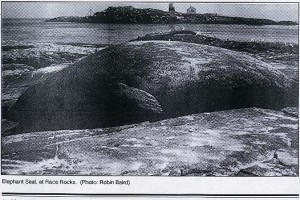
Elephant Sea[, at Race Rocks. (Photo: Robin Baird)

Moulting occurs at different times throughout the year depending on the age and sex of the animal. Juvenile Elephants Seals (about 1.5 – 2 metres in length) moult in the spring. In B.C. this is the age class most frequently seen hauling out to moult.

Moulting in Elephant Seals not only involves losing the hair, but the entire outer layer of skin, often in great sheets, and frequently the animals suffer from skin infections, resulting in bleeding. These infections are usually of low level and do not typically seriously harm the animal. When Pinnipeds (seals, sea lions and walruses) come out of the water their eyes continuously water to keep them moist, an adaptation that protects their eyes but also contributes to their sick appearance.

Most people assume that Elephant Seals are much larger than the juveniles which typically haul out in this area, but at this stage they appear fairly similar to Harbour Seals. In fact, confusing juvenile Elephant Seals with Harbour Seals occurs frequently. Despite the fact
Elephant Seal, adult male. (Photo: P.J. Stacey)

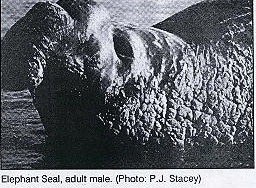
Elephant Seal, adult male. (Photo: P.J. Stacey)

that Elephant Seals can be approached closely by people on foot, have watering eyes, and due to their epidermal moult have skin that is literally falling off and sometimes infected, these are normal conditions and the animals are in reality quite healthy. There have been several occasions around Victoria in the last year where such Elephant Seals have been mistakenly identified as sick Harbour Seals and this has resulted in the inadvertent euthanization of the animals.

The differences between juvenile Elephant Seals and Harbour Seals are fairly obvious once you know what they are. Unlike Harbour Seals, Elephant Seals have no spots on the skin, rather they are a uniform greyish brown or yellowish colouration, although while moulting, their skin appears very patchy. The rather “swolled’ snout, and the horizontal crease just below the nostrils are characteristic of Elephant Seals, and a harbinger of the bulbous nose that comes with adulthood for the males. The hind flippers of Harbour Seals are relatively straight along the trailing edge, while Elephant Seals have a inverted U-shaped curve to the trailing edge of their hind flippers. Many of the animals are also tagged on the hind flippers, while very little work has been done in tagging Harbour Seals.

More accurate identification of Elephant Seals will both prevent the types of accidents mentioned above from occurring, and will assist research in terms of trying to monitor the numbers of Elephant Seals in the province. If population numbers in B.C. mimic the increase seen in their breeding range off California, Elephant Seals may become a more common sight off our coast. Such an increase should not worry those concerned with potential conflicts with fisheries, as the diet of the Elephant Seal consists mainly of species largely ignored commercially, such as Ratfish, Dogfish and other sharks, various species of skate, some squid, Cusk Eels, and occasionally deep water, slow swimming fish.

Records of Elephant Seals around southern Vancouver Island have been increasing in the last year, although it is not known if this is due to an actual increase in their presence, or just that more people are aware of the differences between Harbour Seals and Elephant Seals, and are reporting their presence.

We have been attempting to respond to most reports of hauled out Elephant Seals, or of 1arge sick Harbour Seals that you can walk right up to”. We try to check for tags, record age and if possible sex (not an easy task since you’d have to roll the distress.

Some animals are branded as well as tagged, although they lose the brand when they moult. Many are double tagged, with a different number on each tag, so both left and right hind flippers should be checked if an animal is found.

A summary of records of Elephant Seals in B.C., including information on their origin (for tagged individuals), is presently being compiled by Victoria resident Marcel Gijssen and others. Dr. Burney Le Boeuf is responsible for tagging many of the animals born near Ano Nuevo, a site in central California between Santa Cruz and San Francisco.

Anyone observing elephant seals in B.C. can assist with this project by reporting sightings to me at the following address:Department of Biological Sciences,Simon Fraser University, address now not applicable
References:
Hindell, M.A., Slipp, D.J., and Burton, H.R. 1989. Diving
Be-haviour and Foraging Ranges of Southern Elephant Seals (Mirounga leonina) From Macquire Island. Page 29 in Abstracts of the Eighth Biennial Conference on the Biol ogy of Marine Mammals, December 1989, Pacific Grove.


6The Victoria Naturalist Vol. 47.2 (1990)