Xanthocephalus xanthocephalus-Yellow-headed blackbird–The Race Rocks Taxonomy

Ecoguardian Anne Stewart made the first record of this species by photographing  this Yellow-headed blackbird female at Race Rocks, May 22, 2015 It is one of the 58 species that has been recorded by photograph as a migrant stopping off at Race Rocks.

Xantho= yellow,  Cephalus = head

YhblkbrdScientific classification
Kingdom: Animalia
Phylum: Chordata
Class: Aves
Order: Passeriformes
Family: Icteridae
Genus: Xanthocephalus
Species: X. xanthocephalus
Xanthocephalus xanthocephalus (Bonaparte, 1826)

yellow-headed blackbird
Other Members of the Class Aves at Race Rocks.

taxonomyiconReturn to the Race Rocks Taxonomy
and Image File
pearsonlogo2_f2The Race Rocks taxonomy is a collaborative venture originally started with the Biology and Environmental Systems students of Lester Pearson College UWC. It now also has contributions added by Faculty, Staff, Volunteers and Observers on the remote control webcams.


Camera 5 back on line

After a period of being down, our IT specialist at Lester Pearson College,  Maxim  Wieser has been able to restore Camera 5 to operation.  Now the only problem is keeping it clean, and that is no easy task as seagulls like to hover above it…….cam5a

https://www.racerocks.ca/video-cameras/camera-5-race-rocks/


Please read carefully the directions to control the camera on that page :

“Please close this screen in your browser after watching. The bandwidth used is very high so more viewers will be able to use the site if it is not streaming to your computer when you are not watching. If no one else is waiting, you can renew your view after two minutes.  

Directions for Control: Press the lower right square cross icon to gain control for 2 minutes at a time .  (You can regain control if no one else is trying to control the camera by clicking on the bi-directional arrow icon at the top.) Click directly on the image to change positions or on the panorama image below.  Use the vertical bar to zoom. At the top middle click on 320×240 down arrow and select 640×480.  If you see a “camera is busy sign”, this is because the maximum number of users has been reached. Wait a few minutes and try again. When not in control by a viewer, the camera will automatically move to pause 30 seconds at the 20 different presets.”


Misleading information in recent STANTEC report on Whales.

Also see the APRIL 23 post with graphs on Whale Observations from Race Rocks 2009-2014.
I believe that the increasing frequency in recent years in the number of humpback whales observed in the area which will be affected by increased tanker traffic from the Kinder Morgan/ TMX project has not been taken into account In the Consultant’s report issued today
“ Quantitative Assessment of Increased Potential for Marine Mammal-Vessel Interactions from the Trans Mountain Expansion Project TRANS MOUNTAIN PIPELINE ULC TRANS MOUNTAIN EXPANSION PROJECT –-Prepared by: Stantec Consulting Ltd. 500 – 4730 Kingsway Burnaby, BC, V5H 0C6 Ph.: (604) 436-3014, 

Quoted from the report :
“While the BC CSN data includes numerous opportunistic sightings of humpback whales in the study area over the course of the last four decades, the majority of the Marine RSA is generally not recognized as a humpback whale hotspot, although the western extent just overlaps with the eastern-most extent of humpback whale critical habitat –(Fisheries and Oceans Canada 2013a). As such, and since actual humpback whale density values for the Marine RSA (Regional Study Area) do not exist, this species was assigned a density according to the lowest density observed for humpback whales during the surveys reported on in Best and Halpin (2011) elsewhere in BC ((Williams and Thomas 2007) did not observe any humpback whales during their summer 2004 survey in this area) This value corresponds to roughly 10 whales distributed across the majority of the Marine RSA

——As a result, humpback whales were assigned a proportion of time in the study area of 0.17 (i.e., two months of the year) based on the largest concentration of sightings from the BC CSN data (British Columbia Cetacean Sightings Network 2013)”

Here is a good example, in my opinion,  of how a decision having long term implications regarding the welfare of a species recovering from near extinction may be completely misdirected if based only on a consultants interpretation of officially published scientific resources which can quickly become dated.

G.Fletcher
Agelaius phoeniceus :Red-winged blackbird–the Race Rocks taxonomy

This was our first photographic record of this species as a migrant at Race Rocks. It nests in the marshes throughout BC , and locally in the tidal marshes along Taylor Beach

A brief visit was made by six Red-winged Blackbirds.

A brief visit was made by six Red-winged blackbirds on April 27, 2015-Photo by Anne Stewart

Scientific classification
Kingdom: Animalia
Phylum: Chordata
Class: Aves
Order: Passeriformes
Family: Icteridae
Genus: Agelaius
Species: A. phoeniceus

Agelaius phoeniceus (Linnaeus, 1766)

Other Members of the Class Aves at Race Rocks.

taxonomyiconReturn to the Race Rocks Taxonomy
and Image File
pearsonlogo2_f2The Race Rocks taxonomy is a collaborative venture originally started with the Biology and Environmental Systems students of Lester Pearson College UWC. It now also has contributions added by Faculty, Staff, Volunteers and Observers on the remote control webcams.
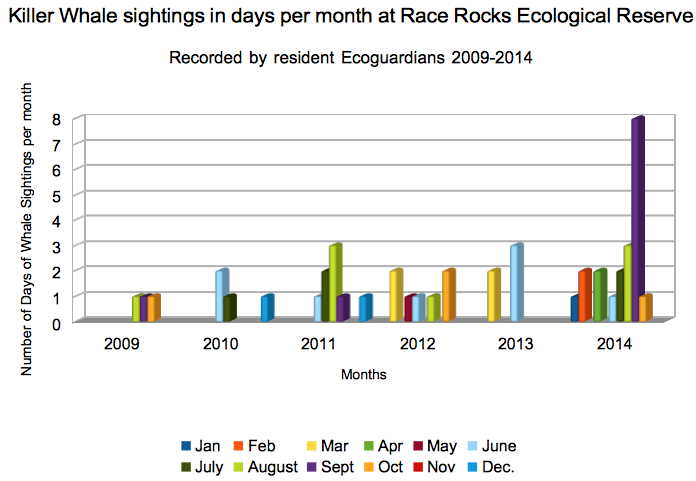
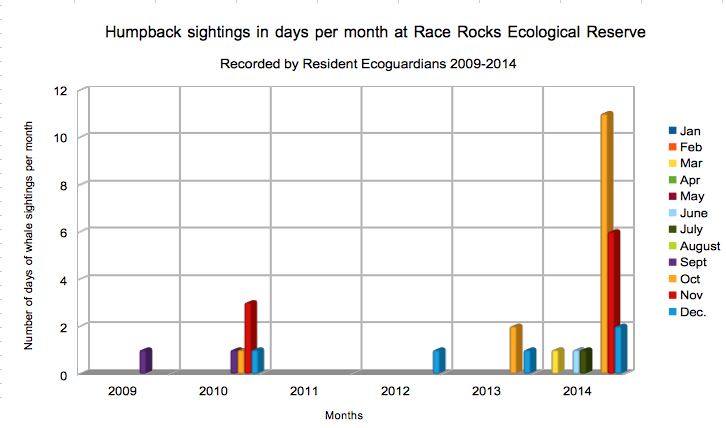
2009-2014 Whale Observations from Race Rocks

Lester Pearson College has employed the Ecoguardians at Race Rocks Ecological Reserve since 1997. One of the benefits of this is in having observers on site 24 hours on this archipelago in the Strait of Juan de Fuca. A great amount of citizen science is achieved as they record in their logs the events such as whale sightings of the area.

In the past year I have been working as an intervenor for the Board of Friends of Ecological Reserves to try to question and advise  the National Energy Board and the Kinder Morgan Corporation on the problems of increasing the traffic of oil tankers from the Westridge terminal through the Strait of Juan de Fuca. The area of potential impact from chronic and catastrophic oil spills puts at risk the ecological integrity of  up to 17 of our Marine Ecological Reserves around southern Vancouver Island. In our submission I was able to draw upon the records from the Race Rocks Ecoguardian’s logs to demonstrate the increase in the incidence of whales in this area. A recent report of the Department of Fisheries (Sufficiency Review of the Information on Effects  of Underwater Noise and  the Potential for Ship Strikes from Marine Shipping on Marine Mammals  in the Facilities Application for the Trans Mountain Expansion Project )has criticized the Environmental assessment done by Trans Mountain as being ineffective to take account of the increasing potential of Impact on the large whales such as humpbacks and the underwater noise which will masking of the ability of whales to communicate and get food.

I put together the following graphs to show the increase in the number of days per month that whales were observed from Race Rocks:

orcasighting
humpbacksighting

Thanks to Ryan, Raisa, Adam, Alex, Virginie, Julie, Courtney, Nick, and Anne for contributing to this database.

Addendum :  see the April 27 post on the report issued today ” Quantitative Assessment of Increased Potential for Marine Mammal-Vessel Interactions from the Trans Mountain Expansion Project TRANS MOUNTAIN PIPELINE ULC TRANS MOUNTAIN EXPANSION PROJECT –Prepared by: Stantec Consulting Ltd. 500 – 4730 Kingsway Burnaby, BC, V5H 0C6 Ph.: (604) 436-3014,

Garry Fletcher, Race Rocks Ecological Reserve Warden.


Seawater Salinity and Temperature March 2015

Year: 2015
 Date Time Sea Jar Hydro- meter No. Observed Density YSI Salinity YSI Temp °C
Temp. Temp.
°C °C
 Mar 1 9:30 30.2 8.9
 Mar 2
 Mar 3 12:41 30.6 8.8
 Mar 4 12:31 30.1 8.8
 Mar 5 13:16 30.1 8.9
 Mar 6 14:19 30.4 8.9
 Mar `7 20:20 30.1 9.0
 Mar 8 17:30 30.4 8.9
 Mar 9 18:00 30.2 9.0
 Mar 10 18:41 30.6 8.9
Mar 11 17:45 30.3 9.0
 Mar 12 15:45 30.1 9.0
 Mar 13 12:37 30.2 9.0
 Mar 14 6:28 29.9 9.2
 Mar 15 7:33 29.9 9.0
 Mar 16 8:53 30.2 8.9
 Mar 17 10:35 30.3 8.9
 Mar 18 12:16 9.1 9.1 10802 240 30.8 8.8
 Mar 19 13:28 30.7 8.9
 Mar 20 14:31 31.0 8.8
 Mar 21 15:38 31.2 8.9
 Mar 22 16:34 30.8 8.8
 Mar 23 17:49 31.2 8.8
 Mar 24 21:30 31.0 8.9
 Mar 25 22:49 30.7 8.9
 Mar 26 7:30 30.7 9.0
 Mar 27 6:17 30.3 8.9
 Mar 28 8:36 30.6 9.0
 Mar 29 7:20 30.5 9.1
 Mar 30 10:30 30.4 9.5
 Mar 31 11:49 30.6 9.4
MEAN: 30.5 9.0

Recorded by Race Rocks Ecological Reserve Guardian for Lester B. Pearson College

Students Project week at Race Rocks 2015

Pearson College students  Annabelle, Chloé, Hanne, Malou, Michael and spend time on their  project week at Race Rocks in March of 2015. They produced this PowerPoint presentation to document their time there:

A sampling of their photographs below: 


  Race Rock

New DFO Report highly critical of Kinder Morgan /TMX environmental assessment on Whales

The recentlly released DFO report:
(See Full PDF) SUFFICIENCY REVIEW OF THE INFORMATION ON EFFECTS OF UNDERWATER NOISE AND THE POTENTIAL FOR SHIP STRIKES FROM MARINE SHIPPING ON MARINE MAMMALS IN THE FACILITIES APPLICATION FOR THE TRANS MOUNTAIN EXPANSION PROJECT was very critical of the Trans Mountain Expansion Project Application documents. The Conclusion of the report is concerned with Vessel strikes on Whales and the overall impact of noise from increased Project-related traffic.  Included below are the conclusions of the report.

Conclusions

There are deficiencies in both the assessment of potential effects resulting from ships strikes and exposure to underwater noise in the Trans Mountain Expansion Project Application documents.

There is insufficient information and analysis provided with which to assess ship strike risk in the Marine RSA from either existing or Project-related traffic. Ship strike is a threat of conservation concern, particularly for baleen whales such as Fin Whales, Humpback Whales and other baleen whales (Gregr et al. 2006). If shipping intensity increases as projected in Section 4.4 in the Marine RSA and the Strait of Georgia and Juan de Fuca Strait as a whole, the significance of this threat to cetacean populations that occupy the region will increase.

Incidence of recovered whale carcasses is not considered to be an adequate measure of the frequency of ship strikes. No information is provided about the speed and maneuverability of Project-related ships or the distribution of whales in relation to the shipping lanes. Analyses that consider the statistical probability of ship-whale encounters and the risk of collisions are considered appropriate methodologies to assess this potential effect.

The JASCO MONM model, as it has been applied by the Proponent, is not adequate to assess the overall impact of noise from increased Project-related traffic. Although state-of-the-art acoustic modelling has been used to model the noise propagation associated with a single Project-related tanker in the Marine RSA, only four locations were chosen to represent the Marine RSA; therefore, the assessment does not adequately represent the noise exposure for the entire time a marine mammal would be in the RSA. The assessment represents only Project-related tanker traffic and not the current noise environment or the potential increase due to Project-related traffic. Finally, the method used to assess the significance of impacts from the modelled noise level contours resulting from a single Project-related tanker and tug on indicator cetacean and pinniped species is qualitative and the lack of an appropriate assessment framework reduces DFO’s ability to evaluate the assessment.

(See Full PDF) SUFFICIENCY REVIEW OF THE INFORMATION ON EFFECTS OF UNDERWATER NOISE AND THE POTENTIAL FOR SHIP STRIKES FROM MARINE SHIPPING ON MARINE MAMMALS IN THE FACILITIES APPLICATION FOR THE TRANS MOUNTAIN EXPANSION PROJECT

See other posts on Oil Spill Risk for the Race Rocks Ecological Reserve