Pleasant return trip… This time with all our stuff…(Thanks to Chris), ready for the 2 months ahead. We spot right away our first 1st gull chick actually pretty big and this time a very small oystercatcher baby, close to the jetty. It was easy enough the parents were so loud and the nest has just vanished.
Category Archives: Bird Notes
Shift Switch
The almost constant wind of Race Rocks did not disappoint today. Although is started slowly, once it warmed up there was a steady blow from the west of 25 to 30 knots. The sky was mostly clear with a little fog coming and going late morning and high clouds spreading out from the mountains. The barometer peaked at close to 1019 hPA. and then started to fall in the afternoon. There is a strong wind warning in effect again for tomorrow with the prediction following the pattern of light winds in the morning and building in the afternoon. The last few evenings have been quite windy and rough and the forecast tomorrow has a 40% chance of rain in the late afternoon and evening, on top of the wind.
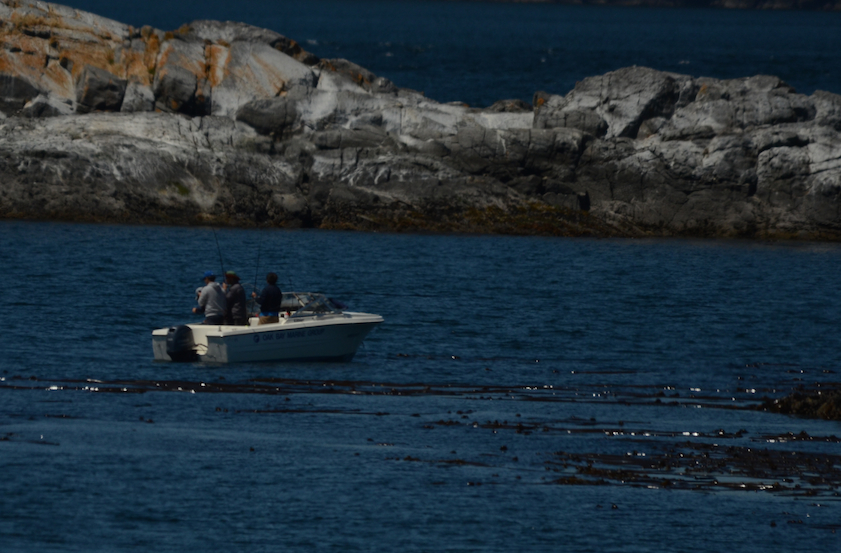
Two whale-watching boats came through the Ecological Reserve today. A Pedder Bay rental boat was observed fishing for rockfish in Rockfish Conservation Area which is closed to fishing. When I went out to take their photos they tried to move out of sight and ended up fishing about 50 feet off of Middle Rock. When I continued to document their activity they moved out close to the boundary and that is when the Pedder Bay folks showed up to encourage them to move out of the Reserve. That kind of support and community encouragement to follow the rules is really amazing. A big shout out to Pedder Bay Marina, thank you for making the effort for conservation. That kind of response will help keep your business sustainable.
Things continued as expected today with the usual ecological happenings described in the the last few days’ Logs. Chunk and Floyd avoided each other a bit more today which is definitely a good thing for the gulls which don’t stand a chance when the big guys get out of control. Floyd is almost finished his moult with just a few vibrissae and wee scraps of old skin on his back to go. He has lost a tremendous amount of the bulk he brought ashore when he first arrived.
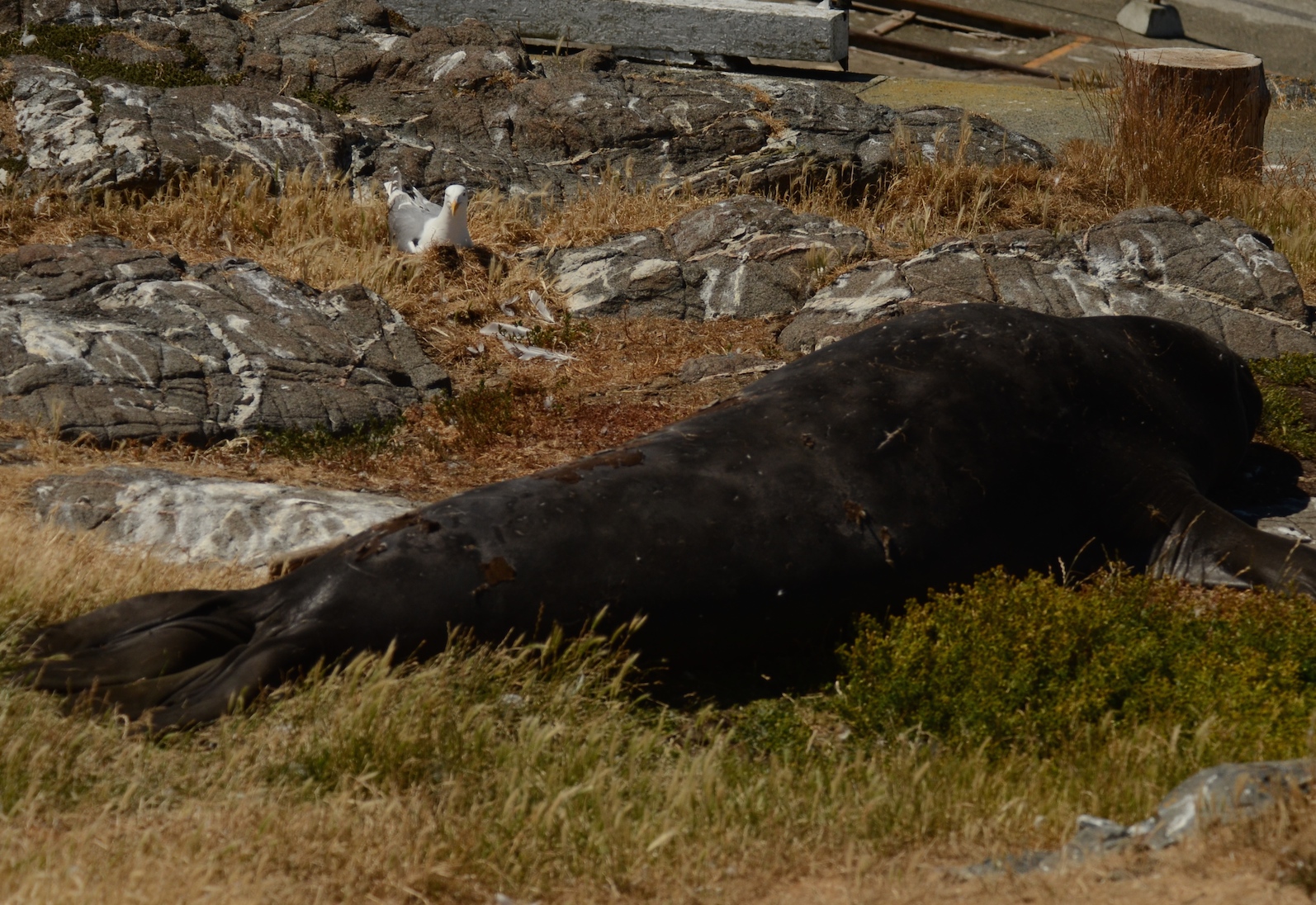
Floyd has lost not only his skin and fur but also ~30% of his weight, since he came ashore to moult.
Killer Whales were in the vicinity in the early evening. A small pod of Biggs’ Killer Whales swam slowly westward through Race Passage and the whale watching boats were talking about the Southern Resident Killer Whales’ L-pod being a little further west.
There were no visitors and work was focused mainly on preparing and cleaning things for the next crew, Guy and Christine, who will start tomorrow. It has been a real privilege to be out in this special, bio-diverse and productive place and I look forward to returning and meeting the next wave of marine science students in September.
Small Seal Hauls On Bull Kelp
The wind blew steadily 25 to 30 knots from the west today, all day. The morning was relatively calm on the lee side but by early evening it was really rough all around Race Rocks. Cloudy morning skies gave way to a sun-dominated mix, of sun and clouds in the afternoon. There was no precipitation in spite of the clouds. Remarkably, the total annual rainfall here to date is ~22 cm, not much. The barometer climbed back up to 1016 hPA., before starting another little slide. The forecast is calling for sunshine with increasing cloud and continuing strong westerlies.
No vessels were observed in the Ecological Reserve during the day today. One whale watching vessel was observed working in the Reserve just at sunset.
Ecological happenings are all in motion and continue on the path that has been described over the last few days. The bull kelp growth may be slowing as evidenced by some epiphytic growth showing on a very small percentage of the “plants”.
These algae are super carbon fixers and not only crank out food, they also grow so thickly that they shelter the Sea Otter and today I saw a small Harbour Seal actually climbing out of the water onto the bull kelp. It is slippery stuff so I was surprised when I looked a few hours later: it was still there and had managed to dry off the upper part of its body while hauling on bull kelp.
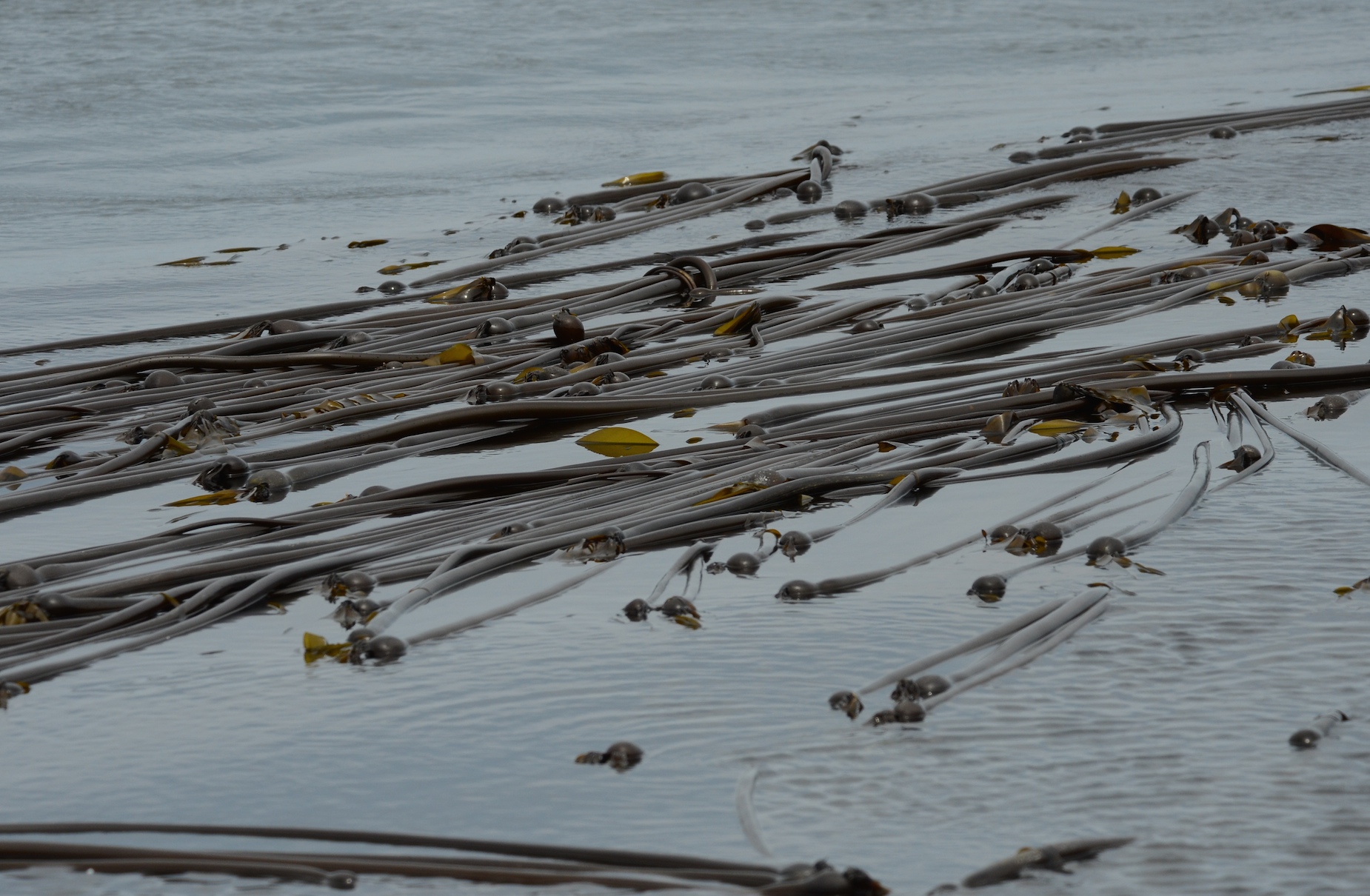
Bull kelp is still actively growing.
I realized today that the Harbour Seals, of which there are a lot more (225 to 250) than Northern Elephant Seals (maximum count 35), may have had the short end of the stick when it comes to mentions in the Log entries. Maybe it is because the elephant seals are up close and personal and not bothered by our presence. Maybe it is because it has been such an priviledge to get to know the elephant seals and their diverse personalities and behaviours. The Harbour Seals are further away and hard to tell apart as individuals. An adult Bald Eagle was very interested in the Harbour Seals today and although it is early for inside waters, I thought that there might be some pupping activity soon.
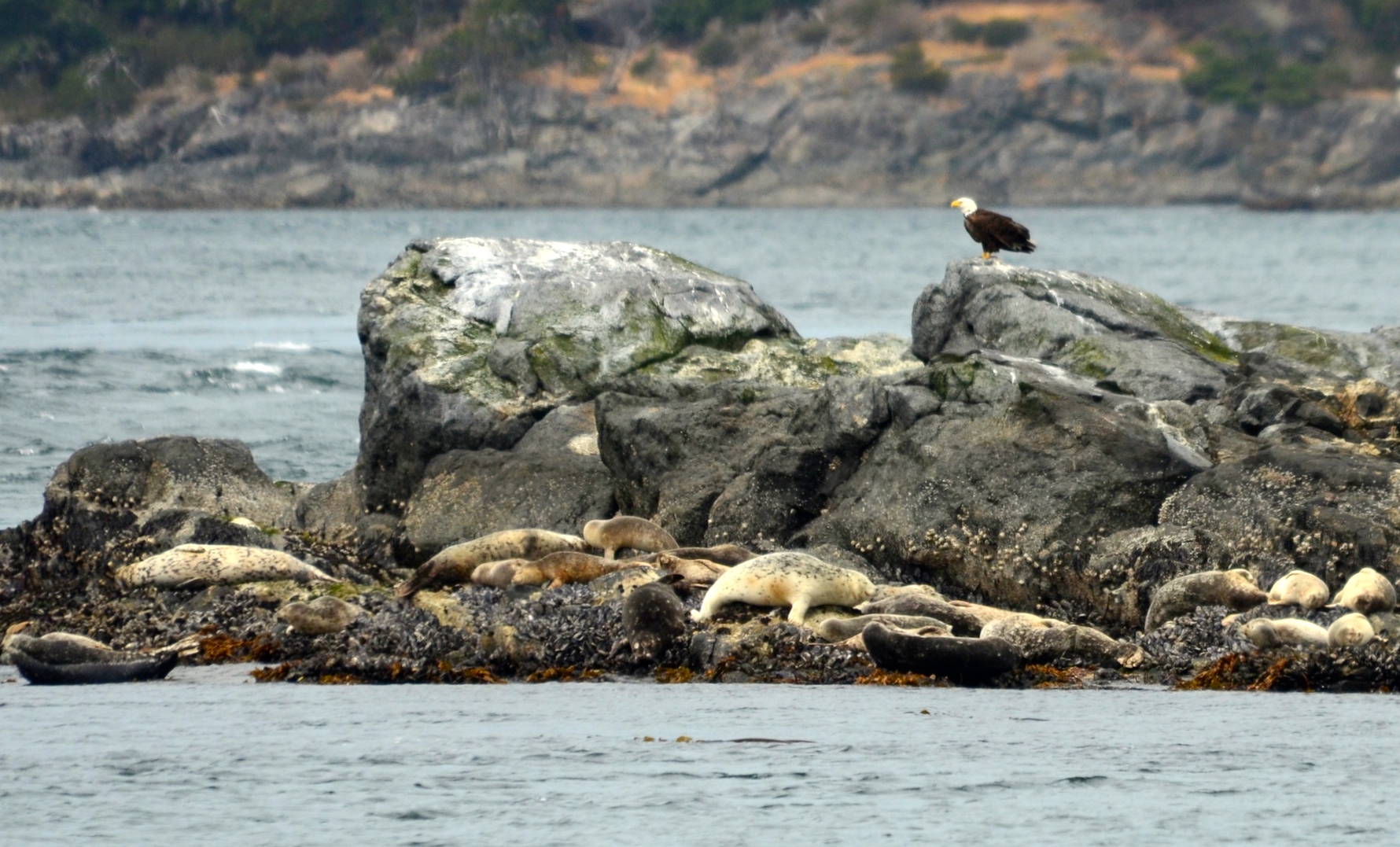
Adult Bald Eagle on watch near hauled out Harbour Seals on Turbine Rock.
Chunk and Floyd often sleep together behind the science house. Floyd’s moult is more than two thirds done while Chunk has not even reached a third yet.
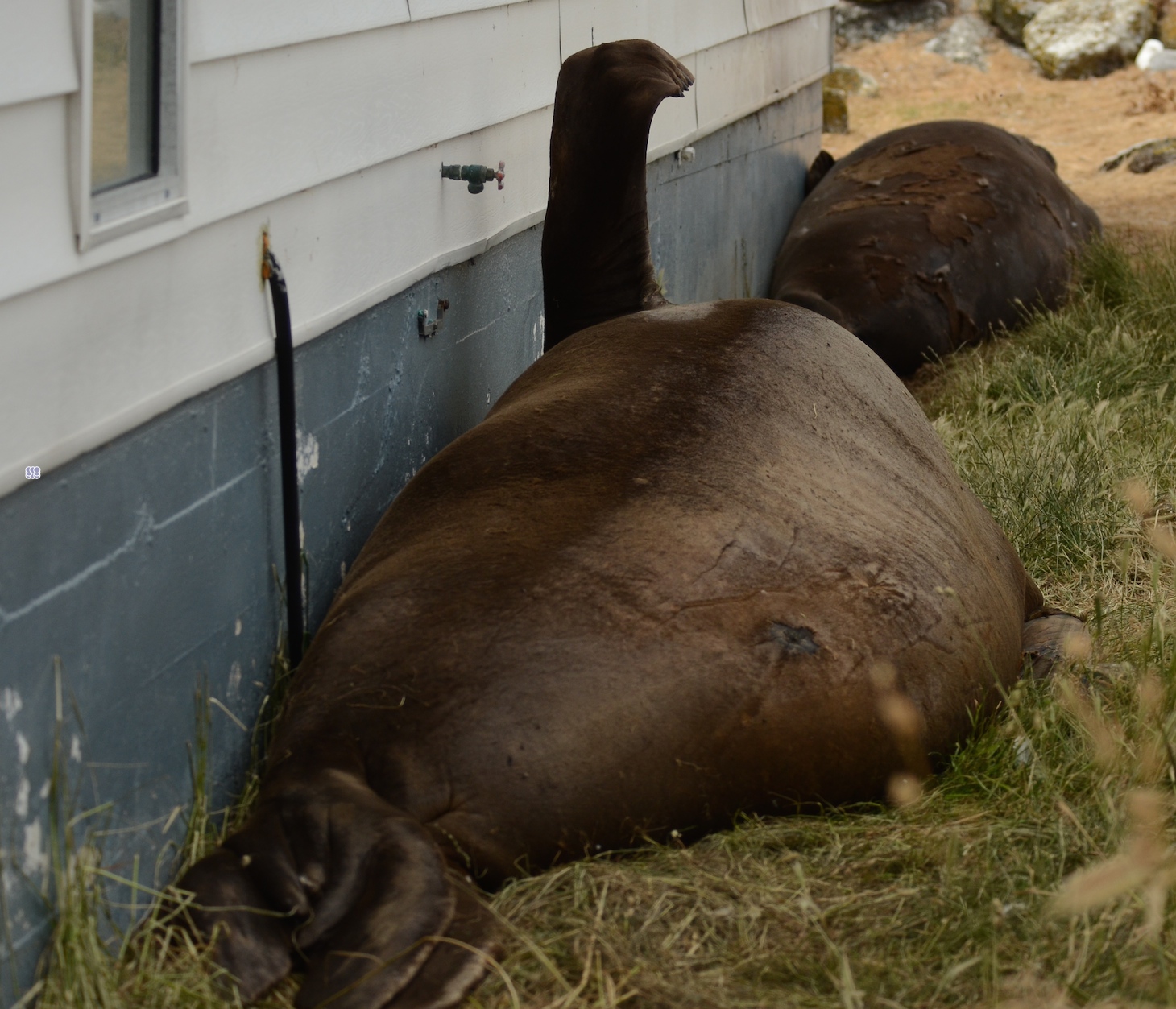
Chunk (closest) and Floyd stretched out behind the science house. Chunk is stretching his right fore flipper.
Chunk and Floyd also have their battles and tonight they chose to fight in amongst the nesting gulls, crushing at least one nest and killing an adult that was trying to defend its nest.
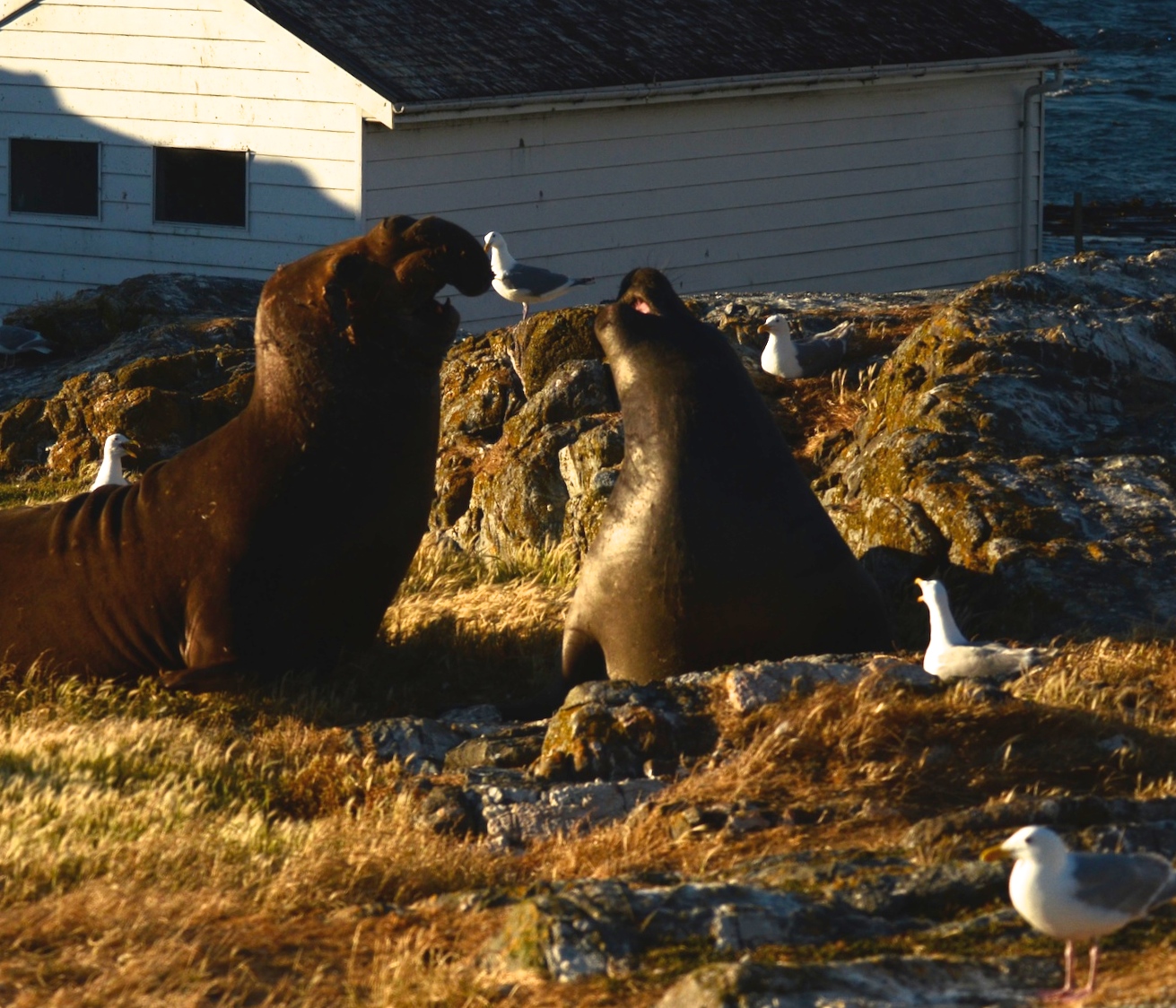
Chunk and Floyd go at each other in among the nesting gulls.
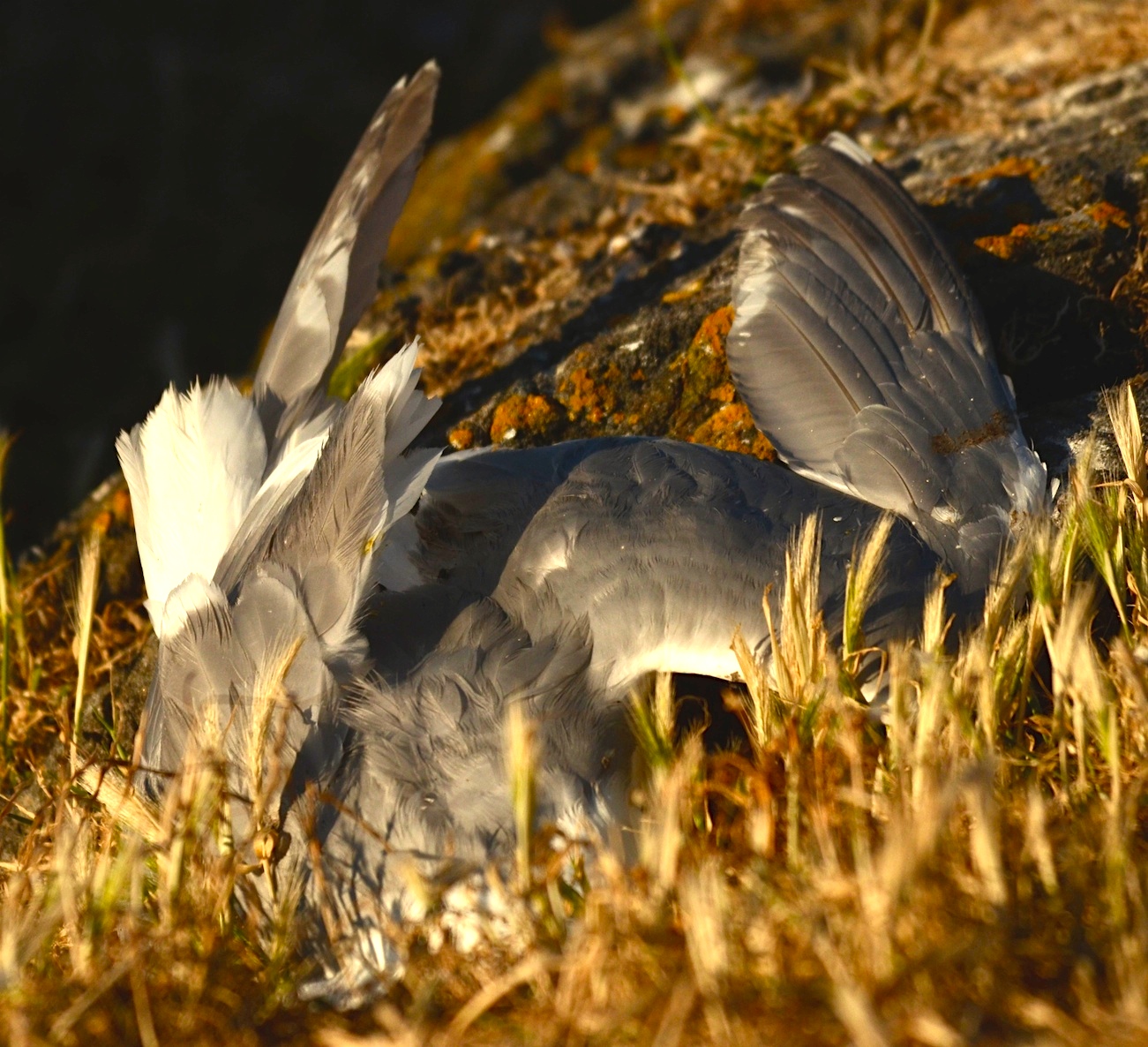
Gull versus adult bull elephant seal: seal 1; gull 0.
My favorite bird here continues to be the Black Oystercatcher, there is something about their very spartan nests and their willingness to take on adult Bald Eagles and Ravens that makes me cheer them on. Their looks are pretty great too. The newly hatched chicks are very precocious and can follow parental commands almost immediately. They are so good at remaining perfectly still when “told to” that they are almost impossible to see. Thank goodness for telephoto lenses. I will try to get a photo of the chicks from a distance tomorrow.
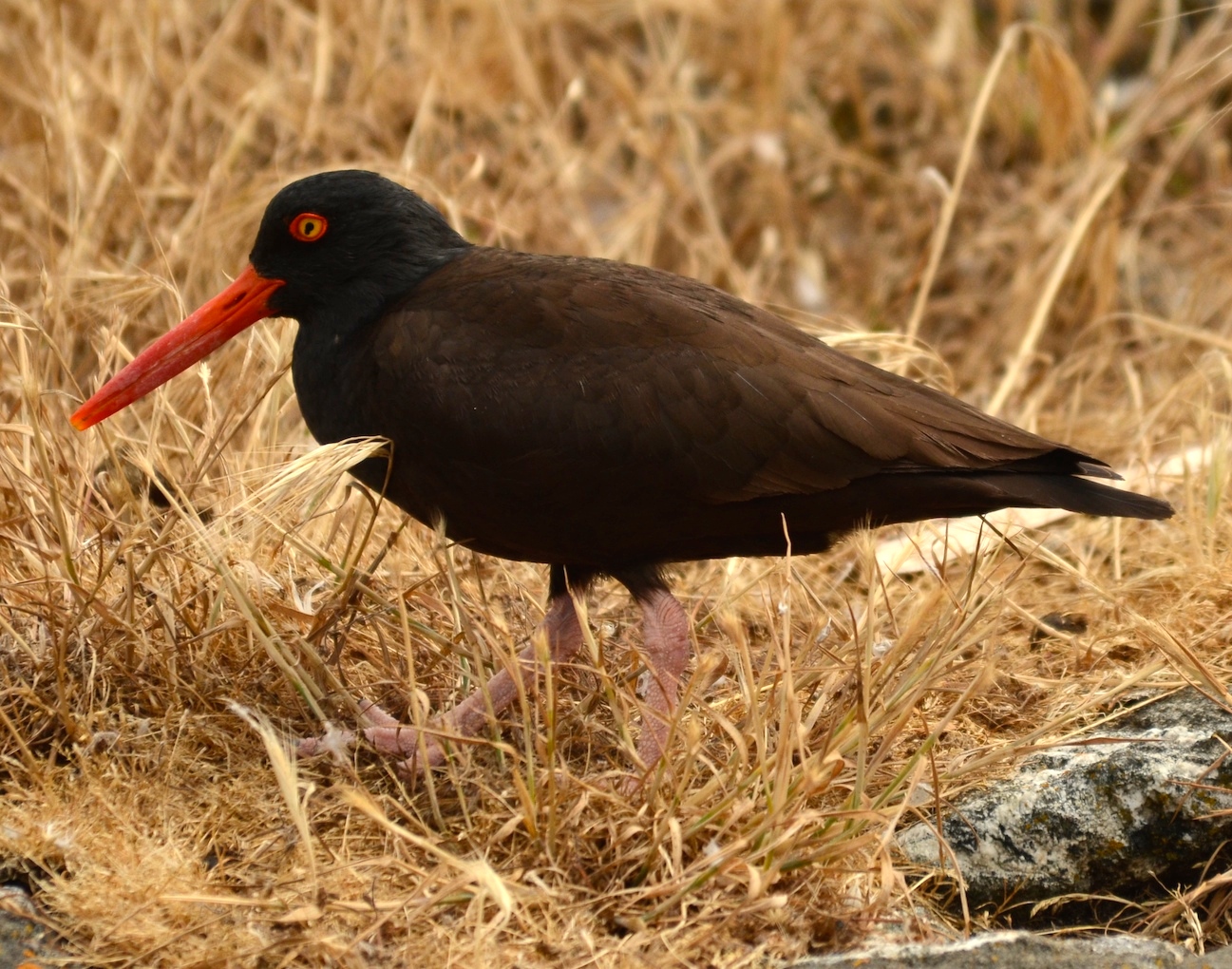
Black Oystercatchers are fiercely brave little birds and willing to chase off Ravens and even Bald Eagles. Their nests are entirely comfortless with only pebbles and shells for decoration.
There were no visitors today and chores were routine as I wrap up the last few days of my shift.
National Aboriginal Day at Race Rocks Heritage Site
The wind was slow and relaxed most of today at Race Rocks. In the morning, it blew 5 – 10 knots east and in the afternoon it turned to south/southeast and blew just enough to make the flag look good. The outflow wind pushed out the fog that had formed early to the west. Eventually the wind backed around through south, southwest and over to west. At the end of the day it was blowing west 20 to 25 knots and a strong wind warning is part of the forecast along with a mix of sun and cloud, mostly cloudy with fog banks in the morning.
The sky was clear all day today and with the clarity, cloud formation on the Cascade and Olympic Mountains ranges was visible. Mount Baker stood like an eastern sentinel and Bahokas Peak was visible, low, like a distant lookout, at the far southwestern entrance to the Strait of Juan de Fuca.
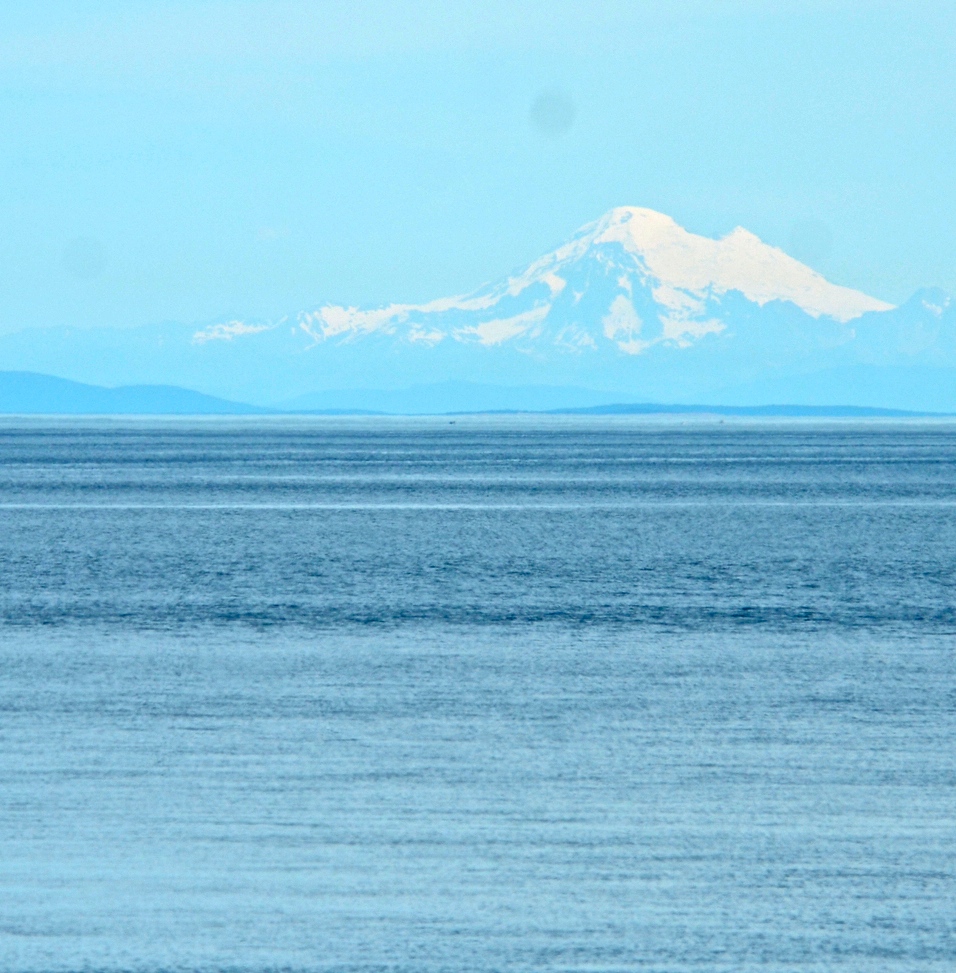
Mt. Baker to the east.
Today, the barometer continued the slide it started on Friday and ended up just above 1010 hPA. in the late afternoon. With the still wind and intense sunshine came higher temperatures. The high today of 18o C is a big jump up from the week’s average of 13.9 o C to Saturday and from the overnight low of 10.5 o C. That was sea surface temperature yesterday 10.5 o C.
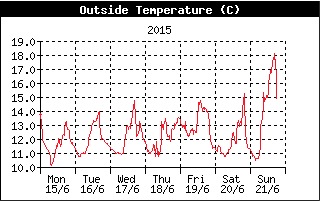
Outside air temperature at Race Rocks for last week.
There was very little whale watching activity today with only one vessel observed working in the Ecological Reserve. There were quite a few sports fishing vessels in reserve including rentals, charters and individual fishers. Two boats were observed fishing for rockfish in the closed Rockfish Conservation Area, within in the Ecological Reserve. Most people respect the closure and this is how the area has a chance to rebuild and start to contribute juvenile fish to adjacent areas.
Today is national aboriginal day and I would like to honour the First Nations within whose territories Race Rocks lies today. I would also like to draw attention to the stone cairns on the island, which date back to ~500AD. These cairns are a testament to a long and storied history that has been too often down-played or downright ignored, by Euro-Canadian historians. https://www.racerocks.ca/history-of-race-rocks/first-nations-burial-cairns-at-great-race-rocks/
Ecologically we are moving into summer and these lovely long days are important markers of biological activity. Most of nesting gulls are incubating and almost all the nests I have had a peek at, have three eggs. This island is an ideal location for nesting studies as the light tower offers an incomparable 360-degree view. Observational activity from that height does not disturb the nesting birds.
Seasonal timing is important and gull and oystercatcher chicks should start hatching out in a couple of weeks. It is trickiernow to pinpoint what is going on with the Pigeon Guillemots and easier later, once they start to carry fish to their chicks. The early nesters (Canada Geese) have young almost full size now and their numbers have dropped again. There are only two pairs of adults left; one pair with five goslings and the other with three. An adult Bald Eagle was hunting here today.
In the water around Race Rocks, at least three species of salmon are passing by (Chinook, Coho and Sockeye) and halibut have moved into the relatively shallow waters outside the reserve. At the surface, mixed species, feeding flocks are starting to form, driven from below by diving birds such as Rhinoceros Auklets. That is where the juvenile gulls seem to be feeding. The sea lions have all gone now and pregnant Harbour Seals are starting to look very round. Just Chunk and Floyd remain in the elephant seal department and they were both sleeping up against the back of the science house most of the day.
I went ashore briefly today and was back by breakfast. There were no visitors and chores were routine today.
Chunk Chilling
The morning was relatively calm with west winds of 5 to 10 knots. As the day progressed wind speed picked up gradually. When the fog rolled in, early afternoon, the wind rose more and by 18:00, it was blowing the more usual, 25 – 30 knots. By sunset it had calmed right down to 10 -1 5 again. The sky was clear all day and the blue was even visible, looking straight up through the fog. The barometer dropped very slowly all-day and ended up at ~ 1014HPA. in the early evening. The forecast calls for continuing west winds increasing to 15-20 knots (strong wind warning) Sunday afternoon, with a mix of sun and cloud.
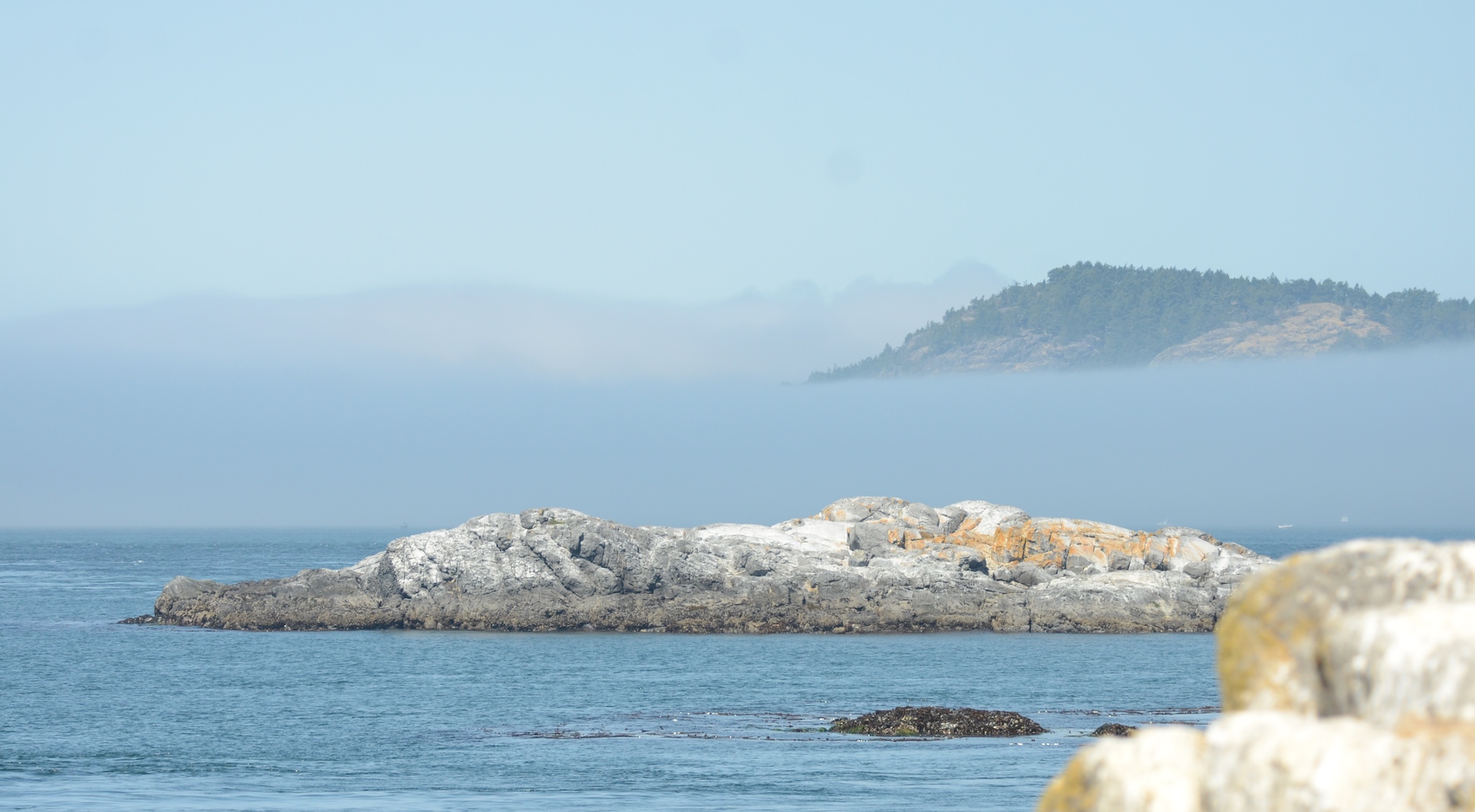
The fog rolling in past Church and Swordfish Islands (obscured).
It was another busy whale-watching day at Race Rocks and 18 whale watching visits to the Ecological Reserve were noted. There were many more vessels that passed just outside the Reserve following pods of Southern Resident pods of Killer Whales. The usual Saturday dive charter operator also worked in the Ecological Reserve. Three sports fishing vessels came through as well and they mostly respected the speed restriction (7 knots) in the Ecological Reserve boundary.
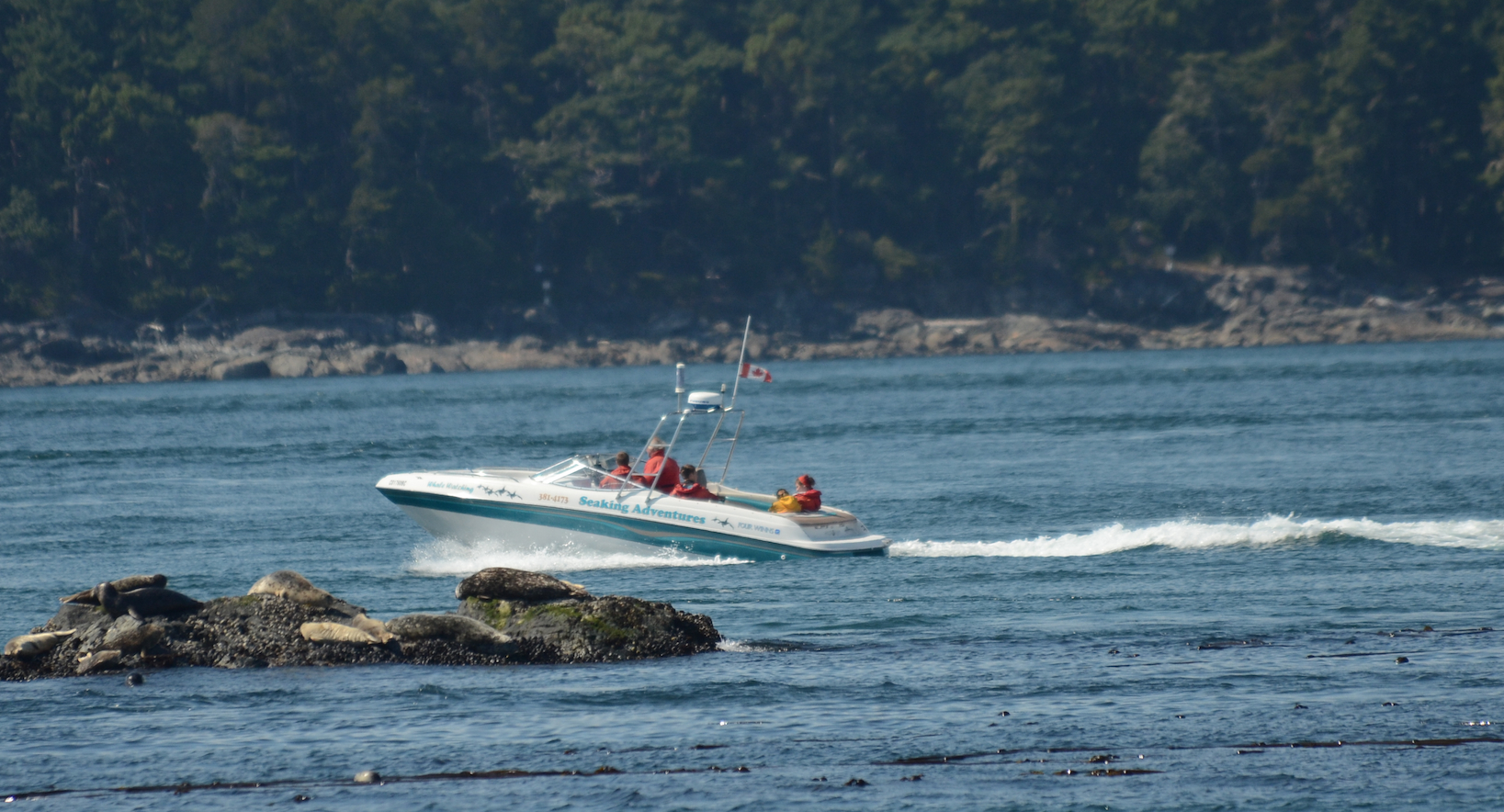
Race Rocks was again at the centre of whale activity today. A large Humpback was feeding to the east early and then headed west through Race Passage and then off to the south. Several groups of Southern Resident Killer Whales passed through the Ecological Reserve, through Race Passage and over Rosedale Reef, with the afternoon/evening flooding tide. One group of three to four individuals came right through middle passage passing within meters of the end of the Jetty. According to the whale-watching fleet there were animals from both J and K pods going through Race Rocks at the same time. Biggs’ Killer Whales also passed by Race Rocks through Race Passage also heading east with the flooding tide.
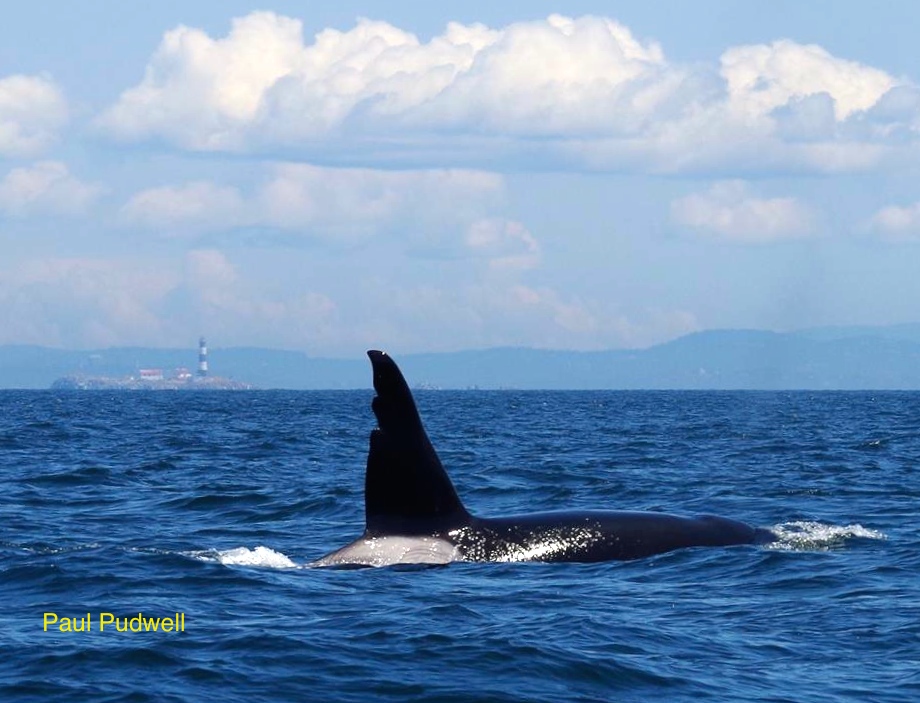
Chainsaw is the nickname for this big, male Killer Whale. Chainsaw is what we used to call a transient or T -killer whale. The Ts are now known as Biggs’ Killer Whales named after the late Mike Biggs who did ground-breaking, pioneering work on Killer Whale identification and social systems on the west coast. Photo thanks to Paul Pudwell.
The same three Northern Elephant Seals continue their moults on Great Race. There are no elephant seals left on Middle Rocks. The little, two-year-old, Stellers Sealion was joined by the one and only Californian, on South Islands and it was just as well they were hauled out with the Biggs Killer Whales around. The usual spots were filled with Harbour Seals at low tide.
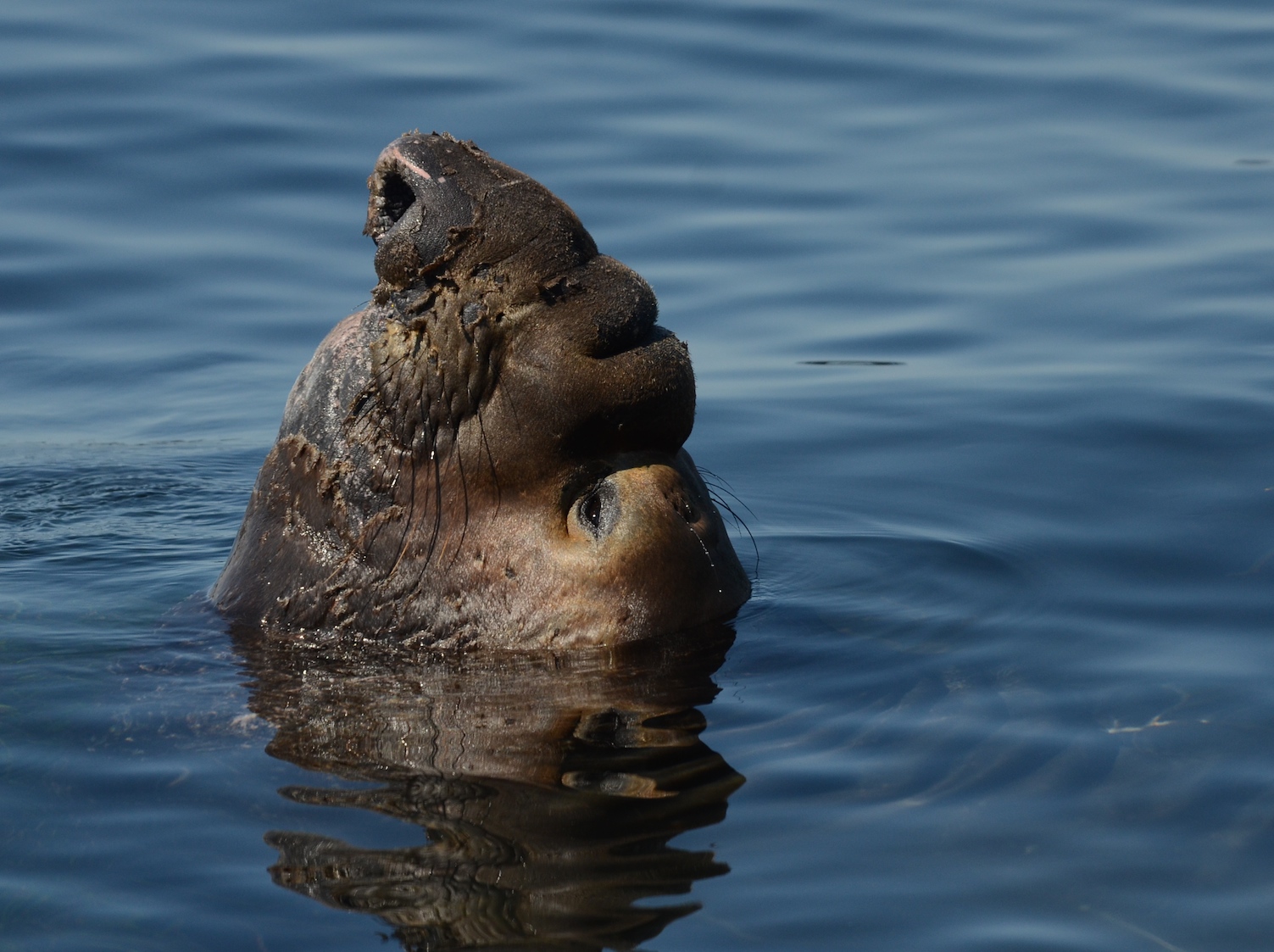
Chunk chilling.
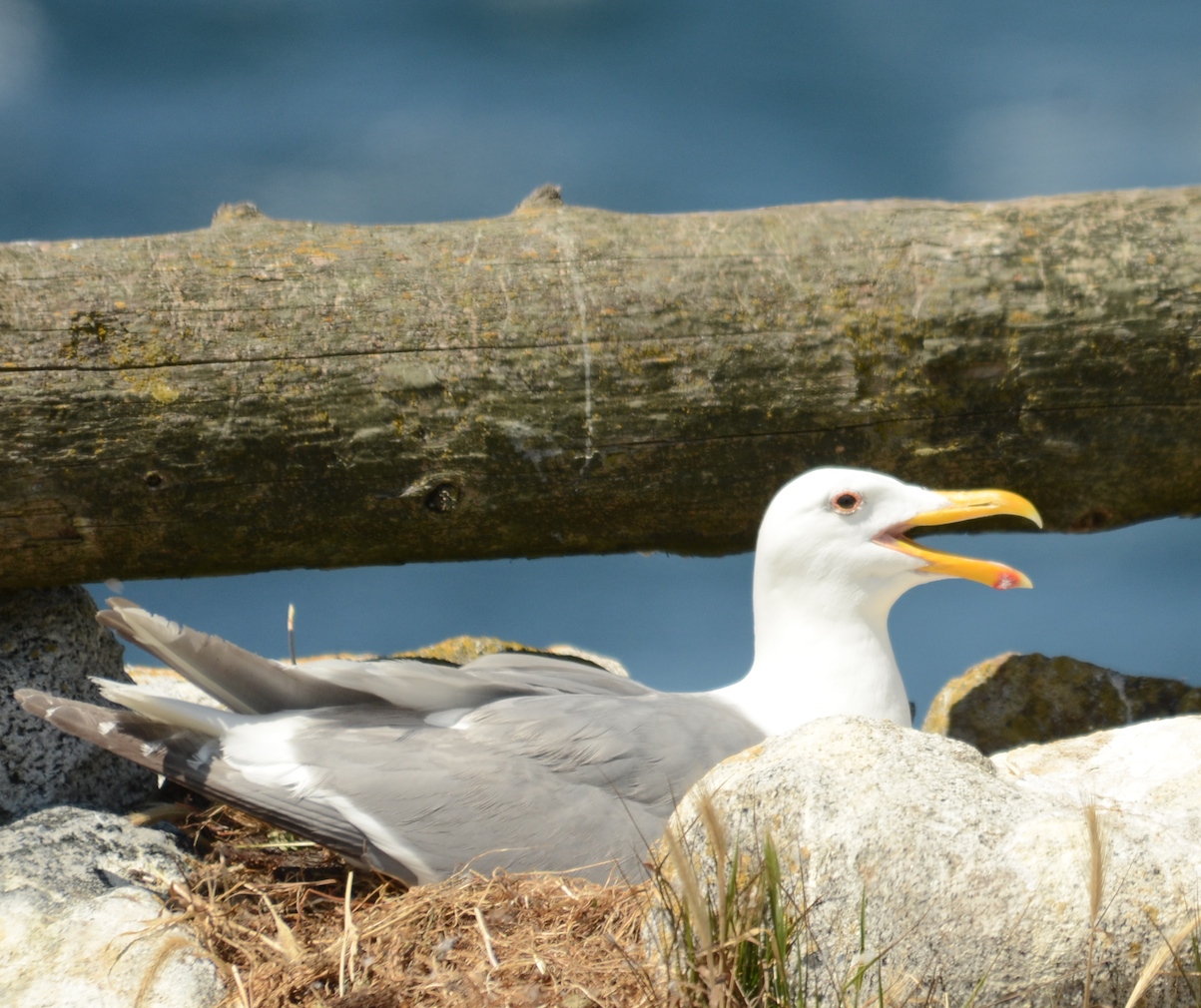
Lots of Glaucous-winged Gulls were seen mouth open and panting, to cool their eggs today during the intense sunshine. The Black Oyster catchers continue to incubate as well and Pigeon Guillemots continue to mate. The main nesting sites for the Guillemots seem to be in the rock piles just west of the jetty, west of camera five and in the surge channel southwest of the science house. There is also scattered guillemot activity around the perimeter of the island especially in boulder and crevice areas. The ten Canada Goose goslings left are at different stages of development but quite a few of them are getting flight feathers now and the black and white colouration on the head and tail (like the adults) is starting to fill in.
An interesting sighting today was an Anna’s Hummingbird, spotted by Alex near the Science House. Missing in action was the Sea otter, which was nowhere to be seen today. There was quite a bit of Bald Eagle activity early on and that might have an effect but I was also thinking of the parade of 25 whale watching boats that all made up-close and personal connections with the sea otter a few days ago and wondering if it was just too much.
The sunshine continues to provide almost all of the electrical power requirements for the island. There were no visitors today and chores were routine.
A Tale of T-Whales
Today the wind continued its westerly path, bringing fresh ocean air in through the central Strait of Juan de Fuca at 20 to 35 knots. The sky was mostly clear, with clouds forming in the distance, along the tops of the Olympic and Cascade Mountain ranges. The barometer continued the climb it started yesterday until late afternoon, reaching almost 1020 hPa., before starting to gradually drop as the sun descended toward the horizon. Gale warnings continue to be in effect and the forecast calls for a mix of sun and cloud tomorrow.
Five whale watching vessels were observed working in the Ecological Reserve today in spite of adverse weather conditions. They all moved carefully and at a respectful speed being mindful of the marine mammals (Elephant Seal, Harbour Seals, Sea Lions, Sea Otter) and nesting seabirds in the Reserve. The only other vessel observed transiting the Ecological Reserve today was the Fisheries and Oceans vessel, Cape Kuper travelling at a discreet 25 knots towards Victoria, in the go slow zone.
Ecological happenings described in some detail in my earlier logs continue. (Elephant Seals haul out, socialize, sleep and moult. Other pinnipeds haul-out socially. Glaucous-winged Gulls, Pigeon Guillemots and Black Oystercatchers mate, nest, lay, incubate and get territorial. Mixed species feeding flocks (fish balls) attract gulls on the water and kelp is still growing.)
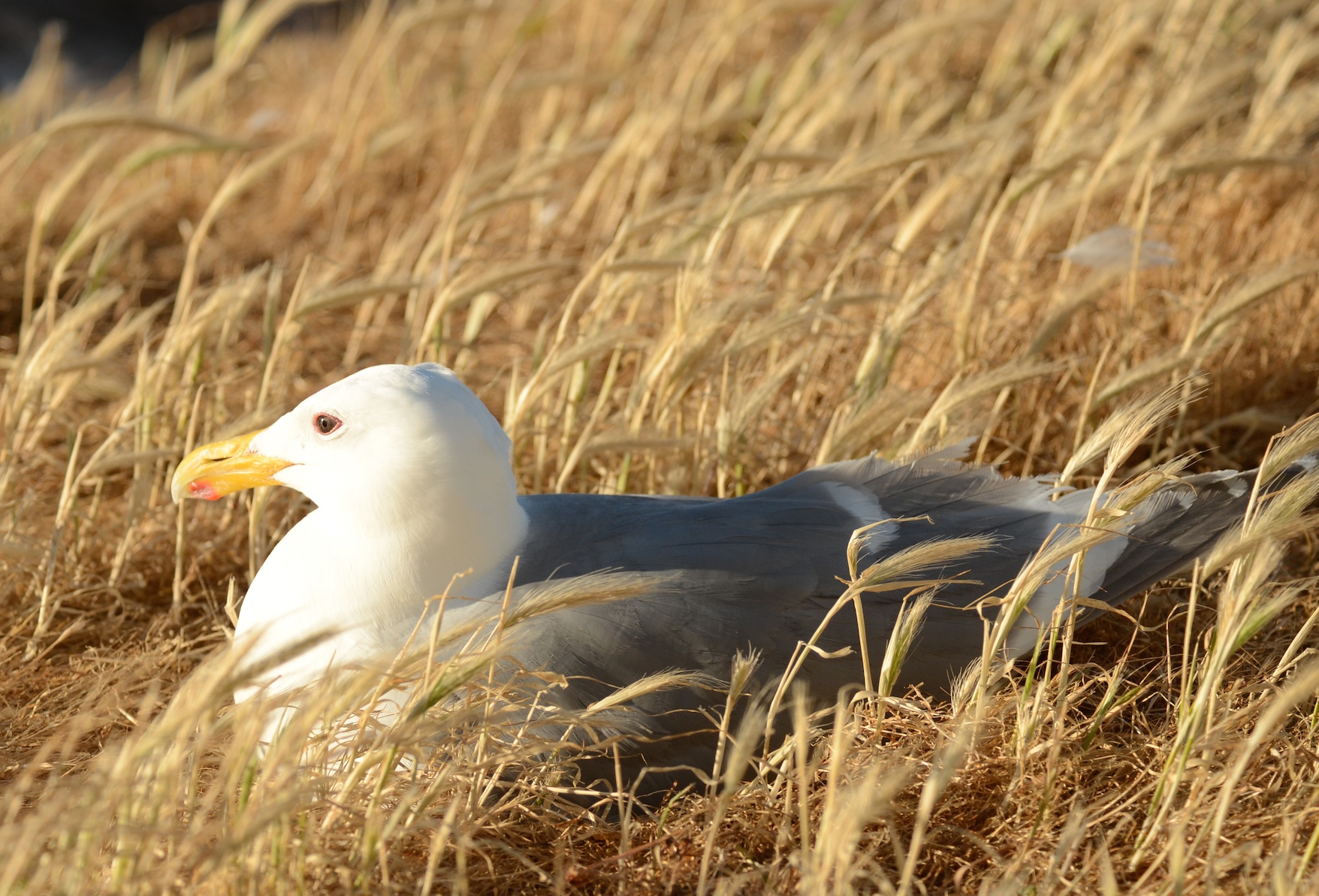
Glaucous-winged Gull incubating three eggs.
Of note was the sighting of Biggs’ Killer Whales (Transients) in the evening. I counted six individuals including a large bull with a very triangular fin. The two whale watching boats closer to them reported seven or eight individuals including a young calf. As often happens with T’s, as they used to be known, we spotted them a couple of times and then they totally disappeared. They showed up again, with the whale watching boats “in tow” a mile or so to the east.
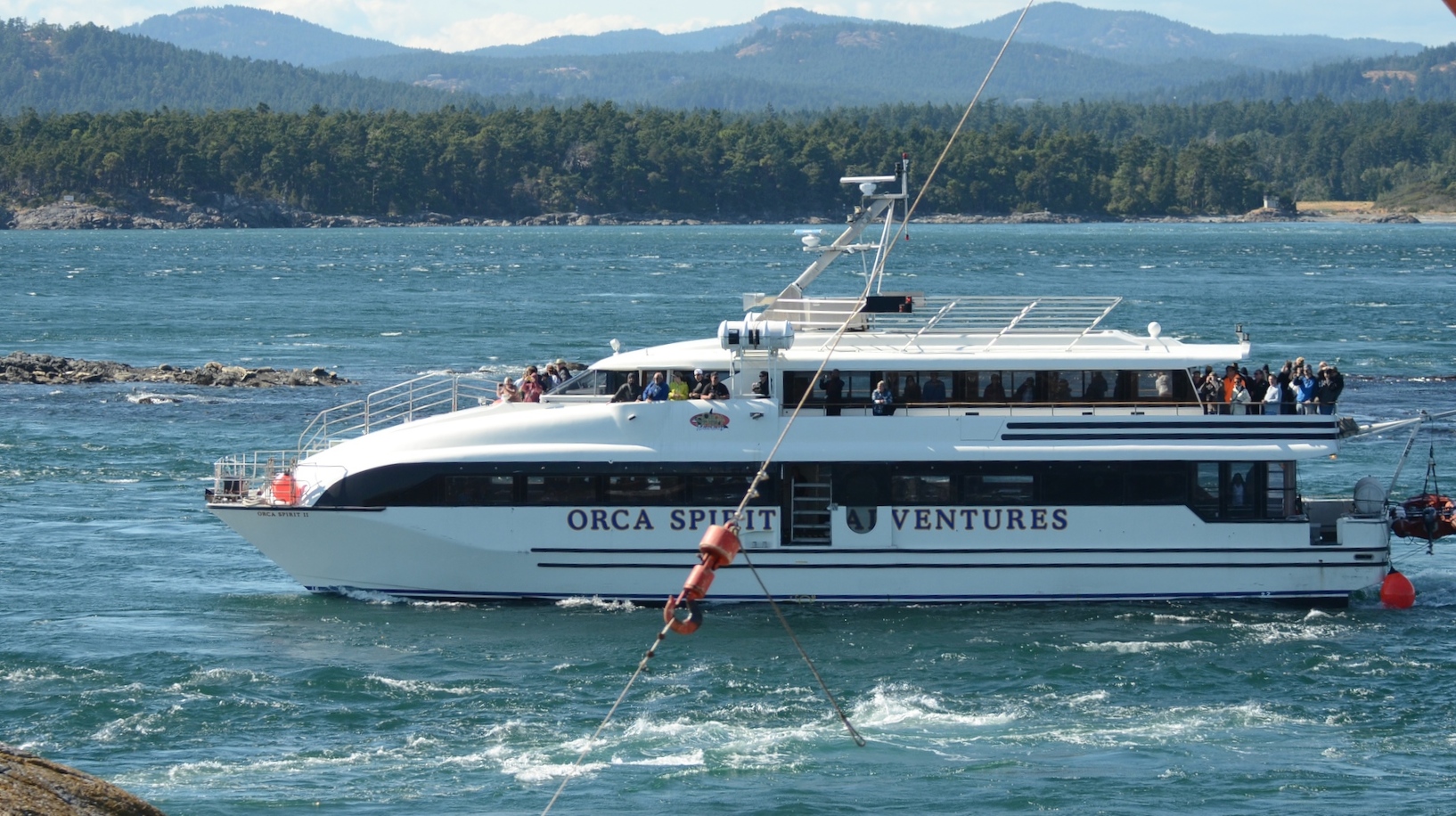
Orca Spirit runs upstream through Middle Channel.
Here are the results of the weekly animal census.
Northern Elephant Seals 3 (Chunk, Floyd and young female) only on Great Race, none on Middle Rocks)
Harbour Seals 221
California Sealions 1
Northern or Stellers Sealions 1 (juvenile (Could be the two year old that was still with its mother earlier in the season (that size).)
River Otter (not seen but probably still here, fresh feathers in boat house)
Sea Otter 1
Biggs’ Killer Whales 6 (Transients) (Just north, outside of Ecological Reserve in Middle Channel near North Rock.)
Humpback Whale 1 (“Big Mama”) (Just outside of Ecological Reserve to the south of Rosedale Reef.)
Canada Geese 16 (= 10 goslings + 6 adults) (most have left)
Pelagic Cormorants 3
Double Crested Cormorants 5
Bald Eagles 1 sub-adult (no adults seen)
Black Oystercatchers 8 (4 nesting pairs)
Kildeer 2
Pigeon Guillemots ~100
Glaucous-winged Gulls total 457 (385 adults in nesting areas; 72 roosting/resting on Middle Island including 14 juveniles). Large majority of gulls are incubating now, although some are still getting started. No chicks observed yet
Alex and I came out on Second Nature last night with Chris. Christine and Guy returned to shore the same way. A big shout out to Chris for all his support.
There were no visitors and chores were routine, but more fun with company.
Swimming Lessons Continue
The west wind was moving at dawn and fog followed shortly after. By mid-day it was blowing 15 to 20 knots. Hints of blue could be seen overhead, even as visibility was often reduced laterally, to several hundred meters, as the fog came and went throughout the day. A gale warning remains in effect for today and they are calling for clear skies, fog patches and some cloud for tomorrow. At noon the barometer seemed to have leveled out at ~ 1012 hPA., with a falling tendency however, according to Environment Canada.
Two whale watching vessels were observed working in the Ecological Reserve in spite of fog hampering visibility. There may have been more.
Chunk and Floyd continue to have mock battles without much serious damage and then conk out for hours at a time almost next to each other. Floyd is half moulted now and Chunk is still really just starting with just his chin and face showing the change.
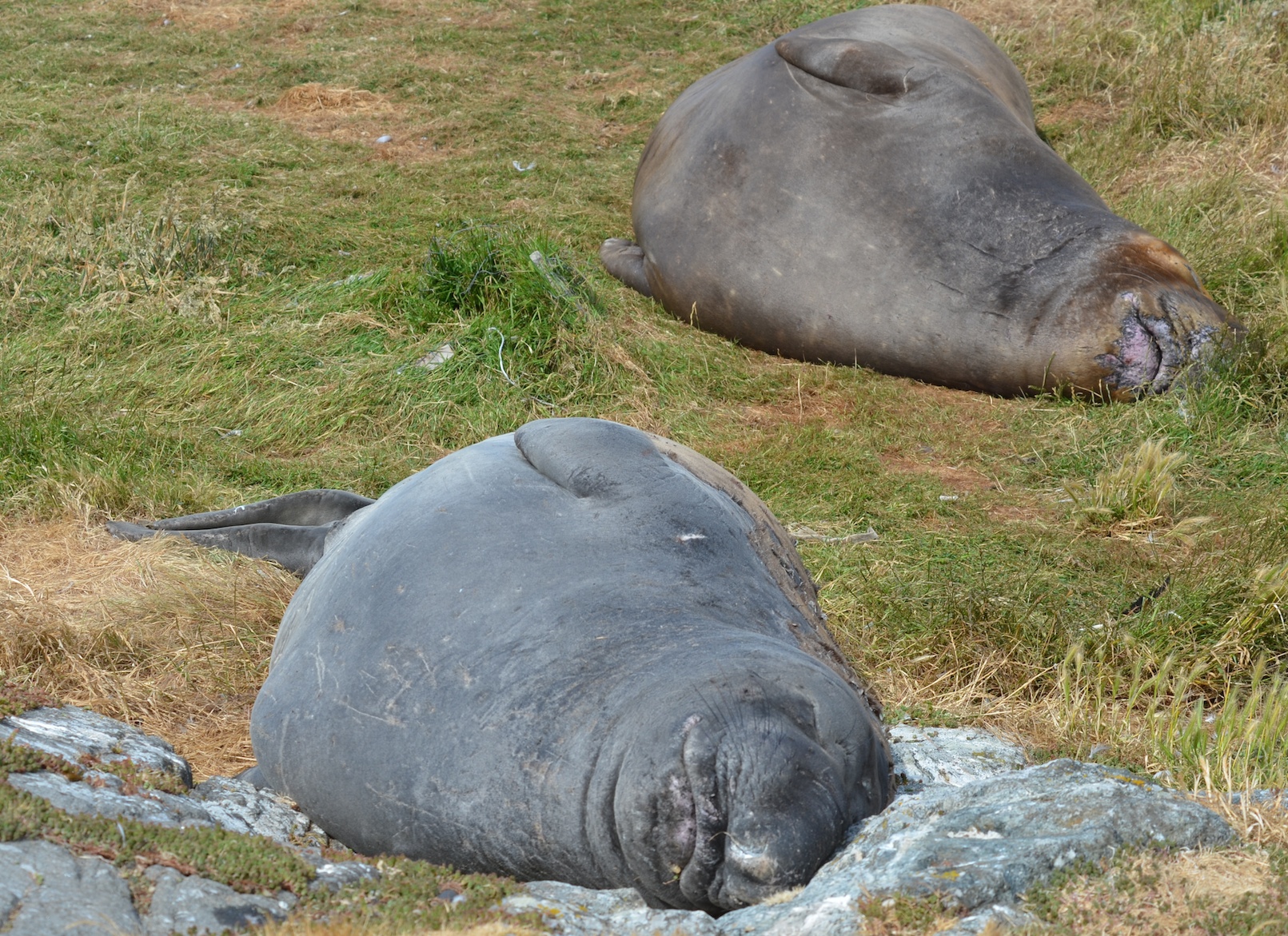
Floyd (foreground) and Chunk, huffing and sloughing.
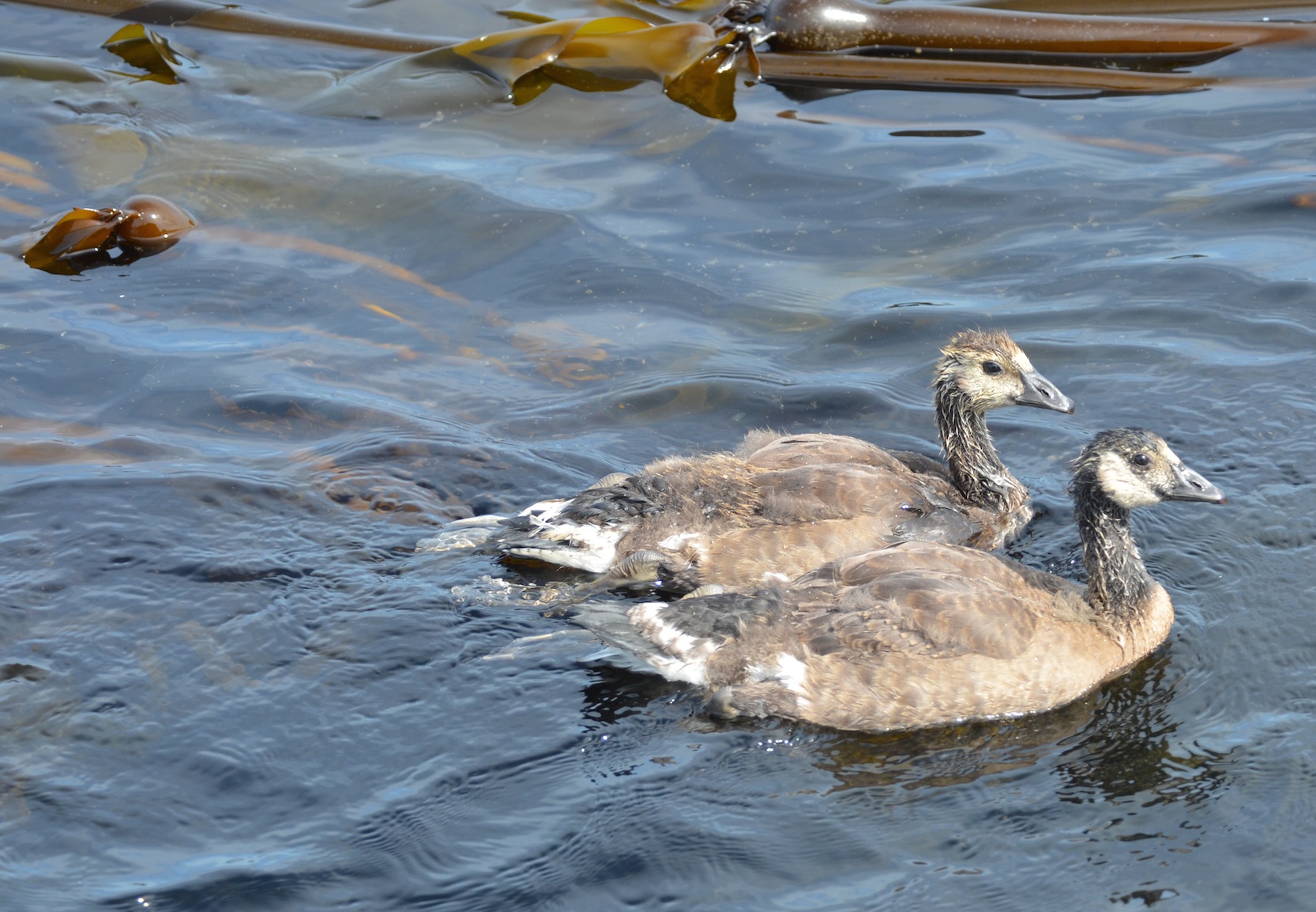
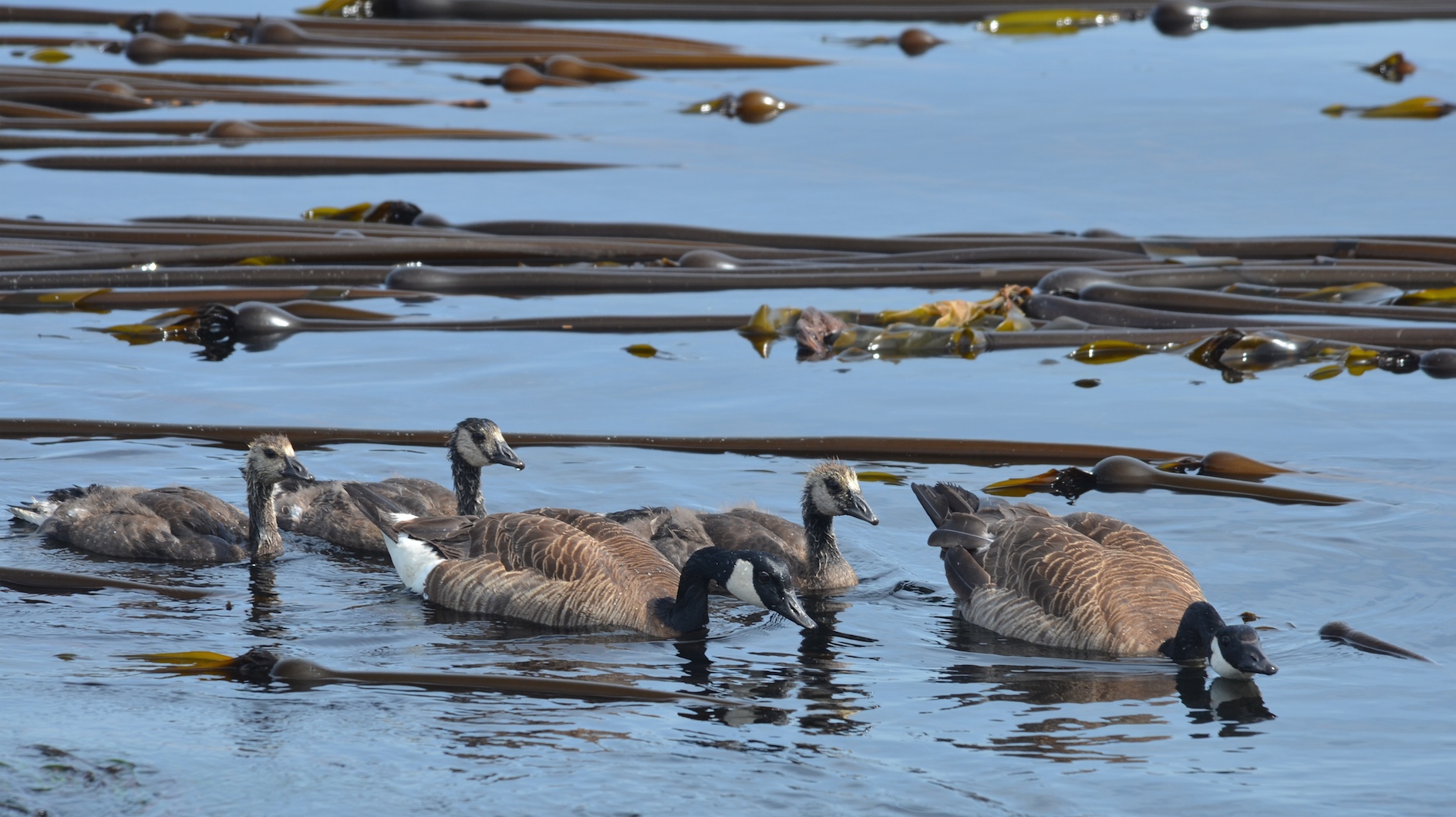
More geese were observed doing swimming lessons this morning. An adult was observed foraging on Ulva sp., the green algae referred to as sea lettuce. They must be hungry.
This log is a little shorter and written earlier in the day than normal because I am hoping to launch the boat between the fog and the gale on a high enough tide, with a slack enough current, to allow me to go ashore for a few days. Christine and Guy will take over again in my absence. I plan on being back Thursday night.
Chores were routine and there were no visitors today.
Panting to Cool Down on Great Race
Westerly breezes of 15 to 20 knots kept the island comfortably cool today as the sun shone steadily. The overall tendency of the barometer, was to slowly fall today ending up at 1012 hPA., as the sun set. The forecast is for continued strong westerlies and clear skies.
Twenty-one visits to Ecological Reserve by whale watching boats were observed today and there were probably more that I missed while doing other chores. Again most of the operators were great but there are a few who speed and a few who go too close. Several sport fishing boats and one rental were also seen transiting the Reserve.
The large Humpback whale affectionately known as Big Momma by the whale watchers did a complete circuit of Race Rocks today without actually entering the Reserve itself. While travelling through Race Passage she was accompanied by five to ten whale watching boats and was never alone.
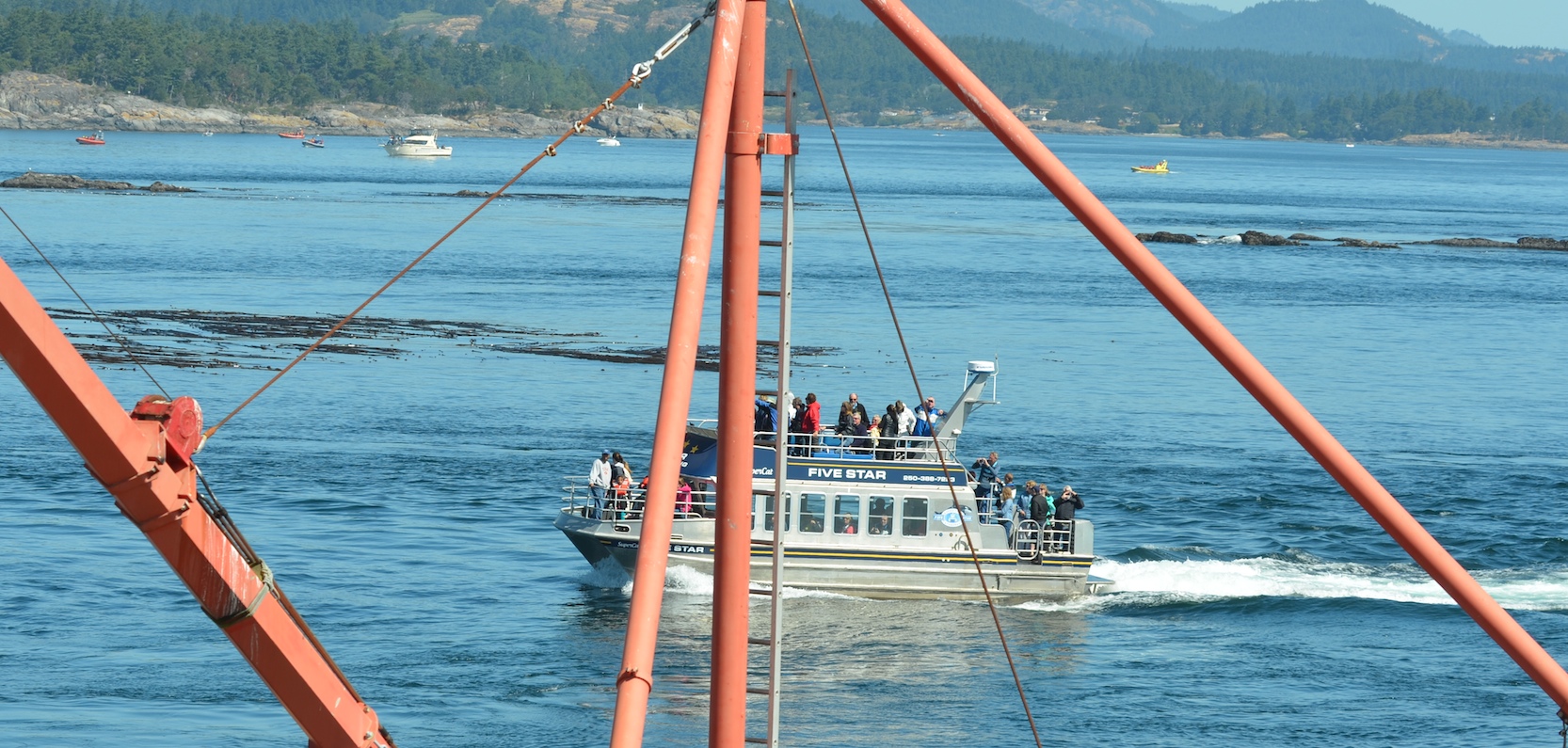
Vessels in Race Passage can be seen in the distance with Humpback Whale “big Momma”
Chunk and Floyd, the two large male Northern Elephant Seals spent a lot of time “fighting’ in the water today and that was also draw for the whale watching boats. Chunk definitely has the advantage over Floyd both in terms of size and personality. Floyd had quite a few fresh bleeding scars this evening and Chunk was doing quite a bit of perhaps, triumphant bellowing.
The lone male, sea otter that hangs out in the Middle Channel kelp bed directly opposite the eco-guardians’ house was also a draw today. The sea otter was viewed close up, by just about every vessel and he seemed completely unfazed by all the attention. Whale watching vessel congestion in the Ecological Reserve continues to be potentially problematic. Also dangerous for the little rental boats that like to follow close behind some of the bigger whale watching boats.
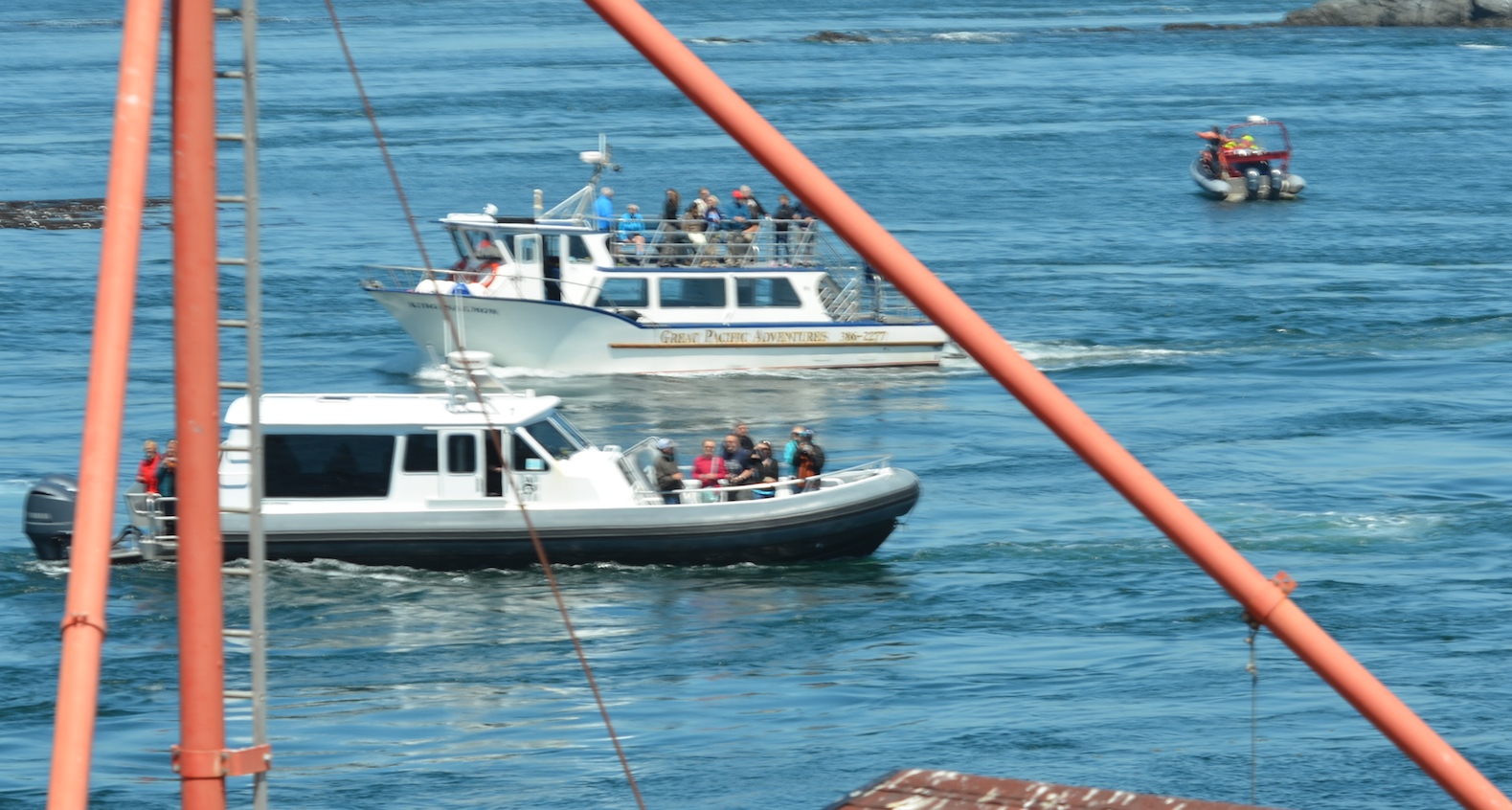
Whale watching vessel operators are good at avoiding each other in narrow channels.
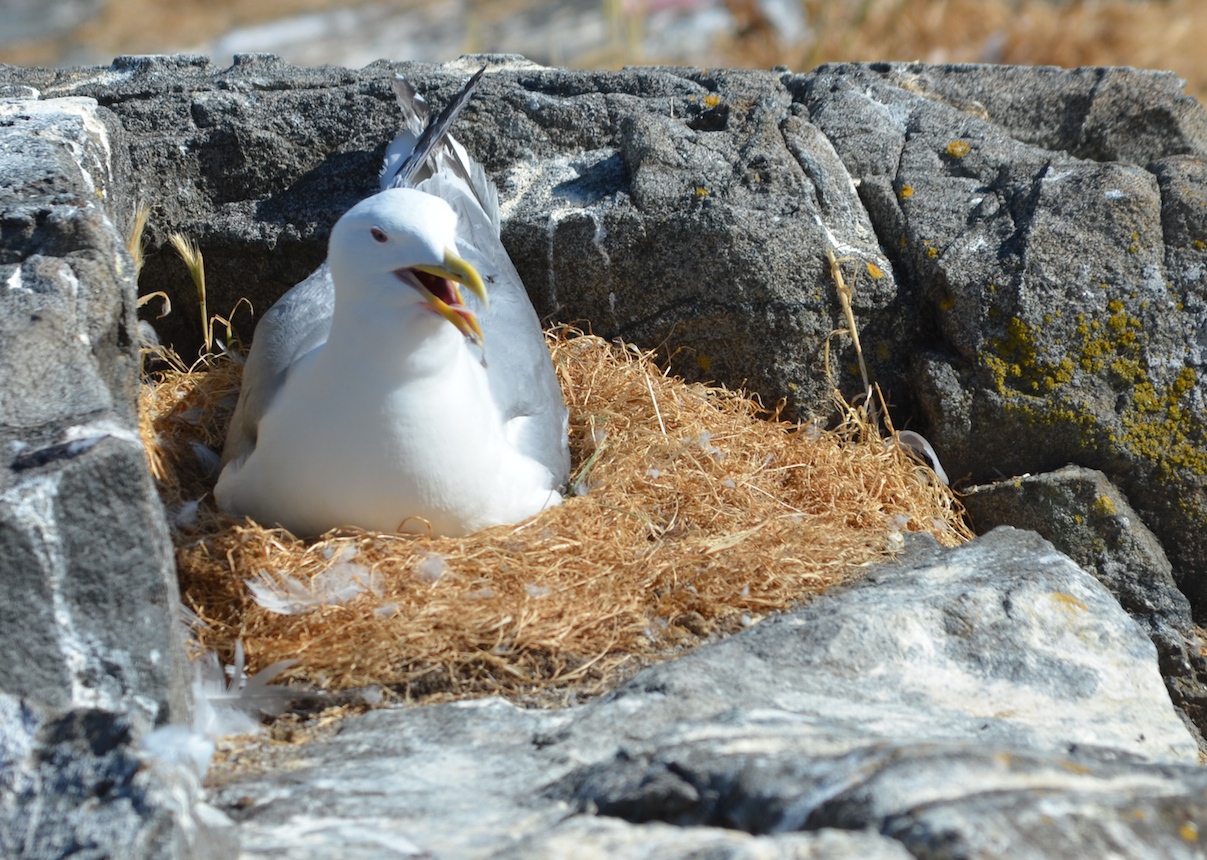
Gull incubation is happening right now and one of the interesting behaviours observed is thermoregulation by panting. Today there panting gulls everywhere.
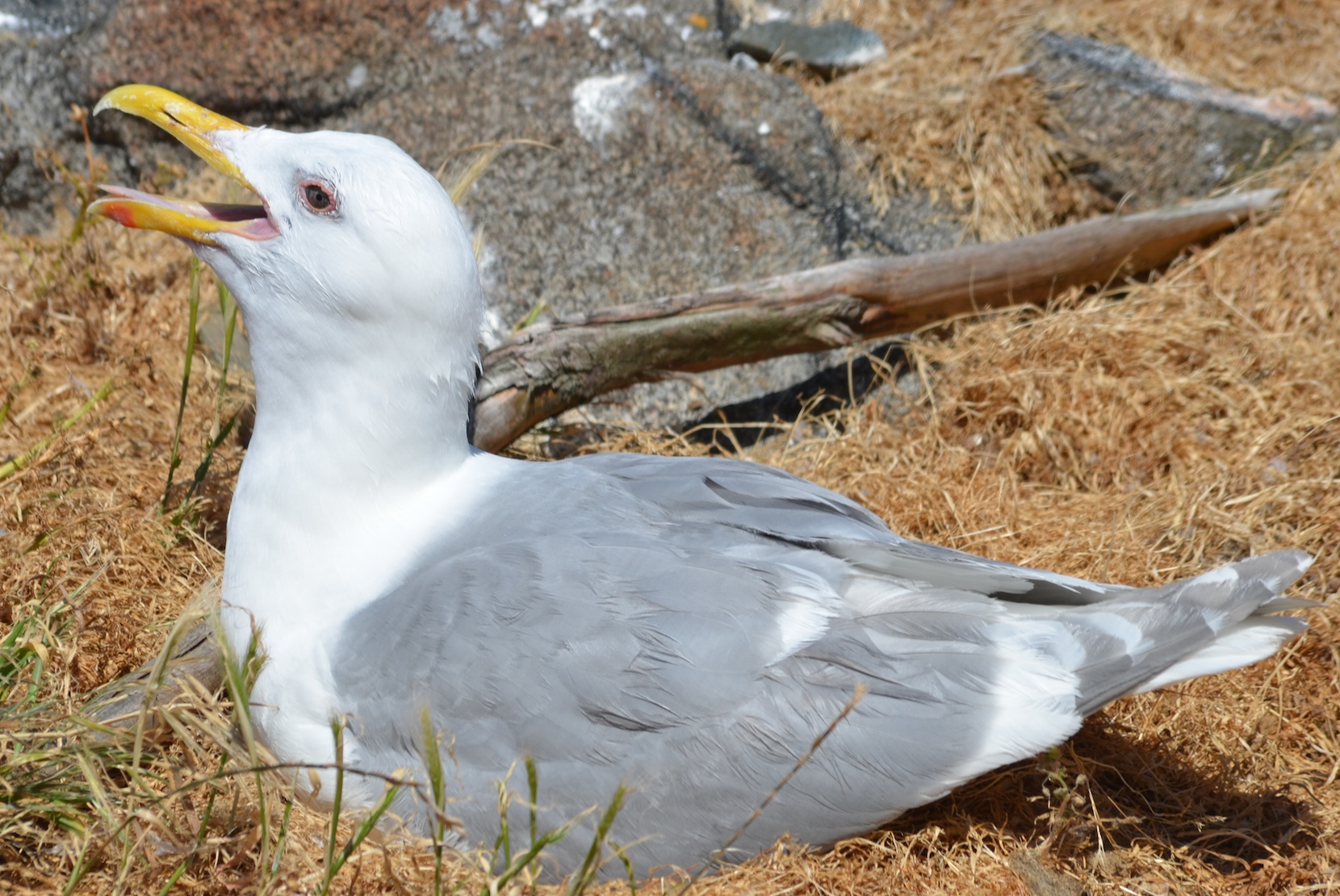
Gulls can keep their eggs at just the right temperature by evaporative cooling through panting.
Of note, the majority of the Canada Geese have left the island after a rash of Bald Eagle attacks. They were observed practicing the swim across to Middle Island with the goslings and were gone by June 10th, leaving three pairs of adults and their 10 collective goslings.
There were no visitors today and chores were routine.
Double-Billing (Thursday-Friday)
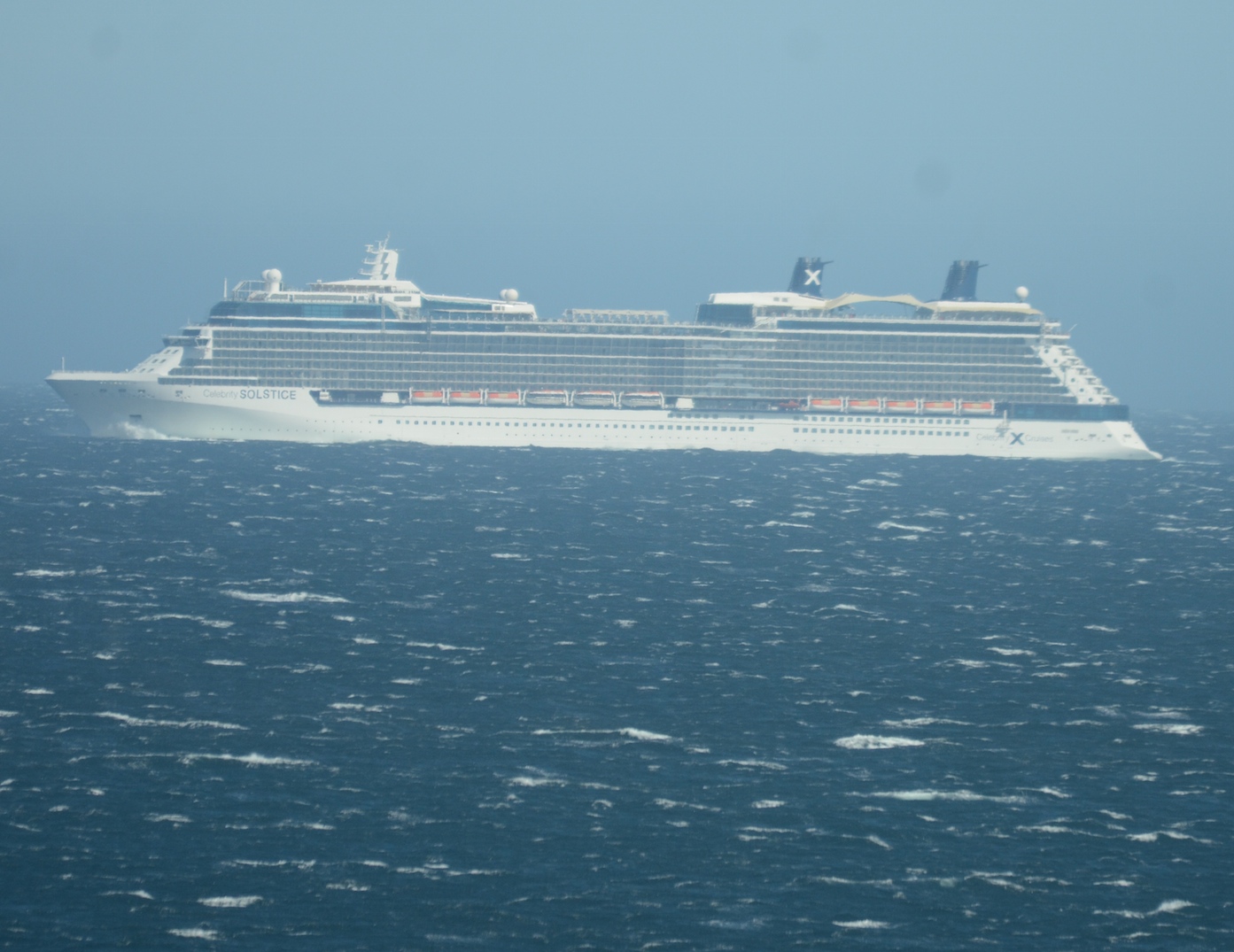
Thursday was a howler. The wind started early and blew ferociously all day. Although it developed into a classic westerly, it actually started out from the west-northwest, which is closer to the direction running down the outside coast of Vancouver Island (NW). Most of the day, it was westerly from 30 – 40 knots and late in the afternoon there gusts over 40 knots. The fog that formed early on the Port Angeles side of the Strait was blown away early and the sky stayed clear until just after sunset when clouds became visible in the west. The barometer has been rising since Wednesday and the forecast is for continued gale warnings and mix of sun and cloud.
It really calmed down on Friday. The westerlies with a touch of southwest, continued but at moderate speeds of 15 -25 knots. Although there were clouds to the west early in the morning, they evaporated quickly and it was full on sunshine all day. The barometer is dropping from a high of 1020 hPa and the forecast is for strong winds and mostly clear skies.
There were no whale-watching boats, or sport fishers on Thursday, as the weather and sea conditions were just too wild. Friday was a totally different story with 16 whale-watching vessels observed, visiting the Ecological Reserve. Some vessels made multiple visits.
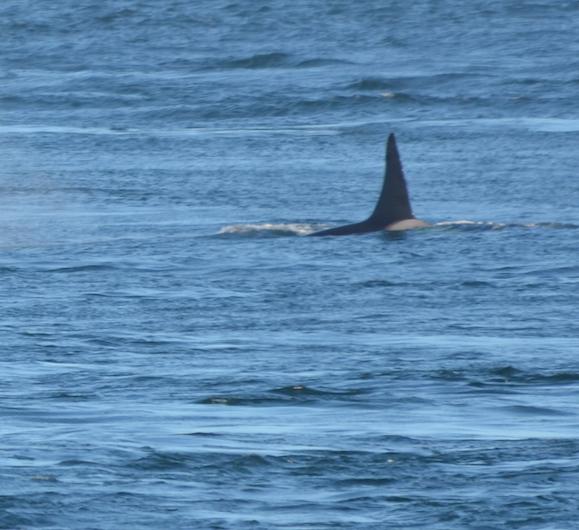
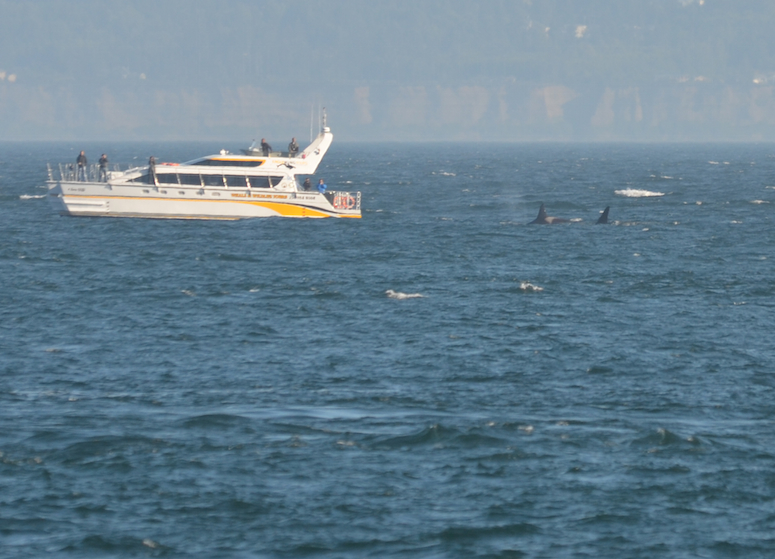
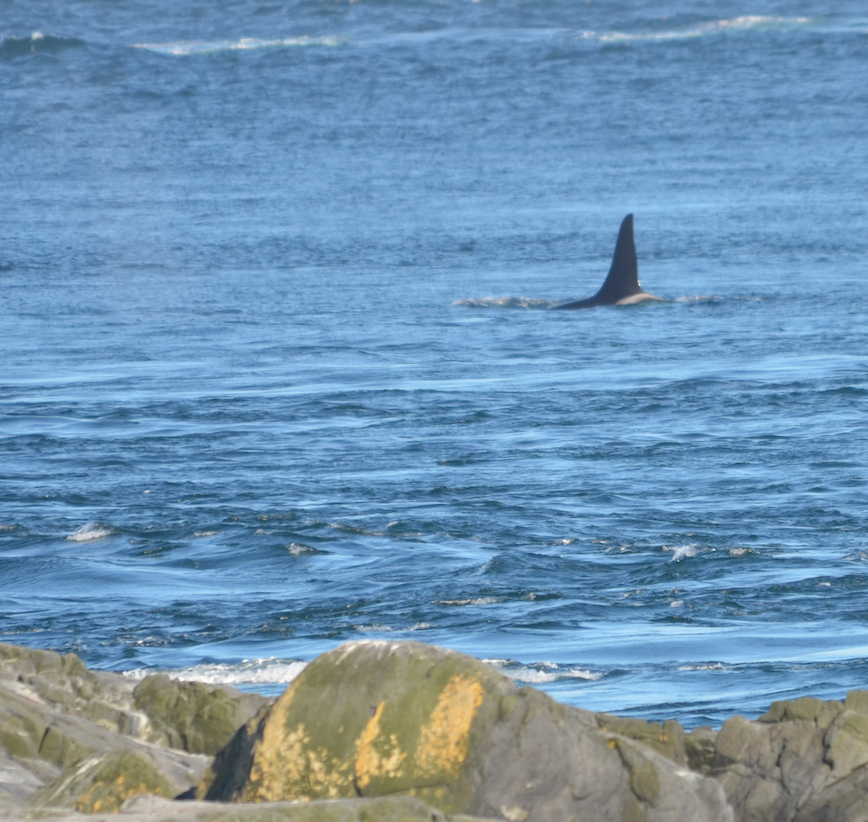
There was a lot of whale activity within and around the Ecological Reserve. Both a Minke Whale and a large Humpback were feeding just to the southeast and south respectively and three different pods of Killer Whales moved through the area in the afternoon and evening, including small group of Bigg’s Killer Whales (Transients), two pods of southern residents ( J-pod and L-pod according to the whale-watching boats). One of the SRKW pods came right into the Reserve within fifty meters of South Rock, heading east. There were two large adult males, one small calf and about 15 individuals all together. Another ~ 20 individuals were travelling in the same direction about one mile to south, at the same time. It appeared as though the two groups met up and mingled to the east of Race Rocks. Time for the sockeye to be running.
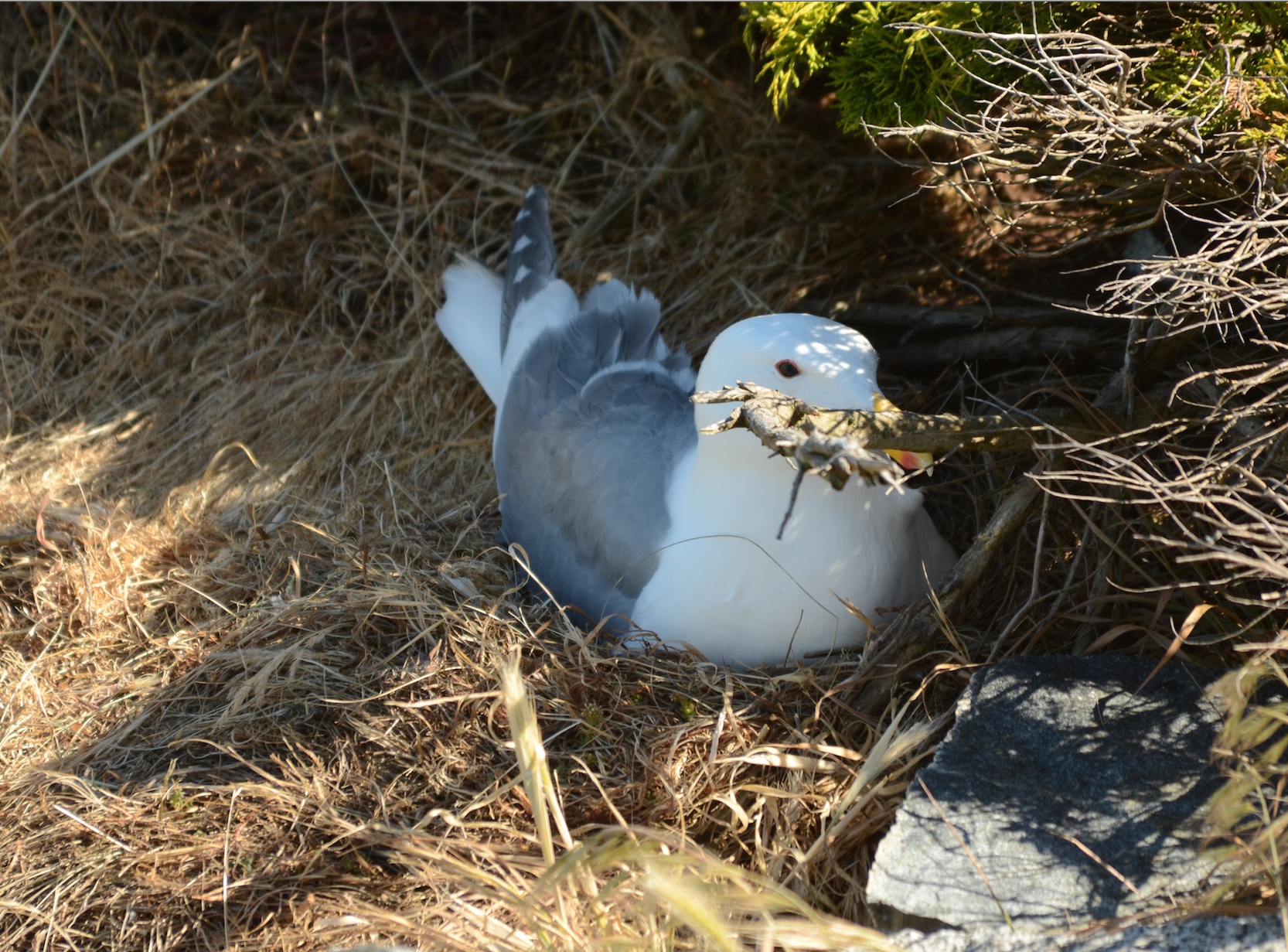
Other ecological happenings are progressing as has been reported on for the past few weeks. I started a Glaucous-winged Gull nest survey Thursday and finished surveying about one third of the island. On Friday the female Northern Elephant Seal # 5866’s tags were noted. Chunk and Floyd have been peacefully moulting, sleeping and travelling up and down the ramp for several swims a day (more like lolly-gagging in the water).
Thursdays are animal census day. It is worth noting that the winter resident bird species such as Black Turnstone, Harlequin Duck and many species of gulls that nest elsewhere are gone now and so are the transitory migrant shorebirds and other migrants that stop off briefly or for a while. The sealions are at their lowest number which is expected since they too should be on or heading towards their breeding grounds. Census results follow.
Northern Elephant Seals 10 (including 5 on Great Race)
Harbour Seals 218
California Sealions 5
Northern or Stellers Sealions 2
River Otter 1
Sea Otter 1
Canada Geese 24 (= 10 goslings + 14 adults) (many appear to have swum away)
Pelagic Cormorants 3
Double Crested Cormorants 5
Bald Eagles 2 (1 adult, 1 sub-adult)
Black Oystercatchers 10 (5 nesting pairs all incubating)
Kildeer 2
Pigeon Guillemots 110
Caspian Terns 2
Glaucous-winged Gulls total 424 (402 adults in nesting areas; 22 sub-adults in roosting/resting area). Most gulls are incubating now, although some are still getting started.
There were no visitors on Thursday and two visitors Friday, who did a retreat in the science house. They came and went in Second Nature with Chris.
Chores and maintenance were routine today and I am glad to report that I am able to wash windows again.
Chunk ‘nd the Trunk
It was a glorious day at Race Rocks with westerly winds continuing from yesterday but with more moderate speeds of 15 – 25 knots and even lighter winds of 10 – 15 early in the morning. The sky was clear above although there was a ‘marine haze’, which reduced visibility early to less than ten nautical miles. As the winds picked up so did air quality leading one to wonder if the ‘marine air’ actually has an onshore and anthropogenic source. Solar radiation intensity was high today peaking at over 900 W/m2. It is 19:00 hours as I write this, with more sunshine to come and the accumulated solar radiation for the day is already close to 700 Langleys. The forecast includes a westerly gale warning for tomorrow afternoon and evening with clear skies and a high UV index of seven.
Only one whale watching boat (from Sooke) was observed in the Ecological Reserve today.
There were more large and startling (at least to me) explosions today, which did not result in even a visible flinch by the Northern Elephant Seals. The Harbour Seals got into the water and were looking around at the surface and the Pigeon Guillemots flew but quickly returned and recovered. Two vessels with containment booms, one travelling at a fairly urgent-looking speed towing some of the booms were observed in the vicinity of Race Passage today. It may have just been an exercise, as they didn’t stay long.
Ecologically, things are continuing to grow at a tremendous rate as spring accelerates for the shift into summer, in less than two weeks. The goslings have graduated from short paddles to longer endurance swims crossing Middle Channel. Their grazing pressure on the island continues but doesn’t seem to exceed the productivity of the grasses that they graze on.
In the water, the productivity of Bull Kelp or Nereocystis lutkeana continues unabated and large, well formed kelp beds fringe all of the islets and reefs, producing tremendous amounts of food for a broad array of direct grazers and both peripheral and out-lying detritovores that eat the sloughing bits and pieces that drift down from the canopy and out of the kelp beds.
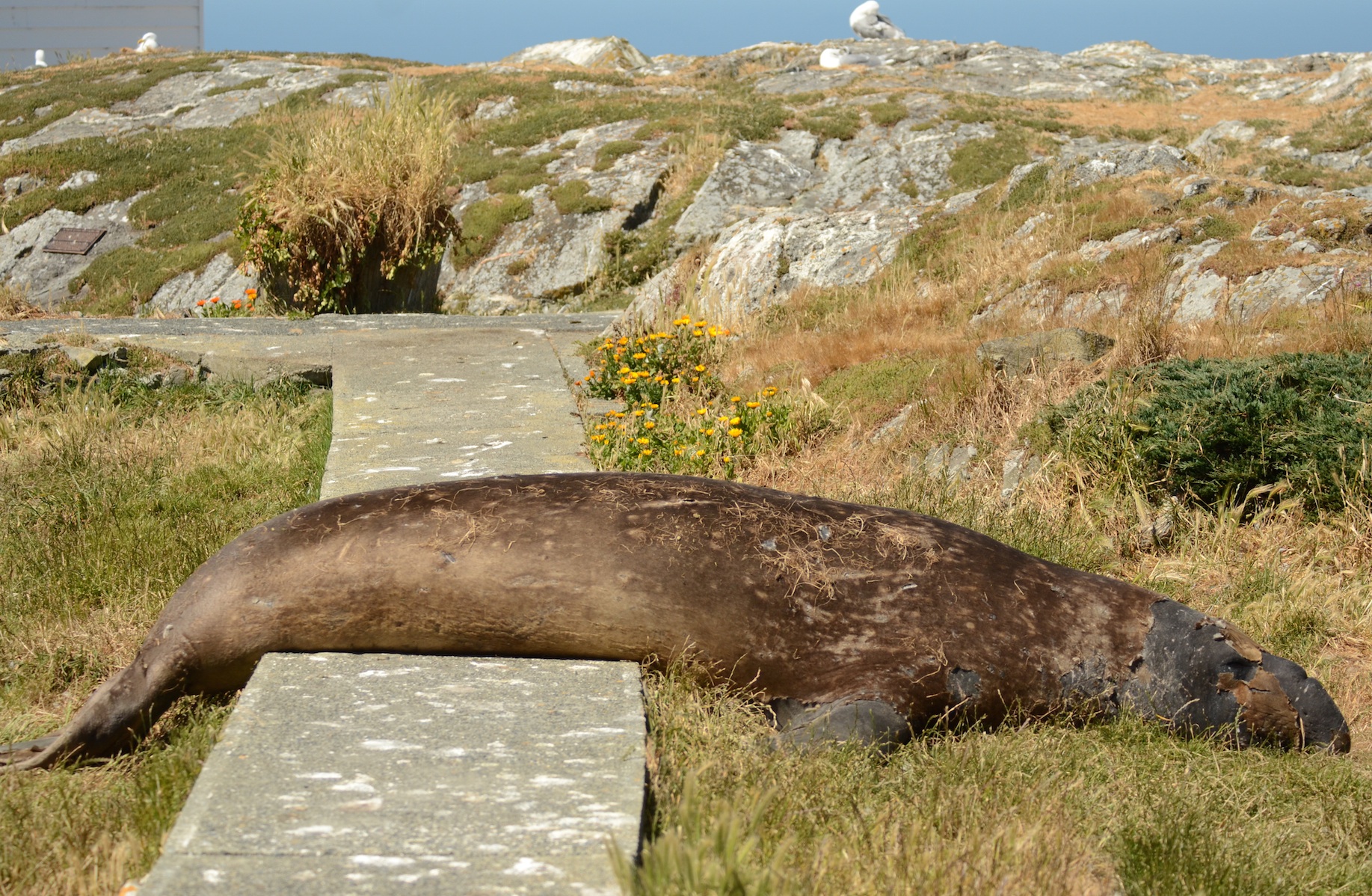
We are supposed to stay on the walkways when moving around the island. Not always possible when there are traffic jams like this one in this morning’s commute.
The Northern Elephant Seals spend time in the water draped in the kelp and playing with it with their mouths. What is not clear is whether this is intentional or just there (in the way). The big males are taking several swims a day right now thanks to the marine railway, which makes access so much easier for them. Chunk’s moult is just visibly starting today, on his nose and just below his mouth and on what would be a chin if he had one. Floyd’s moult is progressing visibly as wound sites and patches where he can scratch are coming off. There were some interactions between the two big guys today but hostilities were averted through strategic maneuvering by Floyd, basically avoidance behavior. Above, he is making a slow get-away which of course requires a tremendous amount of energy and much resting.
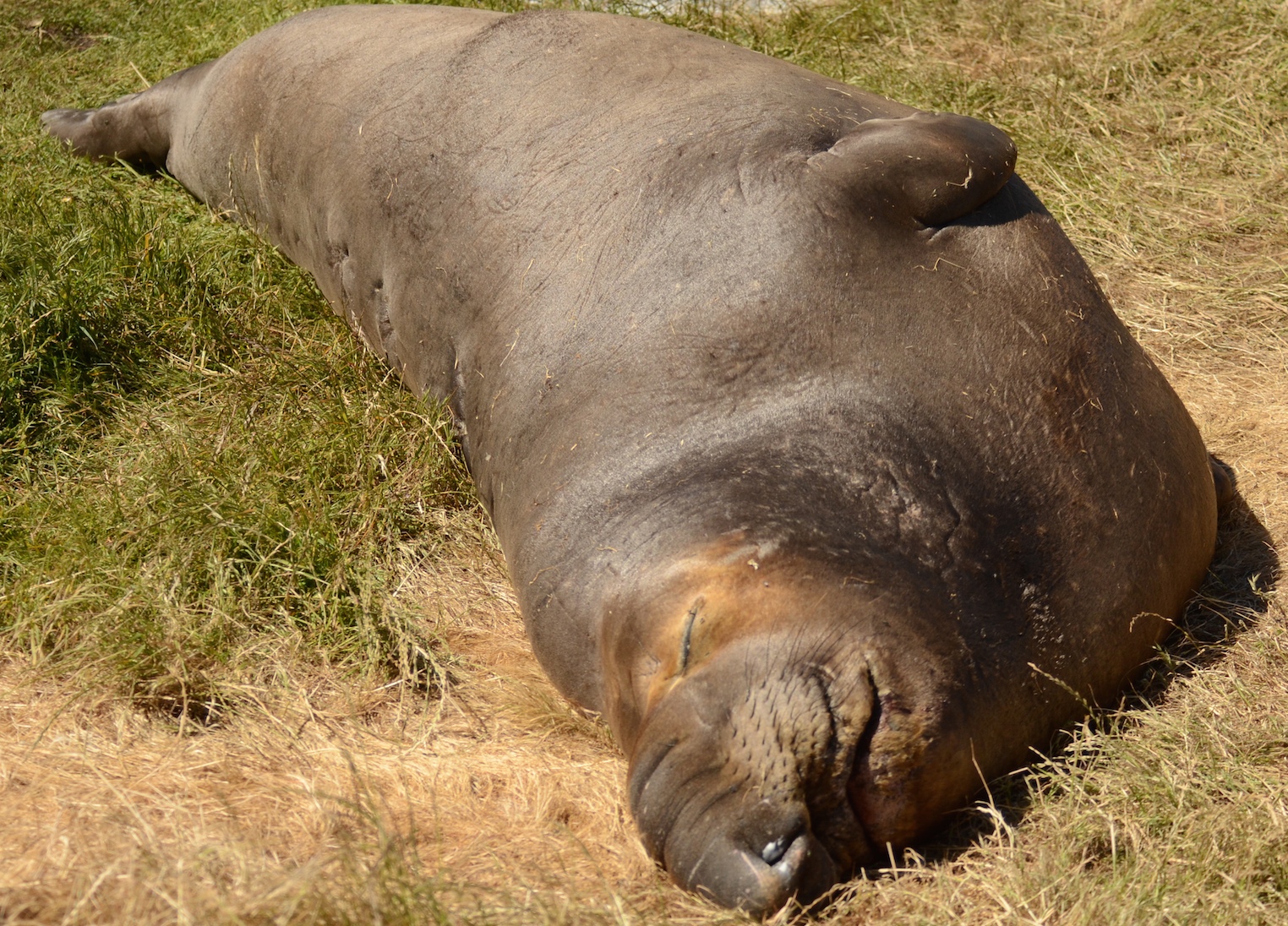
Chunk stretched out, having a nap. His large proboscis is prominent and the scars that run along his back are just visible.
More gulls are sitting on eggs each day and their nests are beautifully made by pulling up grass by the roots and carefully packing it into just the right shape by pushing down with their sternums, tails in the air. Level is of course important. All of the nests observed today had three eggs.
There were no visitors today and chores were routine.