 Pam from the UK using the remote cameras has noted the increase of sealions on her Flickr site;
http://www.flickr.com/photos/66339356@N00/sets/72157632533500094/page3/
Pam from the UK using the remote cameras has noted the increase of sealions on her Flickr site;
http://www.flickr.com/photos/66339356@N00/sets/72157632533500094/page3/
Morning Wx: wind – N 7kts, sky – Ovrcst
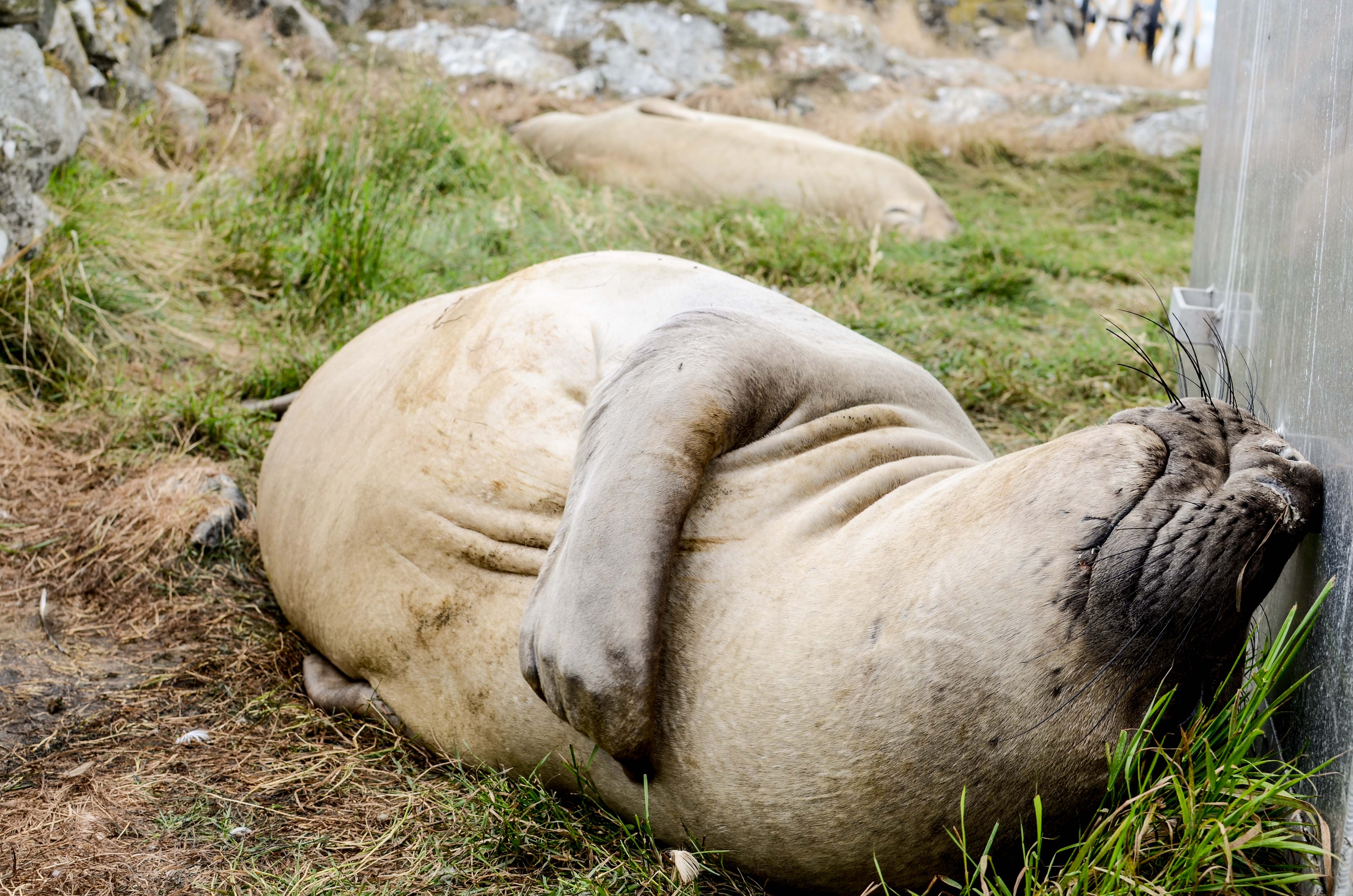
Elephant seal snoozing, #6375 in the background
Another female elephant seal, significantly larger than the tagged #6375, has visited twice this week. It is not tagged. The tagged female has also stayed around. Yesterday, she was resting in the shallow water and blocking the boat ramp as I was returning from the mainland in the Whaler. I left the boat tied up so not to disturb the seal and returned in an hour. The seal had moved to a very crowded area that many of the sea lions use as their water entrance/exit and was snapping and chasing the sea lions. I assume this was playful behaviour although the elephant seal was quite aggressive.
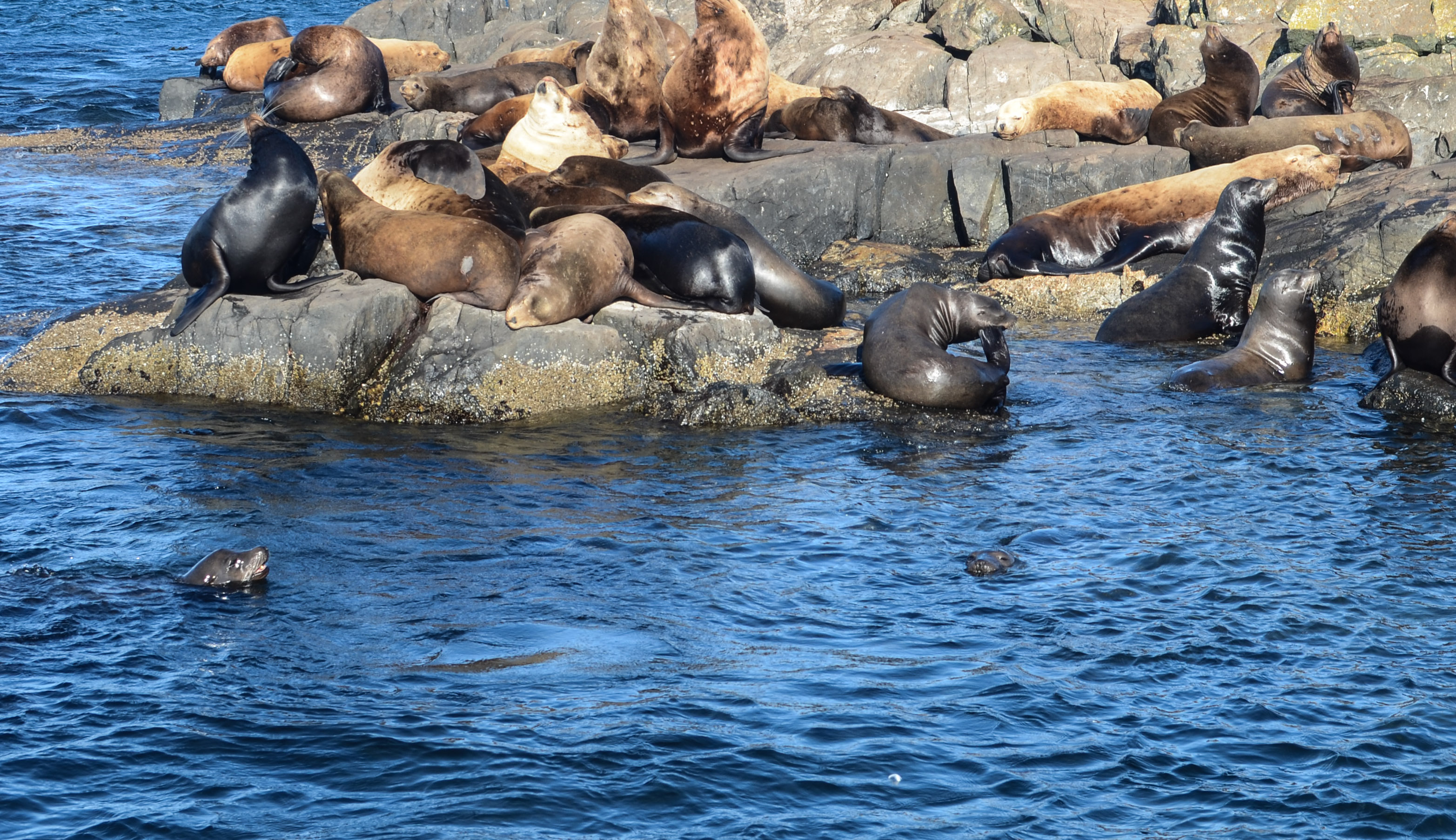 This first image shows the seal waiting at the surface.
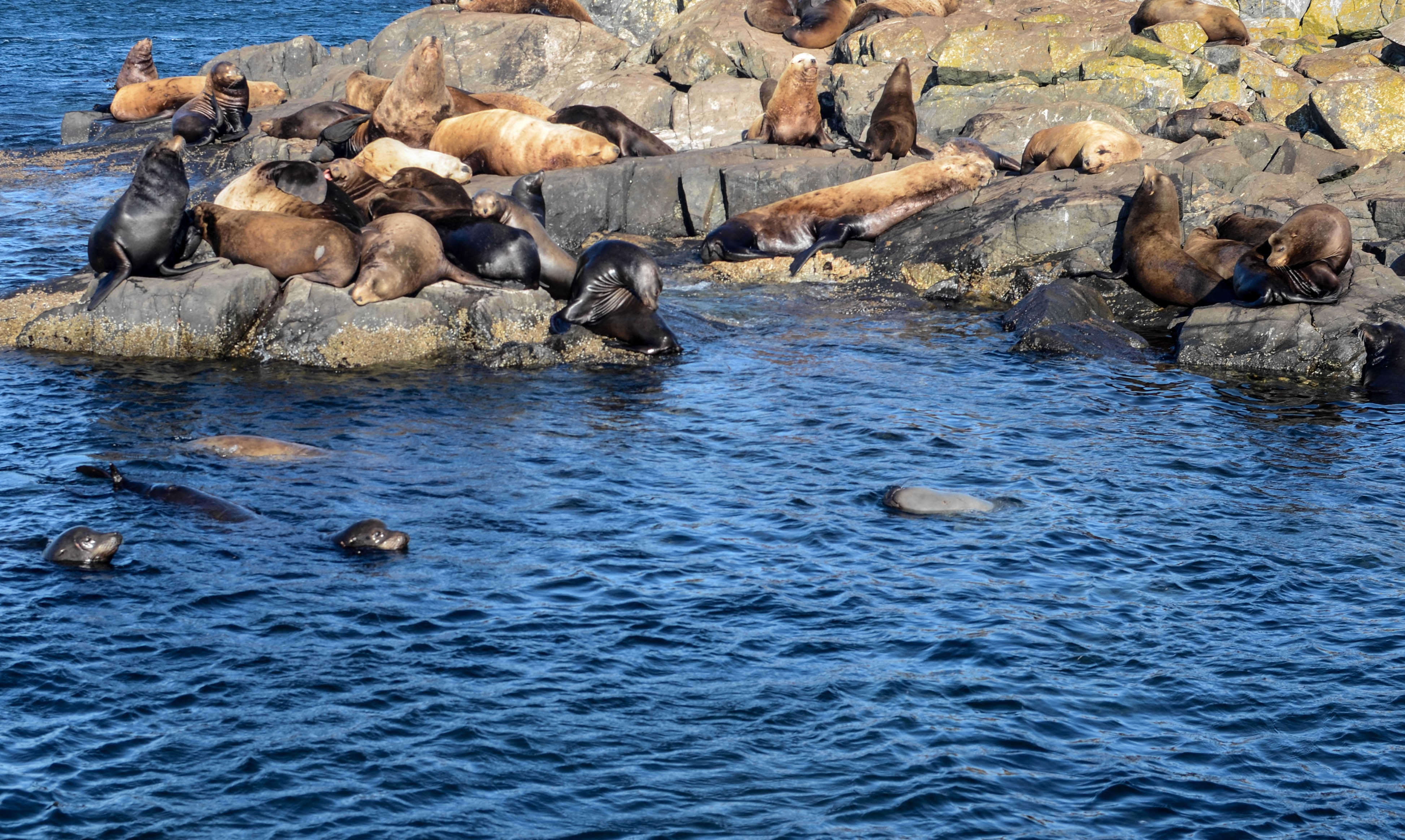
Then the seal approaches the sea lions on its back, provoking them.
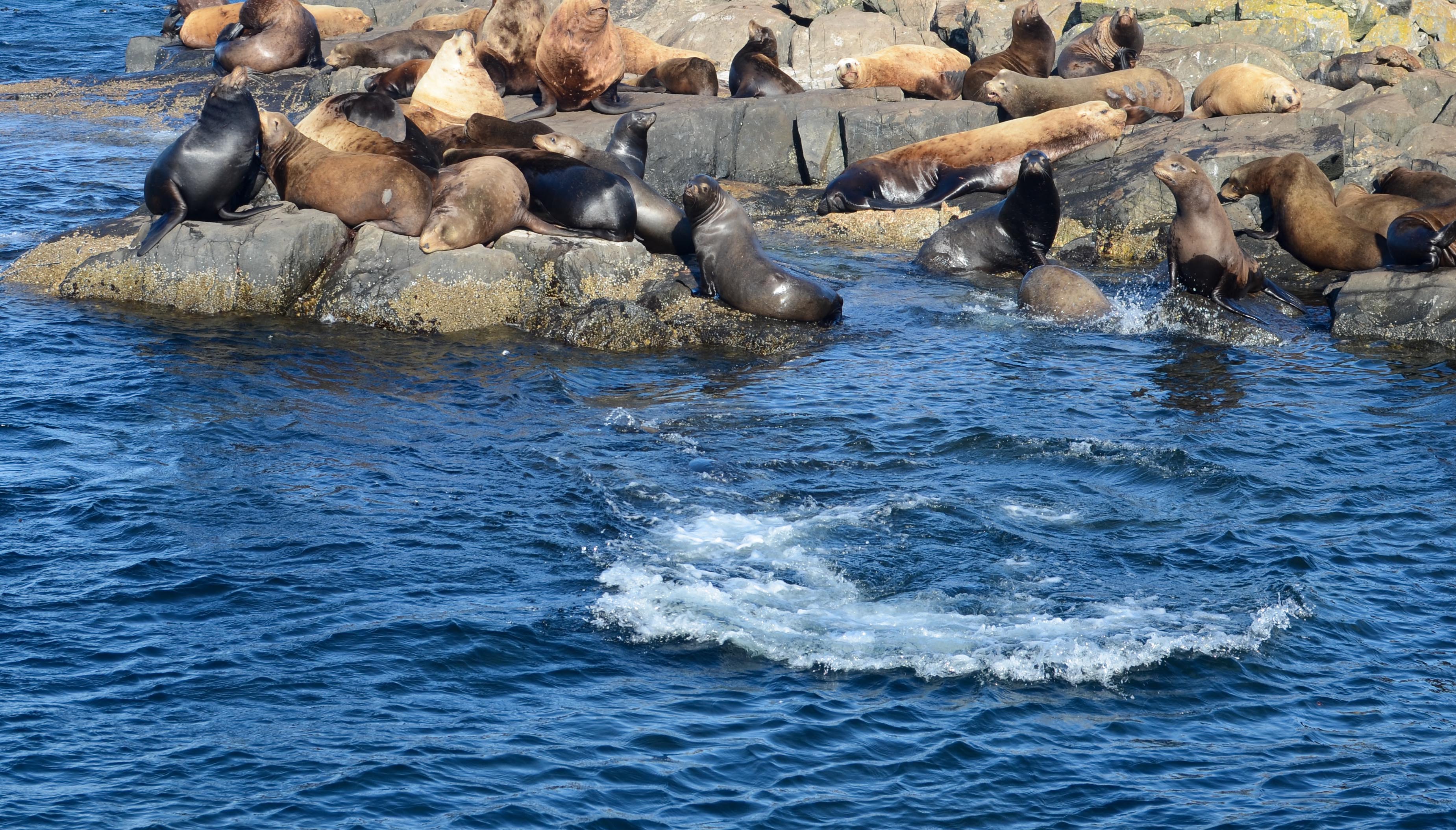
And with a splash, the chase ensues!
A new project on-the-go is a daily count of the number of fishing boats. The Department of Fisheries and Oceans are wanting to monitor the impact of sport fishing in the area. We survey an area from Beechey Head to Albert Head. On some days, there more than 100 sport fishermen in the area.
The tagged female has returned, but on the opposite side of the island. Her number is 6375, which means she’s been returning to the island since 2011 or earlier. Pictured below, she is dosing on the south side of the island.

Female seal, August 15
We have had very low winds in the last few days. Even though summer months typically have less wind, it is very rare to see 0.00 knots as the wind metre read yesterday. We also had our first rain of the summer.

The group from Discover Channel and Ogden Point Dive Centre
On Thursday we had a visit from Discovery Channel who were working with the Ogden Point Dive Centre (based out of Victoria) to film and document sea lions and seals on the reserve. They asked questions about the sea lions’ migration patterns and the role of Race Rocks as a reserve among others. The footage will be used as part of The Blue Realm series, by Danny Mauro.

Stellar and California sea lions
The California sea lions moved onto the main Rock last week, and the Stellars have joined in the last few days. Currently, approximately 30 are resting on the rock and in the water. Misery, our largest resident male, left last week and has not returned or been spotted on the other rocks. The female in the last post has also left. However, on Saturday, a different young female was resting on the jetty. Unfortunately, I did not notice she had a tag on her back fin until she was swimming away and it was too late to mark down.

Female elephant seal on the jetty
Saturday evening when collecting the water sample, I noticed the familiar glow of Noctiluca scintillans, a type of dinoflagellate that when agitated by movement in the water, lights up; a process known as bioluminescence. A curious mammal approached me on the jetty when I realized it was a female elephant seal, which haven’t frequented the island for a number of weeks now. The female didn’t come onto the main island until the following afternoon, and I suspect she is the same one that came most recently about a month ago in early July. She has returned to her usual hangout spot next to the hose box.

Juvenile female elephant seal
Illegal fishing on the reserve is hard to moderate although remains an important role of the reserve. Today I came across two Glaucous-winged gull chicks picking at what seemed to be a worm, but turned out to be fishing tackle some adult gull had probably returned with from the kelp beds.

Fisher in a kelp bed near West Race Rocks
These unexpected fisherman, above, claimed ignorance when I approached them about fishing poles in the water.
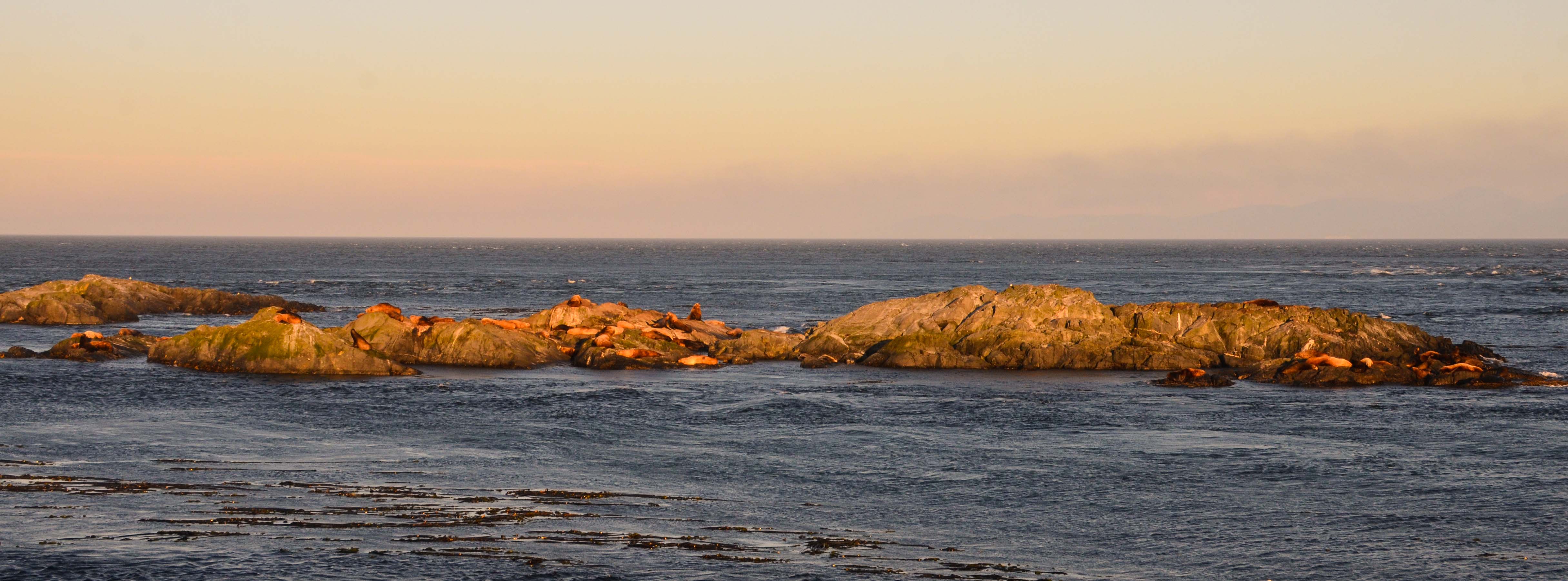
Sea lions at sunset
California sea lions have joined the Stellars on the southern rock.

Injured Glaucous-winged-gull near the jetty
Yesterday evening as I went out to collect the water sample I interrupted a couple of harbour seals feeding on a glaucous-winged-gull. Harbour seals feed on fish more commonly although they do sometimes feed on gulls. The seals, upon seeing me, fled leaving the injured gull in the water. It clumsily exited onto shore but was tripping over its dragging wing. I shooed it back to the water in hopes the seals would return. When they did not and I went out a second time to find the gull wandering aimlessly in the rocky intertidal zone. Meanwhile, the seals had returned to the jetty area and were feasting on a fish. In situations like these we have to make a judgement call and the gull seemed to be needlessly suffering. The chance of it being eaten by the seals was very unlikely since they had found other food and an eagle coming to finish the deed was also unlikely because it was late in the evening and their visits are generally midday. It didn’t seem right to let it suffer through the night so I put it out of its misery.

The solar panels within less than 24h of cleaning
In other gull news, an ongoing project we’ve been working on is tilting the solar panels. Angling the panels allows more direct sunlight but more substantially, discourages the gulls from using them as resting spots. Gull droppings can have a large effect on energy intake of the solar panels. Sounds unreasonable? Here’s a picture of the panels after just one day since being cleaned.
On another note, more stellar sea lions have accumulated on the southern rocks. The count has reached over 30.

Stellars on south Race Rocks
We’ve had the most fog of the summer yesterday and this morning, so thick the shoreline isn’t visible from the tower at points. The fog yesterday didn’t clear until late evening.

The lighthouse tower
The gull chicks are just starting to fly, although there have been some later hatchings this year too. The parent gulls have been very protective and aggressive. When young chicks wander close to another nest, mothers attack the chick or its parent gull. There have been at least four chick casualties this season because of this. These two chicks, pictured below, discovered the protected corner of the boathouse just before I was about to paint the floor. Luckily their squawking parents were close by and I was able to help them on their way.

Glaucous-winged gull chicks in the boathouse
A group of five stellar sea lions arrived on West Race Rocks and the southern rocks this past weekend. Only one California is here now that has been here for a few weeks now. Chunk, however, left the island last week and has not returned, leaving Misery as our only elephant seal at the moment.

Rear view of Chunk, the day before his departure

This past week, we delivered over 4000L of diesel to the island. Even though Race Rocks tries to source its energy from more sustainable practices like our solar panels, often they’re not sufficient to completely power the island. During the dark cloudy days we see so often in winter we rely on our diesel powered generator. Erik Shauff collects thousands of litres of diesel per load in a large metal container from Pedder Bay Marina and delivers it to the reserve by boat. Then we use an electric pump and hose system to transfer the diesel across the island into its holding tank. Pictured above is Misery supervising the process. Erik surveys the yellow diesel tank in the background.

We also had a whale sighting in the past week. A pod of orcas (with at least one calf) passed through the south side of the reserve on Friday. As always, orcas attract alot of boat traffic. I noticed a cluster of whale watching vessels before the orcas. When the pod moved towards the reserve the whale watchers didn’t follow but instead kept their distance and motored ahead to the next point they calculated the pod to be.

Orcas and boaters on the south side of the island
One private boat-owner, however, chased the whales right through the reserve.

Caught on Underwater Camera 2 by Adam Harding
On one of the trips for diesel, Erik also brought his dive gear to clean the Underwater Camera 2.

30 knot winds at North Race
The wind since Sunday evening has been very strong and even reached over 50 knots on Monday just before midnight. The photo shows North Race during a 30 knot wind. As the wind carries the water in the photo, it also sprayed the house windows which now are in sorely need of a clean.
During the winds, the Coast Guard paid a vist.

Coast Guard helicopter passing by a quick visit to the island, hovering over the helicopter pad for several seconds without landing and then taking off again. It looked like it was having trouble with its stability in the wind.
Another noise-maker for the past two weeks have been the blasts on DND. There have been as many as 5 or 6 per day on severals days since my arrival June 24.

Juvenile female elephant seal
A new female visitor came to the island Wednesday night. I noticed a juvenile elephant seal
Tuesday evening resting near the fire hose box. She was gone the following day but returned at around 22:30 when I ran into her with Chunk and Misery in the shallow water near the jetty while taking a water sample. Something that has been interesting upon her arrival is that Chunk and Misery have both changed their regular resting spots. Possibly just a coincidence, Misery has always been the one closest to the female.

Parent oystercatcher with chick
On a bird note, the new oystercatchers have left the nest. The two have been exploring the jetty and surrounding area accompanied by two adults who become very vocal when any danger is in sight. The eggs on the opposite side of the island have yet to hatch.