Swiftsure Race

Strong Westerlies all day. Clear skies. Force 6. Barometer took a turn around midday and started to fall. Forecast is for the wind to ease a bit tomorrow. 26 tour boats 1 dive boat 4 halibut boats on the edge of the reserve 1 boat jigging on the East edge

Swiftsure2

A busy day on the water

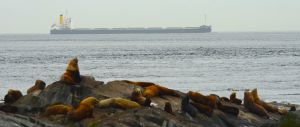
It was a busy day on the waters of the Juan de Fuca today, with way more humans than usual out on the water because of the Swiftsure sailing race. The Swiftsure boats passed by this morning, along with plenty of spectator boats, and several marine tour boats. Most boats went between Race Rocks and Bentick Island, and a few went on the South side of the reserve. There were about 6 tour boats going in and out of the reserve as the sailboats passed by. The first boat on the return run to Victoria (from Cape Flattery) just passed back by Race Rocks; flying a spinnaker and going crazy fast.

Tour Boats

Clear. Light West wind. Force 3
Barometer is falling.

23 tour boats
1 dive boat
3 recreational boats passed through

I think the marine tourism season has come into full swing in Victoria. Around 1530 about 10 tour boats passed through the reserve from the West heading back to Victoria. At one point there were 5 boats in middle channel.

There was 16 Elephant seals on Great Race today. They did their usual routine where they are in the water first thing in the morning and then make their way back ashore. Most of them a lying behind the Boat Shed now. Then around midday most of them head back down to the water to cool off. A few of them spent the whole afternoon in the shallows by the jetty.

Albatross..?

Strong Westerlies, clear skies. Force 4-5
Barometer is falling again, with a strong West wind warning overnight.
The Washington Marine text forecast has not been updating since yesterday.

4 tour boats
3 halibut boats on the edge of the reserve

RIP Farley Mowat: acclaimed Canadian author, and ardent environmentalist.

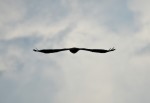
I saw another pair of Canada geese with a single gosling today. There are now 3 goslings in total. I realized the other day that there are no Black Turnstones around any more, I guess they’ve gone North for the summer breeding season. There is a pair of Oyster catchers setting up shop on the steep slope East of the jetty, I hope they make a nest there where it is easy for me to observe them. The Cackling goose and White Fronted goose are both still on Great Race. The animal highlight of the day was a mystery bird. It was up really high above Great Race when I first came out this morning. It was mostly white underneath and was clearly an offshore bird because it had that albatross-esque silhouette. It made a really awkward, throaty sound, almost like a heron. On the Race Rocks species page the only offshore birds list are the Sooty Shearwater and the Laysan Albatross. The Shearwater is ruled out because it is grey underneath, so my best guess is that this morning I saw a Laysan albatross.

-Trouble shooting temperature issues on inverter 1
-Finished leak repair on outside of Science house door
-Washed Keeper’s house windows

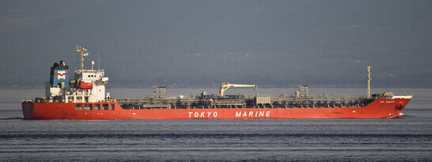
Ships Currently in the Area of Race Rocks, and the Associated Hazards

Shipping in the Strait of Juan de Fuca poses the greatest risk to the ecological integrity of the Race Rocks Ecological reserve. The risk of chronic oil spills increases directly with the Number of vessels in the waters. Chronic oil is a greater risk to marine life around the world than are the disastrous large spills, but the risk from both will increase if tanker traffic is allowed to proliferate in the Strait of Juan de Fuca:

These tagged posts detail the risk to this and other Marine Ecological reserves on southern Vancouver Island: https://www.racerocks.ca/tag/oil-spill/

frontierLeadertankerOn this page we profile Marine Vessel Traffic Images which show how close they are to the Animals of Race Rocks


The live tracking image below shows the ships, their size and other details that are in the Strait around Race Rocks right now.

Either go to this site and create a username and password to access:

or use the more restricted map below:


View Larger Map

Problems with Marine Vessels and their risk for Race Rocks:

It has always been a concern that Race Rocks is located in a very vulnerable location in the Entrance to the Strait of Juan de Fuca. There is a need for regulations preventing the dumping of bilge and sewage from ships, and an emergency plan in the event of disaster from marine shipping.Shipping  Prshipwreckoblems:
The history of shipping in the past in the area is grim evidence that accidents happen. A fuel or chemical spill in the Strait of Juan de Fuca would have an untold impact on the biodiversity of the Ecological reserve.shipwreckMajor Marine Vessel Casualty Risk and Response Preparedness in British Columbia
Prepared for Living Oceans Society
Sointula/Vancouver, BC Canada
by EnviroEmerg Consulting Services Cowichan Bay, BC Canada
Government of Canada Announces Ballast regulations, June 2006
Cruise Ship Problems:
Screen Shot 2014-04-01 at 9.35.14 PM
See the following reference link on potential problems from Cruise ships and how they can be rated for environmental safety with the Cruise Ship Environmental report card.Cruise Ship Dump Raises Alarm
Louise Dickson, Times Colonist
Thursday, May 08, 2003
The accidental dumping of raw sewage into Juan de Fuca Strait has renewed calls for stronger environmental regulations governing cruise ships.Norwegian Cruise Lines has confirmed that its ship, Norwegian Sun, dumped about 62,000 litres of raw sewage into American waters near Port Townsend, southeast of Victoria.
Victoria’s Cruise Ship Industry: Economic Benefits and their Environmental ImpactsBy: Elliot Houlston and Carly Daoust , 2005″Being that a cruise ship functions like a small city, it will pollute like a small city as well. In one week’s time a single cruise ships empties 210,000 gallons of sewage (human waste), 1,000,000 gallons of grey water (water from sinks, bathing and washing), 8 tons of solid waste (paper, plastic, cardboard, food waste) and 25,000 gallons of oily bilge water8. Some hazardous wastes such as photo chemicals and used paint are produced also. These are only the water pollutants created by cruise ships. There are many air pollutants as well.”Dirty Waters: Cashing in on Ocean Pollution 18 January 2010 in DC BureauBy David Rosenfeld
Return to Index of Environmental Disturbances to the ecosystem at Race Rocks

Calm Saturday

Light variable winds most of the day. Four brief periods of rain, clear skies in between. Very low West swell. Rainbows.

6 tour boats
2 dive boats

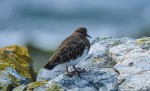
I spent some time today trying to learn to use the Nikon DSLR that lives out here at Race Rocks. The zoom on the big lens is awesome, but I still have a few technical issues to work out. My mission was to get a photo of a Pigeon Guillemot flying away from me with its red feet sticking out, but I wasn’t happy with any of my attempts. While wandering around looking for things to photograph I saw 10-15 Turnstones. They are spending most of their time in the middle of Great Race. There was 4 Western Sandpipers, 1 Sanderling, and 2 Dunlins all feeding in the muck-puddles on Great Race.The Elephant seal that has been next to the tank shed left this morning, but there are still two out on Middle Rocks. There are a few monster Steller Sea lions among the group out on South Rocks. There are now three Canada Goose nests, all with eggs in them.

Pigeon Guillemots

Overcast/cloudy. Light North to North-East wind. Low SE swell in the afternoon.
5 tour boats

This morning there was a Great Blue Heron on the bluffs on the NE side of Great Race, 5 eagles on the outer islands, and Guillemots!
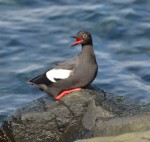
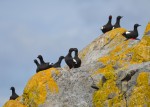
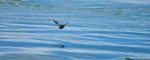
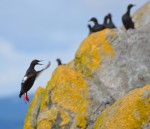
I don’t know if all these birds have been in the reserve for a while, but with the high tide this morning there were probably 100 Pigeon Guillemots whistling their little high-pitched whistle all along the shore of Great Race. Pigeon Guillemots (Cepphus columba) are members of the auk family. They are small diving birds. Their most obvious attribute is their radioactive-red feet that stick out behind them when they fly. Interestingly, these feet only have 3 toes (most birds have 4). They also have large white wing patches with a black bar. They spend spring and summer onshore to breed. A pair mates for life. They build their nests on bluffs and lay 3 to 4 eggs.  The rest of the year they live in offshore waters. They are fairly inefficient flyers, and goofy walkers (kind of like a penguin) but they are amazing swimmers. They use their wings to propel themselves underwater. They typically forage for small fish and invertebrates at 10 to 30 m, but they have been documented at 45 m. A group of Guillemots is apparently called a “bazaar”.


-measured windows
-figured out jetty ladder hardware
-discouraged geese from nesting

Canada Geese

Clear skies. Light winds.

The most Canada geese that I have counted to date is 33. The Canada goose (Branta canadensis. Not “Canadian goose”, they do not have citizenship) is a regular visitor/resident out here at Race Rocks. The species has 11 sub-species, many of which experienced a dramatic decline at the beginning of the 20th century because of hunting pressure and habitat loss. However, in the last 25 years the species has experienced a strong recovery. There are many groups that have also ceased to do their seasonal migration. They have recovered to a point where they are now considered a pest in many places. The main reasons for their change in status and migrations has to do with the bird’s adaptability. It has thrived under decreased hunting pressure and changes in weather/climate. This has combined with an increase in protected grassy areas (eg lawns, golf courses, and parks) and agricultural practices that leave waste grain in the fields over the winter. The species is considered to be invasive in New Zealand, where it was intentionally introduced as a game species. The species was also introduced, and has also migrated, to the UK and several Scandinavian countries. The species’ adaptability means that the Canada Goose is now the most numerous waterfowl in North America.

Continue reading →

Update: past week

On Friday Erik brought out a new wood stove and two guys to install it in the main house. The diesel furnace has turned been off since then and we are plenty warm.  This is a great addition to the island and another positive step Pearson College has taken to reduce its dependance on fossil fuels, reduce the risks of diesel contamination in this sensitive environment and improve financial sustainability of operations.

A group of Pearson College students arrived on Saturday afternoon with Erik on Second Nature to spend their project week at Race Rocks.  They will be helping out with daily tasks, doing some maintenance projects and working on their own creative projects.

On Sunday I picked up Garry and brought him to the island to get a closer look at the pup and to give the students a short marine bio and history tour.

DND blasting occured on March 4th, 5th, and 6th (945, 1030, 1310 big blast, 1350)

Eco tour vessels visited the reserve Feb 27 (x2), 28th, March 1st, 2nd, 4th, and 9th (x2)
Private vessels entered the reserve March 7th, 8th and 9th

Past Week projects and maintenance:

-harvested, cut firewood
-clean and prep for students arrival
-coordinating for project week
-cleaned out oil traps in propane lines of main house
-worked on boat console
-recycling offload to campus
-picked up peat moss and maintenance supplies
-completed month end report and data entry
-2 full propane tanks to island
-assist with wood stove supplies and install

Inverter back online

For most of last week we had steady westerly winds reaching upwards of 40 NMPH. We got a break in the weather on Friday and Saturday some flurries began and the wind shifted back to North East and cold. It has been upwards of 20 NMPH NE today and the past two days. Today it is sunny for a change.

On Tuesday February 18 there were three heavy blasts that appeared to come from behind Christopher Point, not the usual blasting location.

On Friday Feb 21st Erik brought a group out to Race Rocks that include Ric the electrician and his apprentice. The inverter which had been repaired in Vancouver had shipped overnight and arrived on campus just in time to make it out here. We were able to re-install and test run the inverter, replace a broken solar pane- using adapter cables-on the roof of the engine room  and repair a failed light circuit in the assist house. Jonathan also came out and replaced the switch in the assist house and did some troubleshooting of the internet system. He also brought out a replacement conduit access box for Camera 5.  Five other guests from the college also came to visit for a total of 9 visitors including Erik. Erik returned in the afternoon with a group of student divers from the college; they dove near the jetty and brought the electrician and company back to campus. I picked up 3 guests form Pedder Bay and brought them for an overnight visit.

On Saturday, in the morning I counted over 200 Pigeon Guillemots along the shore of race rocks.  I have seen and heard them a few times this year but this was by far the most i have seen. There were at least 3 eco tour vessels in the reserve, there have not been many lately.  I went off island for a few hours in the afternoon.

-fixing running light wiring in boat
-finished building and painting box for GPS console on boat
-coordinating with DFO for tagging elephant seal
-measurements for adapter cables for replacement solar panel
-coordinating with electrician, assisting with gear, installation, etc
-communications about wood stove
-moving back into main house/clean up
-cleaning up jetty more frequently due to NE wind

NE wind, temperature below zero

There has been a fairly steady 20-35 NMPH NE wind blowing since Sunday which has meant pretty constant white caps and waves breaking along the jetty, the sky has been mostly clear. This has made any transport to/from island difficult. On Monday Erik brought out an electrician and apprentice to remove the failed inverter. He wasn’t able to stay tied up very long on the jetty. We got the inverter off and it is now in Vancouver for servicing.

On Tuesday one eco tour vessel passed through the reserve. There was also a government barge and tug boat that seemed to have some trouble while going through Race passage. With a strong tail wind and current the barge seemed to pick up speed and get ahead of the main tug. Between here and Church Rock, I watched them maneuvering in what appeared to be efforts to regain control. Eventually they got it under tow again and reversed direction, with main tug pushing the barge from behind going backwards, and they tucked in behind Christopher point for protection. Several hours later they pulled out and returned in the direction from where they came, apparently having abandoned their original destination. Navy exercises most days this week with large vessels and several zodiacs trailing.

Bertha and Chunk continue mating, pup continues putting on fat. Bertha seems ready to leave any day now, she is visibly thinner, paler in colour and seems more passive and lethargic. The female eseal that had been in S bay has left, I assume to get out of the cold wind which has been below zero plus wind chill while sea temp is currently around 7 degrees C. The younger male e-seal is visible out on Middle Rocks today and has been there the past few days.

A coast guard helicopter arrived today for maintenance on the light and fog horn. They landed next to tower as usual which was pretty close to elephant seals, Chunk took off around the other side of the house but returned soon after to mate. While clearly bothered by the sound, wind/debris and proximity of the helicopter the mother and pup didnt or couldnt really move away.

-Checking heating coils on exposed water lines
-cut, chopped, stacked fire wood
-cleaned panels
-running some heat in main house in the evenings to keep it warm
-worked on wiring/lights in whaler
-communications for wood stove/inverter/solar
-entered data and submitted DFO boat count and Seawater samples
-made parts list for plumbing in main house
-month end report fuel inventory