Weekly Census of Race Rock’s Megafauna

The wind blew about 10 knots from the north.  The barometer rose overnight from 1009 hPa to 1013 hPa as the sun set at 16:29, beginning to drop in the evening.  The sea was rippled.  The sky was mostly overcast with some breaks of sun and occasional light rain showers.  It hasn’t rained here during the day (possibly at all) in about two weeks.

There was one whale watching boat seen in the reserve today.  It spent a lot of time near the southern side Race Rocks, where the whale watching boats don’t usually go. Three small grey inflatable military boats sped around the edge of the reserve at 15:00, coming within less than a hundred meters of the islands.  After their circuit, they headed back towards the navy base.

Here are the results of the weekly census:

Steller Sea Lion: 263
California Sea Lion: 208
Harbour Seal: 7
Northern Elephant Seal: 5
Bald Eagle: 4 (2 adults, 2 juveniles)
Canada Goose: 9
Harlequin Duck: 3
Double Crested Cormorant: 44
Pelagic Cormorant: 147
Black Oystercatcher: 10
Gull: 396
Black Turnstone: 20
Rock Sandpiper: 3
Surfbird: 17
Fox Sparrow: 1

As always, there were variations in the numbers seen since last week.  There were fewer harbour seals.  I checked them throughout the day, the most I was able to see at one time were seven, scattered around the many small islands.  The tide was fairly high during the daylight hours, which tends to not be good hauling out conditions for the seals.  There were more smaller birds seen this week.  It was easier to spot smaller birds this week because of the lower wind speed.  I had a tough time distinguishing the rock sandpipers amongst the surfbirds.  While they look very similar, the surfbirds are a bit larger and have shorter bills.  See if you can tell the difference in the photos below.


Overcast with Calm Seas

The barometer continued to drop slowly from 1023 to 1018 hPa.  The wind continued to blow between 8 and 18 knots from the northeast.  There was a difference in the weather today, compared to the clear sunny skies that have been the usual for the past week.  Low clouds hung over the Juan de Fuca Strait for most of the day.  There were occasional breaks of sun in the late morning and early afternoon.  The whitecaps this morning calmed right down in the afternoon, making the sea the calmest it’s been for the past few weeks.

There was one recreational boat seen this morning in the southern part of the reserve.

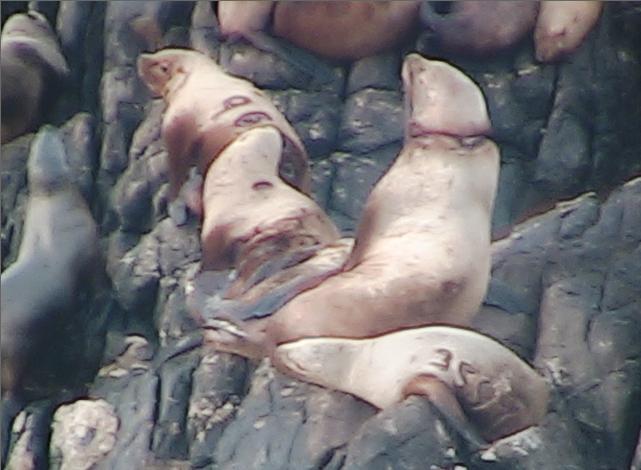
Pam Birley, from the UK, sent two photos of sea lions that she captured on Camera 1, located at the top of the lighthouse.  Pam’s photos show two branded sea lions that have never been spotted at Race Rocks, as far as I can tell.  See the photos below.  Thanks Pam!

The desalinator was run today to top up the fresh water cistern.  The solar panels aren’t soaking up as much energy, due to the clouds.  The generator was run longer today to help out the energy intensive desalinator.

The Barometer Begins to Dip

The wind blew between 8 and 18 knots from the northeast throughout the day, less strong in the afternoon.  The day began with occasional whitecaps and a small swell from the northeast, calming down in the late morning. The barometer dropped from 1030 to 1023 hPa, ushering away the high pressure system that has been around for the past week.

There were no boats seen in the reserve today.

At 13:00, a group of humpback whales were surfacing about one kilometre to the northeast of the reserve, with no whale watching boats in sight.

The usual daily tasks were performed: salinity test, running the generator, collecting wood, cleaning the solar panels and general maintenance.

Weekly Census of Race Rocks Fauna

The wind was gusting up to 33 knots from ENE overnight.  In the late morning, the wind settled to around 15 knots from the ENE, and has maintained that throughout the afternoon.  The gale warning for the Juan de Fuca Strait was lifted mid morning.  The barometer dropped slightly from 1018 to 1015 hPa, between overnight to the afternoon.

Two whale watching boats were seen in the reserve at 16:00.

There were a few differences noticed while doing today’s census, compared to last week. There were not as many smaller birds seen today.  The elephant seals are not hanging out near the jetty, where they have been for the past few weeks.  They are now a few hundred metres west, on Middle Rocks.  The harbour seals were easier to spot because they were basking in the sun on the many small islands that make up the ecological reserve.

Here are the results of today’s census:
Steller Sea Lion: 430
California Sea Lion: 359
Harbour Seal: 36
Northern Elephant Seal: 6
Canada Goose: 37
Double Crested Cormorant: 12
Pelagic Cormorant: 41
Gull: 756
Black Turnstone: 1
Savannah Sparrow: 1

Jeff Spears is coming to the Rock to relieve me for a few days, as I head to a meeting in Calgary.

More Wind, Waves and Clear Skies

The wind blew between 23 to 37 knots from the east for most of the day.  A swell with 1m waves continued from the east.  The barometer dropped from 1027 to 1019 hPa.  The visibility was unlimited, with clear skies.

There weren’t any boats seen in the reserve today.

Only one elephant seal was seen today by the jetty, where upwards of 16 have been spotted there in the last few weeks.

I received some information from Pat Gearin at NOAA about three of the branded steller sea lions seen within the past several days.  All three were branded as pups in Rogue Reef, Oregon.  I have reposted the photos below.


833R was branded in July 2009 as a pup when he weighed 32kg and was 110cm long.  Since then he has been seen in June 2011 at Patrick’s Point, CA; and June 2014 in Tatoosh West, WA.
946R was branded in July 2011 as a pup when she weighed 29.9kg and was 108cm long.  Since then she has been seen in December 2011 at Pachena, BC; June through September 2012 in Rogue Reef, OR; and in July 2013 at Jagged Island, WA.
872R was branded in July 2011 as a pup when she weighed 30.8kg and was 107cm long.  Since then she has been seen 16 times between Pachena, BC and Tatoosh West, WA.

The desalinator ran today for 8.5 hours, creating about 600L of fresh water.  The solar panels were producing 1.2kw of electricity this afternoon.  The windows on the Ecoguardian’s house were cleaned inside and out.  More cleaning and installation was done in the basements of the two houses to ready the spaces for the composting drums and collection units for the new composting toilets.

One elephant seal lies on the boat ramp, with waves crashing ashore.

One elephant seal lies on the boat ramp, with waves crashing ashore.

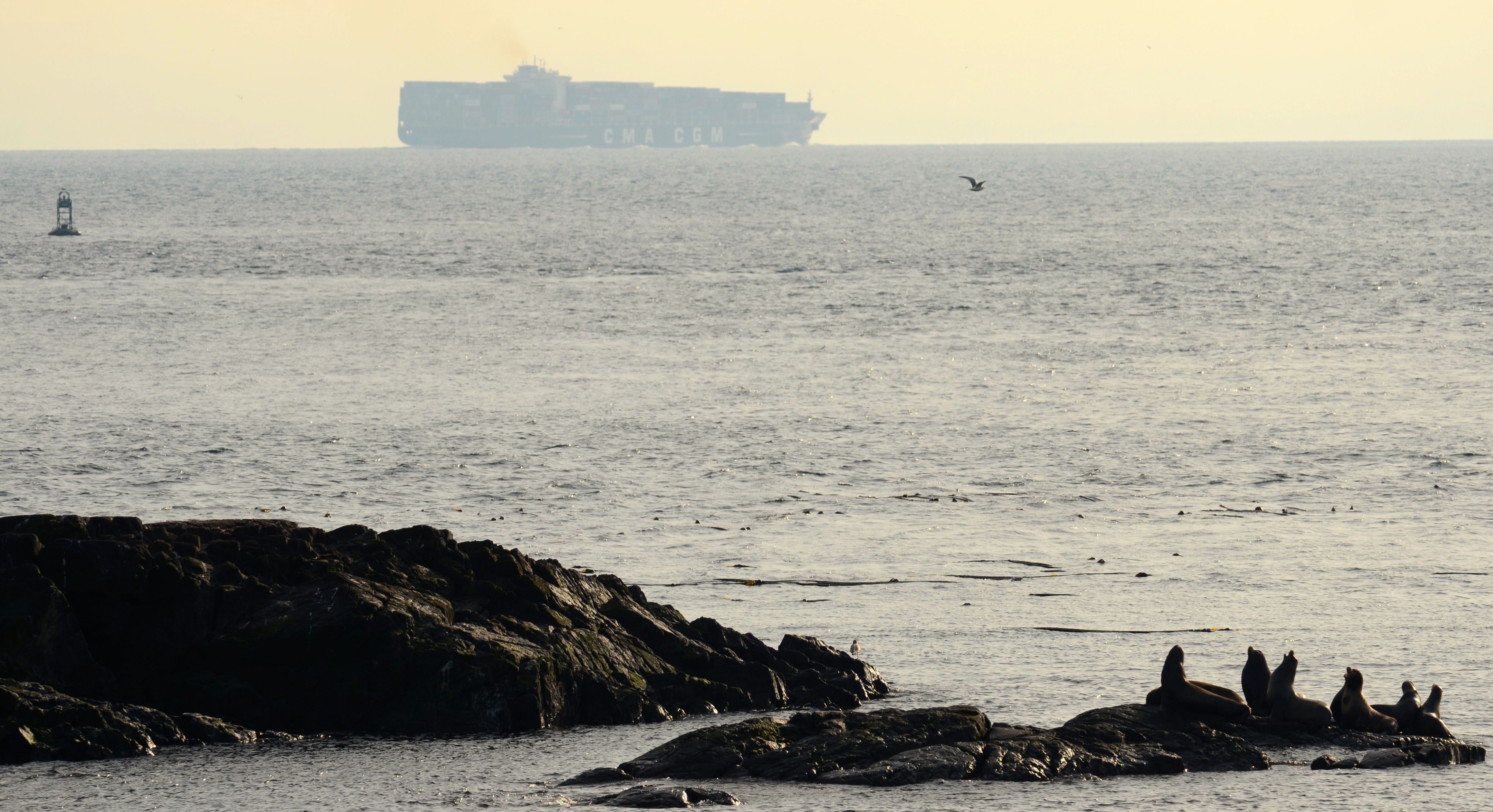
The car carrier Seven Seas Highway and another cargo ship pass within a few kilometres of Race Rocks.

The car carrier Seven Seas Highway and another cargo ship pass within a few kilometres southeast of Race Rocks Ecological Reserve.

The Sun is Shining

The wind dissipated over night. After 8:00am, the wind was calm, only blowing 3 to 5 knots from the southwest. The barometer rose to a high of 1030 hPa at noon, then slowly fell to about 1027 hPa. The temperature reached a high of 12.6oC

There were five visitors that came from Pearson College, on the boat Second Nature. Courtney brought two folks from Cullen Water to install the repaired desalinator pump. Tristan and Robin, volunteers from Wales, helped carry the many boxes that contain the new composting toilets. Each house will have the toilets installed soon.

There were two whale watching boats in the reserve this afternoon. Four halibut fishing boats were spotted to the west of the reserve for most of the afternoon. Many large boats passed within a few kilometres of the southern boundary of the reserve, including a submarine, tankers and HMCS Edmonton.

The harbour seals were difficult to spot for the census yesterday. With the sun and warm weather today, they were hauled out on the rocks to catch some rays. 32 were seen today, compared with only 7 yesterday.

Three branded sea lions were seen on South Seal Rocks, just south of the engine room. I have let Pat Gearin at NOAA know about the sightings and he will let me know where else they have been.

There are updates about the two branded sea lions spotted yesterday.

Pat Gearin wrote to me with the details about the Steller that was branded 966R as a pup at Rogue Reef, Oregon in July 2011.  It is a male and so far we have 9 resights from this individual, all from BC.  In 2011, he was sighted at Pachena Point once, and in 2012 he was sighted at Carmanah 8 times.

Matthew Tennis wrote that U596 was branded on August 15, 2014 in Astoria. At that time he weighed ~193 kg. He was seen in Astoria for a few days following the branding and again in the middle of October. This is the first resight for this animal outside of Astoria. They have high site fidelity and being a relatively young animal, it is very possible he will be seen at Race Rocks for years to come.

Maintenance tasks were performed today: moving propane tanks, pressure washing the algae and bird poop off the exterior of the houses, dismantling the old toilets, picking up garbage that has washed ashore and running generator and new and improved desalinator.

Getting Ready for the Census

The northeasterly wind picked up to 23 knots in the middle of day, producing a choppy swell with frequent whitecaps.  Mixed with the inflowing tide, the standing waves off the end of the jetty became quite large.  The barometer dropped steadily.  There was a low cloud cover with a few scattered showers.

The Juan De Fuca Warrior from Ogden Point visited twice with two groups of four divers.

I prepared for tomorrow’s census by practicing my species identification and counting.  The numbers will be double checked tomorrow and revealed on the log.  The sea lions are proving difficult to count, due to their large cuddle puddles.  Where does one sea lion begin and the other end?

I checked the underwater camera twice today.  Both times there was a sea lion swimming across the screen just as it loaded, but I wasn’t fast enough to click the button to save the image.

Up on land, the california sea lion that was camped out by the desalinator bunker for the past two and a half days decided to move this evening.  It must have got tired of waiting for the new desalinator pump.  Don’t worry, it should be here by Friday.  Just before sunset, the sea lion waddled on all four flippers eastward over the salt water cistern and down the rocks to the water.  Taking many breaks along the 50m overland journey, it collapsed and exhaled large lungfuls of steamy breath.

Desalinator lion

Desalinator sea lion

These steller and california sea lions don't make it easy to count them.

The steller and california sea lion cuddle puddles don’t make it easy to count them.

A self loading self dumping log barge is towed towards the west past the reserve.  Where is this floating forest from?  Where is it going?

A self loading self dumping log barge is towed towards the west past the reserve. Where is this floating forest from? Where is it going?

Sea Lion Thermoregulation

The barometer rose steadily throughout the day as a moderate westerly breeze whipped across the reserve. The clouds parted mid morning to bring an afternoon of sun and a high of 13.1 oC.

The solar panels weren’t the only things soaking up the sun’s rays. Sea lions were floating in small groups with one or all four flippers exposed to the air, using thermoregulation to their advantage. The sun warms the seal’s flippers, which are poorly insulated, then the warmed blood is pumped throughout their body.

One whale watching boat was seen in the reserve, after they spotted humpback whales surfacing a few kilometres to the east of the Race Rocks.

Courtney visited on the Second Nature to give a quick lesson on some of the mechanical systems on the island.

Maintenance tasks were performed today: running the generator, cleaning the solar panels, tracking down equipment and parts, figuring out how to use the equipment, vacuuming, flag care, and sweeping the paths.

Sea lions thermoregulating by sticking a fin out of the water.

Sea lions sticking flippers out of the water for thermoregulation.

Pinnipeds galore

There was a moderate breeze for most of the day.  The barometer dropped slightly throughout the day. There was a low cloud cover and occasional light rain.

There was only one whale watching boat seen in the reserve today.

Two juvenile bald eagles took the rocky perch on the South Islands that was occupied by the adult bald yesterday morning.  Occasionally one of the eagles would assert its authority over the gulls by flying around Great Race and sending the thousands of gulls skyward into a panic.

The pinnipeds are still occupying the reserve in large numbers.  Perhaps wanting solitude from the cacophony of sea lion barking, a lone california sea lion parked itself in the middle of the island for the whole day.

This afternoon, a group of five harlequin ducks were hanging out by the kelp beds to the west of the jetty.

It looks like I'm not the only one excited about the arrival of the new desalinator pump.  This California sea lion spent the whole day in the middle of the island.

It looks like someone else is also excited about the arrival of the new desalinator pump. This california sea lion spent the whole day in the middle of the island near the desalinator bunker.

A male elephant seal making a splash.

A male elephant seal making a splash.

Flake, the elephant seal, flaking out on the ramp near the tank room.

Flake, the elephant seal, flaking out on the ramp near the tank room with the lighthouse in the background.

A cuddle puddle of elephant seals. Notice the two tags on the seal in the foreground: 7688 and 7625.

A cuddle puddle of elephant seals on the boat ramp. Notice the two tags on the seal in the foreground: 7688 and 7625.