Crankypants Has a Number.

By mid-morning, the light southwesterly winds left over from yesterday’s blow had wandered over to south and they stayed southerly until early evening when they turned back to west. The barometer continued the slow ascent begun early yesterday, throughout the day. Although there was a mix of sun and clouds today, light levels were high and reached over 1000 W/m2 at the peak. Forecasters are calling for strong westerly winds again, with a chance of showers Thursday.

Four Whale Watching vessels were noted in the Ecological Reserve today, visiting on return from the west, heading towards Victoria. No sports fishing vessels were noted in the ER.

The Canadian Coast Guard Helicopter (Fisheries and Oceans) dropped by today to service the light, which went dark the night before last. Dave (pilot) and Derek (technician) were a welcome sight in their lovely little Messerschmidt, which was carefully put down at the base of the light tower stairs.
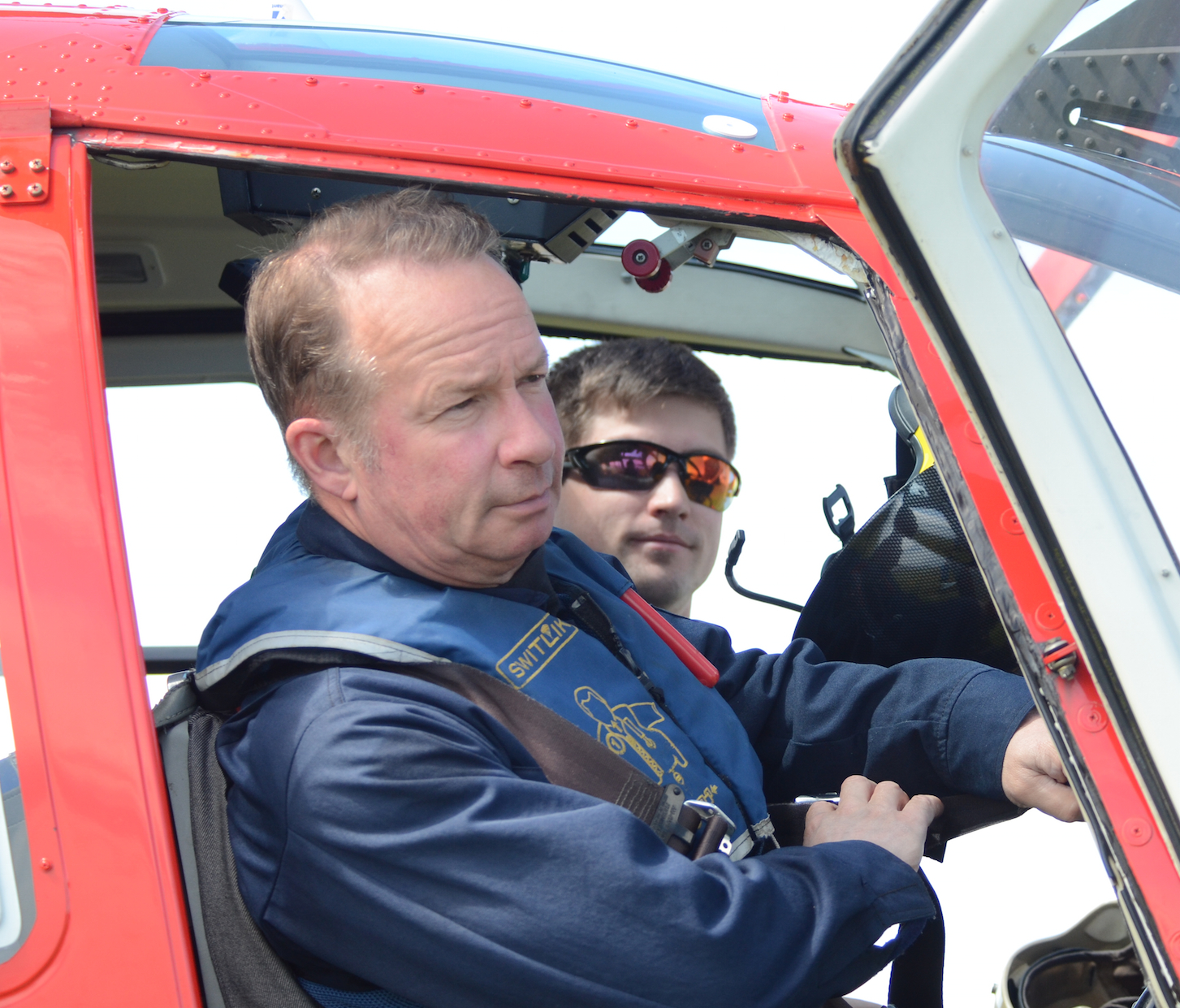
 

Dave and Derek preparing for take off.
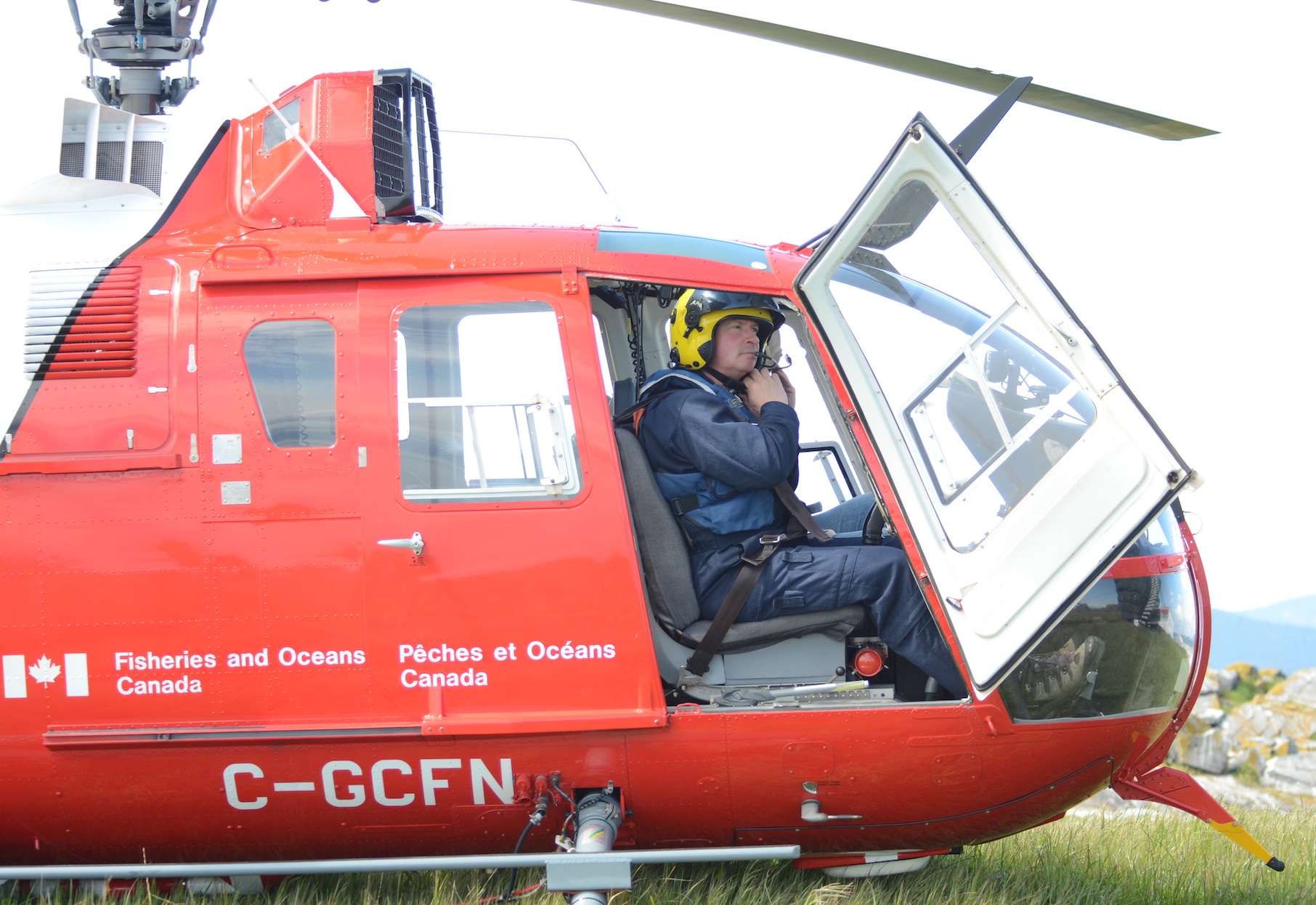
Dave and Derek preparing for take off.
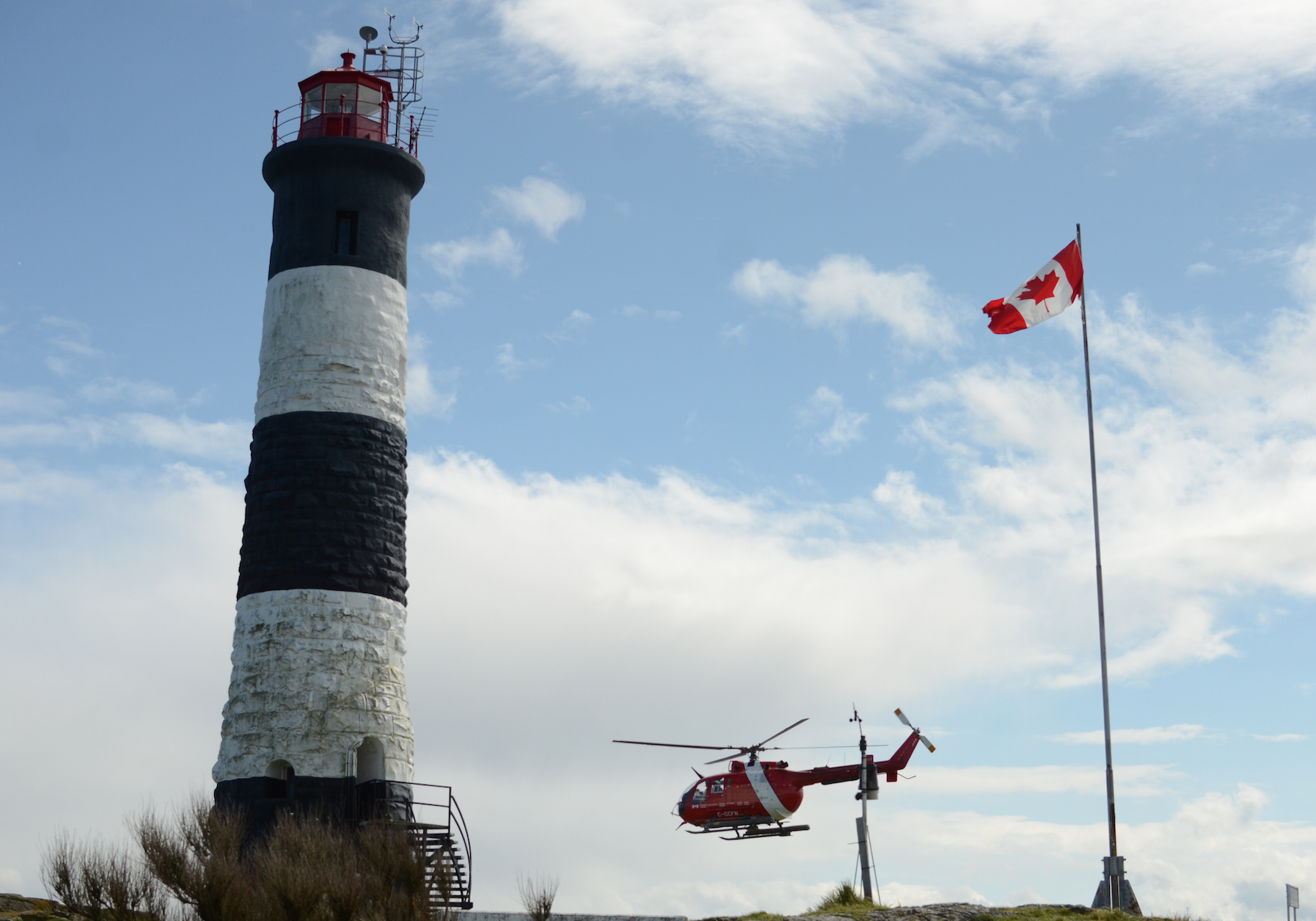
Messerschmidt tower heli flag


Ten Whimbrels stopped for a rest and a feed today. These amazing migrators are on their way to the arctic tundra from South America and it was a treat to see them here.
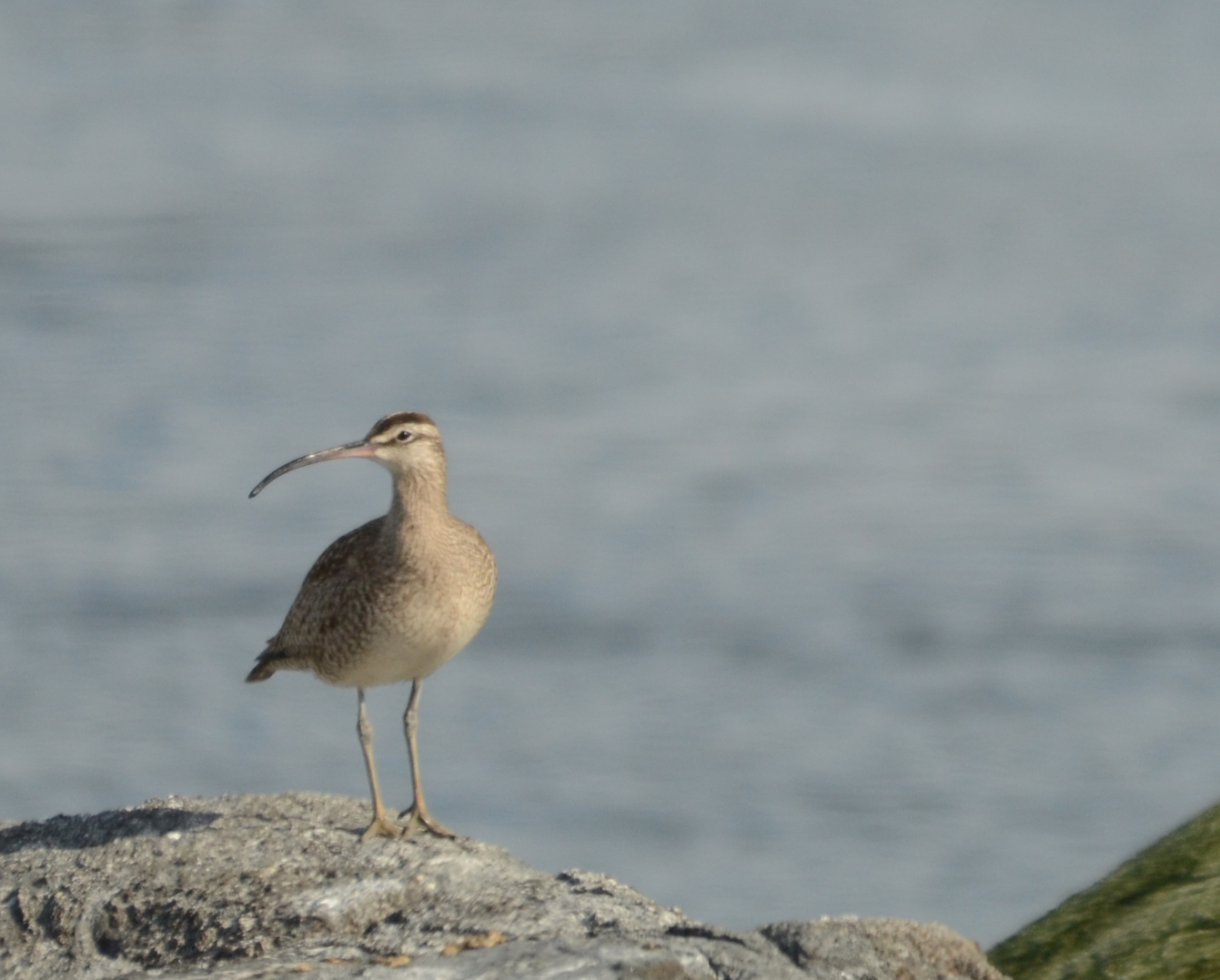
Whimbrels stopped for a rest and a feed in the inter-tidal today.
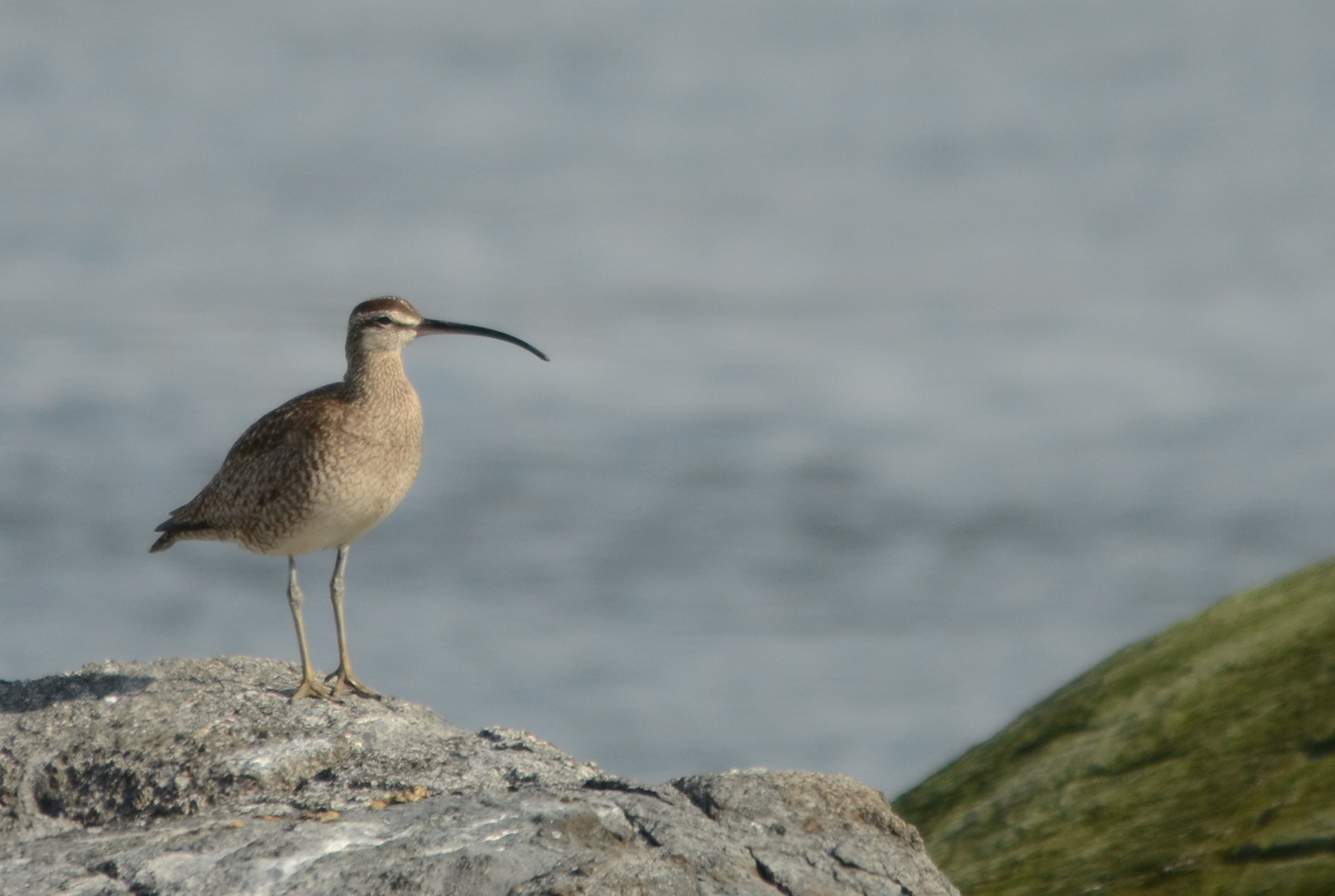
Whimbrels stopped for a rest and a feed in the inter-tidal today.

Whimbrel M

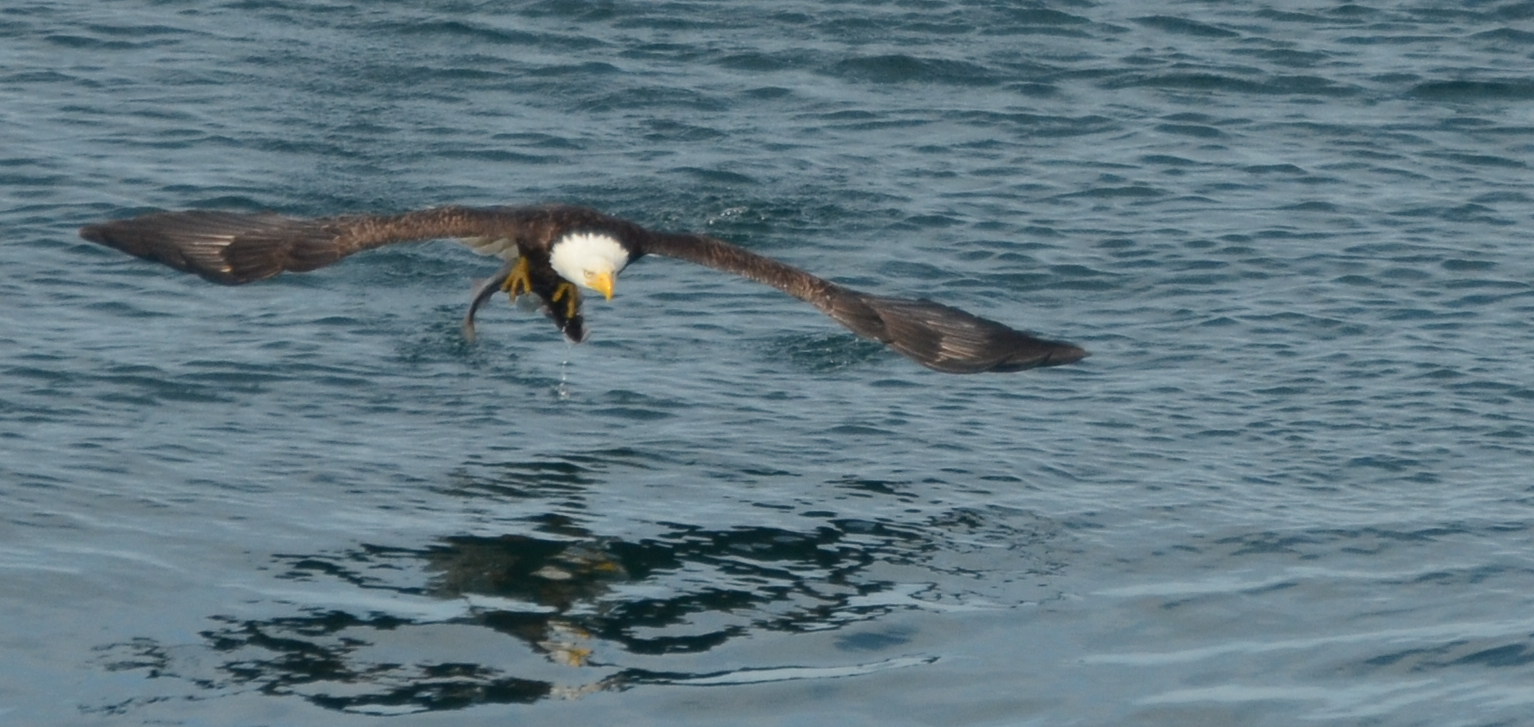
I kept an eye on the Bald Eagles today and yes, they are fishing.
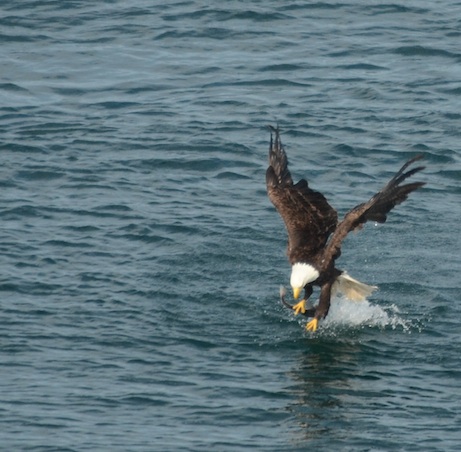
It was a right "hand" catch, transferred to both feet and then tucked up under to the tail to hide it from sight.

It was a right “hand” catch, transferred to both feet and then tucked up under  the tail to hide it from sight.
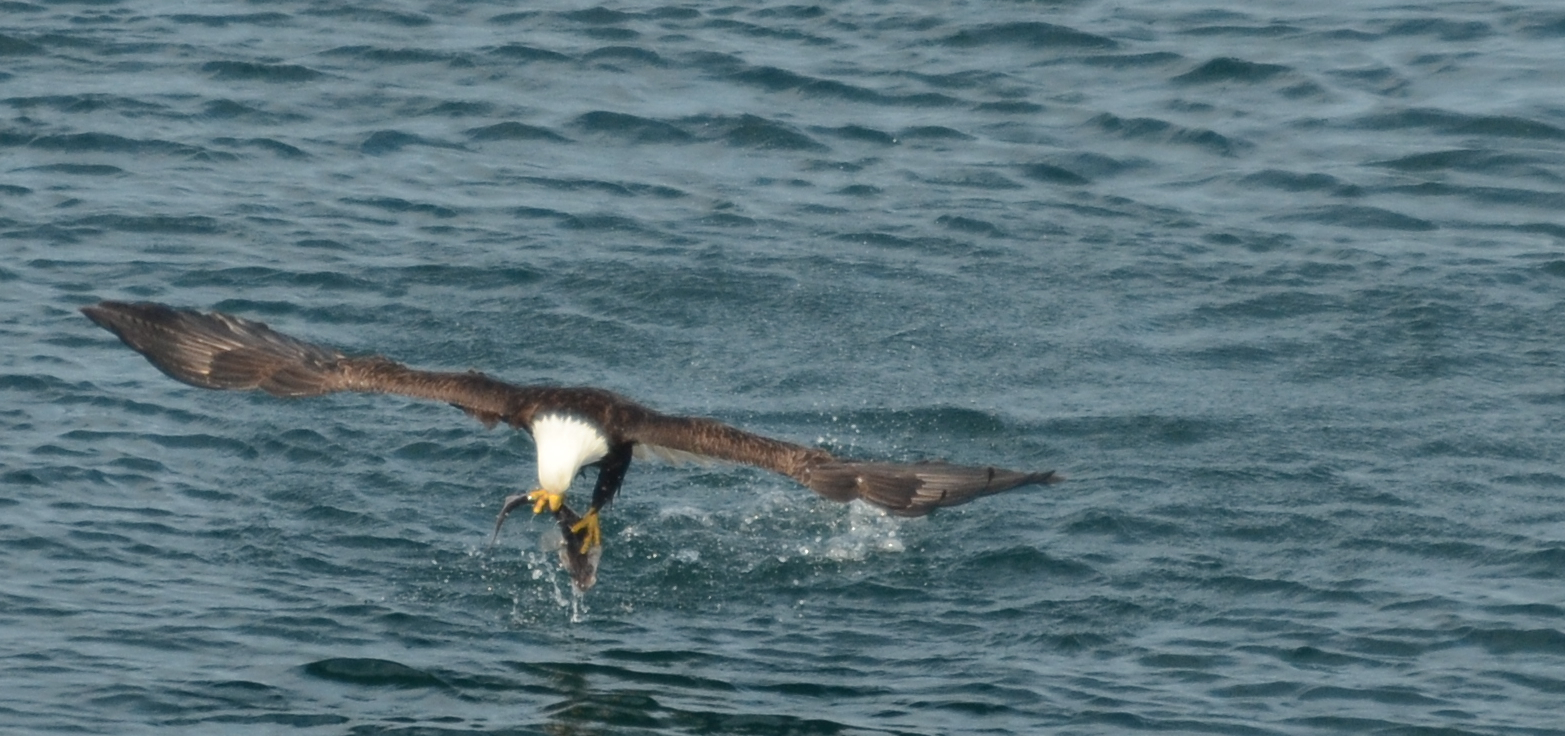
Baea fish hooked Baea catch

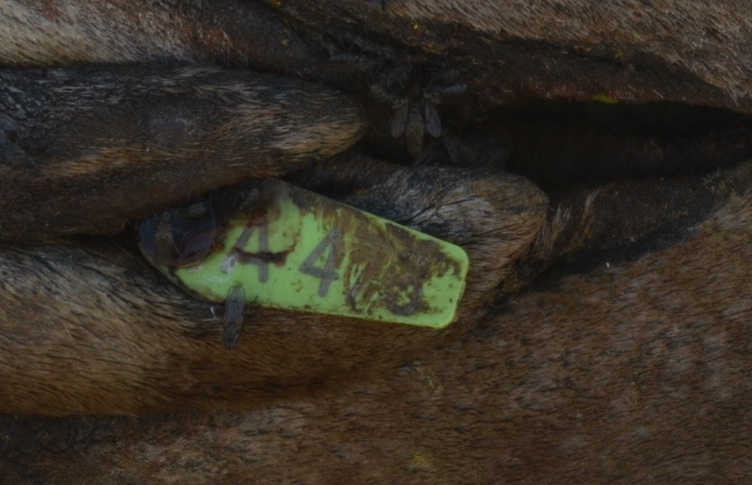
Ten of the elephant seals managed to go through the measuring device today while I was sitting, waiting for them with the camera. I also spotted tags on the young female Northern Elephant Seal with serious skin issues. I may have mentioned her in a previous blog, I called her psoriasis sister last fall and Courtney named her crankypants in spring 2014. She is very vocal and easily disturbed by the other seals. She is usually off by herself but today she was caught in a traffic jam for daily ablutions, which really seemed to upset her. I have observed her many times last fall and this spring but never noticed the tags before. She moves as if in pain, complains loudly and leaves a trail of blood. She has many open wounds that look like holes and cracks. The right tag is number A114 and although it is difficult to read the left side, it is perhaps A476. She has all four tags still.
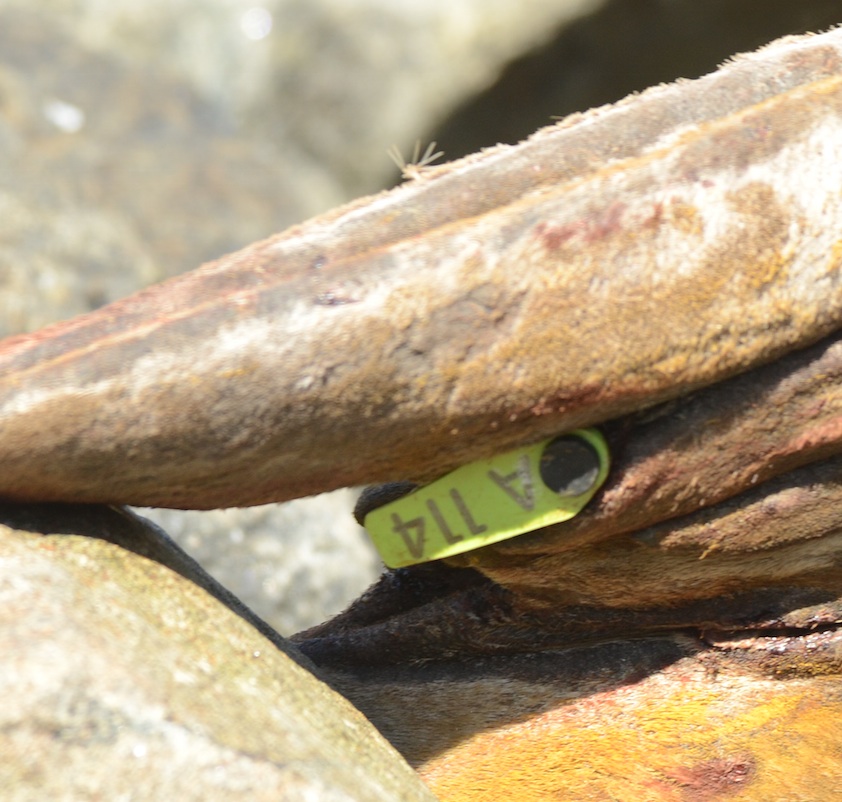
 

Crankypants has a tag number now A114.

Crankypants has right  tag number  A114.
MianA114R_A476?left?

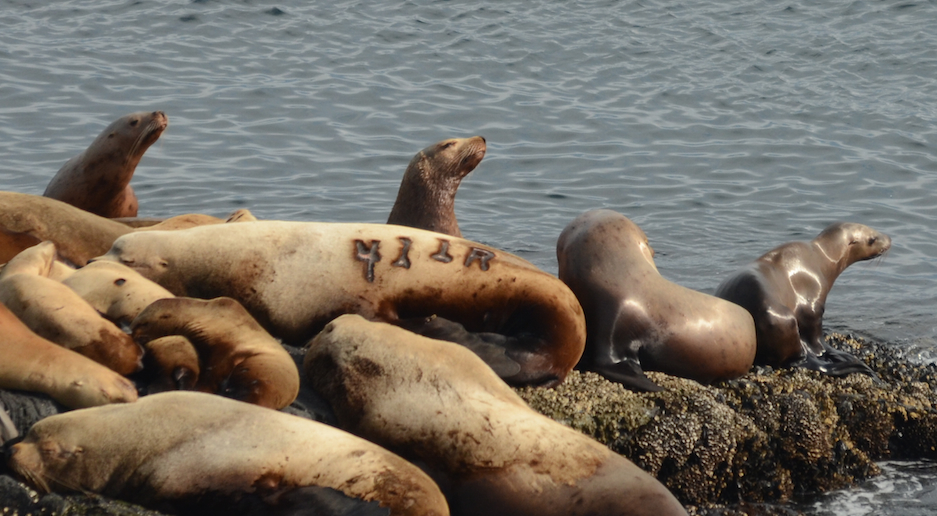
A branded Steller’s Sealion # 411R was noted today. She looks big for a female but that is what the record says, branded as a pup in July, 2005 at Rogue Reef, which is in the very southern end of Oregon. I will check with Pat Gearin on this identification.
Euju#411RApr29_15

There were no visitors other than the Coast Guard crew and maintenance chores were all routine.
Spring Wind Blowing.

It was a day defined by wind, starting in the wee hours of the morning, with 30 – 40 knot northeasterlies which calmed just after dawn, then switched to equally ferocious westerlies. The afternoon westerly subsided to 20 – 25 knots early then built back up to 25 – 30 knots as I post this log blog.

The barometer’s fall, started Monday, was short-lived: it started to rise again in early hours today and is leveling off as the day ends. The forecast calls for afternoon westerlies tomorrow and the gale warning remains in effect. They are calling for only a 60% chance of showers and precipitation is taking on new meaning here south of latitude 48o18’ N. What we consider normal rain and showers on the outer coast just doesn’t materialize in the same way here in the Mediterranean climate of Race Rocks. It is so much more of a desert than the outer west coast.

I only saw one whale watching boat today and they were travelling east, well south of the Ecological Reserve. Sports fishing boats were also notably absent. Very wise considering the sea state, wind and current conditions today.

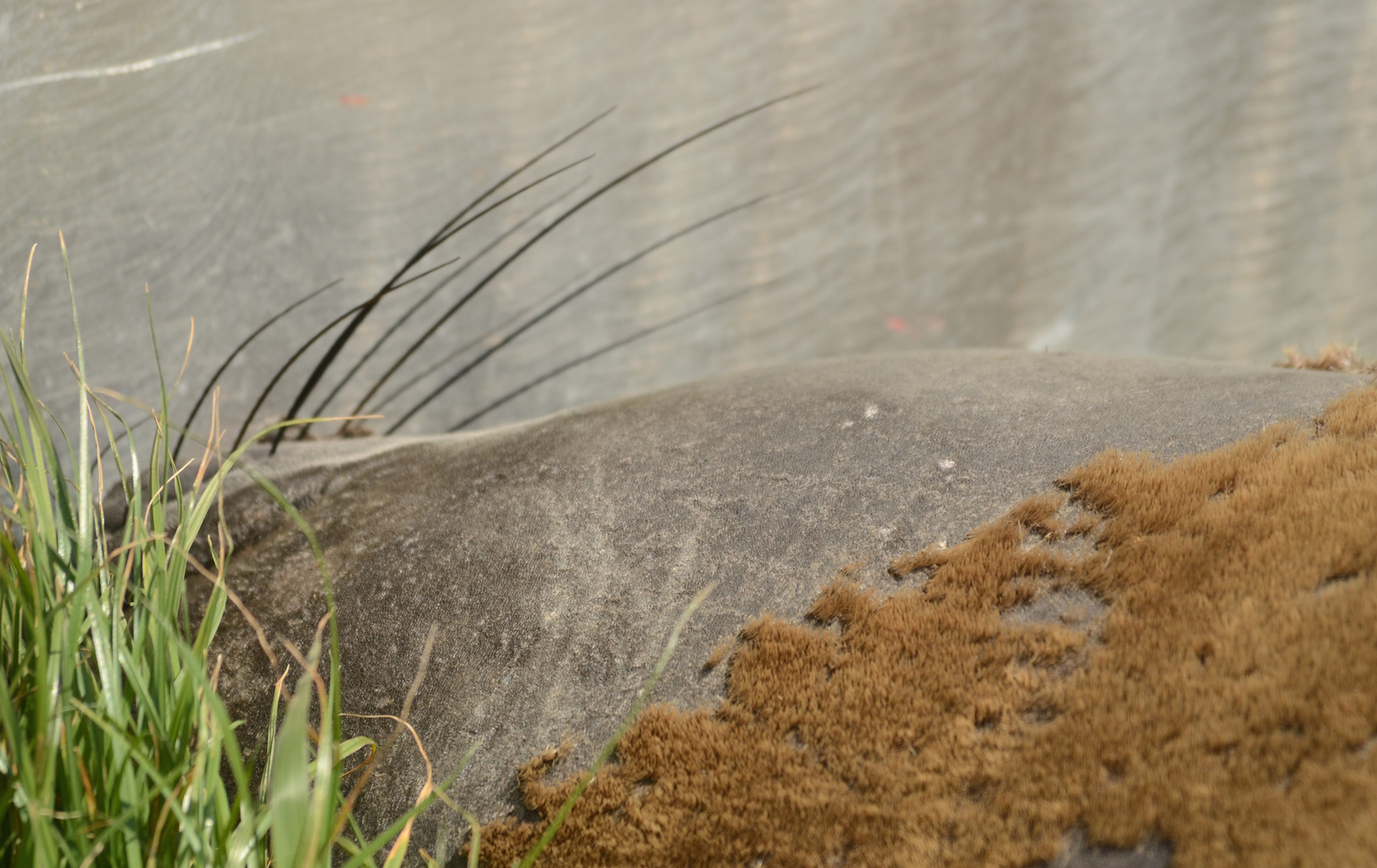
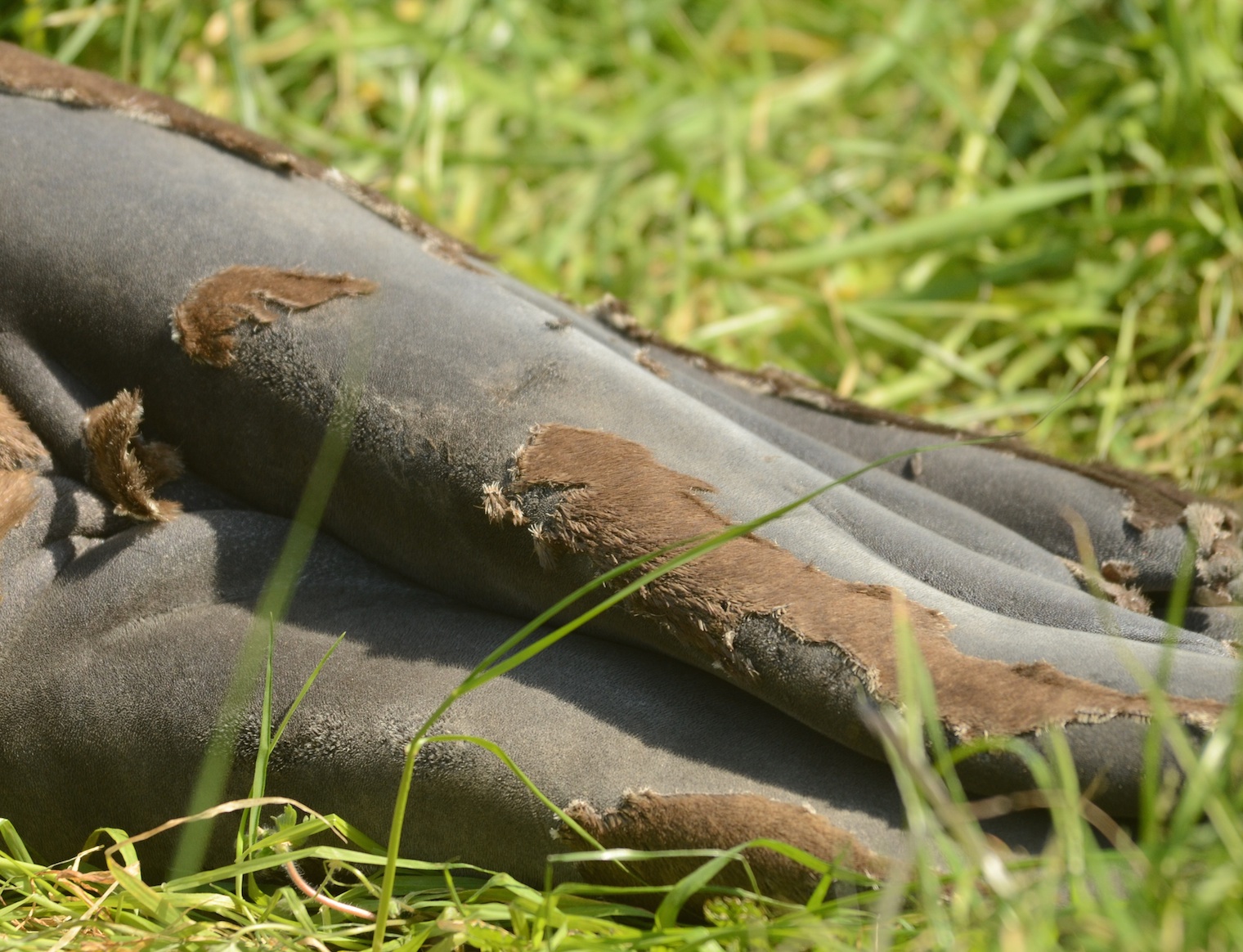
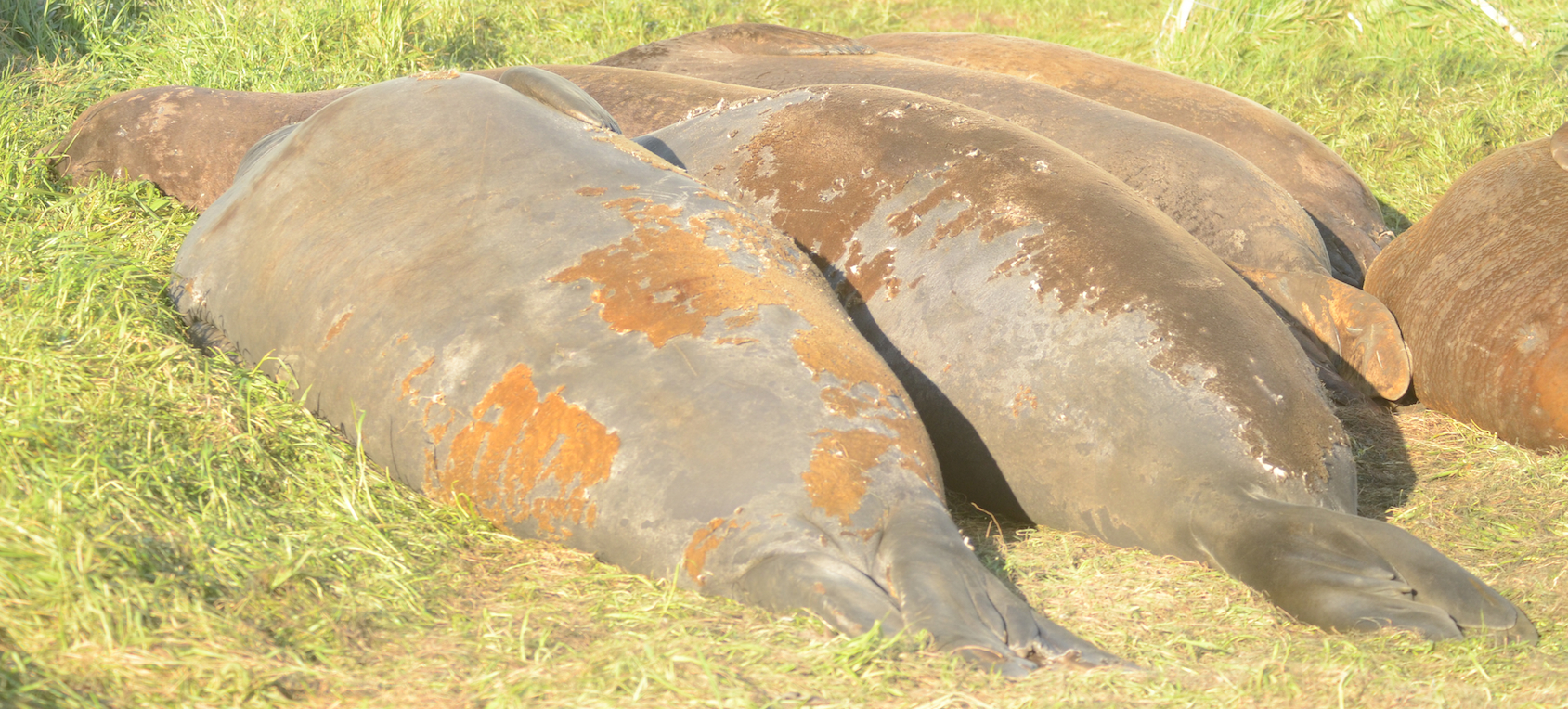
The Northern Elephant Seal moult is taking a new dive into the unconscious with fewer hours awake and active. Some animals have not moved more than a few metres in 24 hours. The larger females seem to be leading the race to moult and the two biggest females and largest male are almost 75% moulted. The soft grey fuzz look is taking over from a once brown and tattered look.

Two of the larger animals on the island are close to 75% moulted, a male (left) and female (right). Young males behind are not as far along.

Two of the larger animals on the island are close to 75% moulted, a male (left) and female (right). Young males behind are not as far along.

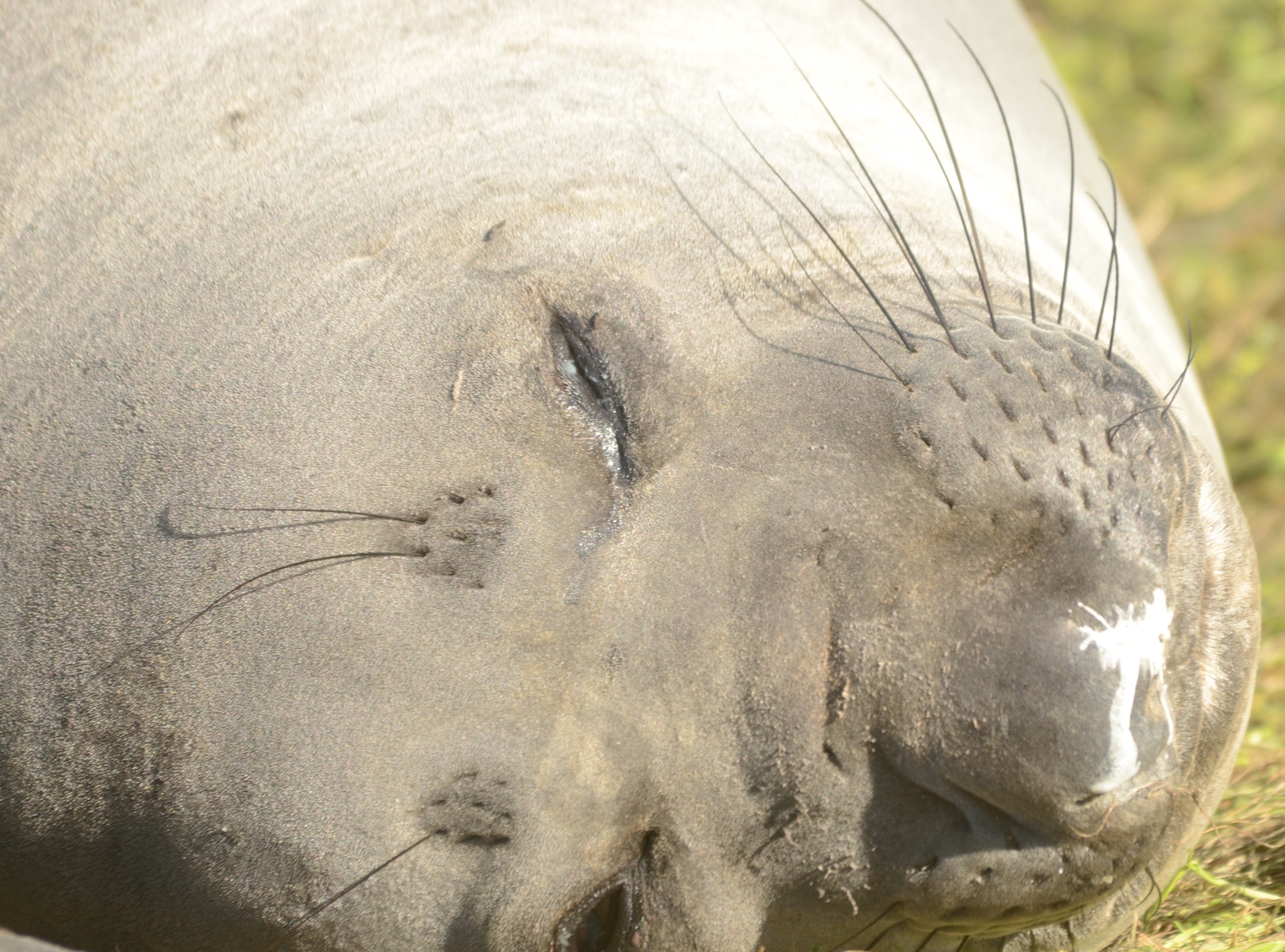
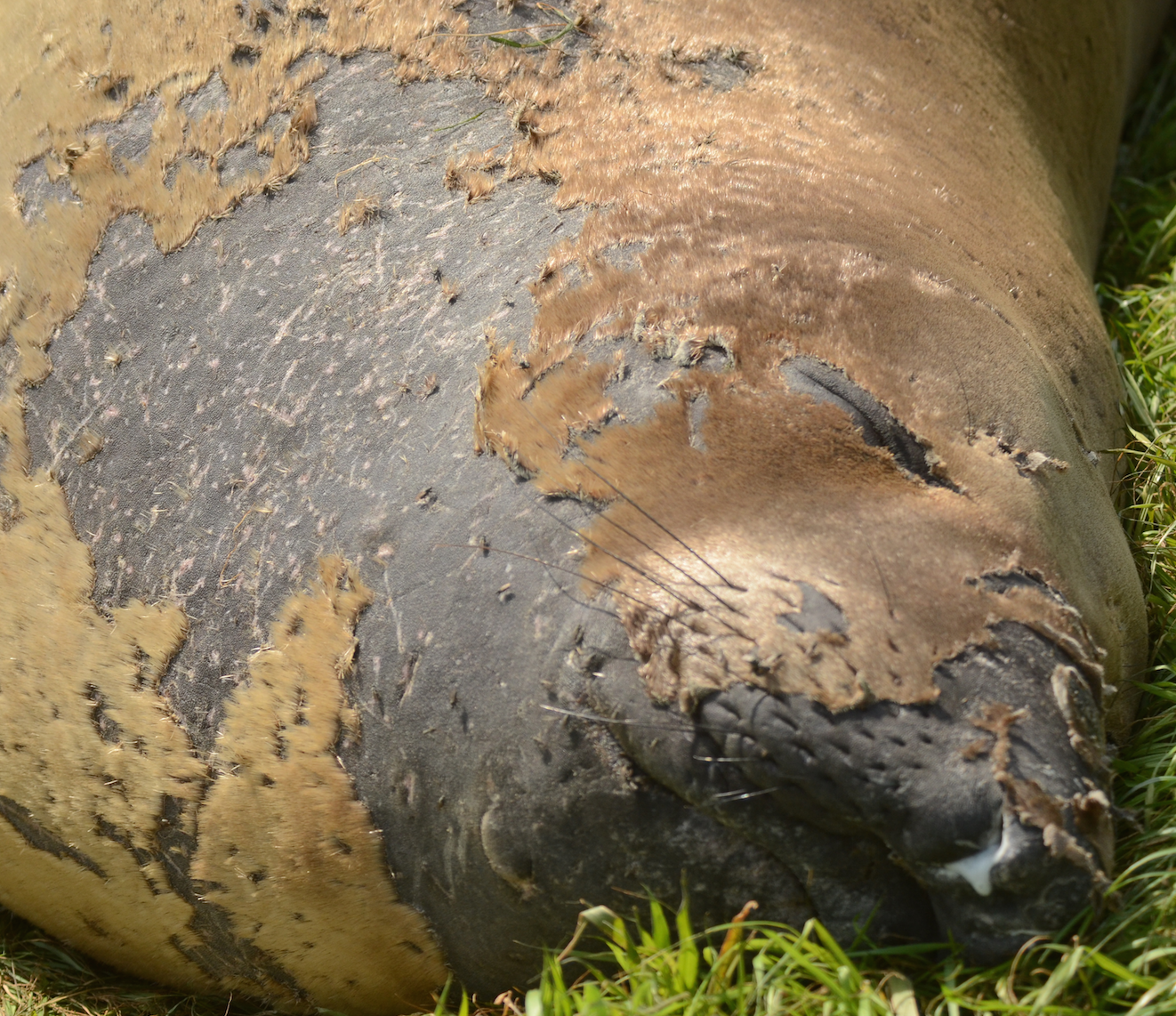
The seals are also moulting their “whiskers” which are referred to by biologists as vibrissae. It is thought they vibrissae are helpful in detecting vertically migrating prey at depths of greater than 500 meters. Of course it is a bit hard to make observations in situ but recent anatomical work on how these whiskers are enervated revealed over 1500 nerve axons per vibrissae giving more weight to their importance as sensory organs.

This female elephant seal has moutled her facial hair and skin, revealing a soft looking gray fuzz. Note that the "whiskers" and "eyebrows" are also moulting. These are important sensory hairs called vibrissae.

This female elephant seal has moutled her facial hair and skin, revealing a soft looking gray fuzz. Note that the “whiskers” and “eyebrows” are also moulting. These are important sensory hairs called vibrissae.

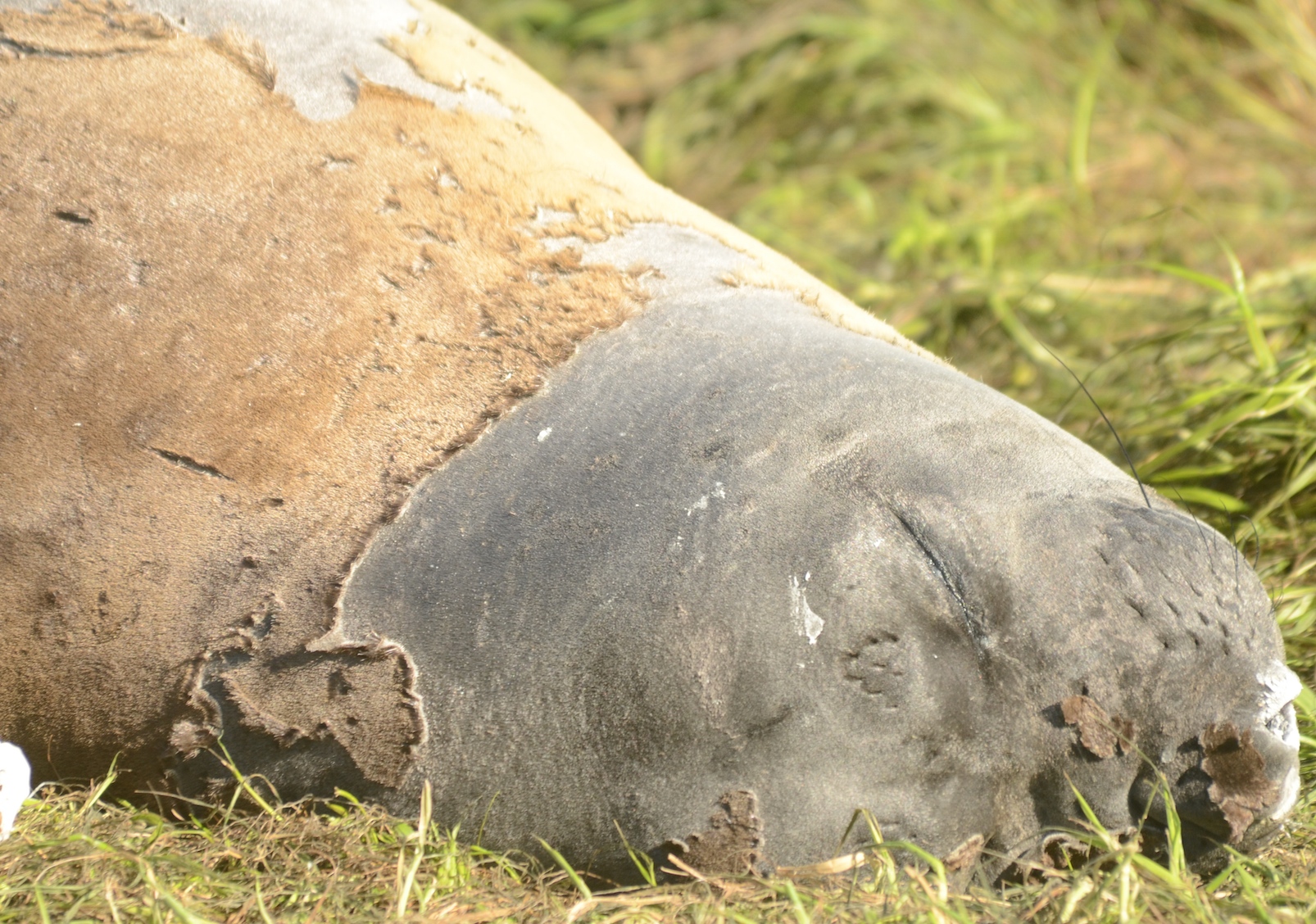
This young Northern Elephant Seal has moulted most of its skin and fur around the head area.

This young Northern Elephant Seal has moulted most of its skin and fur around the head area. You can also see that it has lost its eyebrow “hairs” also known as vibrissae.

More animals are arriving on Great Race Island and there are now fourteen ‘lawn ornaments’ and the lawn is well a truly crushed (Really beats mowing.)

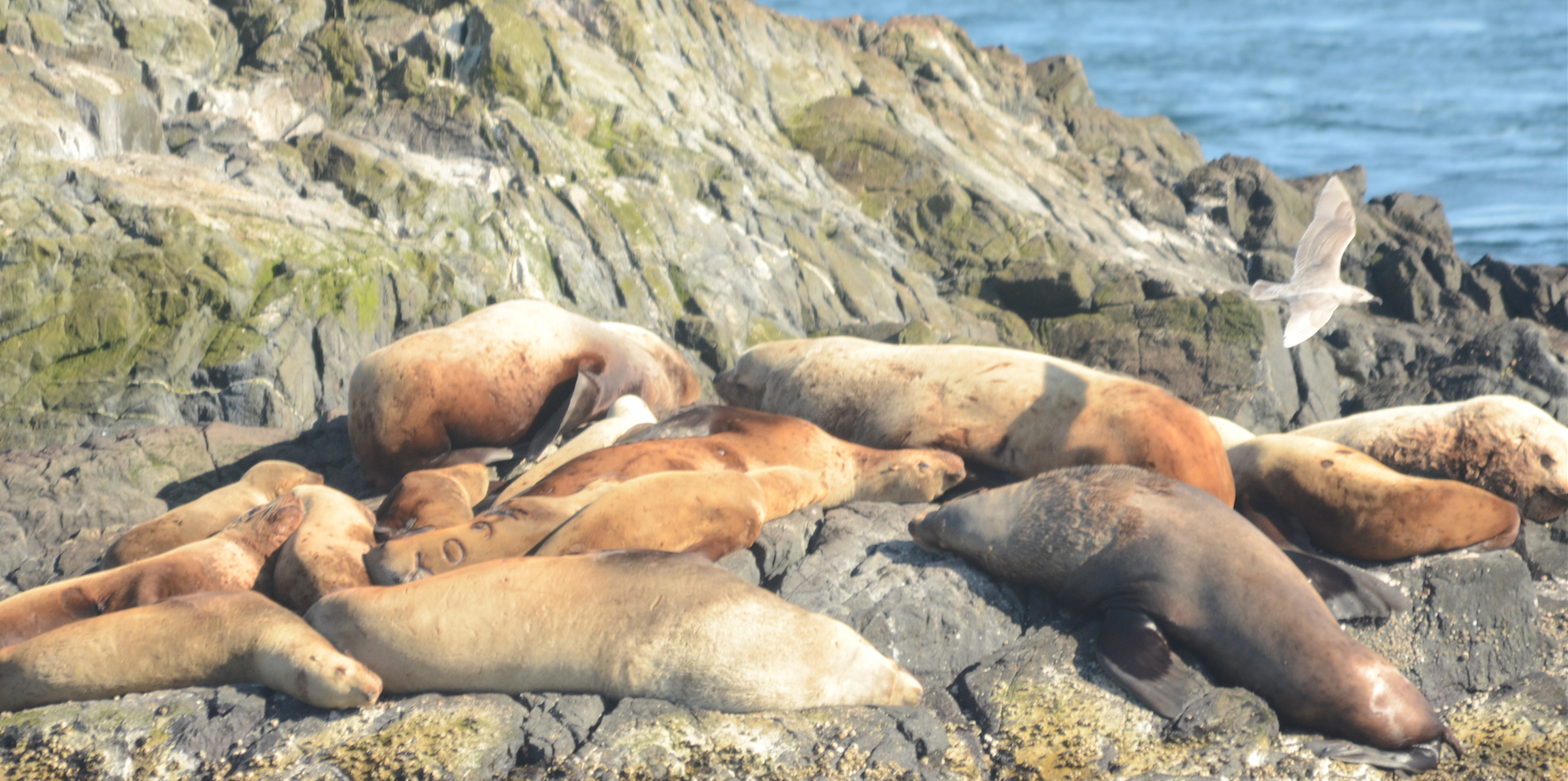
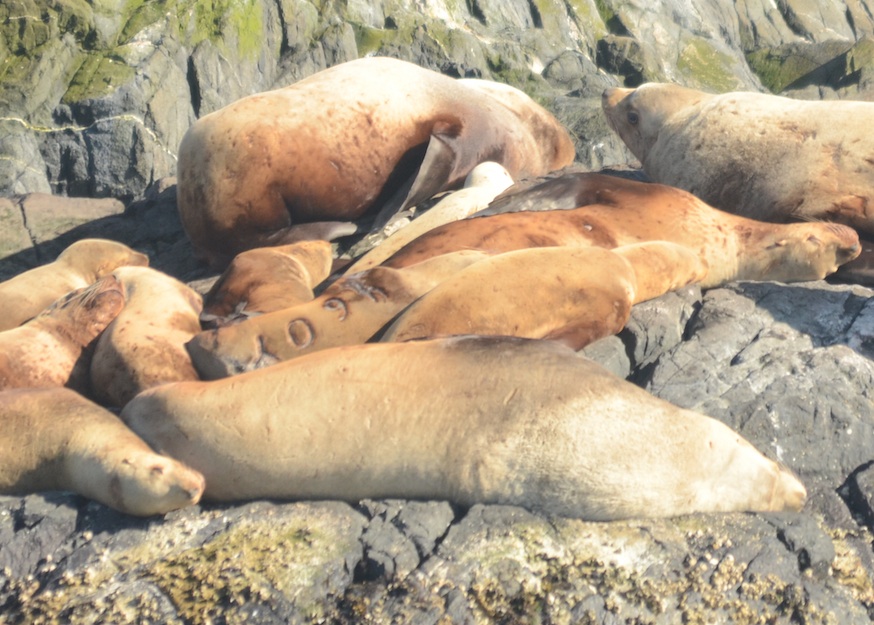
Stellers Sealions hauled out on South Islets. Note the young, branded animal # 460Y, one up from bottom left.

Stellers Sealions hauled out on South Islets. Note the young, branded animal # 460Y, one up from bottom left.

The Steller’s (or Northern) Sealions, and a few California Sealions continue to haul-out on South Islands and I spotted a brand today on the youngest Steller’s that I have yet to see here. #460Y was branded as a pup at St. George in northern California, in the summer of 2013, making it less than two years old at this stage. There are several other Steller’s Sealions that are the same size and appearance that may also be that young.


#460Y was branded in July 2013 . This young animal and probably several others its' size are less than two years old and may still be nursing occasionally.

#460Y was branded in July 2013 . This young animal and probably several others its’ size are less than two years old and may still be nursing occasionally.


There were no visitors today and maintenance was routine.
Fine Day in Spite of the Forecast.

Light northeasterly winds brought some morning showers and kept it cool until late morning. The light northeasterly continued in the afternoon but solar radiation levels went up to a high of over 800 watts per m2 bringing up air temperature to a high of over 13oC. The barometer was fairly steady until noon and then started to fall very gradually. The marine forecast has a strong wind warning in effect overnight diminishing to a 20 knot westerly by early afternoon tomorrow. As I write this in the early evening the north-northeasterly is freshening to over 20 knots.

Three whale watching vessels were observed in the Ecological Reserve today… Sports fishing vessels were observed fishing nearby but not in the ER.

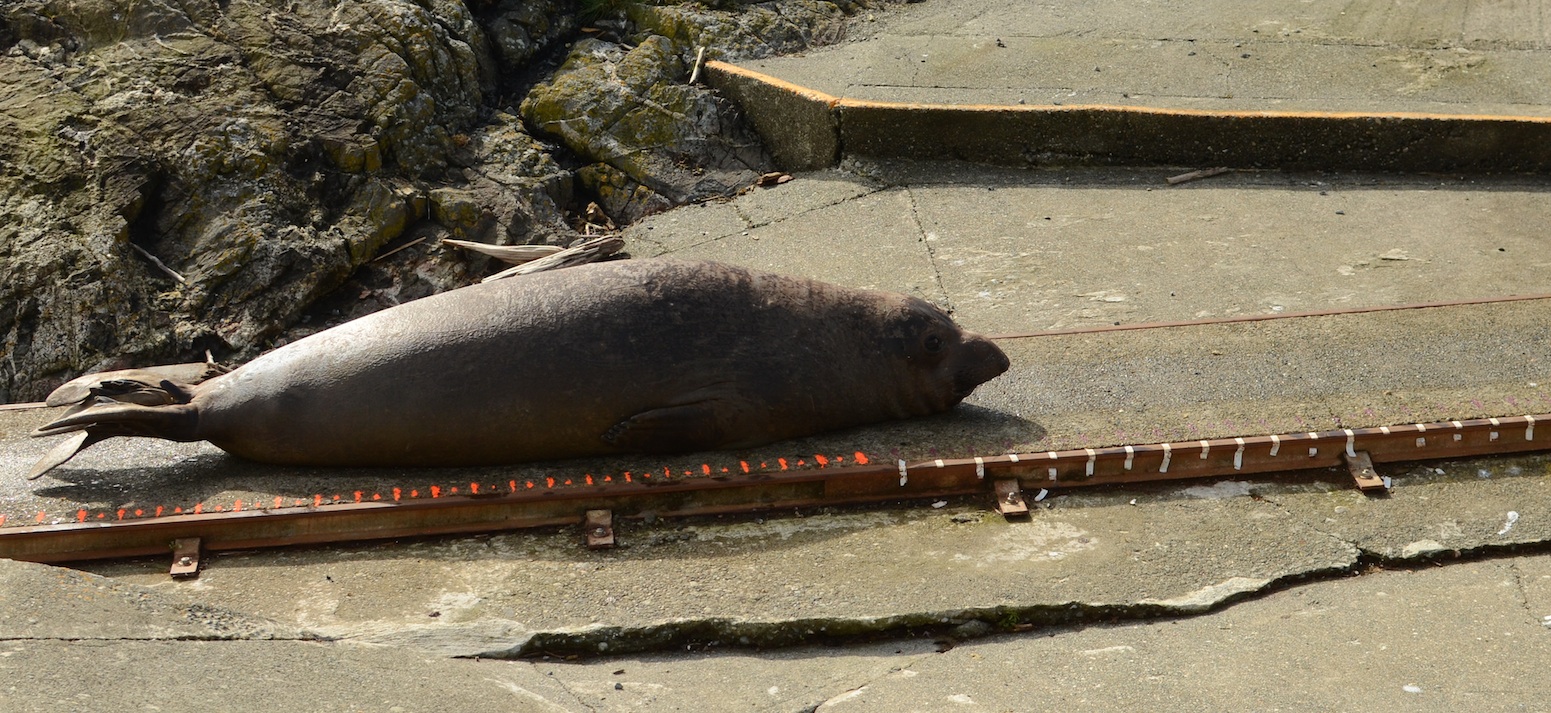
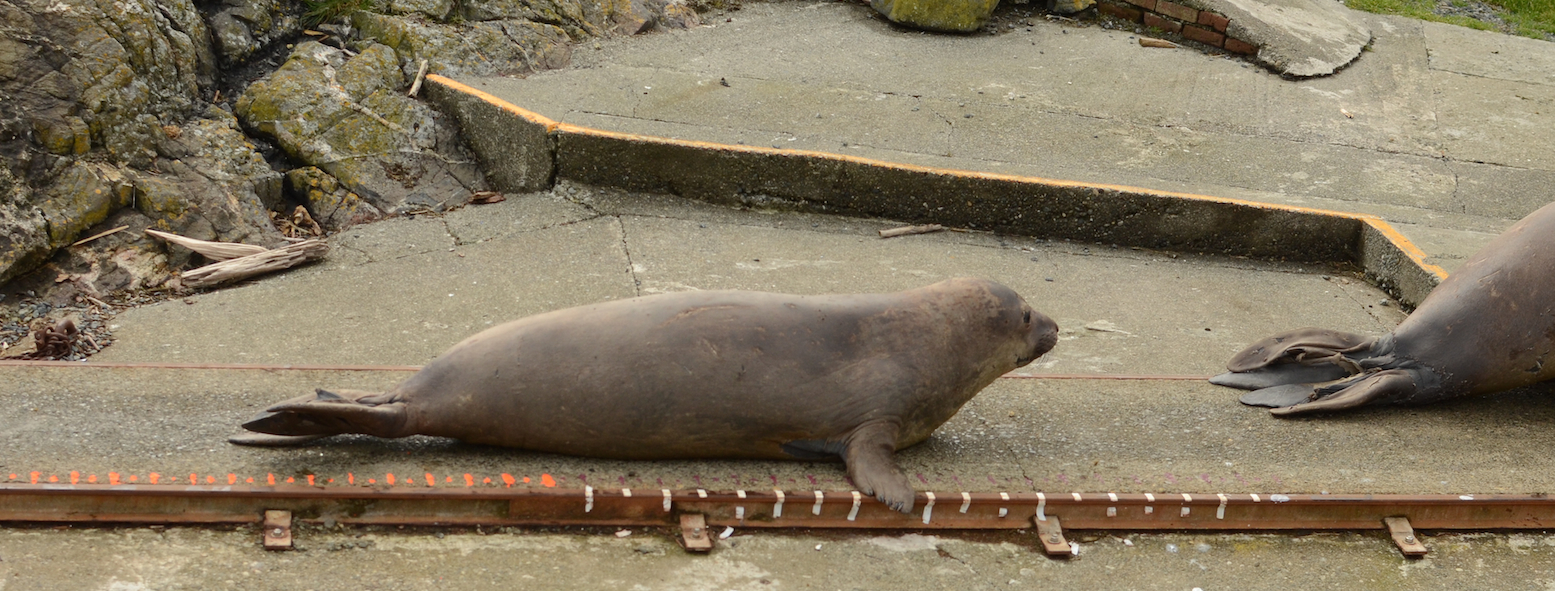
More measurements and individual moult progression, observations were made on the Northern Elephant Seals on Great Race today.

A very cooperative "pose" for length measurements. Note the little tail up in the air between the rear flippers.

A very cooperative “pose” for length measurements. Note the little tail up in the air between the rear flippers.

Traffic jam on the elephant seal measuring device.

Traffic jam on the elephant seal measuring device.

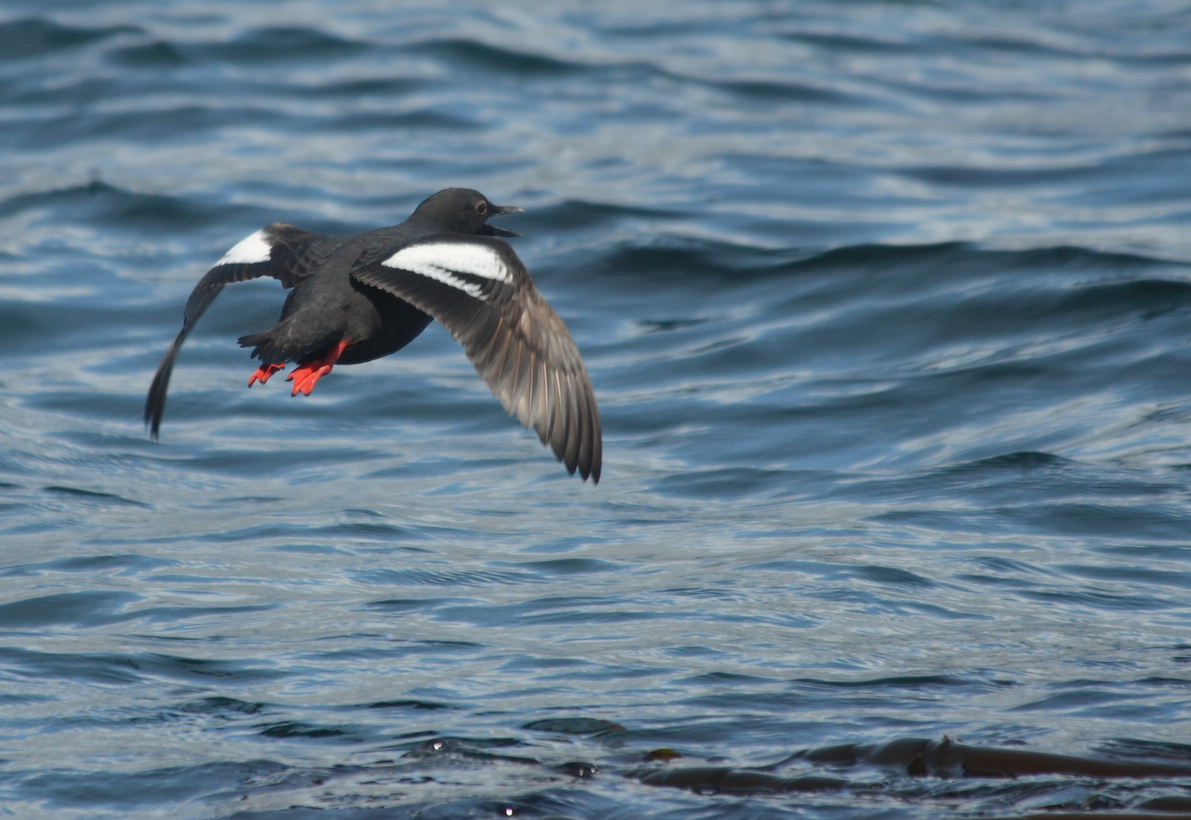
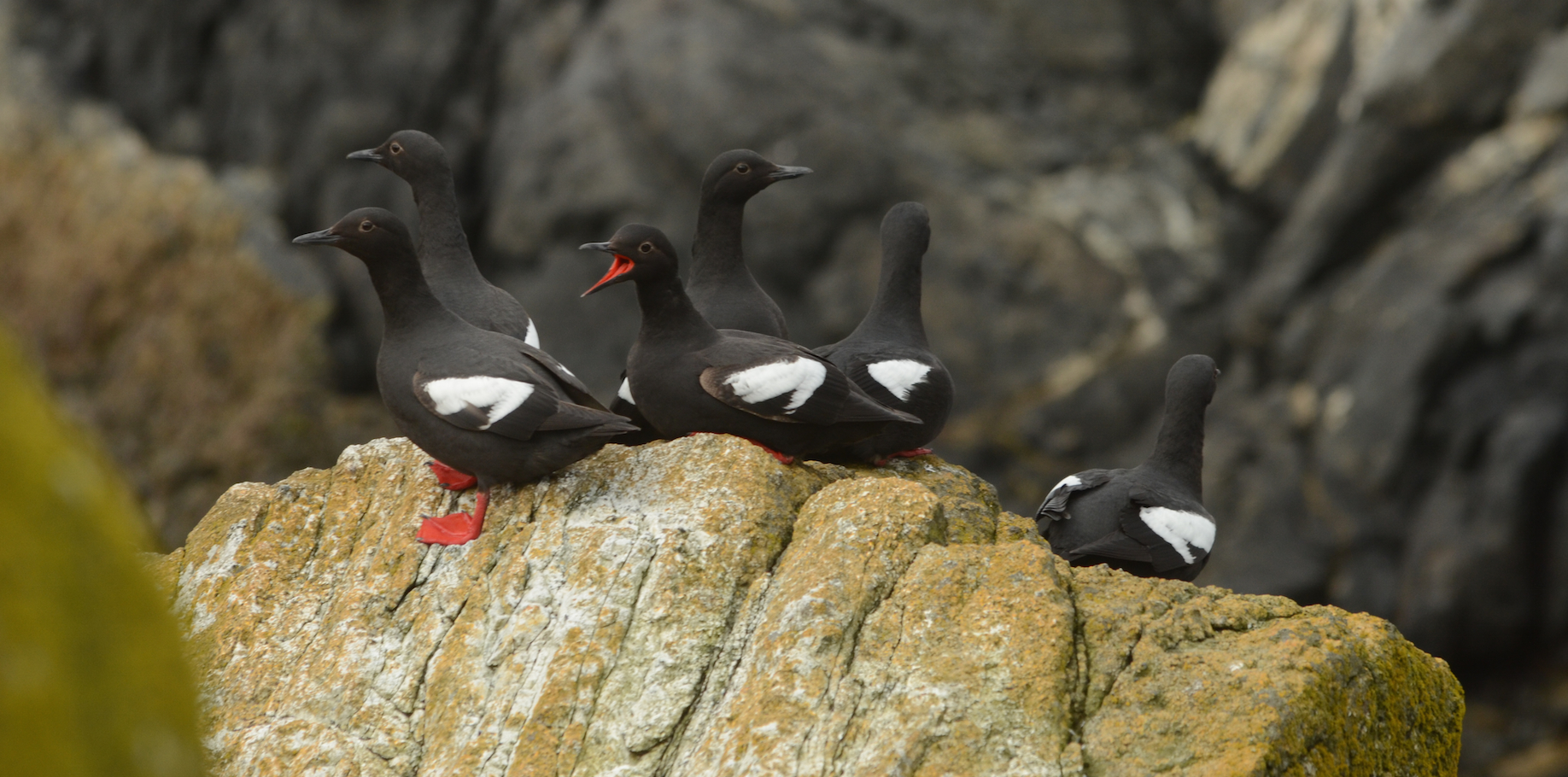
Pigeon Guillemots and Glaucous-winged Gulls were observed mating today, so nesting sites will soon be imperative.

Pigeon Guillemots are getting prepared for nesting.

Pigeon Guillemots are getting prepared for nesting.

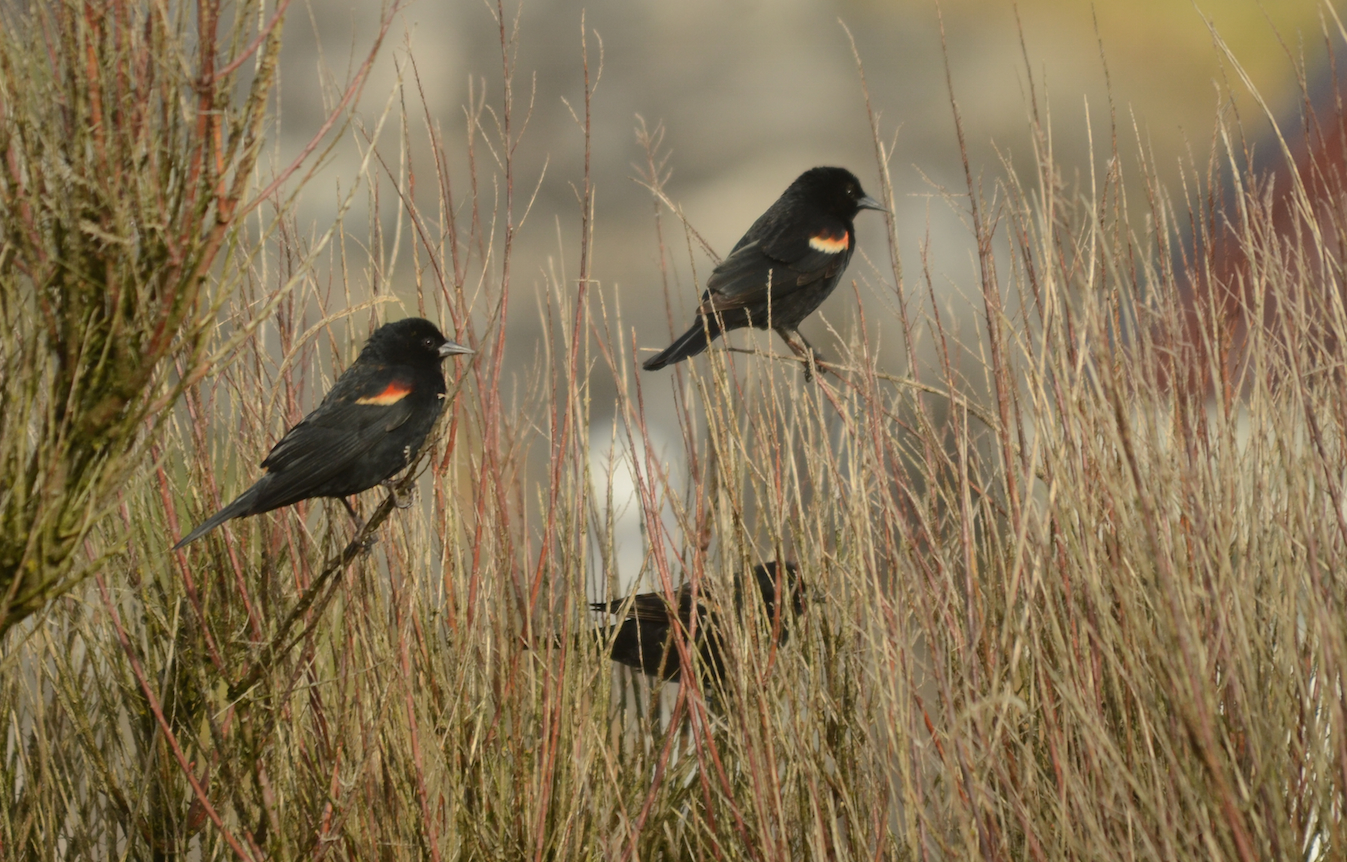
Six Red-winged Blackbirds (Agelaius phoeniceus) landed on the light-tower and then paid a short low elevation visit to Great Race Island today. This is possibly a new record.

A brief visit was made by six Red-winged Blackbirds.

A brief visit was made by six Red-winged Blackbirds.

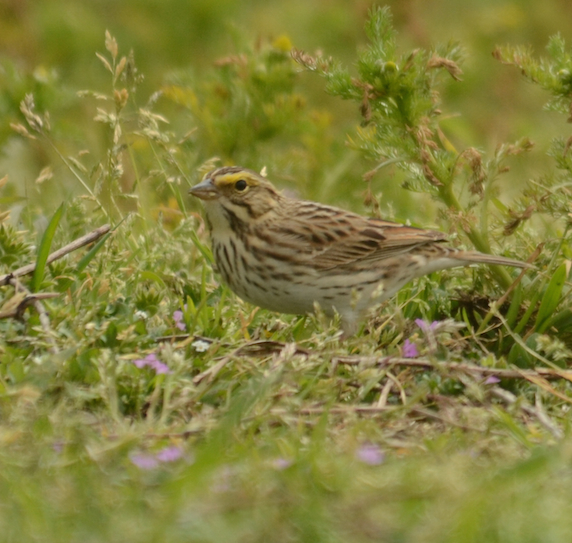
Savannah Sparrows may be nesting somewhere nearby: I am still looking for their nests.

At least ten Savannah Sparrows are seen daily now.

At least ten Savannah Sparrows are seen daily now.

There were no new visitors today and maintenance chores were routine.
A Changeable Spring Day.

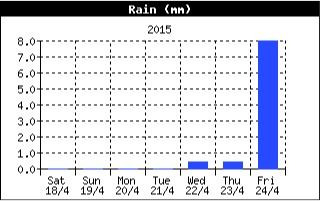
During the early part of the morning, the flag hung vertically, stuck to the flagpole, wetted by fresh rain. Later in the morning, when it occasionally fluttered, it was from almost imperceptible, easterly zephyrs. After lunch it blew north 10-15 knots for a while before switching over to the afternoon westerlies mid afternoon. Although there was significant rain (see figure below) throughout the day, there was also lots of sunlight and we surpassed yesterday’s level by over 30%. The barometer started rising in the early morning and by 17:30 was at 1008 hPa. The forecast for Saturday is for a continuation of the afternoon westerly pattern.

A graph of  the past week's rainfall recorded by a Davis instruments tipping bucket rain gauge.

A graph of the past week’s rainfall recorded by a Davis instruments tipping bucket rain gauge. Check the web-site for lots of cool data.

Only one whale watching boat was observed in the Ecological Reserve, just at dusk, although several headed west and back through Race Channel. One sports fishing boat fished very close to the boundary at Rosedale, but clearly outside. The Life Saving vessel ‘Spirit of Sooke V’ came through middle Channel this afternoon at a very stately pace and then swung around and went in between South and Great Islands and returned to the west.

A pod of at least four Killer Whales passed to the south of Race Rocks, heading west at ~07:00. It was not possible to determine which population and there were probably quite a few more than four. They were quite spread out and moving fairly fast, travelling about half way out to the US/Canada border (yellow can buoy) from Race Rocks. A flock of 23 Black Brandt flew through Middle Channel about the same time, also heading west. The Barn Swallows appear to be staying on the island somewhere; at least they were here bright and early. This place is certainly a haven for an insectivore. I hope they stay.

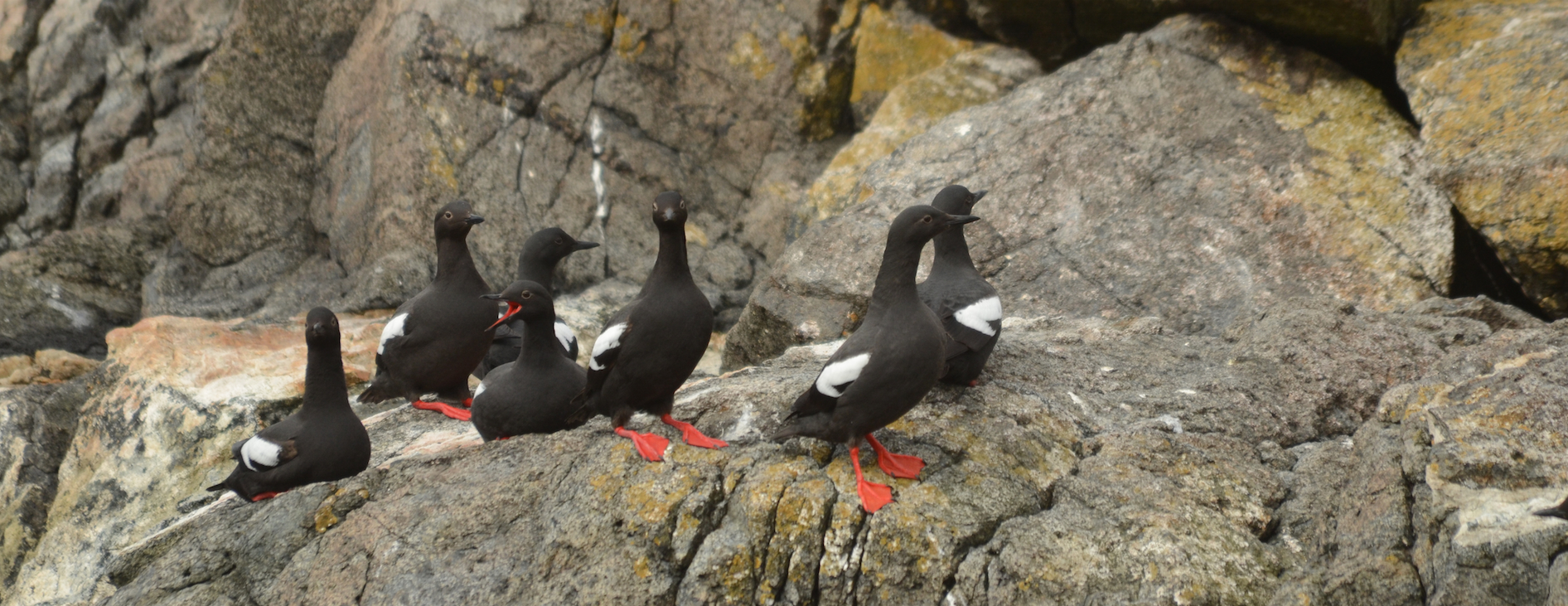
Pigeon Guillemots are members of the auk family, related to murres. They swim underwater using their wings and steer with their feet.

Pigeon Guillemots are members of the auk family, related to murres. They swim underwater using their wings and steer with their feet.


Right now they are in their alternate, or breeding plumage, otherwise in the winter their colouring is more like a winter murre or murrelet with lots of white, gray and dark gray.

Right now they are in their alternate, or breeding plumage, otherwise in the winter their colouring is more like a winter murre or murrelet with lots of white, gray and dark gray.

The Pigeon Guillemots are spending more time on land as spring progreses. These true seabirds are ill equipped for walking with their feet used as rudders for underwater flight, and set far back on their muscular little bodies. I don’t think they are actually nesting yet but certainly getting use to land. Their favorite roosting spots are in the surge channel between the energy building and the science house, on the jetty and its’ upland scree and cliff area and on the little cliffs just southeast of the light-tower.

Now that the winds have settled down, the eagles are back and making determined attempts on the Canada geese. They also spend a considerable time on the pinniped haul-out rocks.

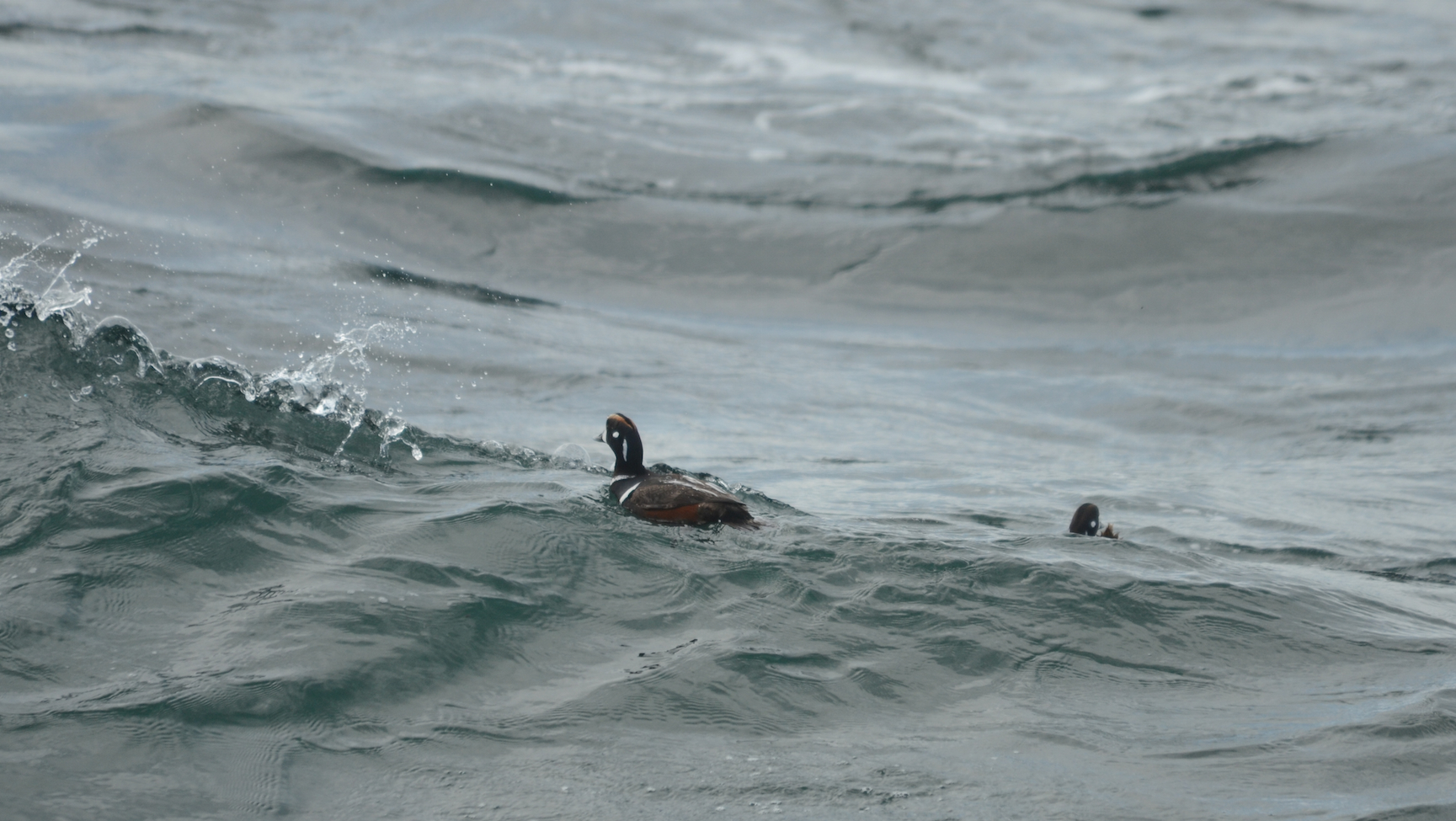
I keep expecting the Harlequin Ducks to leave and head for the mountains, where they nest and lead their summer  lives. There are at least four here still and probably more.

Harlequin Ducks are also supreme under-water swimmers and specialize in white water: in rushing  mountain rivers and streams in breeding season and in the sea the rest of the time.

Harlequin Ducks are also supreme under-water swimmers and specialize in white water: in rushing mountain rivers and streams in breeding season and in the sea the rest of the time.

A new (to me), young, female Northern Elephant Seal joined the Great Race elephant seal group today bringing the total to nine, five males and four females. #5850, the three year old male, embraced the new female (literally) and although he is the smallest of the males on the island, while the other males were practicing their jousting he had his ‘pinky’ out and was snuggling up to the new arrival. It is the first time I have seen seals hold ‘hands’.

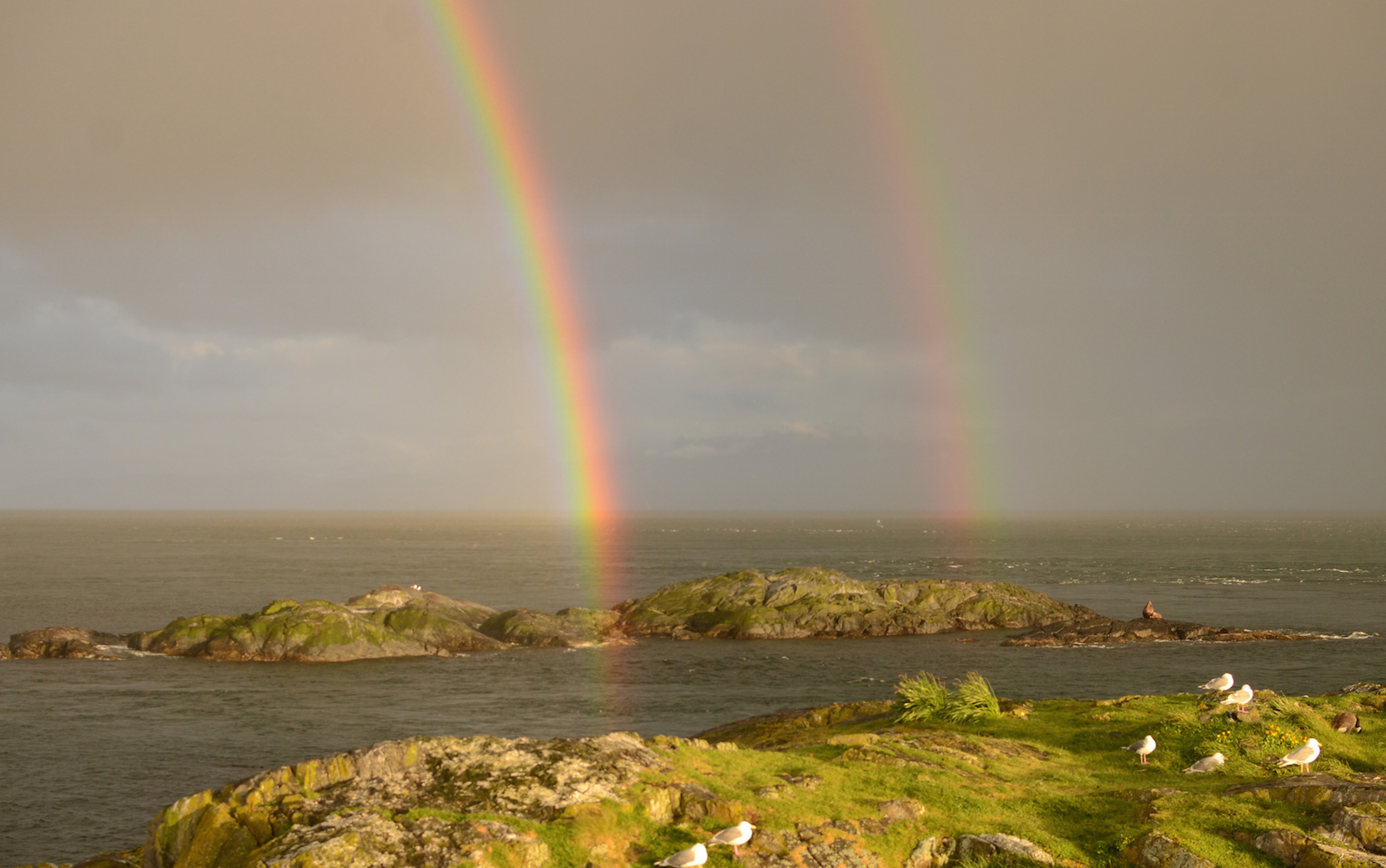
A student group is arrived just before dinner and are staying over. They will be part of a first year biology field trip that will be here most of tomorrow. Work was routine today but the day was anything but routine. Amazing place.
double rainbow

April 22 – Happy Blue Planet Day. (Not for the easily grossed out.)

The posting of this log was delayed a day.

Again the westerly wind blew spring and hints of summer onto the continent, funneling in through the Strait of Juan de Fuca. After a clear night, the wind was not quite so dramatic as yesterday, warping up to a steady 25 – 35 knots most of the afternoon. The sky was clear all day too with the highest energy level so far this week. The barometer climbed to a high of ~1019 hPa before dropping at a similar slope in the afternoon. A strong wind warning remains in effect, with winds forecast to lighten by the weekend. The forecast is for periods of rain tomorrow brought in by the southeasterly.

There were only two boats in the Ecological Reserve today; Second Nature and a sports fisher who heading toward Becher Bay, the hard way. Second Nature brought two groups of second year marine science students out for their last field trip before the final exam but was unable to land so both field trips did at-sea activities within and within sight of the ER. The sports fishing vessel came through the reserve around 18:00 and I was concerned that they were going to get into serious trouble as they were slamming through the big break on the west side and for a while not making headway and looking like they were taking on water. Luckily they made it through and probably won’t be back, at least not when the wind and tide are working in concert to make the sea stand on its head in the race.

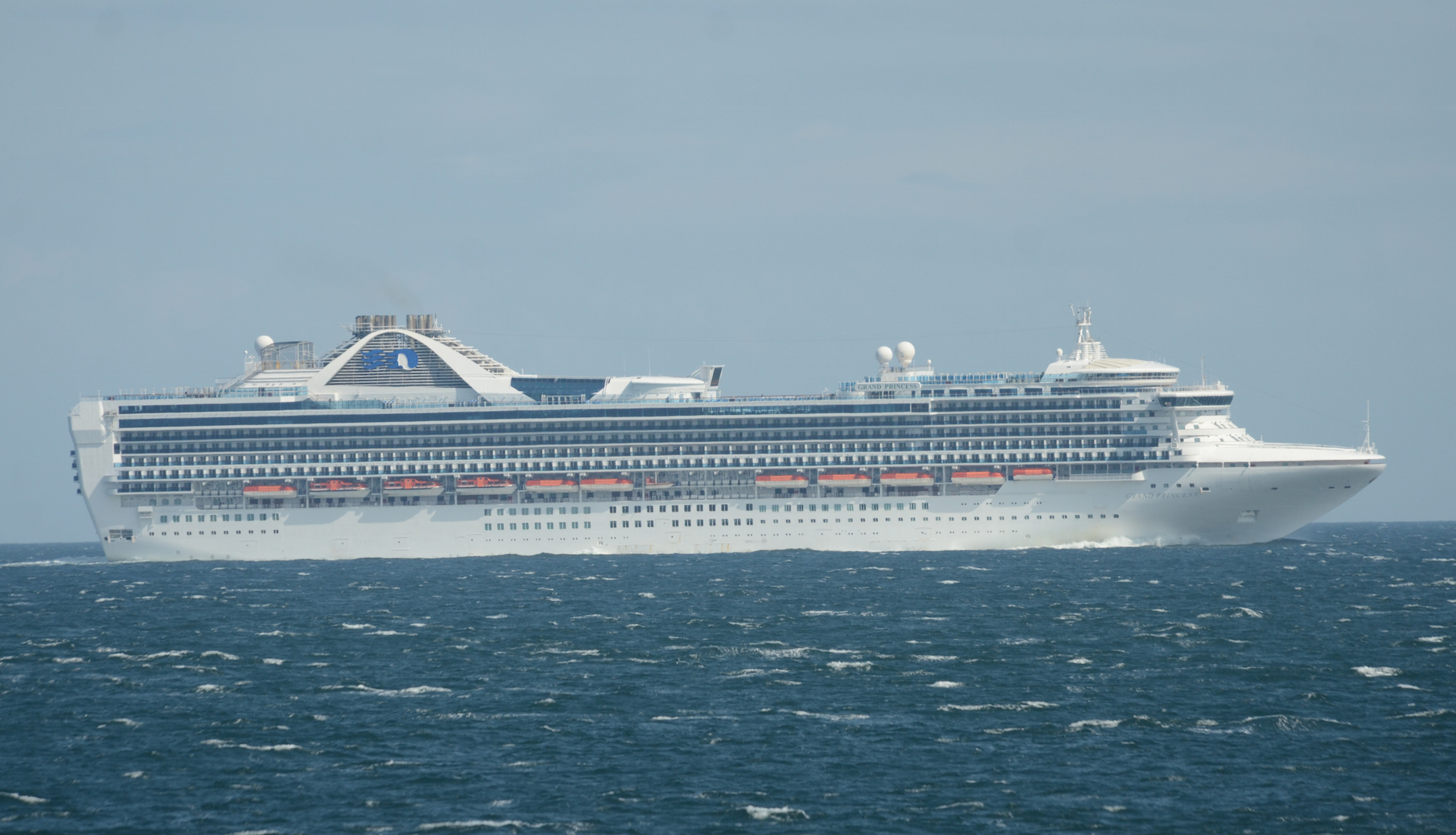
A large cruise ship passed by quite close by south of Race Rocks. I first noticed the Coho with her stern towards Race Rocks and then saw why. She was trying to get around this big princess. Thank goodness for vessel traffic control. As I took the photo, I noticed the heavy lift ship Blue Marlin, in Port Angeles,with what appears to be an oil rig on her deck.

Cruise ship Grand Princess passes south of Race Rocks .

Cruise ship Grand Princess passes south of Race Rocks .

Ecological happenings include continued activity as reported for the last few days. The Northern Elephant Seal moult is proceeding and I am going to go to collect either some moulted skin or whiskers for stable isotope analyses. Stable isotope analyses are really useful in helping to understanding diet and trophic level (how far up the food chain) and can also be used to gain insight on toxins, migration and habitat use.

This female is shedding her  skin along with the very short fur and will also moult her whiskers.

This female is shedding her skin along with the very short fur. Those amazing whiskers can pick up pressure waves from prey to find food in the dark deep.


This male is loosing skin on his face, neck and flippers first.

This male is loosing skin on his face, neck and flippers first.

The smooth, gray fuzz is both new skin and new, very short fur on this female's rear flippers.

The smooth, gray fuzz is both new skin and new, very short fur on this female’s rear flippers.

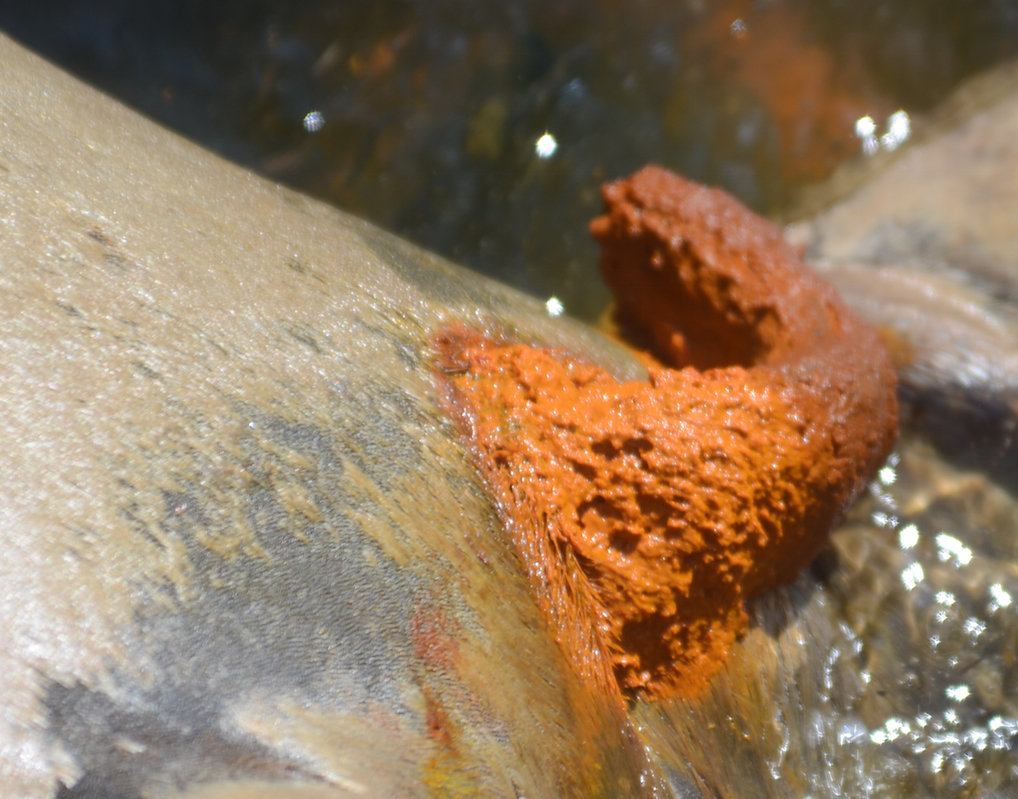
In the “old days” and still in some places, scientists would anaesthetize elephant seals to collect information. This is a potentially dangerous activity (for animals and people), and while the animals were unconscious, researchers would take measurements, sample and ‘lavage’ the seal’s stomach to figure out what they were eating. It is now possible to be less intrusive; more risk adverse and more innovative in data collection. Measurements can be determined using digital photography from a distance. Sampling shed skin or moulted whiskers for an isotope sample can help scientists to learn about a range of health and ecology questions ranging from ecotoxicology to how much of the diet is fish, squid or krill. Another ‘old school’ method for looking at diet, still used, is scatology. It involves collecting faeces. I am going to pass on that one, but here is a photo. I am curious if the bright orange colour comes from krill, or sockeye?

Biologists and doctors study faeces to better understand animal's health, parasites,  diet and more.

Biologists and doctors study faeces to better understand animal’s health, parasites, diet and more.

To change the subject, there were a couple of sparrows here today but they were so shy and fast that I did not get a good look at them. They reminded me of the Savannah Sparrows that were here last fall. I wonder if they nest here?

There were no visitors today (on shore). Chores were various and routine.
Beautiful Spring Day

The wind didn’t do much until mid-afternoon when the westerly came up and blew 10 – 15 knots. Velocity kept increasing during the afternoon and evening and as the sun was setting it was blowing a steady 30, gusting to 35 knots. It was a very sunny day with 354,000 watt-hours per meter2 accumulated throughout the day. The barometer continued its slow descent begun on Saturday and is heading inexorably towards wet weather in the forecast. Although it is still supposed to blow west tomorrow, with showers, the rest of the week looks darker and wetter.

A couple of whale watching boats were observed in the Ecological Reserve today: both were proceeding with caution, at a minimal speed and staying a respectful distance away from the wildlife. These companies are practicing sustainable wildlife viewing practices. One rental boat was observed speeding in reserve.

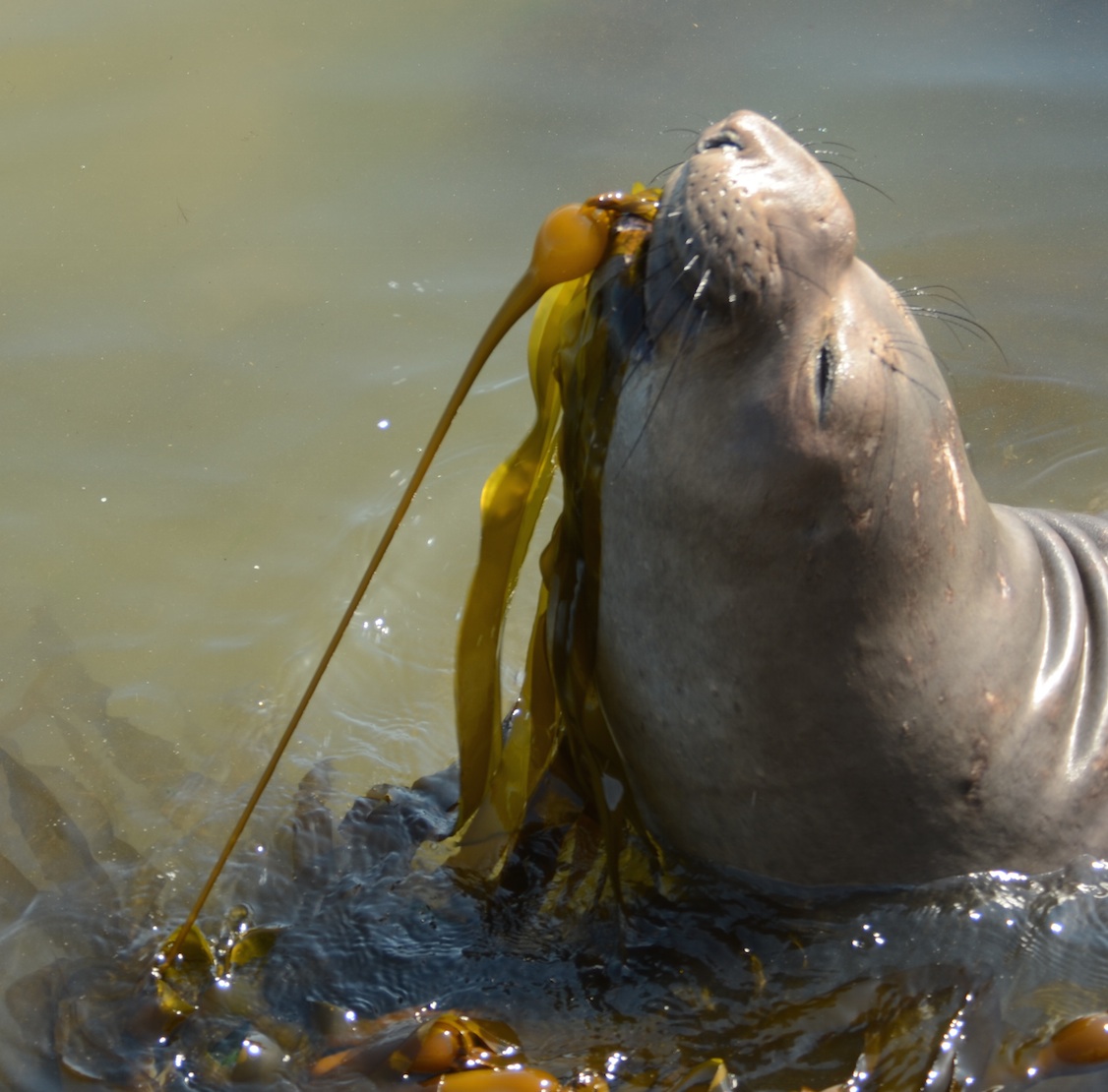
The Northern Elephant Seal moult continues and is becoming more visible on the older animals. The measuring device was modified to allow for more accurate length measurements and the animals continued to cooperate by going one by one, down the ramp and into the sea for a swim. #5850, the young male tagged as a weaner in 2012 was stretching bull kelp stipes today, a biomechanics activity done by phycology students everywhere on the west coast. No teeth involved, so no confounding tearing factor.

Northern Elephant Seal #5850 tests the elasticity of  bull kelp.

Northern Elephant Seal #5850 tests the elasticity of bull kelp.


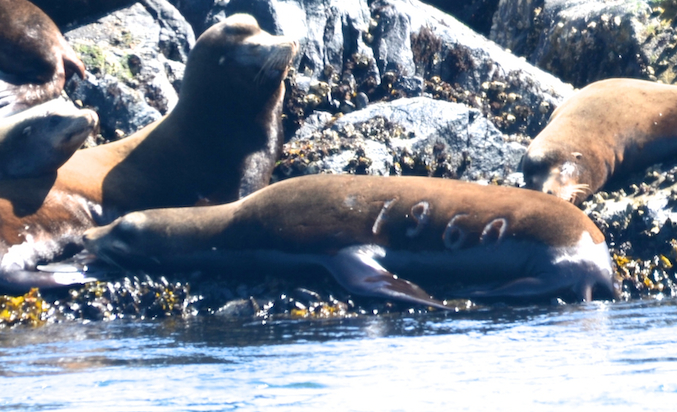
Another tagged and branded California Sea Lion was photographed today. This one is number 1960 (left side).

California Sealion with brand #1960 hauled out on South Islets. Photo lightened to show up number.

California Sealion with brand #1960 hauled out on South Islets. Photo lightened to show up number.

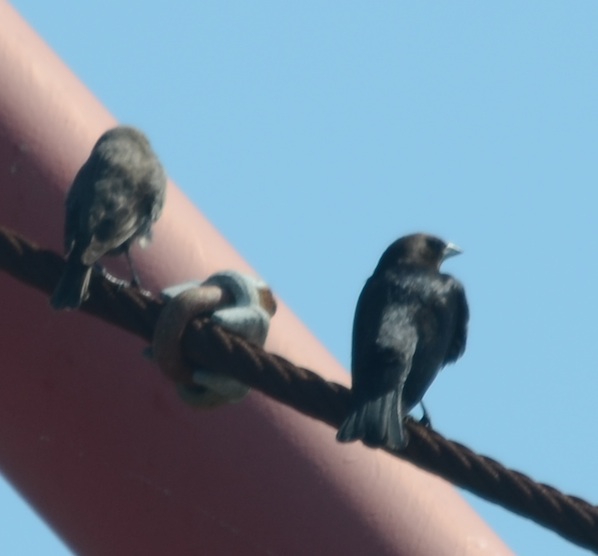
Two unidentified little birds made a brief appearance, they sounded like blackbirds or starlings some kind. I didn’t get a chance to see them again but caught them on camera.

Identification needed on this pair that made a fleeting visit today.

This pair of Brown-headed Cowbirds made a fleeting visit today. Identification by Dick Cannings Bird Studies Canada. (Thank you.)

There were no visitors today and chores were routine.
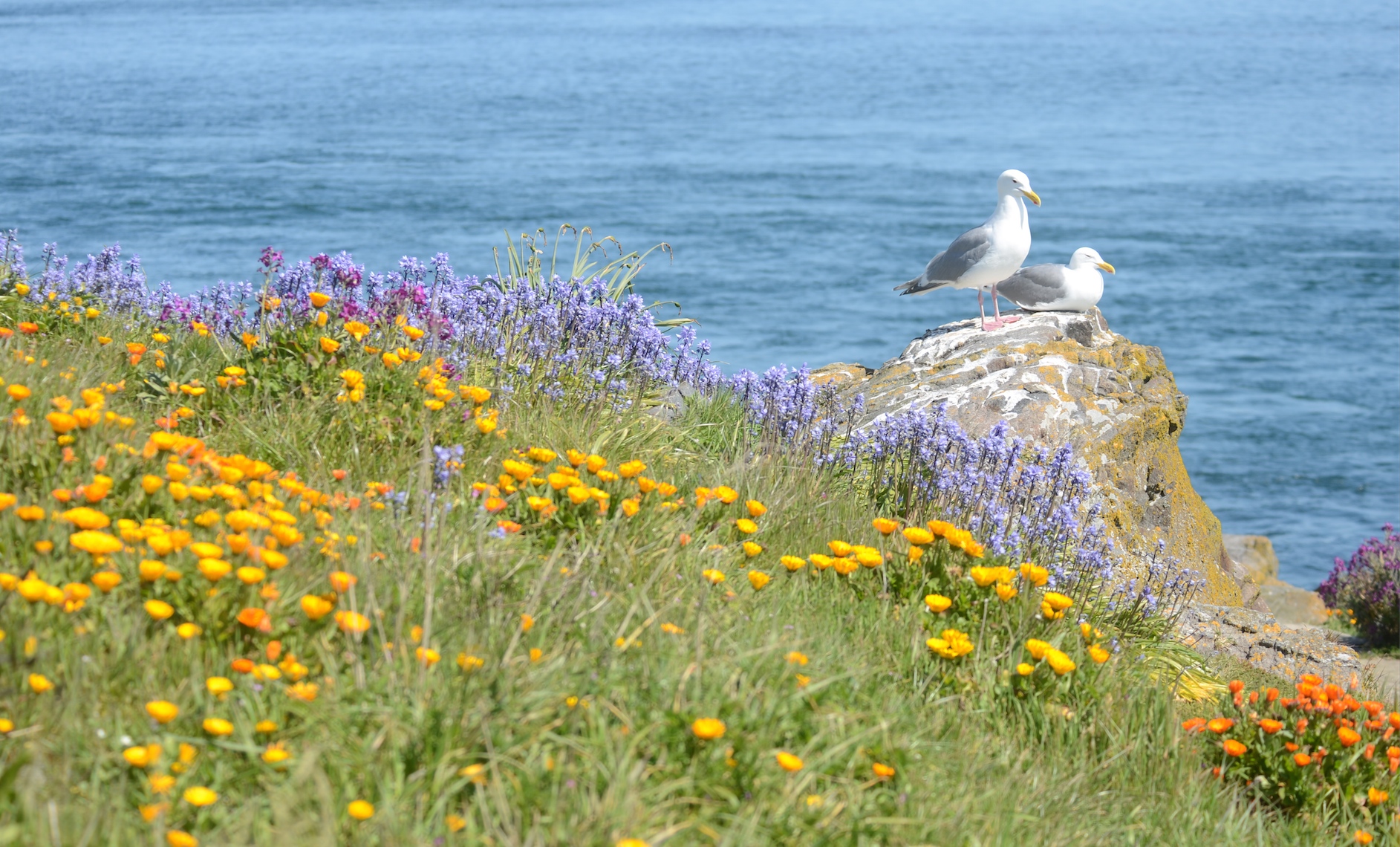
Spring flowers on the site of the original garden from the 1860s. A pair of Glaucous-winged Gulls in the backgroud

Spring flowers on the site of the original garden near where the first keeper’s home was built in 1860. A pair of Glaucous-winged Gulls on their chosen site.

What a beautiful day.

Smokey Skies

The wind was still, early this morning. It didn’t really start moving until mid-afternoon, 5 – 10 knots from an east-southeastly direction. Although it was sunny, there was a haze in the air that made for a blazing sunset last night and sunrise today. I am curious if this is smoke, all the way from Squamish, where there was a big creosote wharf fire a few days ago?

sunset

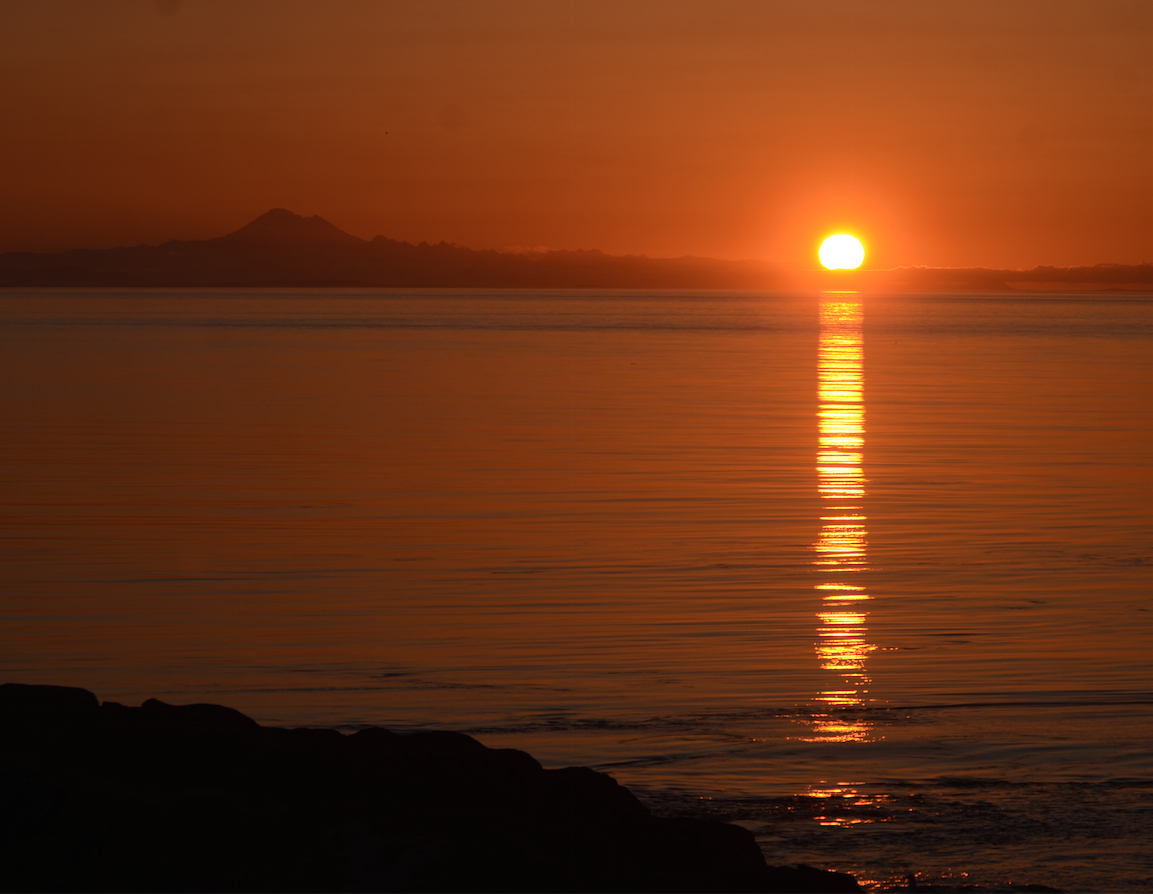
Are these red skies in the evening and the morning a result of the Squamish wharf fire?

Are these red skies in the evening and the morning a result of the Squamish wharf fire?

The barometer rose slowly until about noon and then it started to slowly fall, nothing dramatic and no strong winds. The forecast is for more of the same, with afternoon westerlies tomorrow.

Three whale watching boat were noted in the Ecological Reserve today. The last whale watching vessel of the day, idled slowly through, keeping a deferential distance away from the animals, Tourists were out on the bow, shooting pictures of the blazing sunset and lounging marine mammals. It was a tranquil scene. No sports fishers were observed either speeding in the Ecological Reserve or fishing in the closed area, although several passed through at speeds respectful of the wildlife in the area.

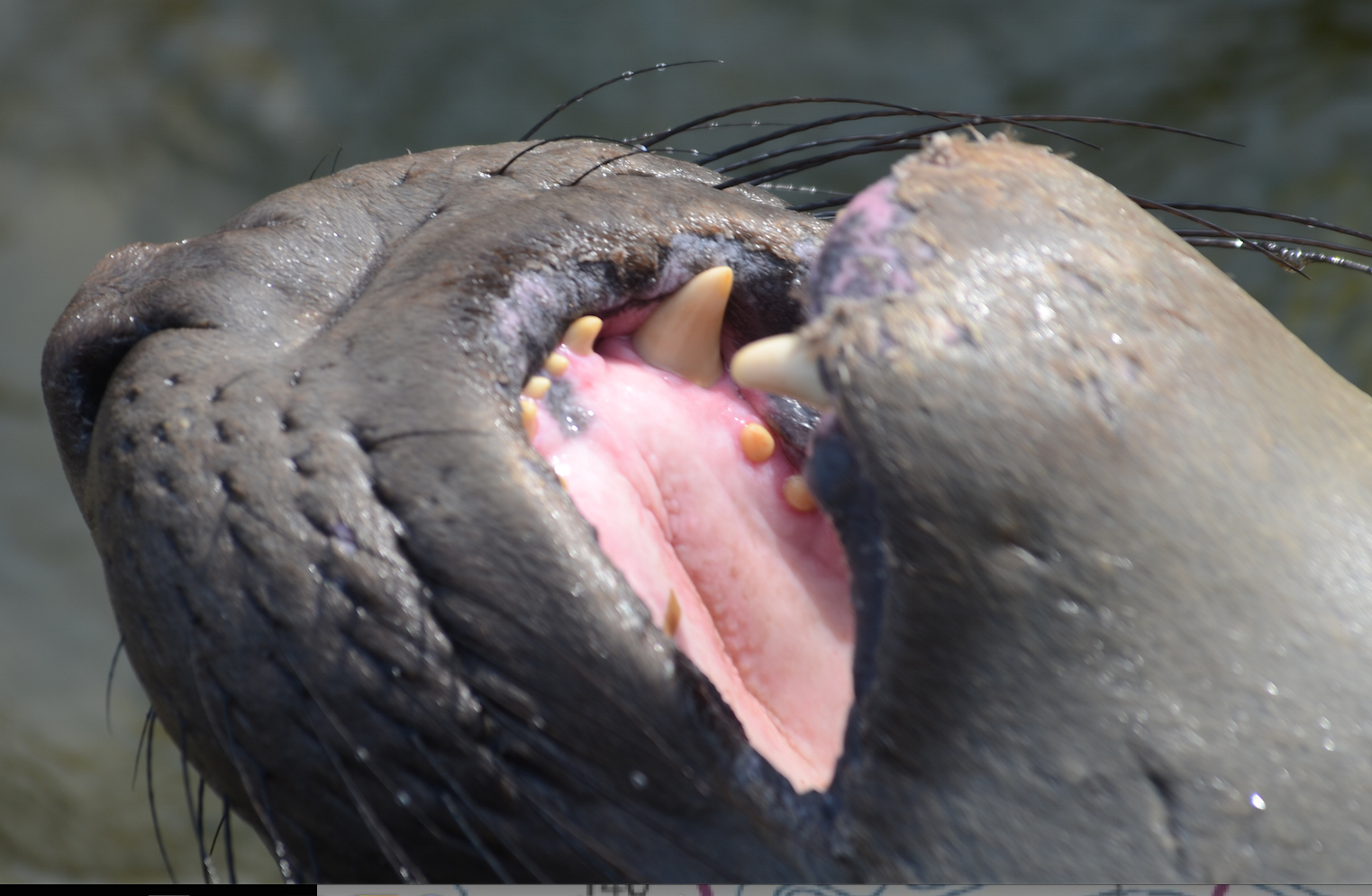
Passive Northern Elephant Seal data collection continued. As luck would have it, all seven animals that had been sleeping in the garden, woke up and decided to go for a swim late morning. This allowed me to take their photos as they passed by the measuring device. I was also able to get some photos inside mouths for dentition information while they were wallowing around gargling saltwater and ‘wrestling’. Tagged animal #5850 continues to hang out as one of the seven ‘gardeners’.

Dentition changes with age and can be a health indicator. Say ah.

Dentition changes with age and can be a health indicator. Say ah….

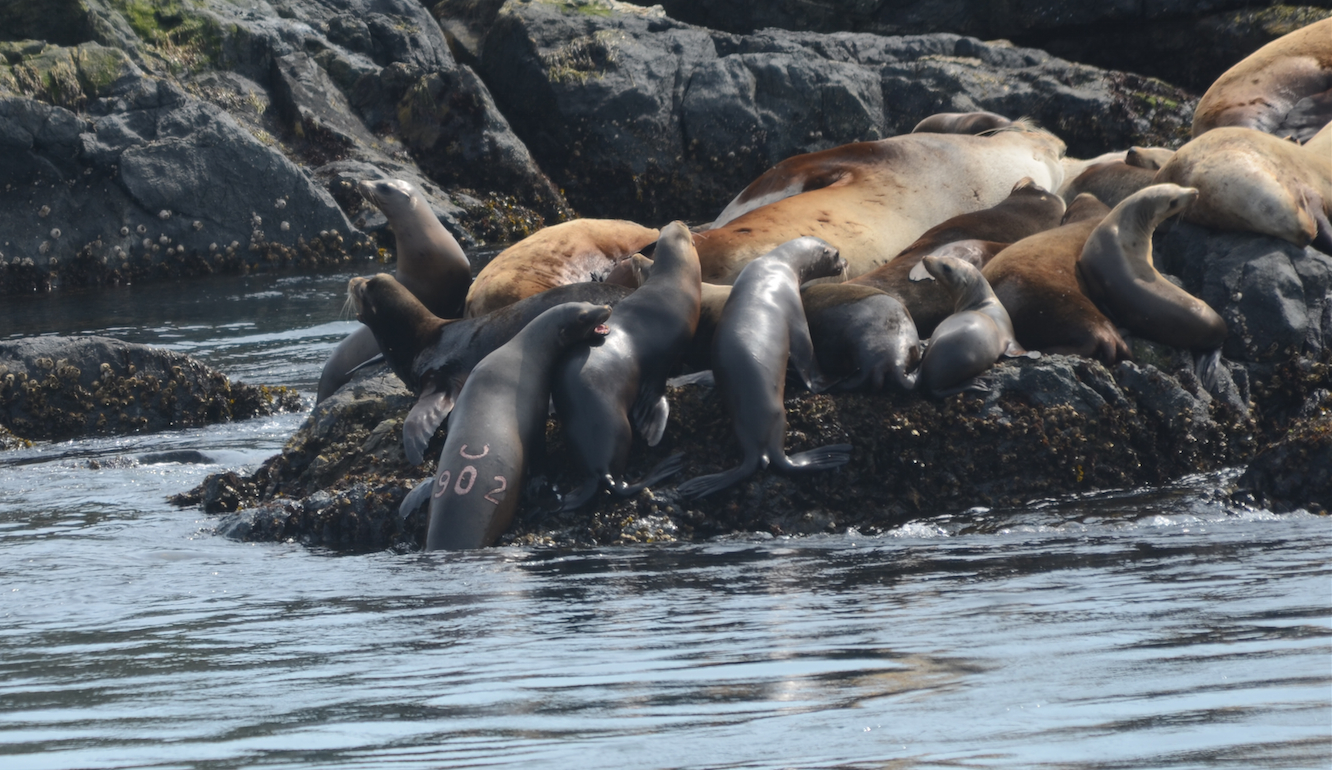
A branded and tagged California Sealion # U 902 was noted hauling out on South Islets this afternoon. Note the large range of sizes of both species.

California Sealion branded and tagged U902 also read as C902 C is for the mouth of he Columbia River where it was born.

California Sealion branded and tagged U902 (lower left) can also be read as C902. C is for the mouth of he Columbia River, where it was born.


There are still three pairs of Canada Geese trying to establish nest sites and they are having a hard time finding territories on this tiny island that already has at least nine Canada Goose nests. Maybe they will head over to Vancouver Island where there is more room. Their territoriality can get in the way of other species having a piece of the very small island as they chase off, not just each other, but Glaucous-winged Gulls, Black Oystercatchers and Pigeon Guillemots.

There were no visitors today. Maintenance chores were routine.  About 9:30 PM the phone/Internet went down for the seventh time since I arrived. Even that is becoming routine.
Bald Eagle versus Canada Goose

Today’s weather was a mixed bag. Early on there was thick fog, which thinned by dawn and cleared in the early morning. Then for a short time it was glorious and fairly calm with winds westerly up to 15 knots. The westerly wind doubled in the early afternoon and by 4:00 PM it was gusting well over 35 knots in the tower. On radio watch for the afternoon’s activities, I kept a weather eye on Pearson College sailing vessel Amatuana as she was blown across to Victoria in no time flat. Nicely done.
Only one whale watching boat was noted in the Ecological Reserve today and when I finally spotted them, they were pounding out through wind and tide towards Race Passage. Their sound alerted me to their presence.
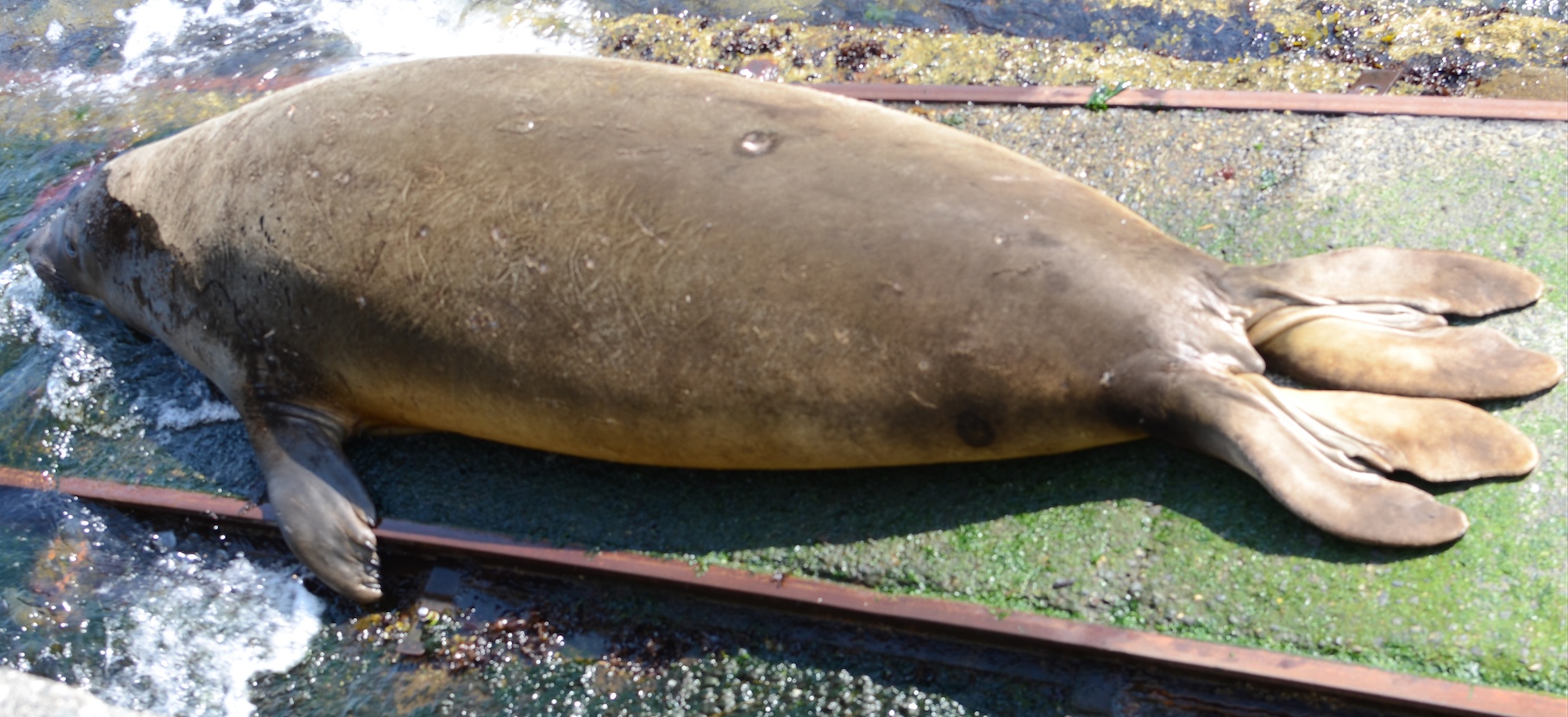
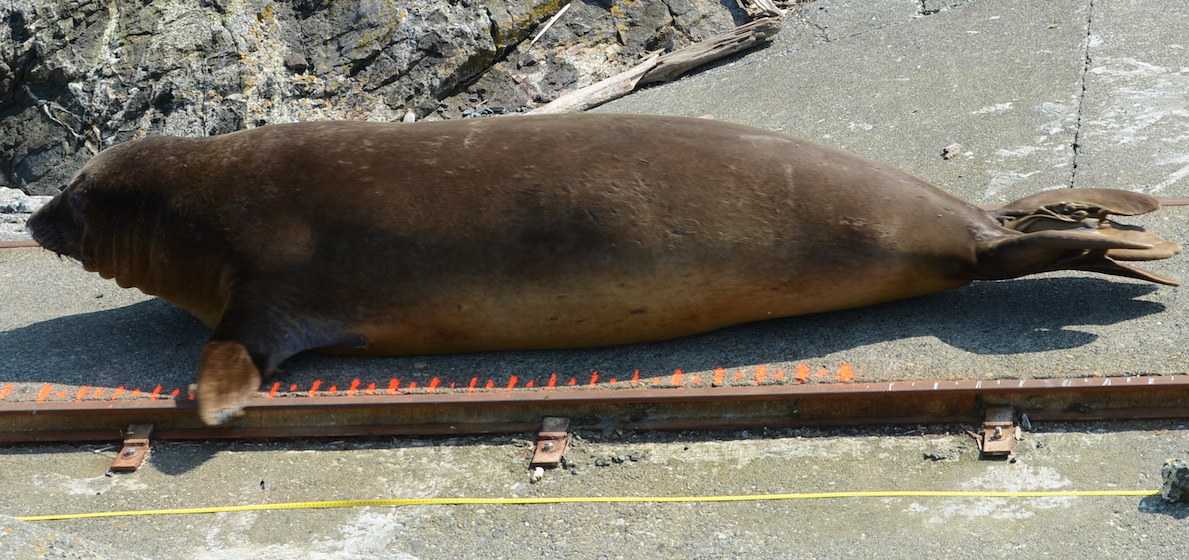
The Northern Elephant Seals are starting to moult and data collection on basic biological parameters began today including non-invasive, length measurements using the marine railway as a big meter stick.


If only this female were lying next to a big ruler, we would have a complete data set on her for April 17, 2015.

If only this female were lying next to a big ruler, we would have a complete data set on her for April 17, 2015.

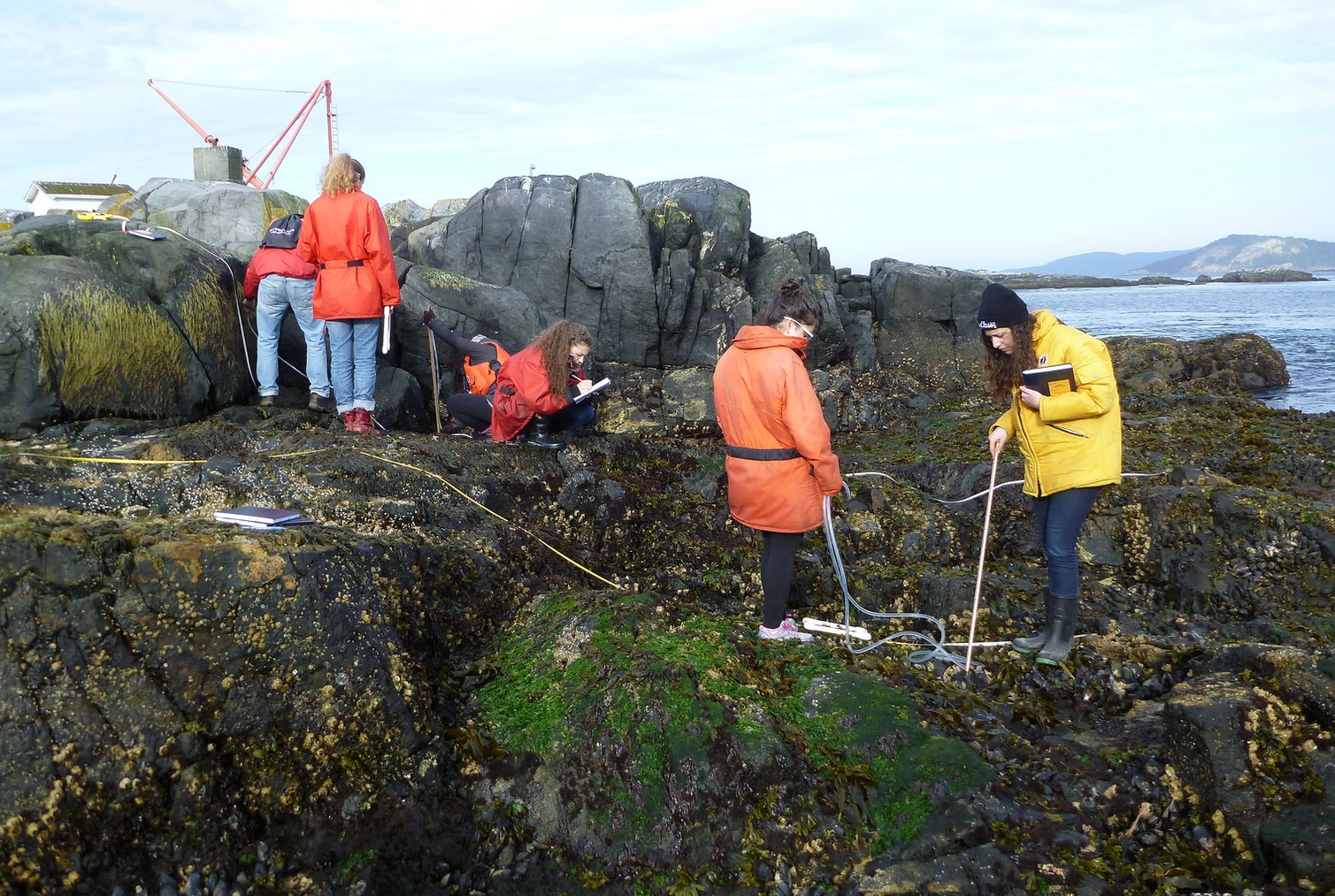
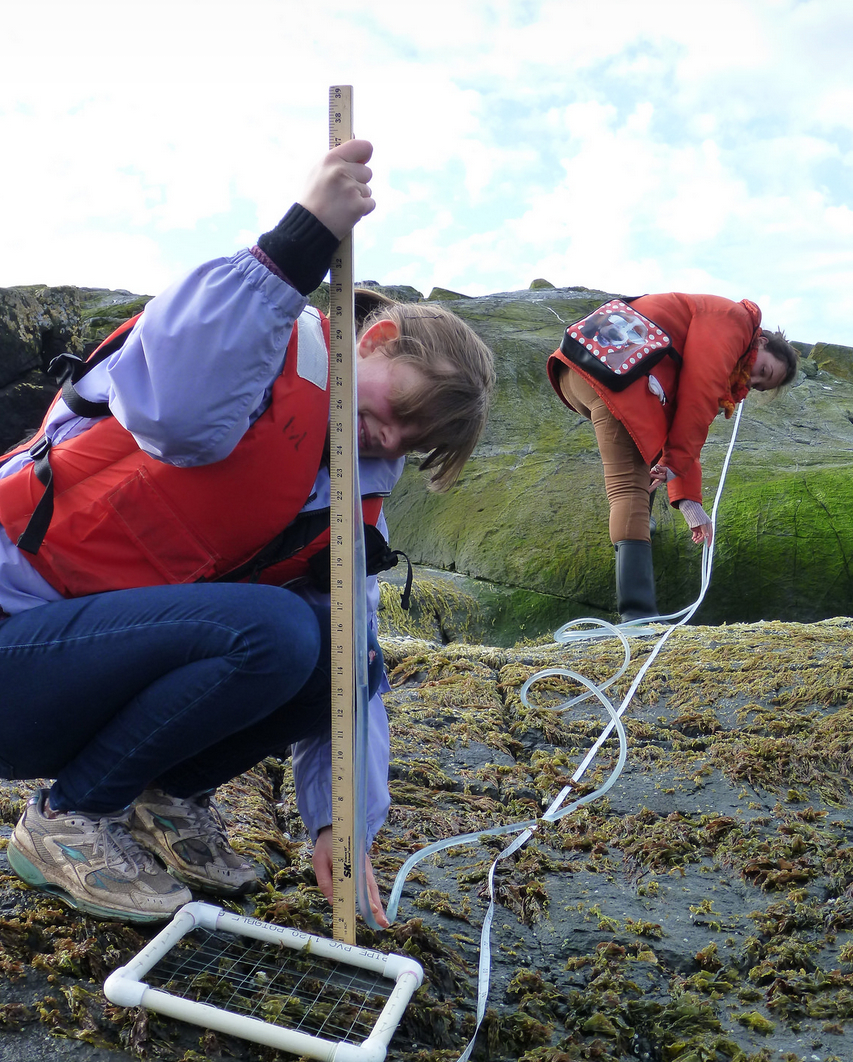
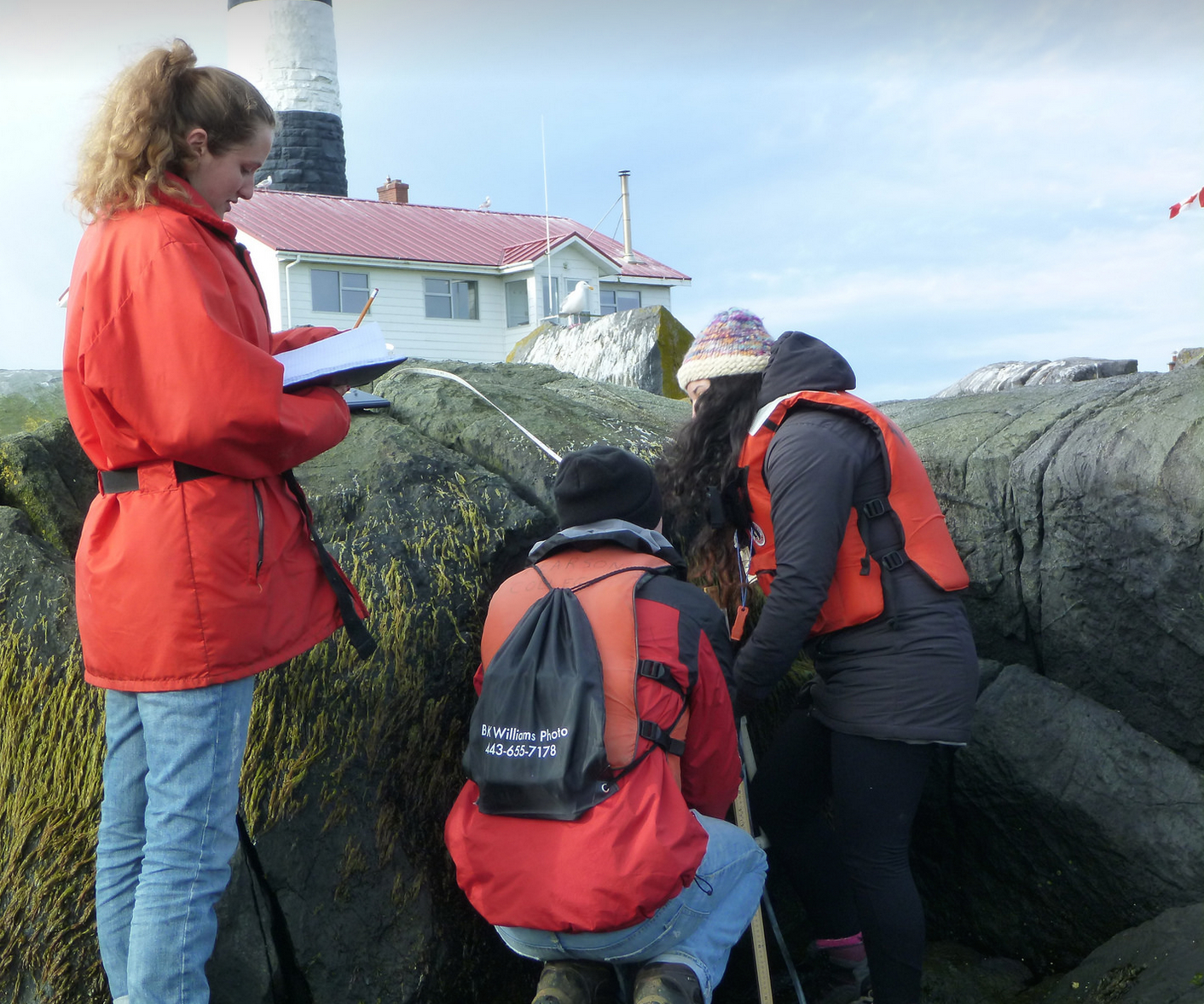
There were 14 visitors first thing this morning. Courtney, driving Second Nature, brought out one of Laura’s first year, marine science classes. It was an early start for these  students but they had breakfast en route and were very efficient on shore. They did a quantitative, community ecology activity on the low tide. They were trying to determine if and how the diversity, abundance and distribution of intertidal macro-biota changed with vertical height. They used water levels to measure vertical height, (an ancient Egyptian leveling technique based on the fact that water will always find its’ own level), transect lines to position sampling and quadrats to focus sampling efforts. These photos of the students, were all taken by Laura Verhegge.

First year marine science students from around the world learn science experientially at Lester B. Pearson College of the Pacific.

First year marine science students from around the world learn science experientially at Lester B. Pearson College of the Pacific.

Catriona and Claudia demonstrate skill and teamwork using the waterlevel to measure vertical height ti the next sample.

Catriona and Claudia demonstrate skill and teamwork using the water-level to measure vertical height to the next sample.


tella, Connor and Tamara discover the intricacies of inter-tidal life.

Stella, Connor and Tamara discover the intricacies of inter-tidal life.

Courtney is a big fan of elephant seals and so she was keen to help with the first elephant seal measurements this morning and assisted in working out a way for one person to measure the elephant seals without disturbing them. As of this afternoon the marine railway is the new ruler and first measurements made of a young male were very close to those made earlier with a laser, measuring device. The laser technique required two people, two long boards, a right angle check and eye safety protocols. The laser technique had potential to bother the animal (if it was awake). The new technique is passive, non-invasive and non-threatening.


Male elephant seal entering the "measuring device".

Male elephant seal entering the “measuring device”.

I saw a juvenile Bald Eagle attack a goose sitting on her nest today. I had suspected this was going on but good to verify. The eagle might have been successful with back-up, but the gander flew in and together with the goose, drove the eagle off. You can guess who I was cheering for. I know it is not science but there is no hockey out here and I am Canadian, eh.


A Stellar Day

Calm seas, sunshine and light winds combined to make it a very pleasant day. The wind really didn’t do much and direction changed throughout the day from west to southeast and back again. There was enough sunshine  to power the solar panels, run the de-salinator  and build up the batteries. The barometer declined slowly all day after a high start and the forecast is for a mix of sun and cloud tomorrow with a strong westerly winds predicted.

Two whale watching boats used the Ecological Reserve today.   From where they were, I am guessing that they enjoyed the pinnipeds and sea otter as well as the birds. Several sports fishing boats transited through at high speed and one fished close to the boundary.

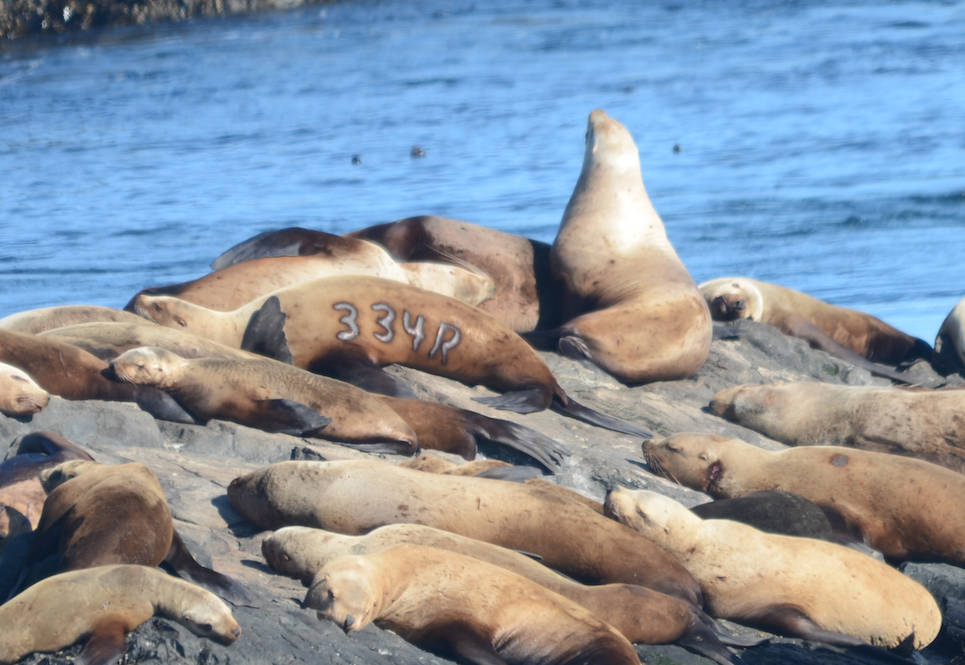
Female Steller’s or Northern Sealion #334R was photographed today. She was branded as a pup in July 2003 at Rogue Reef in  southern Oregon.

Northern or Steller's Sealions hauled out on South Islets,  a female born in southern Oregon, branded with #334R is visible.

Steller’s Sealions hauled out on South Islets, a female born in southern Oregon in 2003, and branded with #334R is visible.

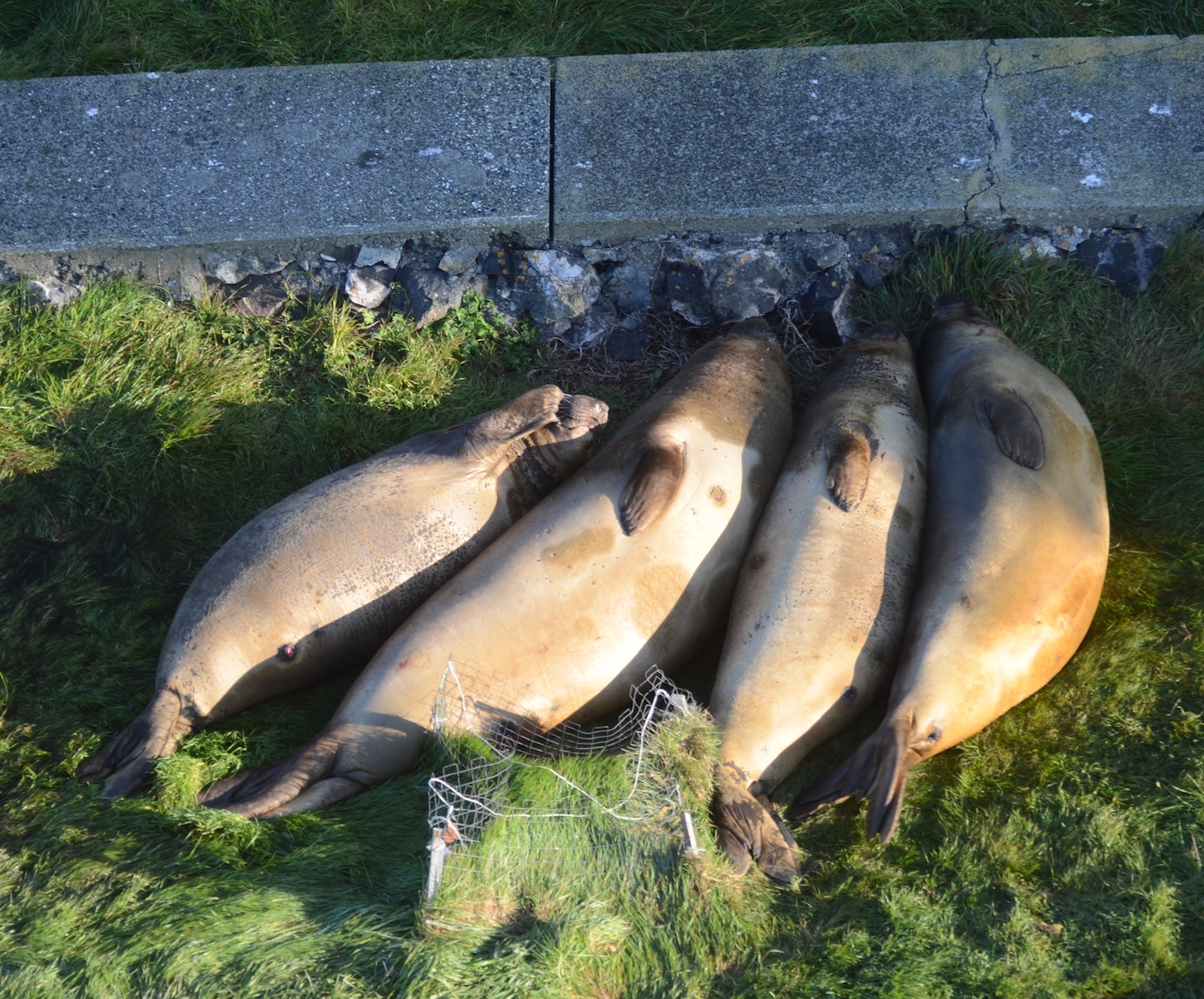
The Northern Elephant Seals continue to grace Great Race and I am getting used to them not reacting at all to my presence on the walkways.

Four Northern Elephant Seals like peas in a pod, next to the walkway to my house with their tails in the goose exclusion cage.

Four Northern Elephant Seals like peas in a pod, next to the walkway to the basement door.

The Glaucous-winged gulls are starting to mate and gather nesting materials. The Canada Geese are busy defending territory and brooding eggs. Black Oystercatchers are likewise busy when not foraging in the intertidal where limpets seem to be their favourite food.

Today was Animal Census Day and here are the results:

Northern Elephant Seals 26

Harbour Seals 147

California Sea lions 30

Steller’s Sea lions 36

Sea Otter 1

Canada Geese 18

Harlequin Ducks 3

Pelagic Cormorants 8

Double Crested Cormorants 7

Bald Eagle 2 adults, 5 sub-adults

Killdeer 1

Black Oystercatchers 10

Black Turnstones 9

Surfbirds 8

Pigeon Guillemots 164

Glaucous-winged Gulls 345

Northwestern Crow 6

Common Raven 1

There were no visitors today and maintenance chores were routine including running the fire pump to fill cistern.


Its a blast… really many blasts.

Today there was a lull in wind velocity. The west-southwest wind continued and even pushed more from the south for a few hours in the afternoon, but the speed was less than half of yesterday’s winds.

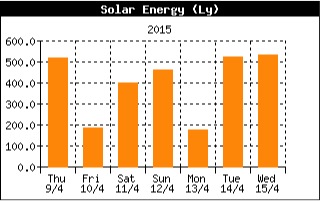
It was a bright day even though it hazed over in the late afternoon. This graph of accumulated, daily solar radiation for the last week shows up the big differences between days depending on cloud cover. The metric, one Langley is equivalent to 41.84 kilojoules per metre2. Check out the weather pages of this web-site for more nifty graphs and information.

Cumulative daily solar energy for the past week.

Cumulative daily solar energy for the past week.

The barometer rose today, levelling off and even dropping a little, late afternoon. The forecast is calling for a day similar to this one.

There were no tour boats in the Ecological Reserve today. Two sportsfishing boats were jigging very close to the boundaries but probably not inside and one aluminum water-taxi like sportsfisher went through the main channel at high speed. A derelict looking fishing vessel, called the Larkin, was towed by a tug, through Race Passage adjacent to the reserve, late afternoon.

Military blasting, as promised, was conducted during the business day. Even during and after the biggest explosions, the largest reaction I observed were sealions raising their heads and looking alert for less than 30 seconds.

Speaking of alert (or not), a total of nine Northern Elephant Seals were hauled out on Great Race today. The four in the garden were joined by two young amorous animals and a third sub-adult male. There was a bit of a kerfuffle involving the biggest male but they all settled quickly as it appeared that conflict was just too energetic.

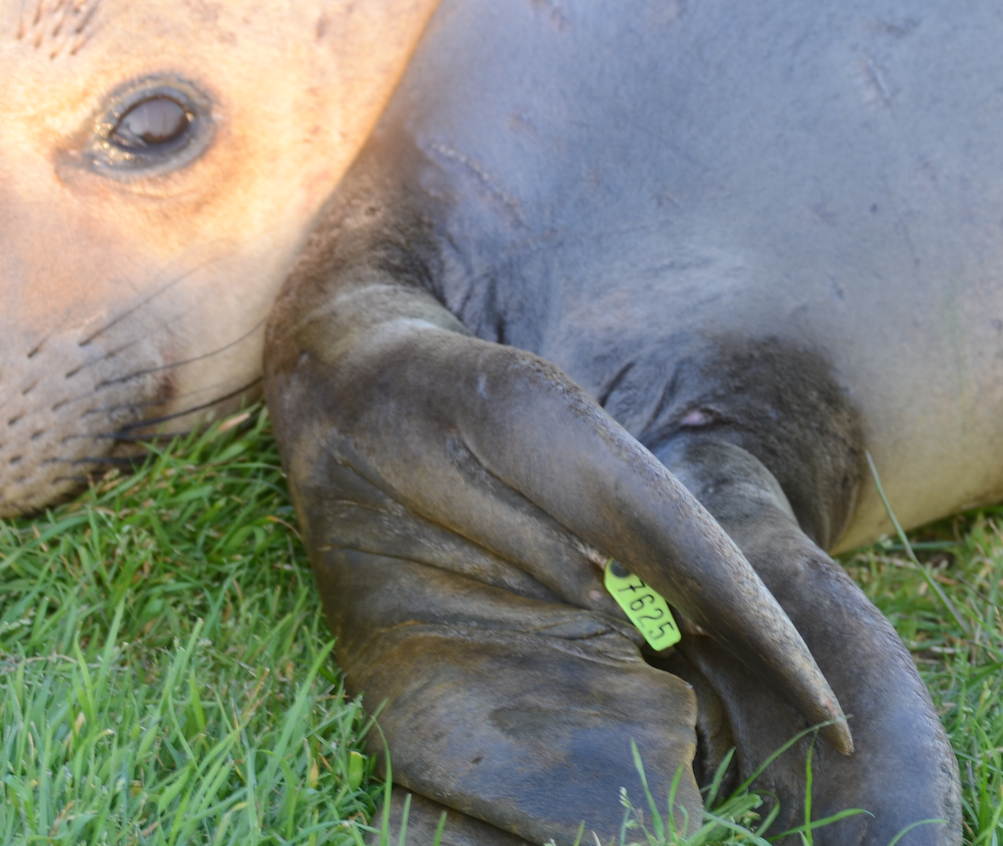
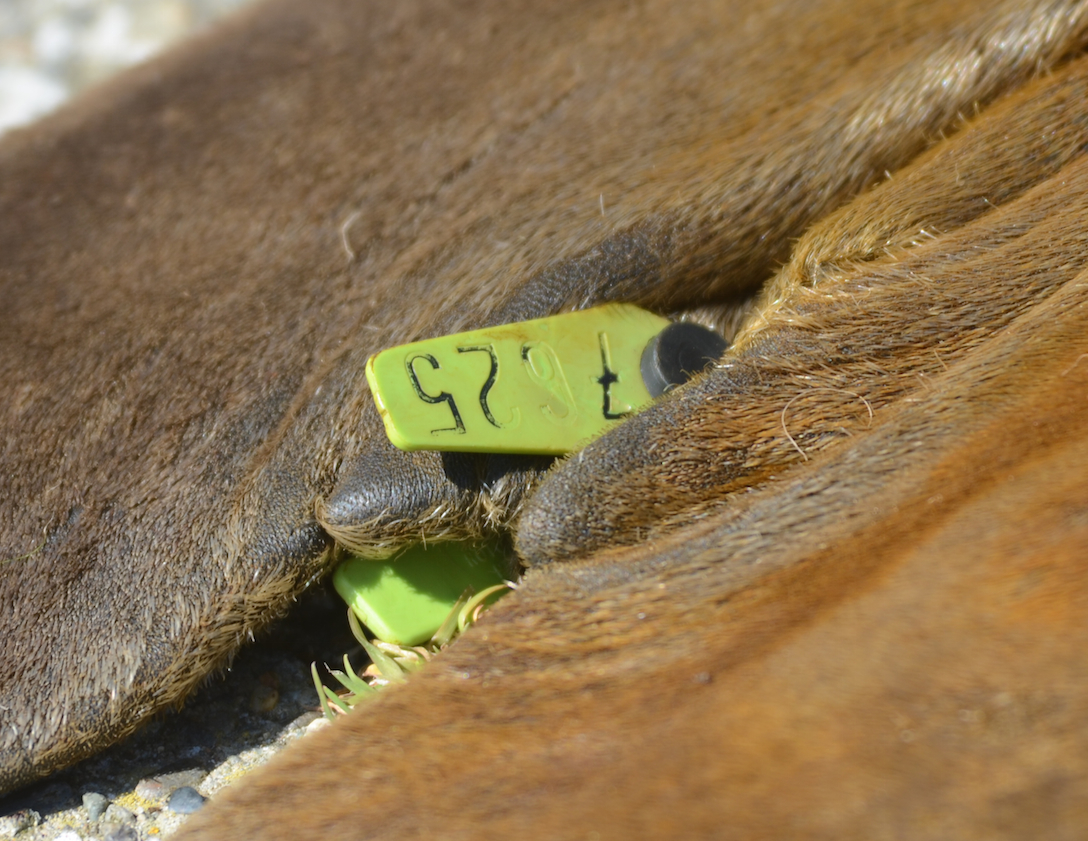
The new (to me) female was well tagged with a left double tag of #7620. The right side was still double-tagged but much more difficult to read with # 7688 confirmed. One of the right tags was yellow instead of the lime green and very worn. Tagged animal # 5850 (left) returned. The animal with psoriasis continues to sleep soundly, off on its’ own right, beside the path and only occasionally, barely opens her eyes when I go past her.

The seal on the right is a female with left tag #7625.

The seal on the right is a female with left tag #7625.


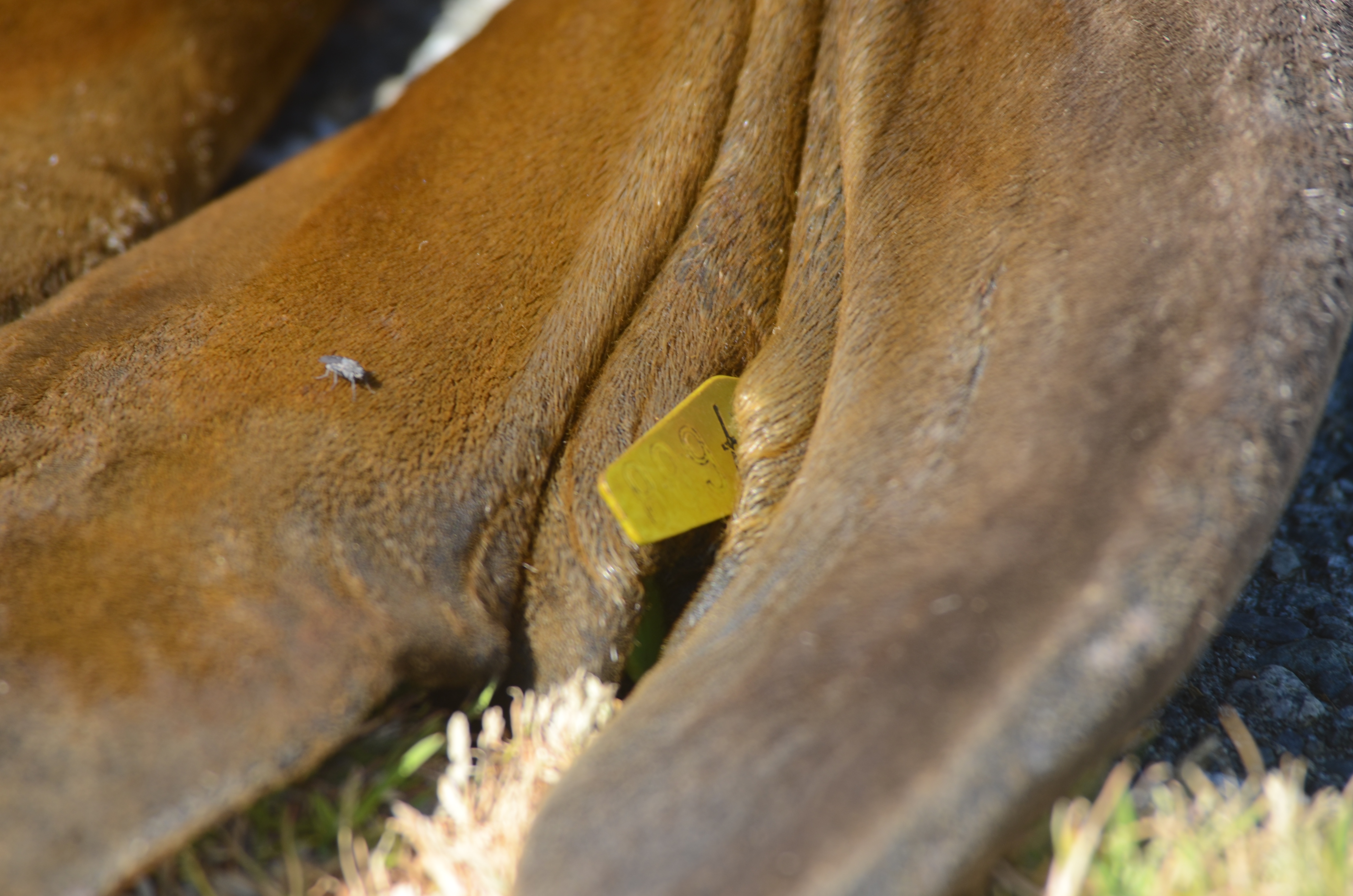
The flip side of left tag #7625.

The flip side of left tag #7625 above.

The same female with #7688  on a yellow tag on her right side.

The same female with #7688 on a yellow tag on her right side.

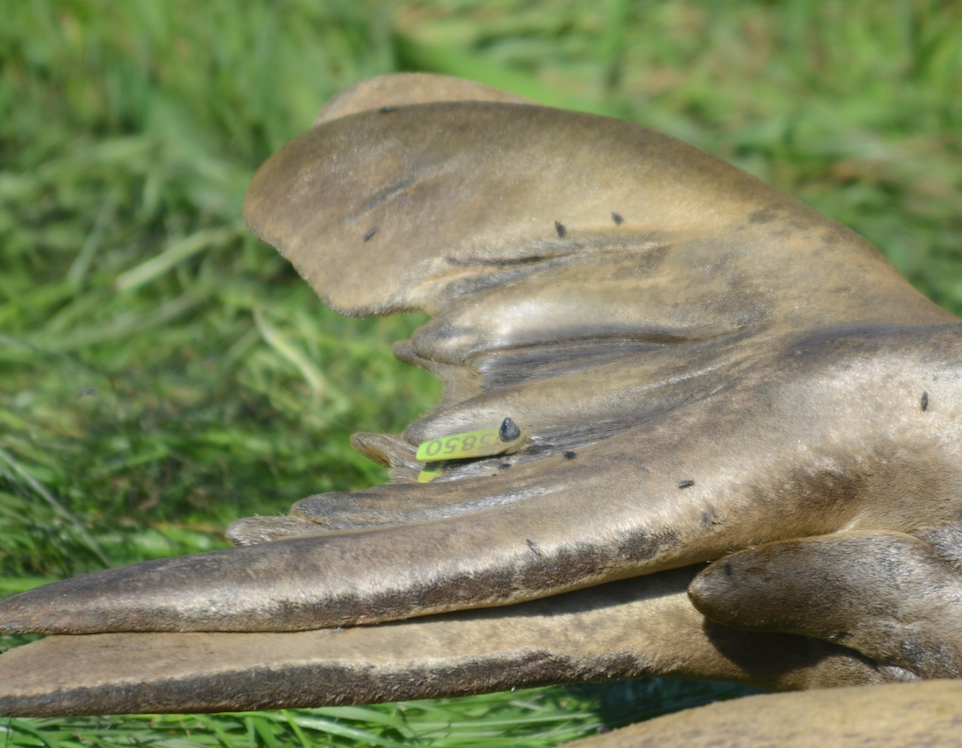
Tag #5850 showing healthy left side flippers and dual tag.

Tag #5850 showing healthy left side flippers and dual tag.

These tags are very important to elephant seal biologists who study the population dynamics: (How many are there? How is the population doing? How long do they live?); the distribution (Where do they go and when?) and the phenology (When are individuals pupping, nursing, mating, and moulting?). The dual/quadruple tags help statisticians test assumptions made about re-sightings so that their mathematical models are more rigorous. We have a lot to learn from this resilient species that has recovered from the brink of extinction and (so far) avoided the pitfalls of genetic bottlenecking.

There were no visitors today and chores were all routine maintenance.