Bald Eagle versus Canada Goose

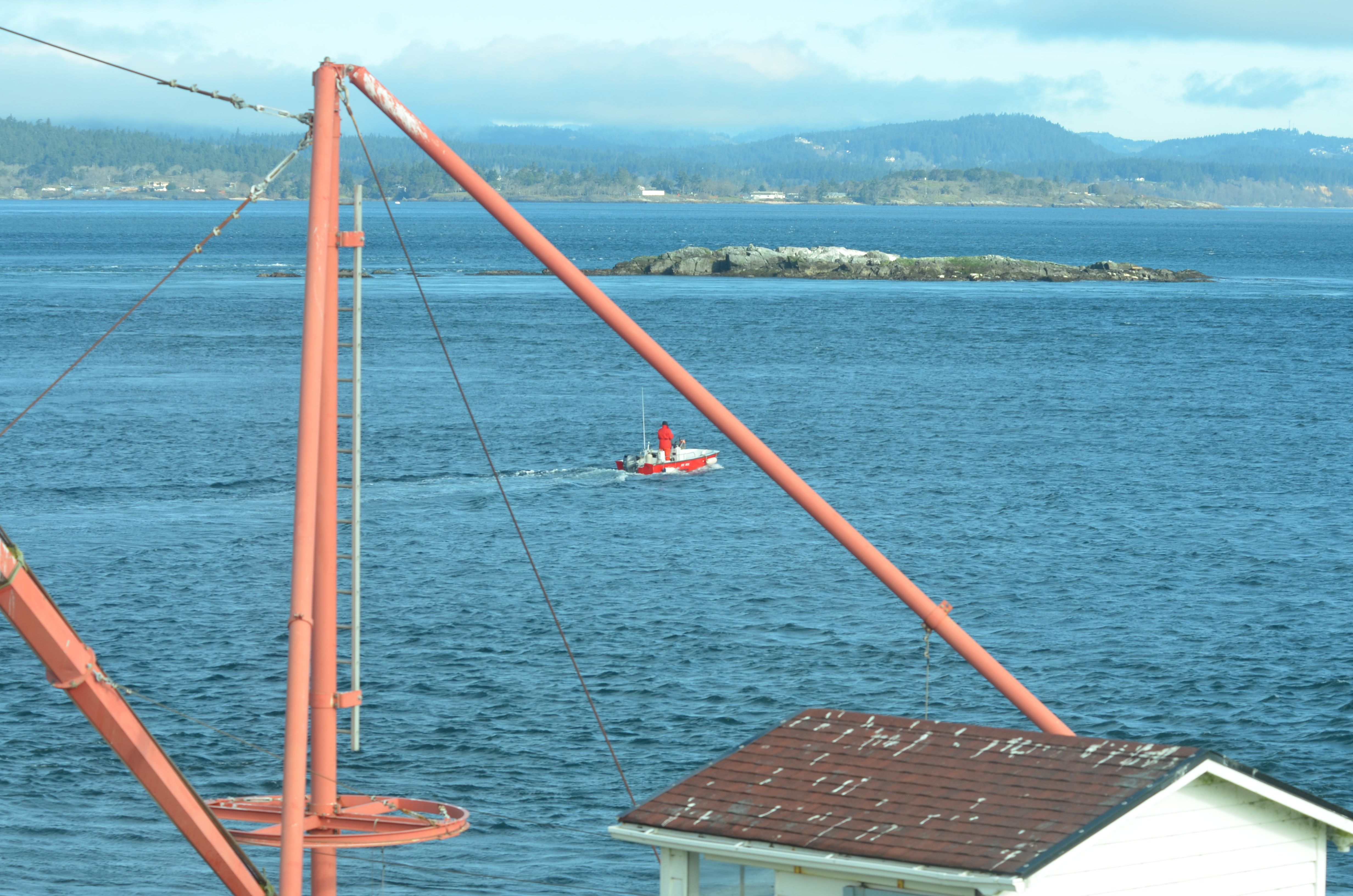
Today’s weather was a mixed bag. Early on there was thick fog, which thinned by dawn and cleared in the early morning. Then for a short time it was glorious and fairly calm with winds westerly up to 15 knots. The westerly wind doubled in the early afternoon and by 4:00 PM it was gusting well over 35 knots in the tower. On radio watch for the afternoon’s activities, I kept a weather eye on Pearson College sailing vessel Amatuana as she was blown across to Victoria in no time flat. Nicely done.

Only one whale watching boat was noted in the Ecological Reserve today and when I finally spotted them, they were pounding out through wind and tide towards Race Passage. Their sound alerted me to their presence.

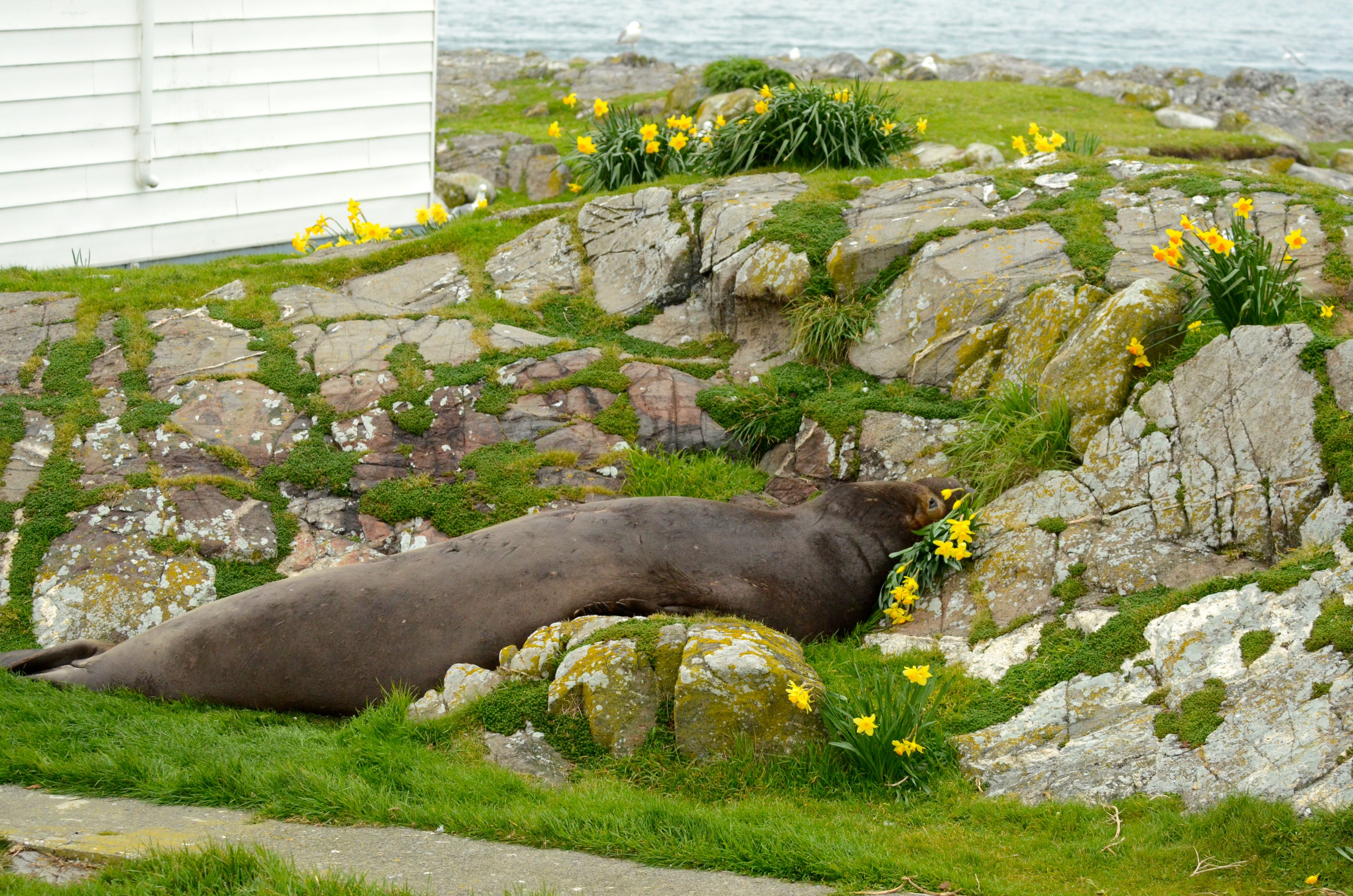
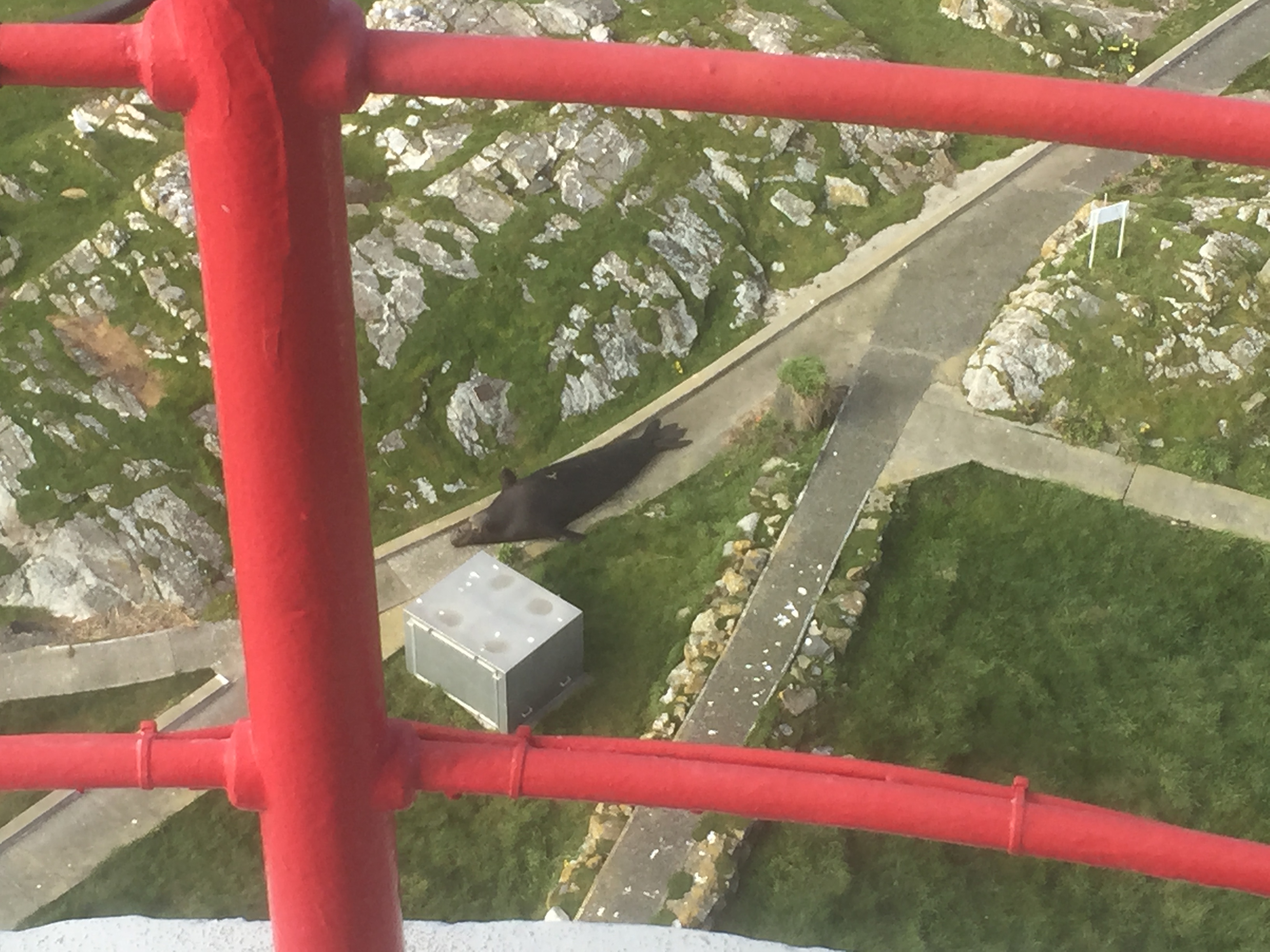
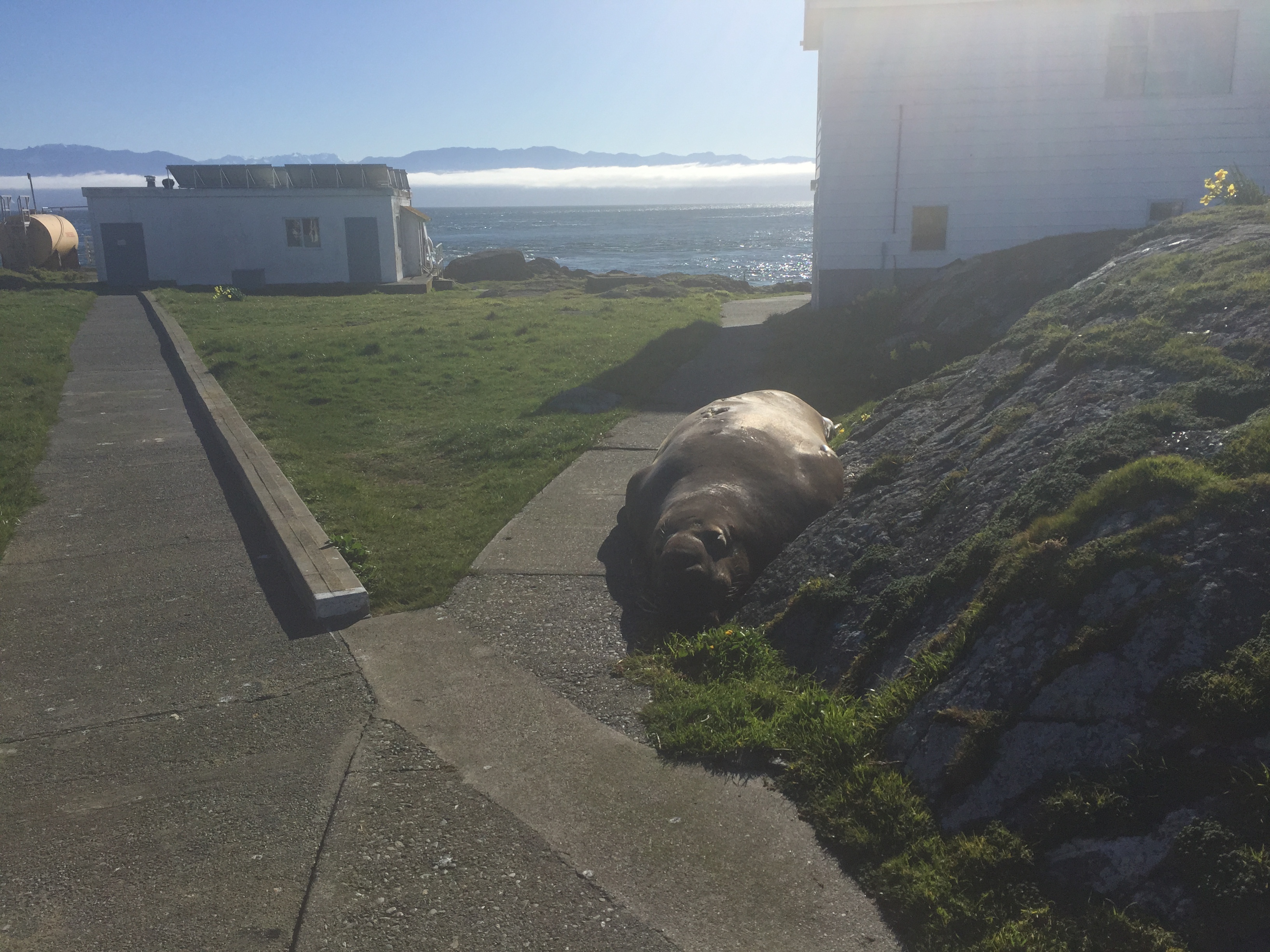
The Northern Elephant Seals are starting to moult and data collection on basic biological parameters began today including non-invasive, length measurements using the marine railway as a big meter stick.
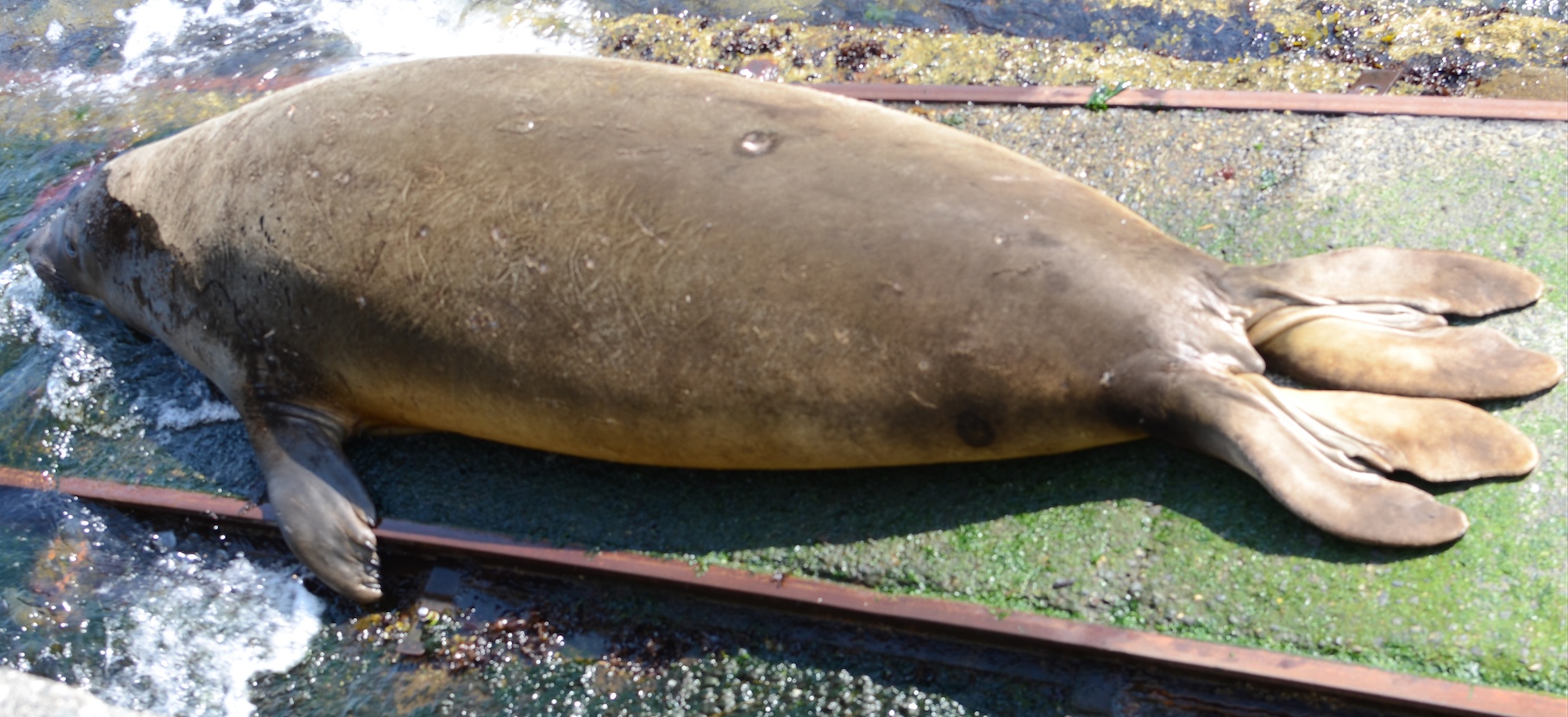
 

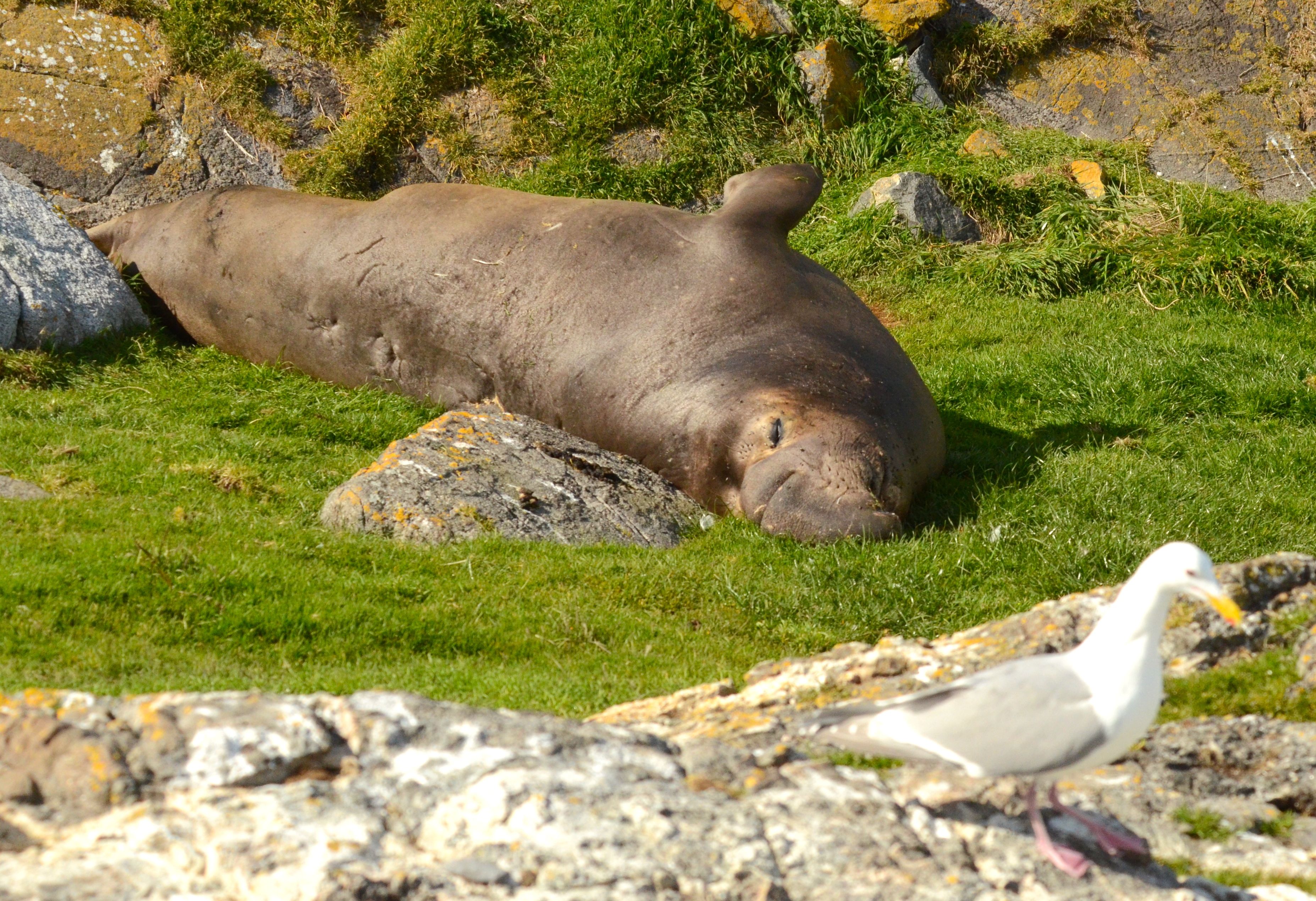
If only this female were lying next to a big ruler, we would have a complete data set on her for April 17, 2015.

If only this female were lying next to a big ruler, we would have a complete data set on her for April 17, 2015.

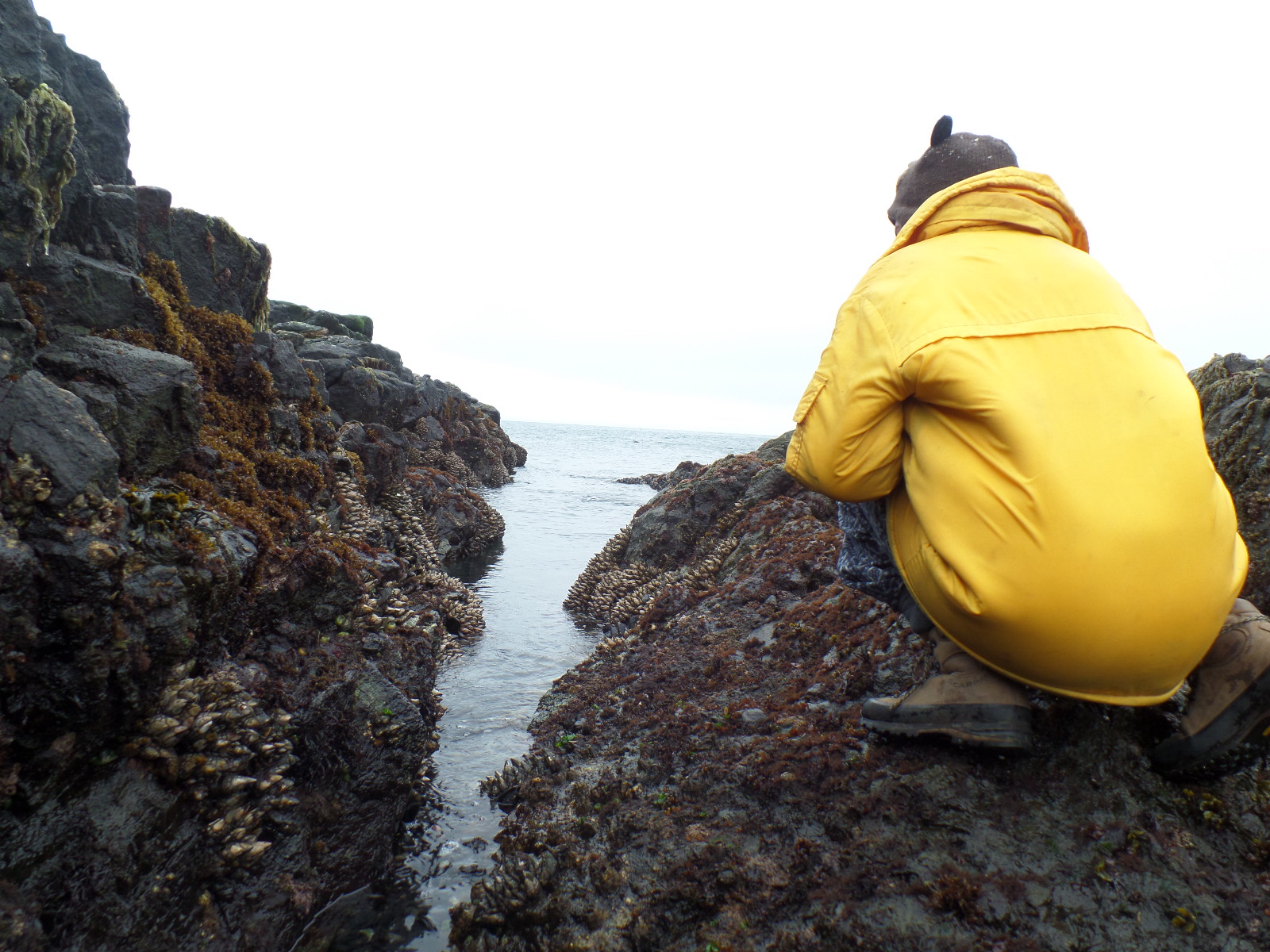
There were 14 visitors first thing this morning. Courtney, driving Second Nature, brought out one of Laura’s first year, marine science classes. It was an early start for these  students but they had breakfast en route and were very efficient on shore. They did a quantitative, community ecology activity on the low tide. They were trying to determine if and how the diversity, abundance and distribution of intertidal macro-biota changed with vertical height. They used water levels to measure vertical height, (an ancient Egyptian leveling technique based on the fact that water will always find its’ own level), transect lines to position sampling and quadrats to focus sampling efforts. These photos of the students, were all taken by Laura Verhegge.
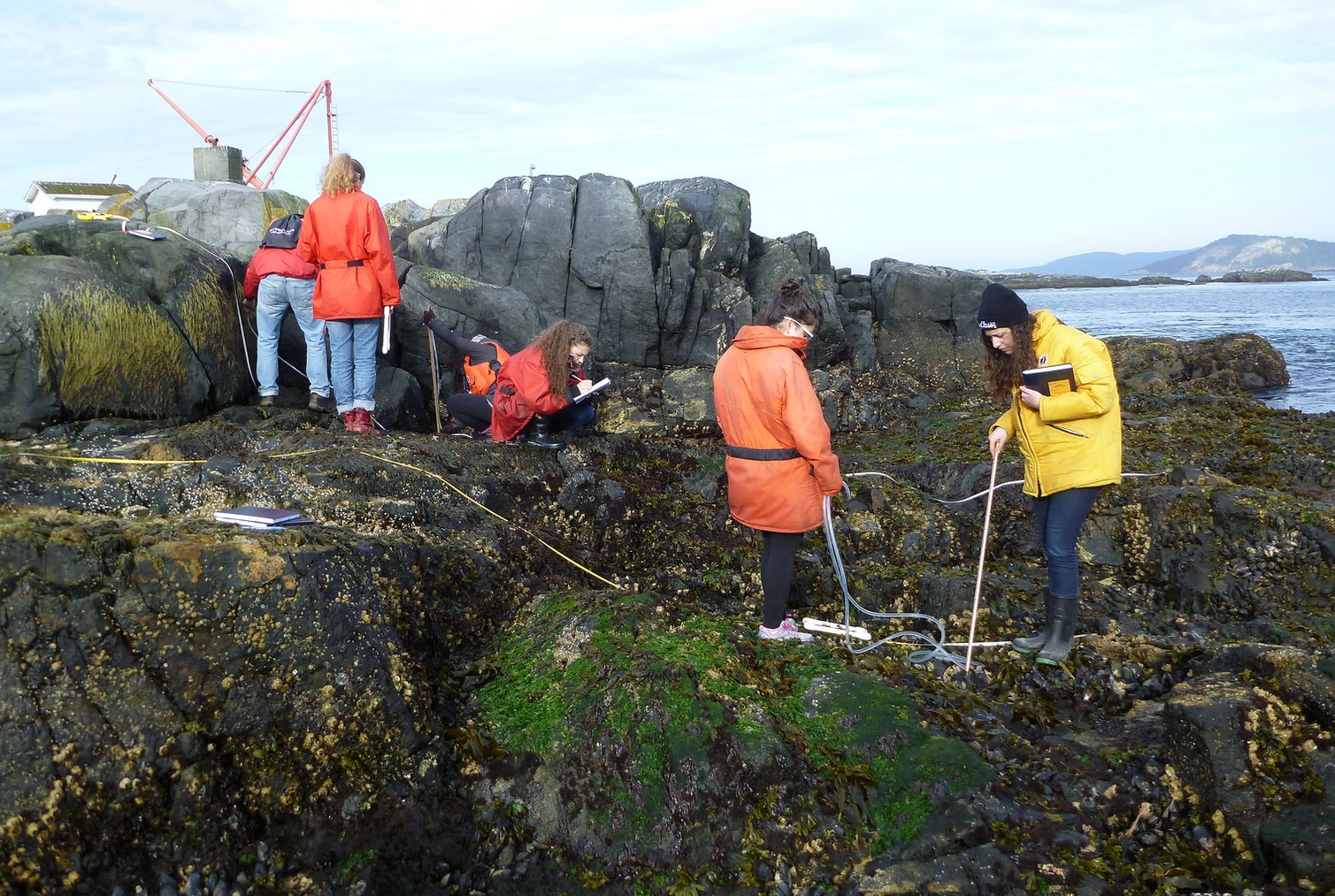
First year marine science students from around the world learn science experientially at Lester B. Pearson College of the Pacific.
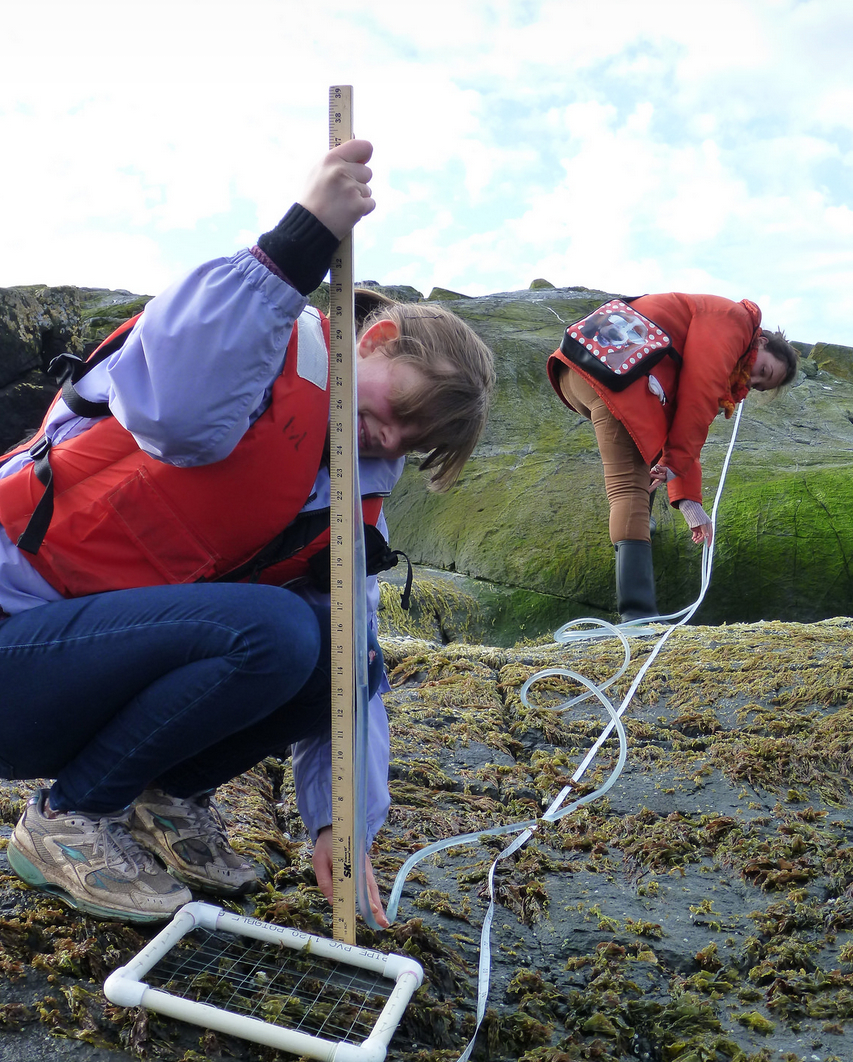
First year marine science students from around the world learn science experientially at Lester B. Pearson College of the Pacific.

Catriona and Claudia demonstrate skill and teamwork using the waterlevel to measure vertical height ti the next sample.

Catriona and Claudia demonstrate skill and teamwork using the water-level to measure vertical height to the next sample.
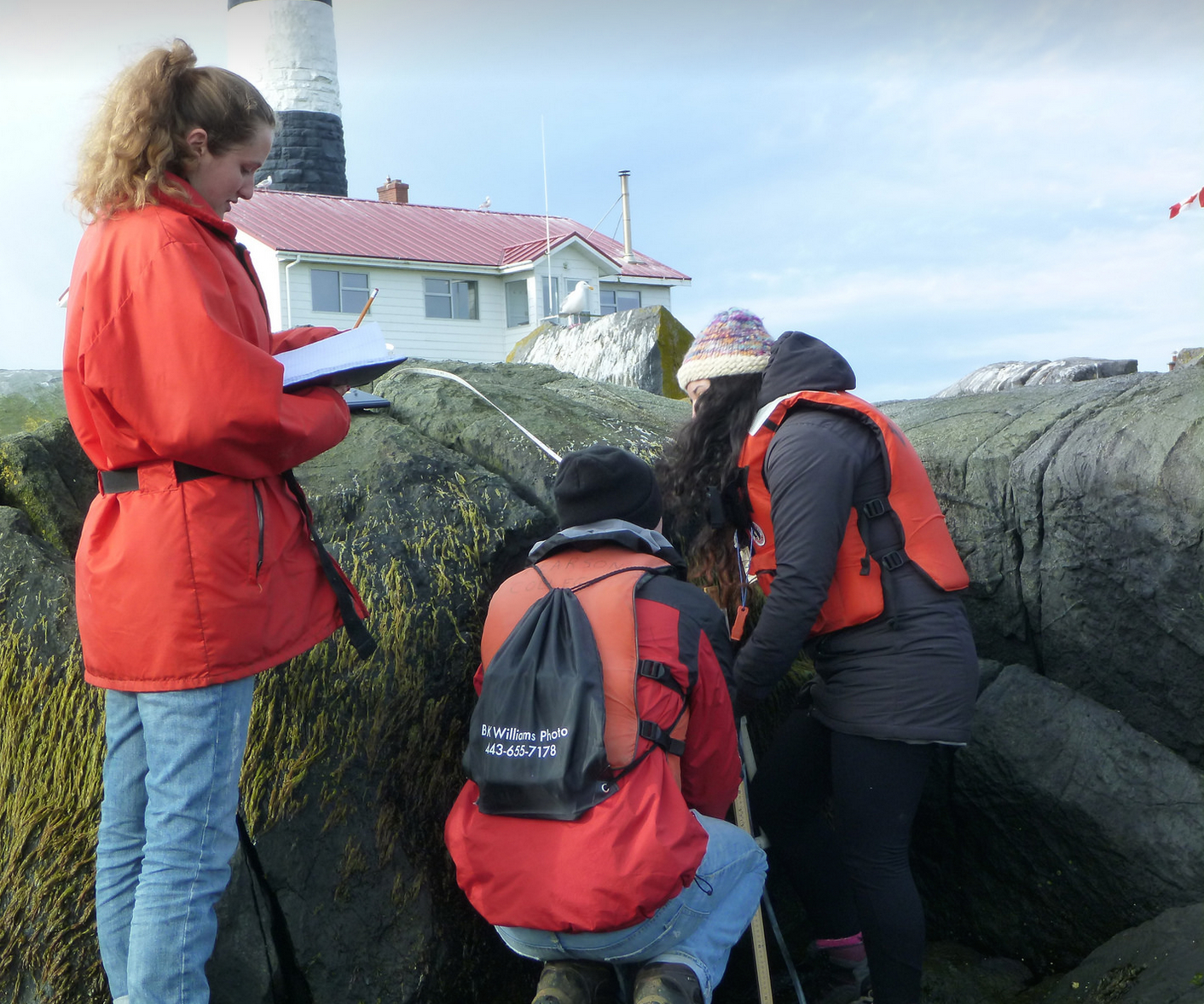
 

tella, Connor and Tamara discover the intricacies of inter-tidal life.

Stella, Connor and Tamara discover the intricacies of inter-tidal life.

Courtney is a big fan of elephant seals and so she was keen to help with the first elephant seal measurements this morning and assisted in working out a way for one person to measure the elephant seals without disturbing them. As of this afternoon the marine railway is the new ruler and first measurements made of a young male were very close to those made earlier with a laser, measuring device. The laser technique required two people, two long boards, a right angle check and eye safety protocols. The laser technique had potential to bother the animal (if it was awake). The new technique is passive, non-invasive and non-threatening.
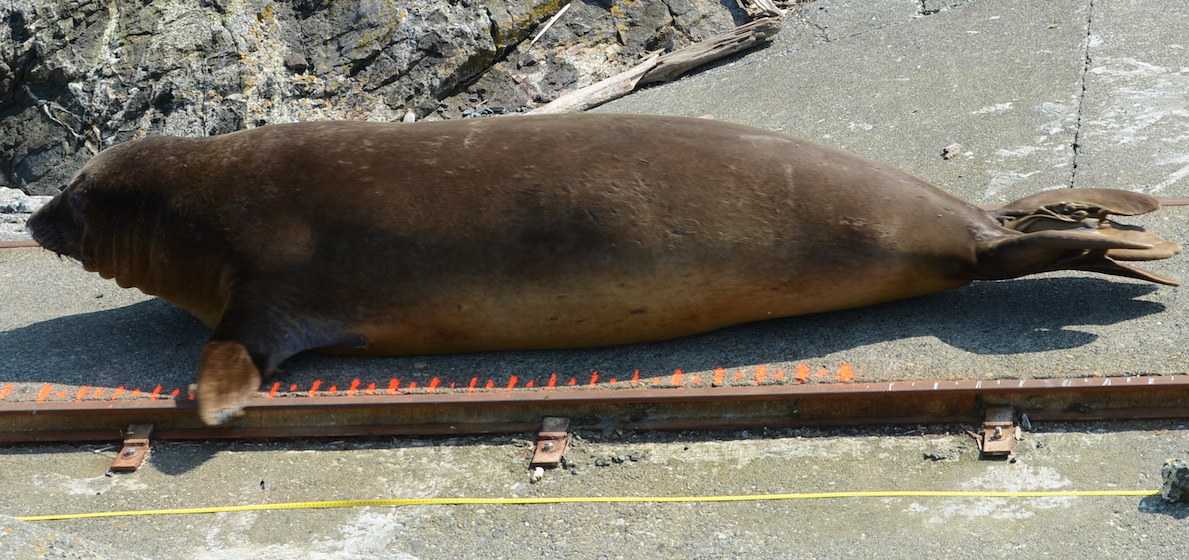
 

Male elephant seal entering the "measuring device".

Male elephant seal entering the “measuring device”.

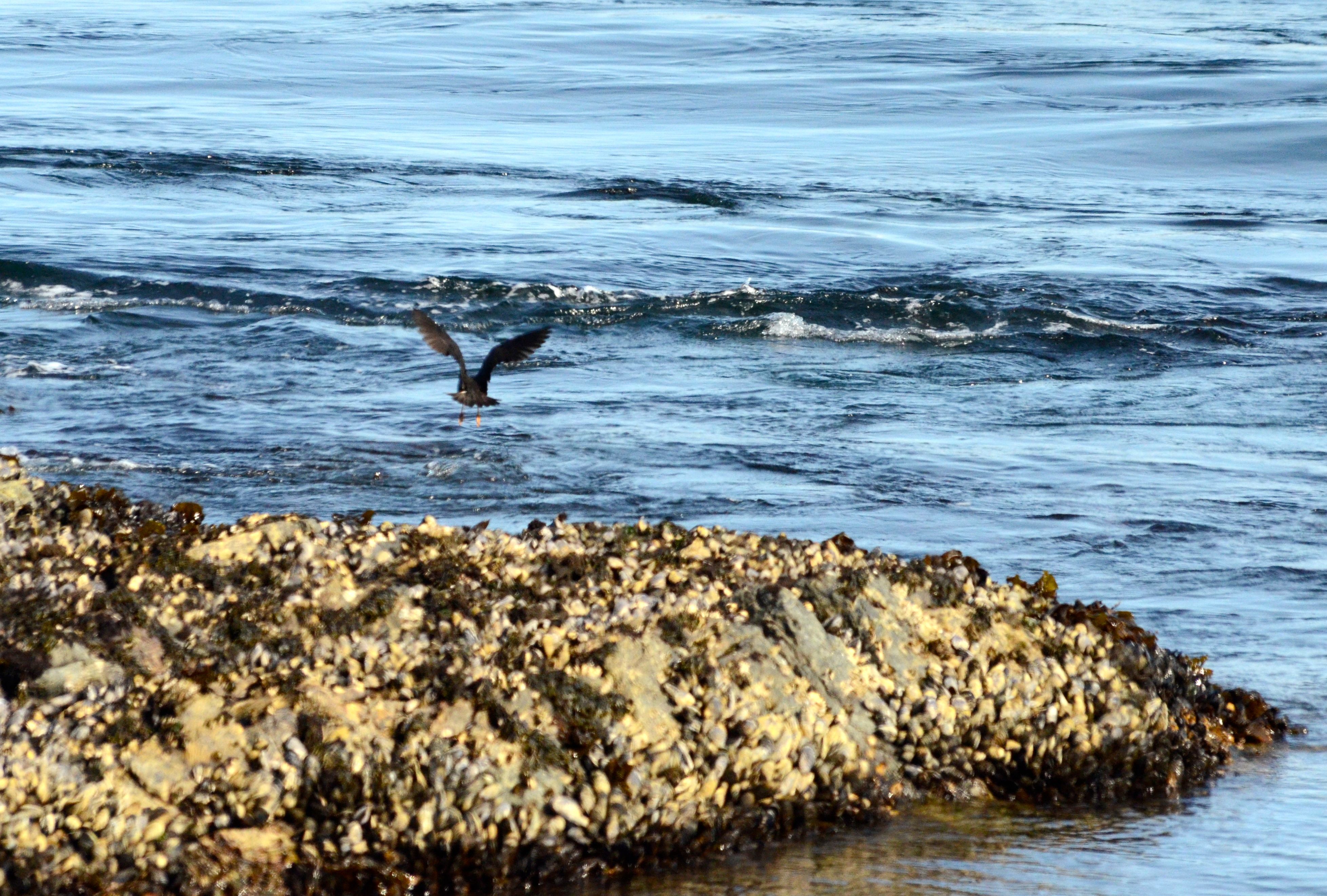
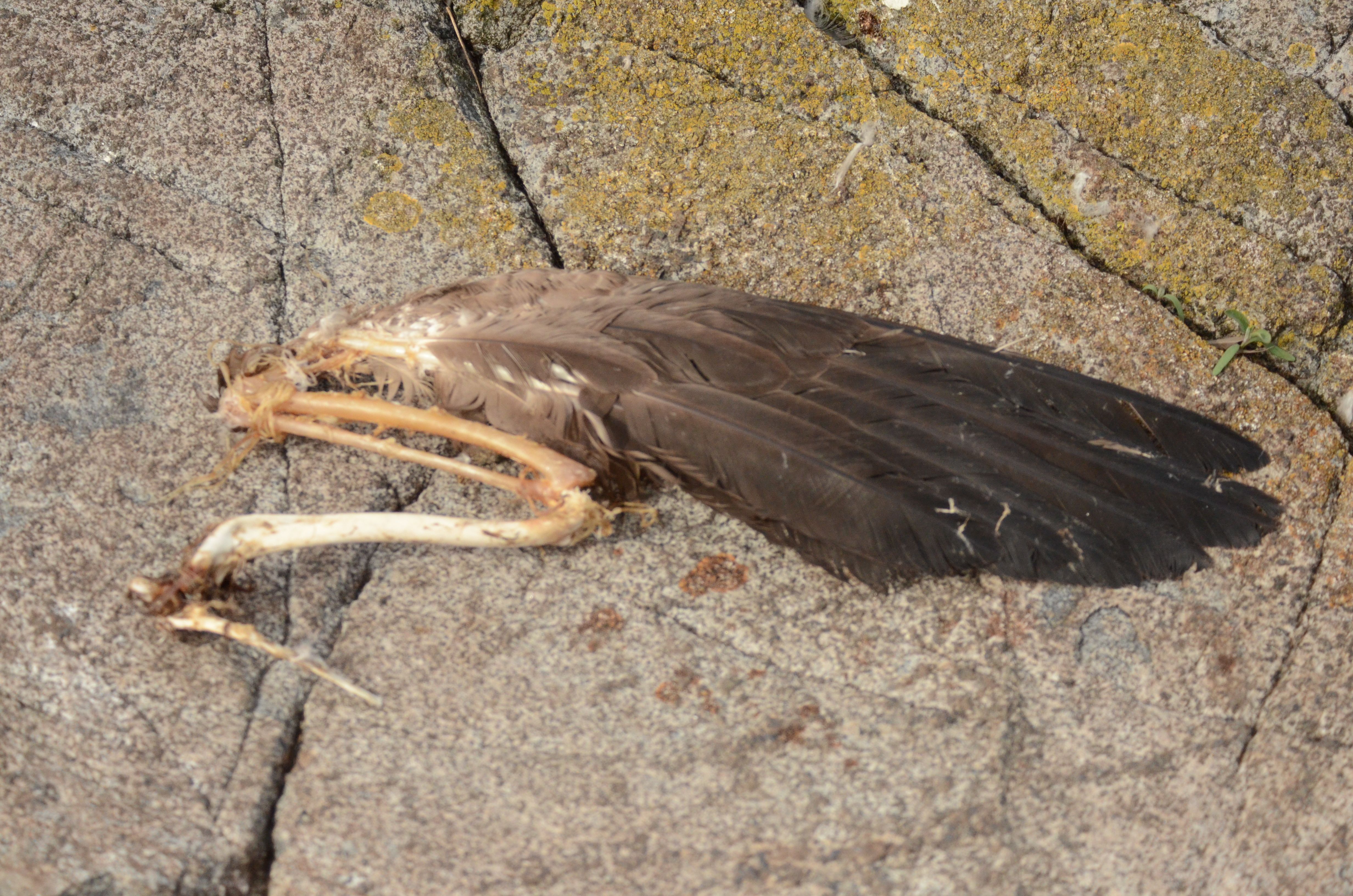
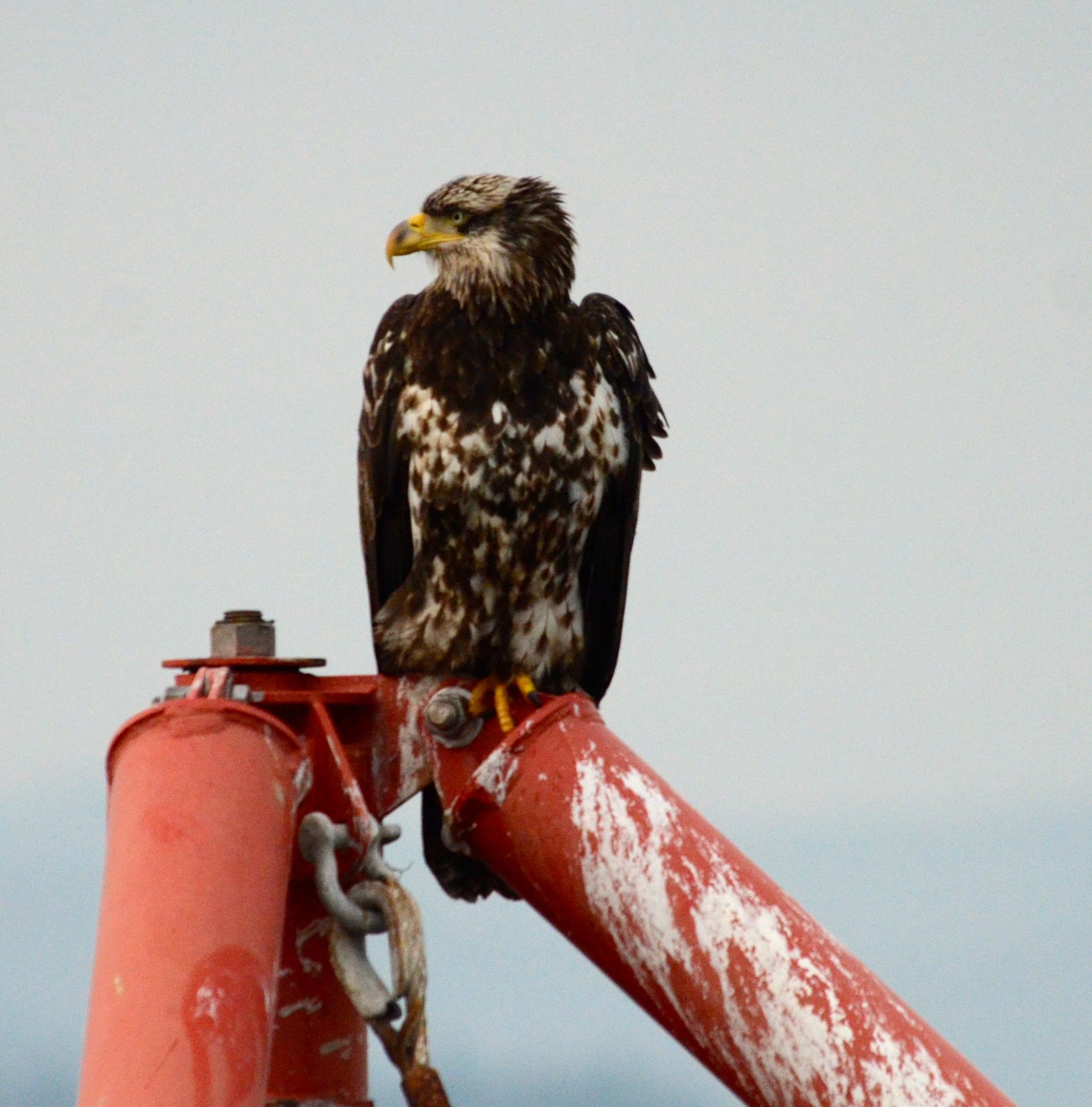
I saw a juvenile Bald Eagle attack a goose sitting on her nest today. I had suspected this was going on but good to verify. The eagle might have been successful with back-up, but the gander flew in and together with the goose, drove the eagle off. You can guess who I was cheering for. I know it is not science but there is no hockey out here and I am Canadian, eh.
 

A Stellar Day

Calm seas, sunshine and light winds combined to make it a very pleasant day. The wind really didn’t do much and direction changed throughout the day from west to southeast and back again. There was enough sunshine  to power the solar panels, run the de-salinator  and build up the batteries. The barometer declined slowly all day after a high start and the forecast is for a mix of sun and cloud tomorrow with a strong westerly winds predicted.

Two whale watching boats used the Ecological Reserve today.   From where they were, I am guessing that they enjoyed the pinnipeds and sea otter as well as the birds. Several sports fishing boats transited through at high speed and one fished close to the boundary.

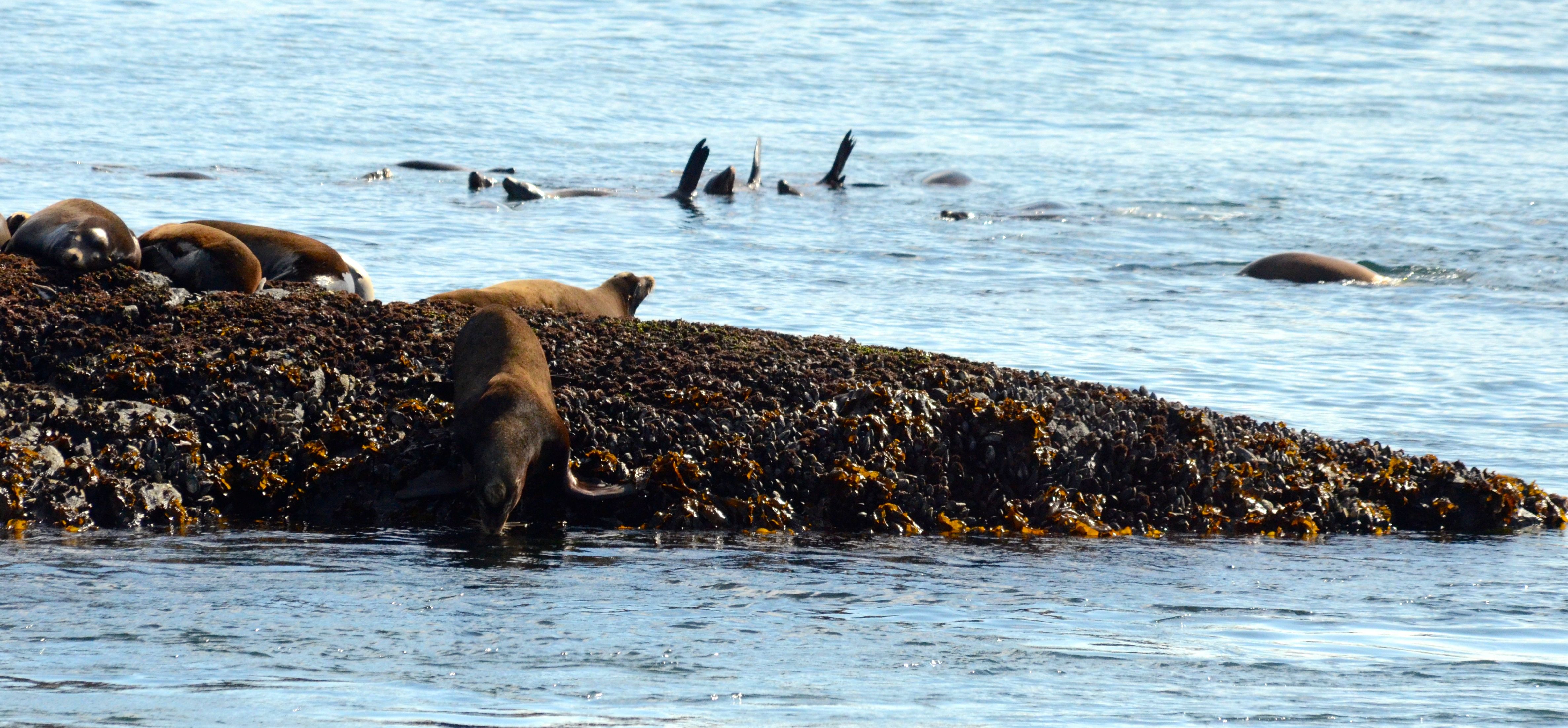
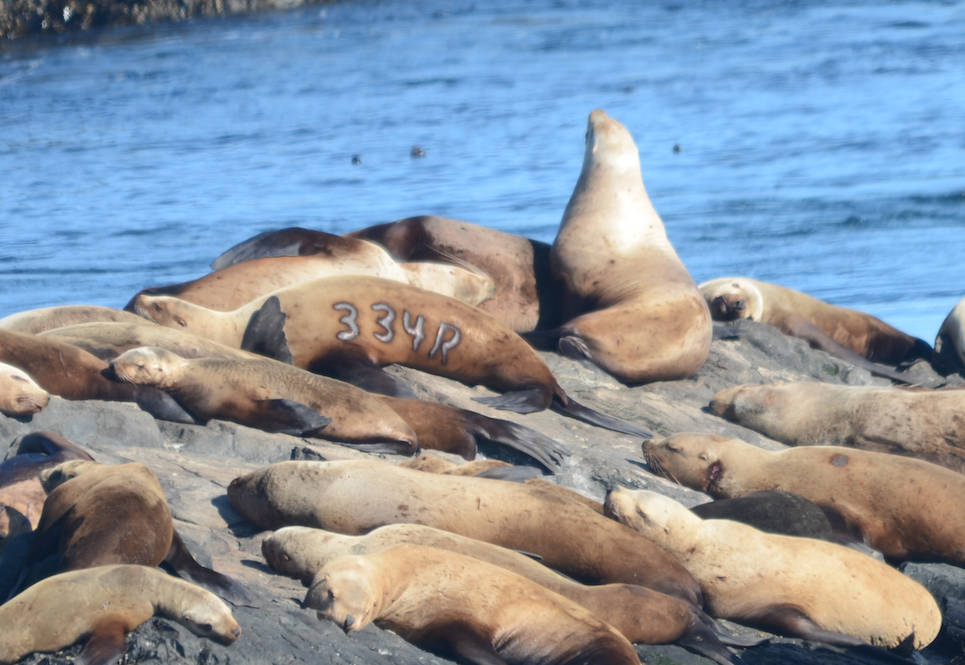
Female Steller’s or Northern Sealion #334R was photographed today. She was branded as a pup in July 2003 at Rogue Reef in  southern Oregon.

Northern or Steller's Sealions hauled out on South Islets,  a female born in southern Oregon, branded with #334R is visible.

Steller’s Sealions hauled out on South Islets, a female born in southern Oregon in 2003, and branded with #334R is visible.

The Northern Elephant Seals continue to grace Great Race and I am getting used to them not reacting at all to my presence on the walkways.

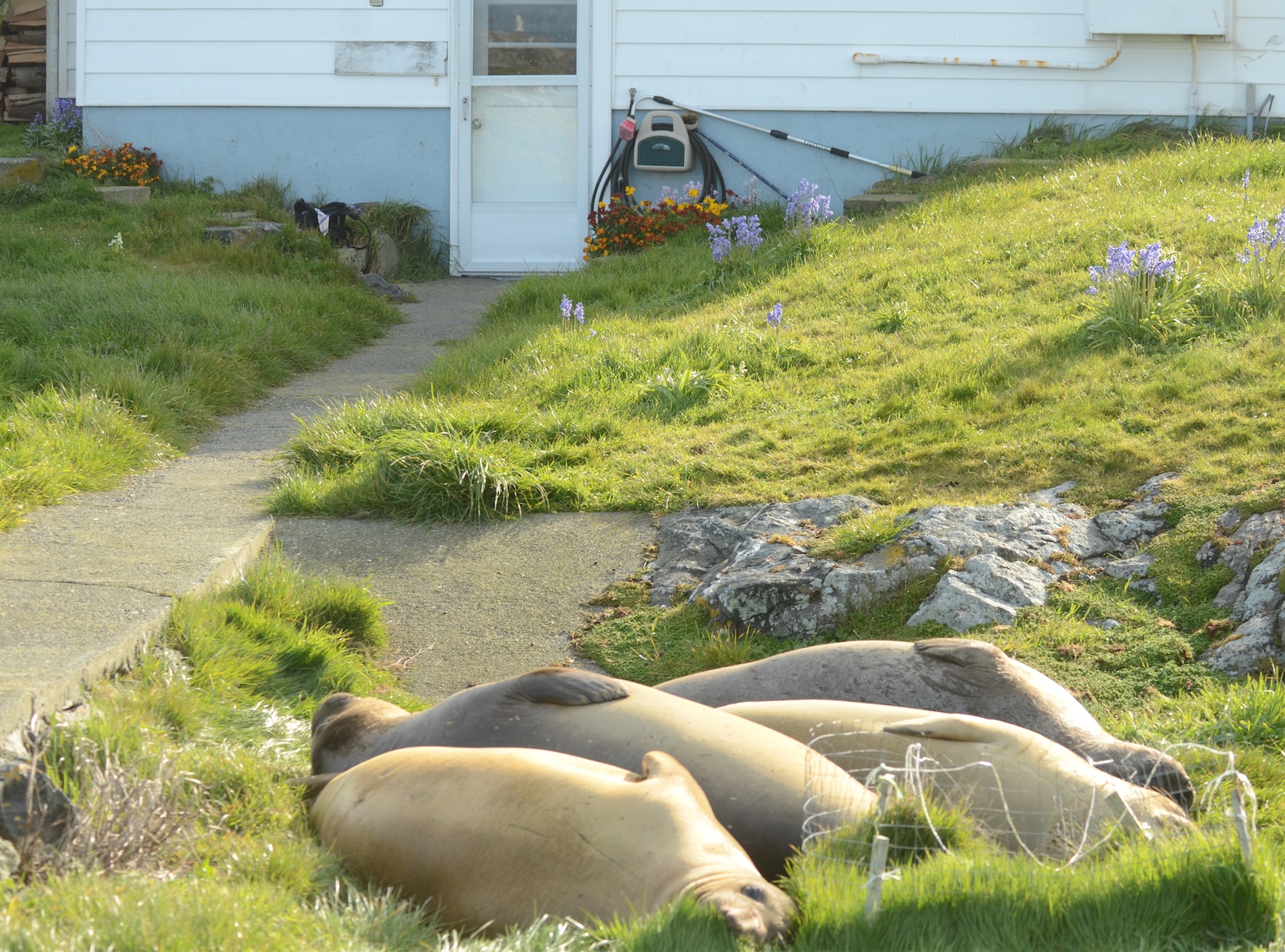
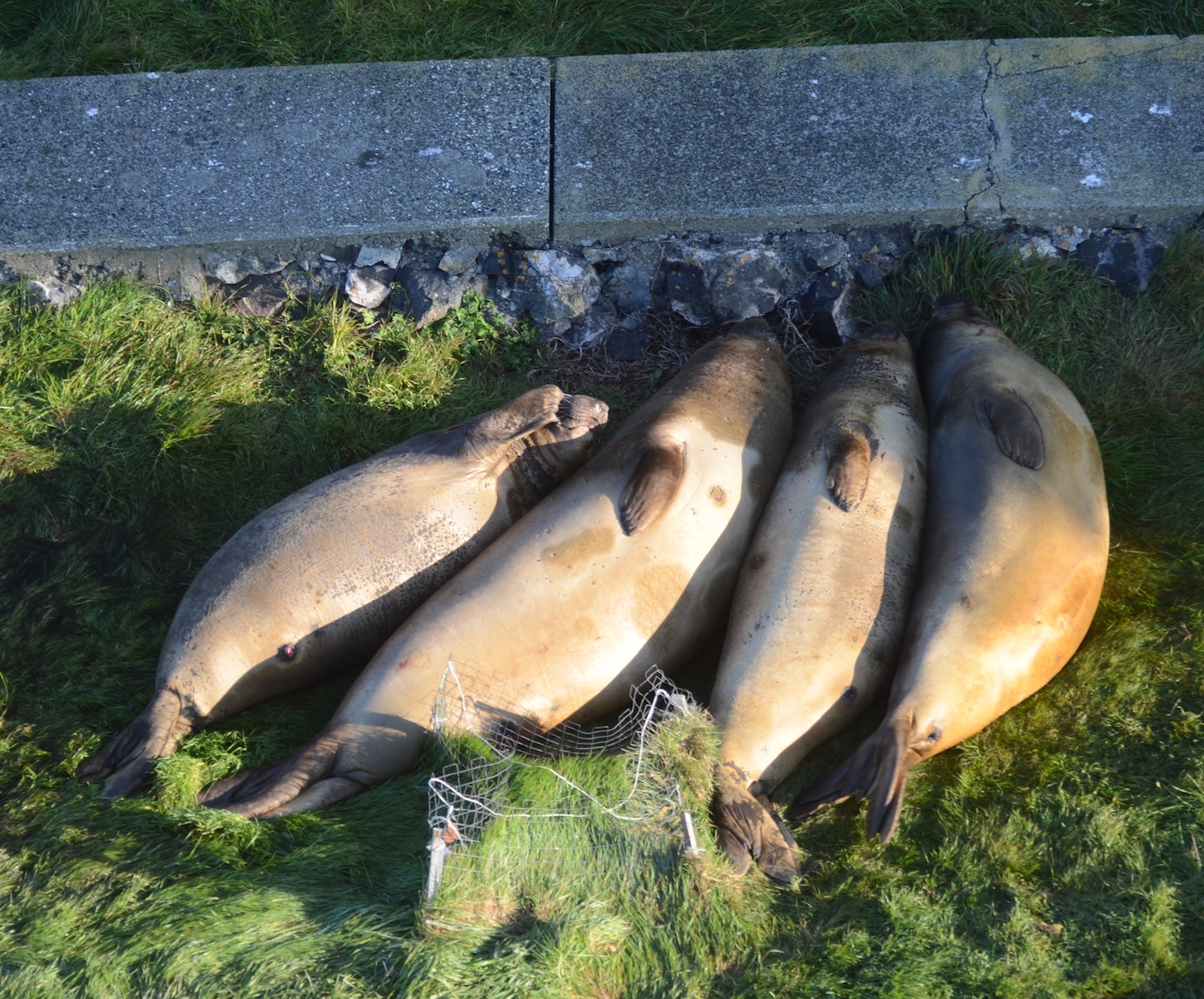
Four Northern Elephant Seals like peas in a pod, next to the walkway to my house with their tails in the goose exclusion cage.

Four Northern Elephant Seals like peas in a pod, next to the walkway to the basement door.

The Glaucous-winged gulls are starting to mate and gather nesting materials. The Canada Geese are busy defending territory and brooding eggs. Black Oystercatchers are likewise busy when not foraging in the intertidal where limpets seem to be their favourite food.

Today was Animal Census Day and here are the results:

Northern Elephant Seals 26

Harbour Seals 147

California Sea lions 30

Steller’s Sea lions 36

Sea Otter 1

Canada Geese 18

Harlequin Ducks 3

Pelagic Cormorants 8

Double Crested Cormorants 7

Bald Eagle 2 adults, 5 sub-adults

Killdeer 1

Black Oystercatchers 10

Black Turnstones 9

Surfbirds 8

Pigeon Guillemots 164

Glaucous-winged Gulls 345

Northwestern Crow 6

Common Raven 1

There were no visitors today and maintenance chores were routine including running the fire pump to fill cistern.


Its a blast… really many blasts.

Today there was a lull in wind velocity. The west-southwest wind continued and even pushed more from the south for a few hours in the afternoon, but the speed was less than half of yesterday’s winds.

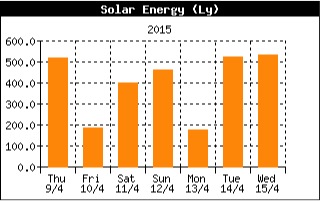
It was a bright day even though it hazed over in the late afternoon. This graph of accumulated, daily solar radiation for the last week shows up the big differences between days depending on cloud cover. The metric, one Langley is equivalent to 41.84 kilojoules per metre2. Check out the weather pages of this web-site for more nifty graphs and information.

Cumulative daily solar energy for the past week.

Cumulative daily solar energy for the past week.

The barometer rose today, levelling off and even dropping a little, late afternoon. The forecast is calling for a day similar to this one.

There were no tour boats in the Ecological Reserve today. Two sportsfishing boats were jigging very close to the boundaries but probably not inside and one aluminum water-taxi like sportsfisher went through the main channel at high speed. A derelict looking fishing vessel, called the Larkin, was towed by a tug, through Race Passage adjacent to the reserve, late afternoon.

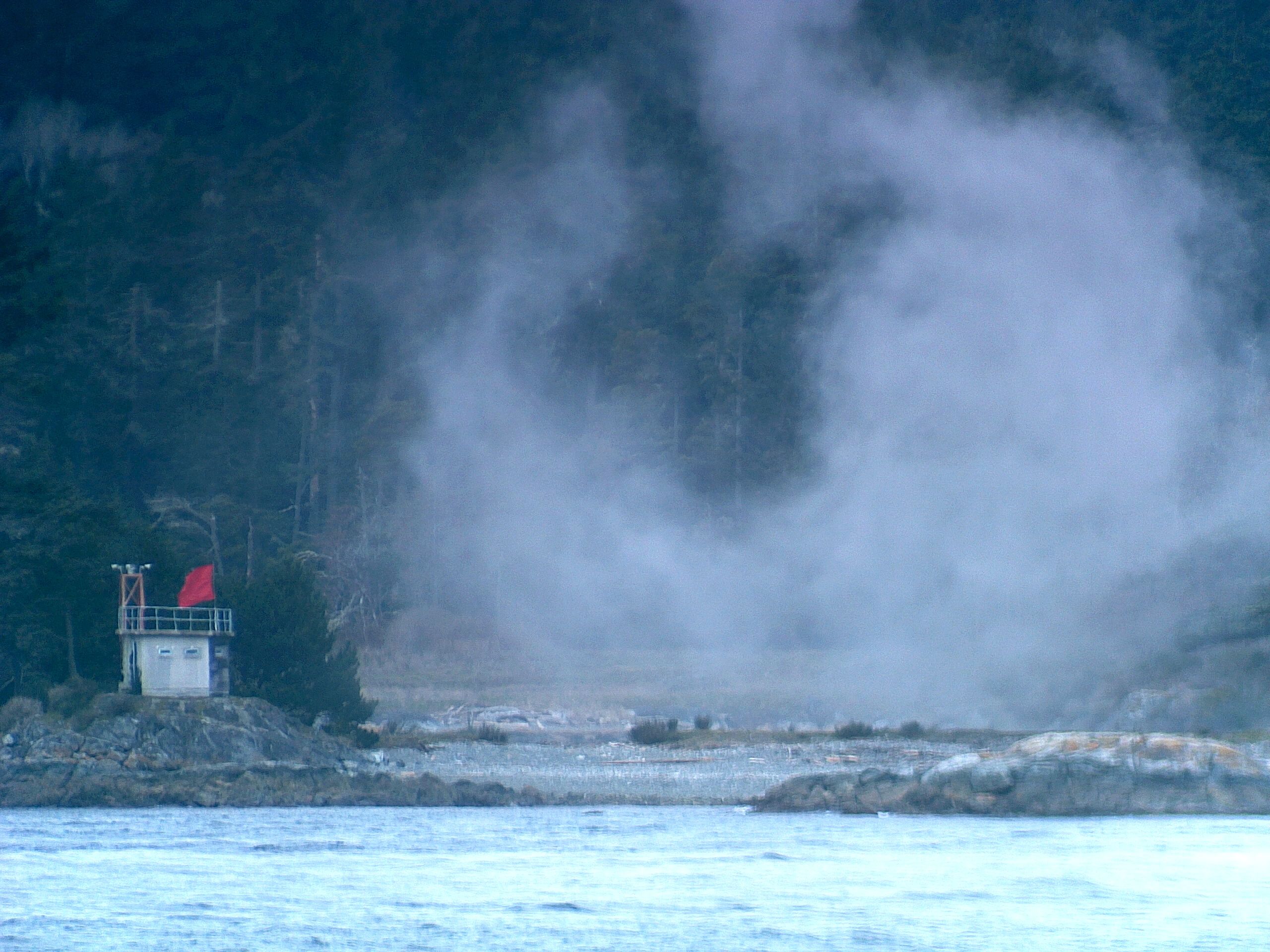
Military blasting, as promised, was conducted during the business day. Even during and after the biggest explosions, the largest reaction I observed were sealions raising their heads and looking alert for less than 30 seconds.

Speaking of alert (or not), a total of nine Northern Elephant Seals were hauled out on Great Race today. The four in the garden were joined by two young amorous animals and a third sub-adult male. There was a bit of a kerfuffle involving the biggest male but they all settled quickly as it appeared that conflict was just too energetic.

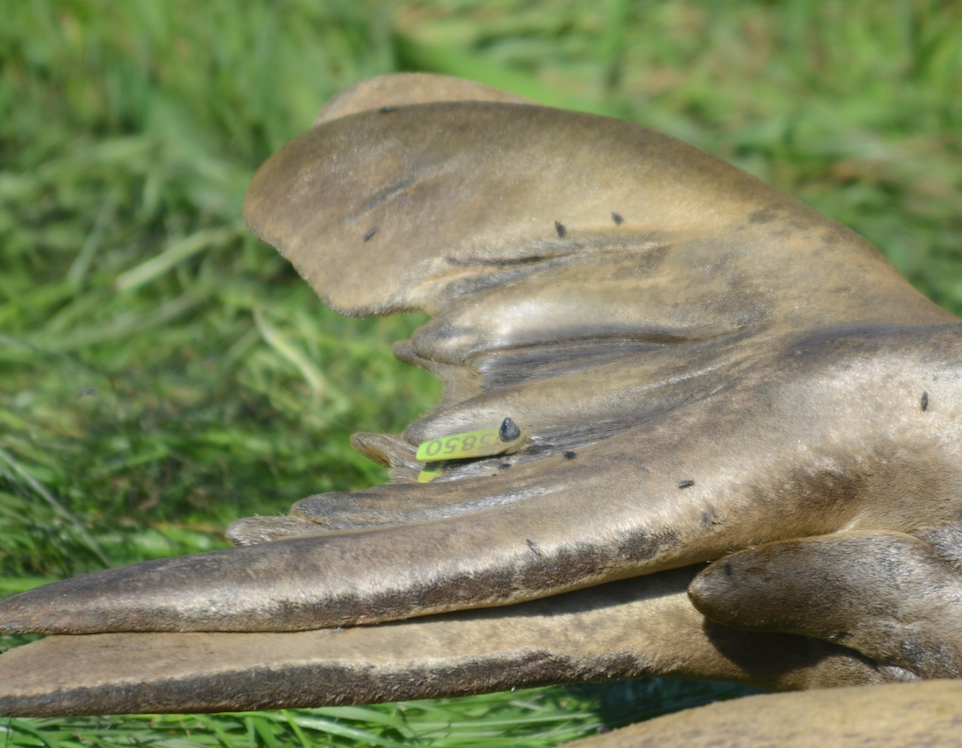
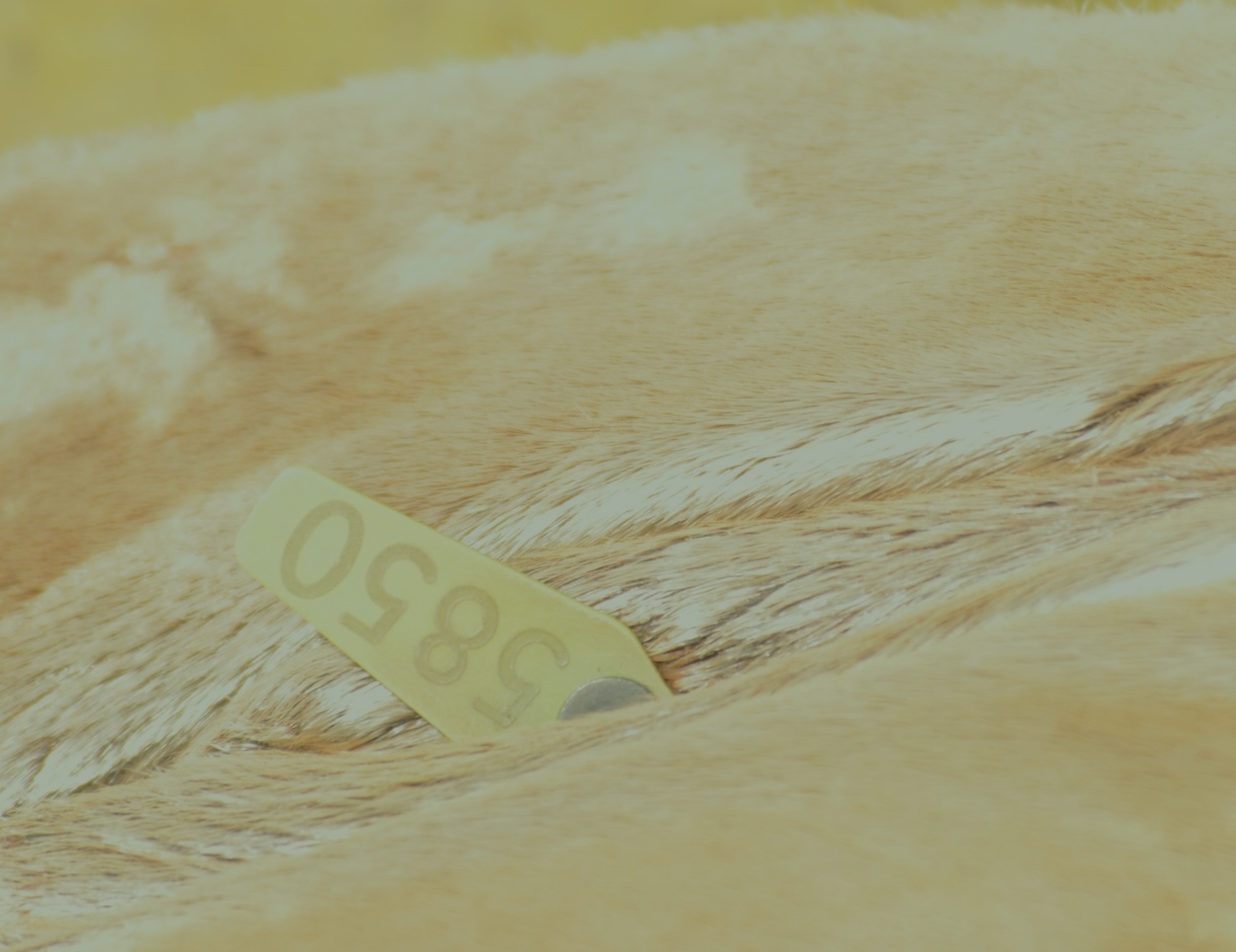
The new (to me) female was well tagged with a left double tag of #7620. The right side was still double-tagged but much more difficult to read with # 7688 confirmed. One of the right tags was yellow instead of the lime green and very worn. Tagged animal # 5850 (left) returned. The animal with psoriasis continues to sleep soundly, off on its’ own right, beside the path and only occasionally, barely opens her eyes when I go past her.

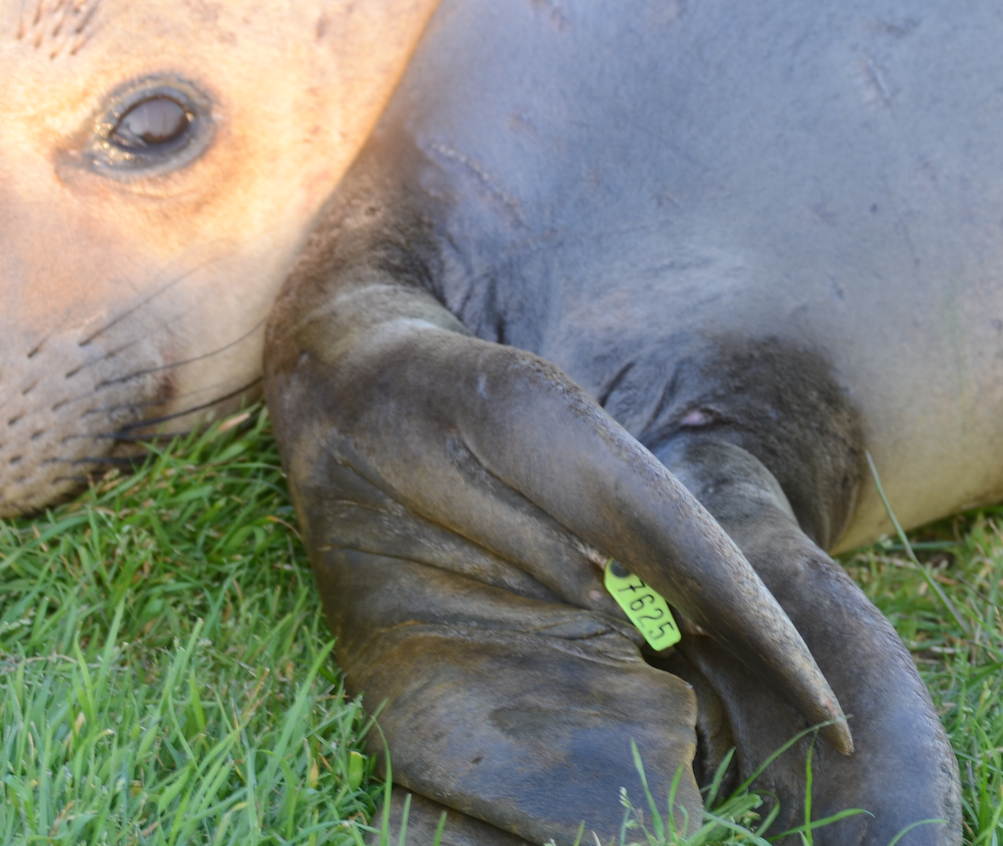
The seal on the right is a female with left tag #7625.

The seal on the right is a female with left tag #7625.


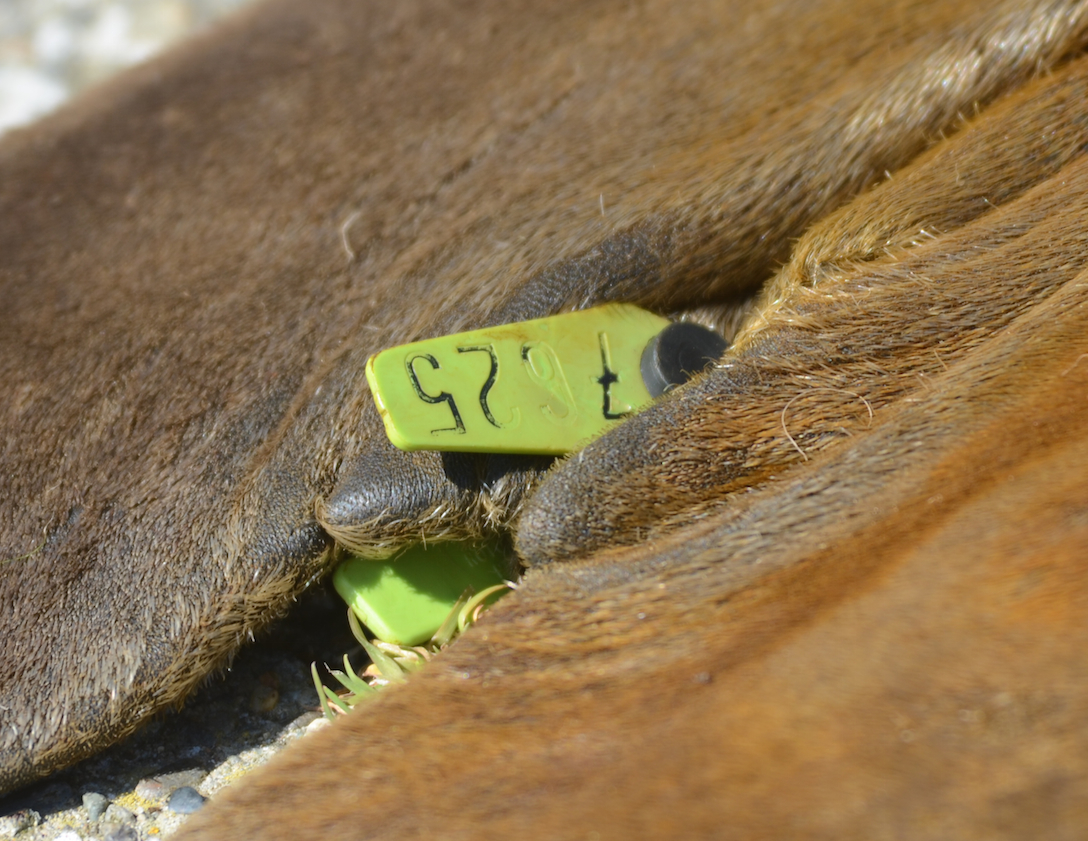
The flip side of left tag #7625.

The flip side of left tag #7625 above.

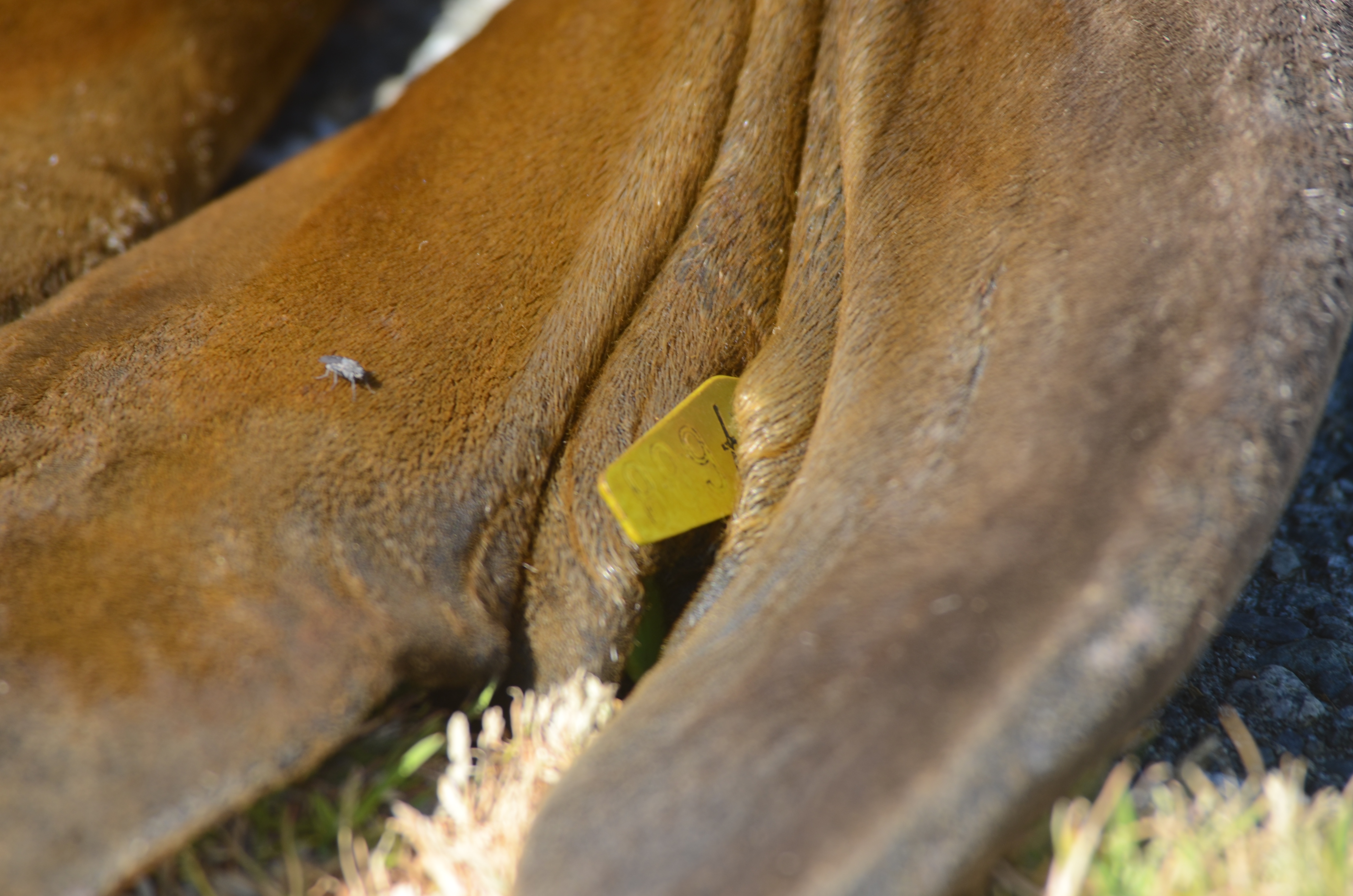
The same female with #7688  on a yellow tag on her right side.

The same female with #7688 on a yellow tag on her right side.

Tag #5850 showing healthy left side flippers and dual tag.

Tag #5850 showing healthy left side flippers and dual tag.

These tags are very important to elephant seal biologists who study the population dynamics: (How many are there? How is the population doing? How long do they live?); the distribution (Where do they go and when?) and the phenology (When are individuals pupping, nursing, mating, and moulting?). The dual/quadruple tags help statisticians test assumptions made about re-sightings so that their mathematical models are more rigorous. We have a lot to learn from this resilient species that has recovered from the brink of extinction and (so far) avoided the pitfalls of genetic bottlenecking.

There were no visitors today and chores were all routine maintenance.


Lawn Crushers Extraordinaires

It was a cold and blustery day with winds from the west-southwest, blowing 25 to 35 knots. It was also dark, with a cumulative solar radiation of only ~130 Langleys and a peak of less than 500 Watts/m2, which was half of yesterday’s high. The temperature was about 6o C most of the day but it felt much colder in the wind. The barometer bottomed out around noon and although the trend is rising it seems tentative. The forecast is calling for a little less of the same, with a gale warning for Central Juan de Fuca Strait and an expectation for westerlies to blow 25 -25 knots again by Tuesday evening.
In late afternoon there was one brave, little whale watching boat in the Ecological Reserve. No other vessels were noted in Reserve today.

The folks on the tour boat were watching the sealions on the south side. The sealions which are usually hauled out on the rocks there these days, were almost all hanging out in the water where it was a few degrees warmer than the air and even cozier for a wet animal in the wind.

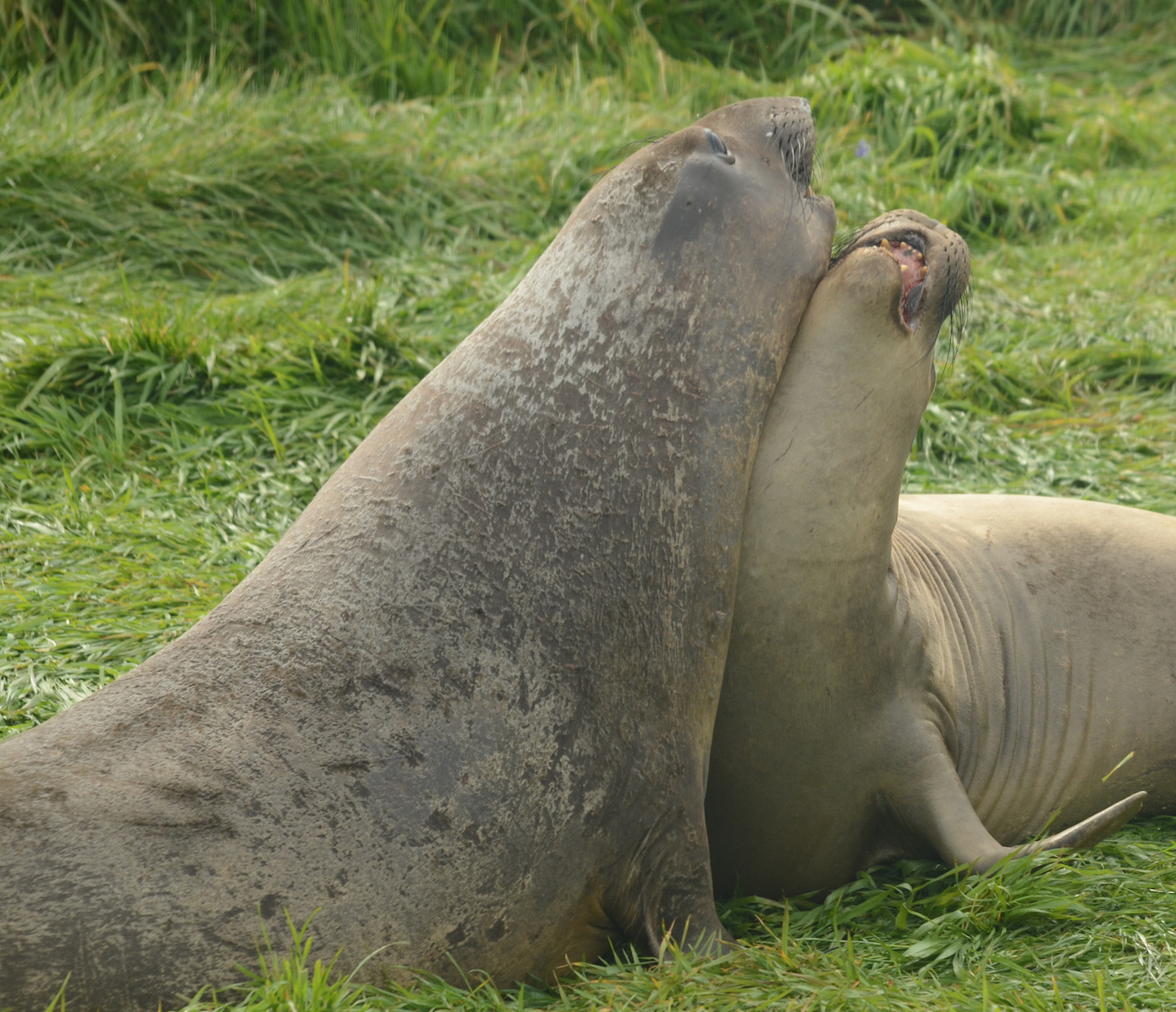
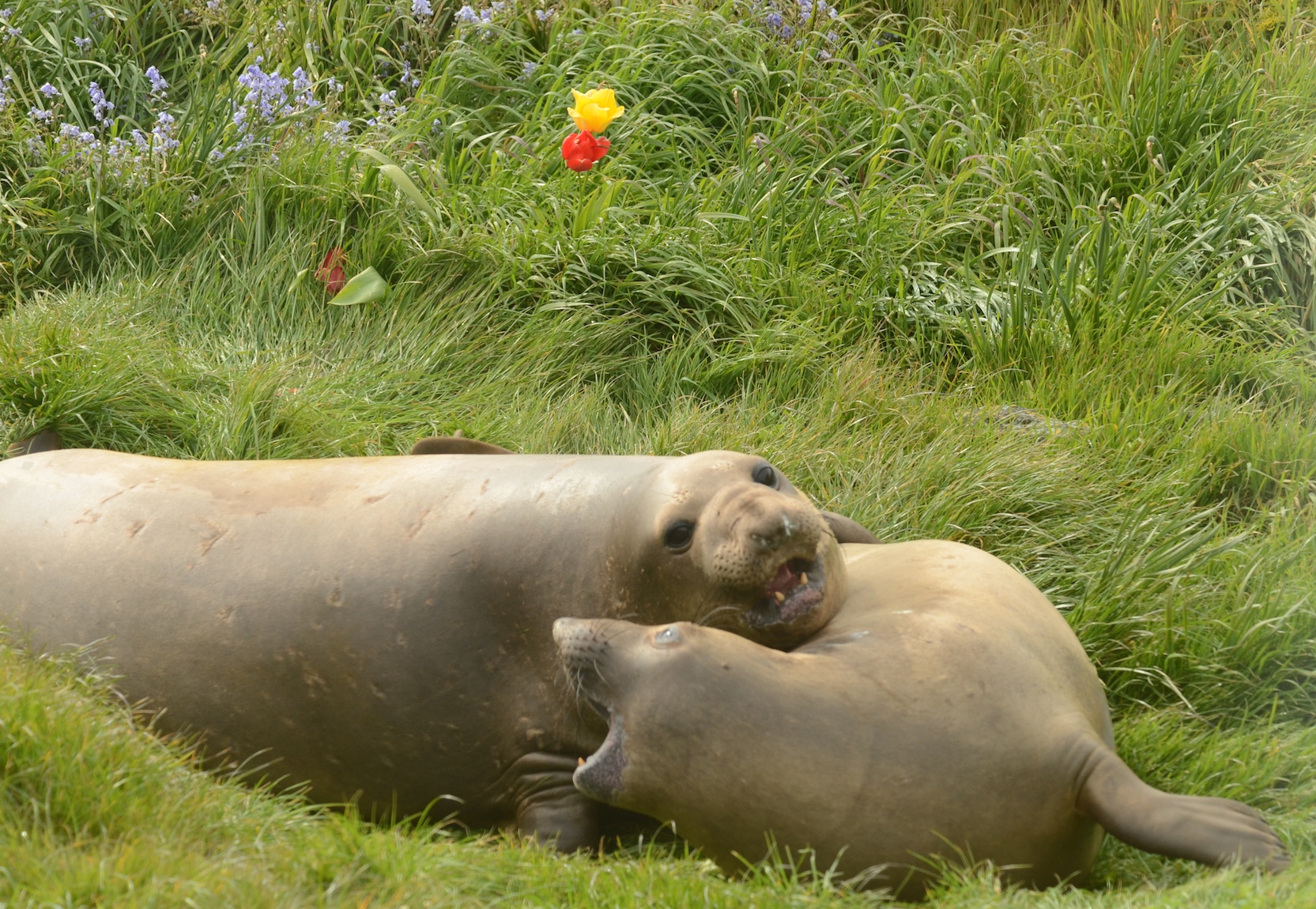
The lawn was freshly crushed, by four Northern Elephant Seals today. It certainly beats mowing. All but the one with the skin condition woke up after a profound 33 hour sleep to “romp” in the grass. The two young males sparred and a larger male and female practiced for parenthood. They all conked out after about three hours of activity and are now back into deep sleeps. The tagged one (5850) left yesterday afternoon and was not seen today.

Young male Northern Elephant Seals practicing for battle. One can see why size matters in this game.

Young male Northern Elephant Seals practicing for battle. One can see why size matters in this game.

Male (left) and female Northern Elephant Seals romping in the grass.

Northern Elephant Seals romping in the grass. The tulips in the background are now firmly squashed.

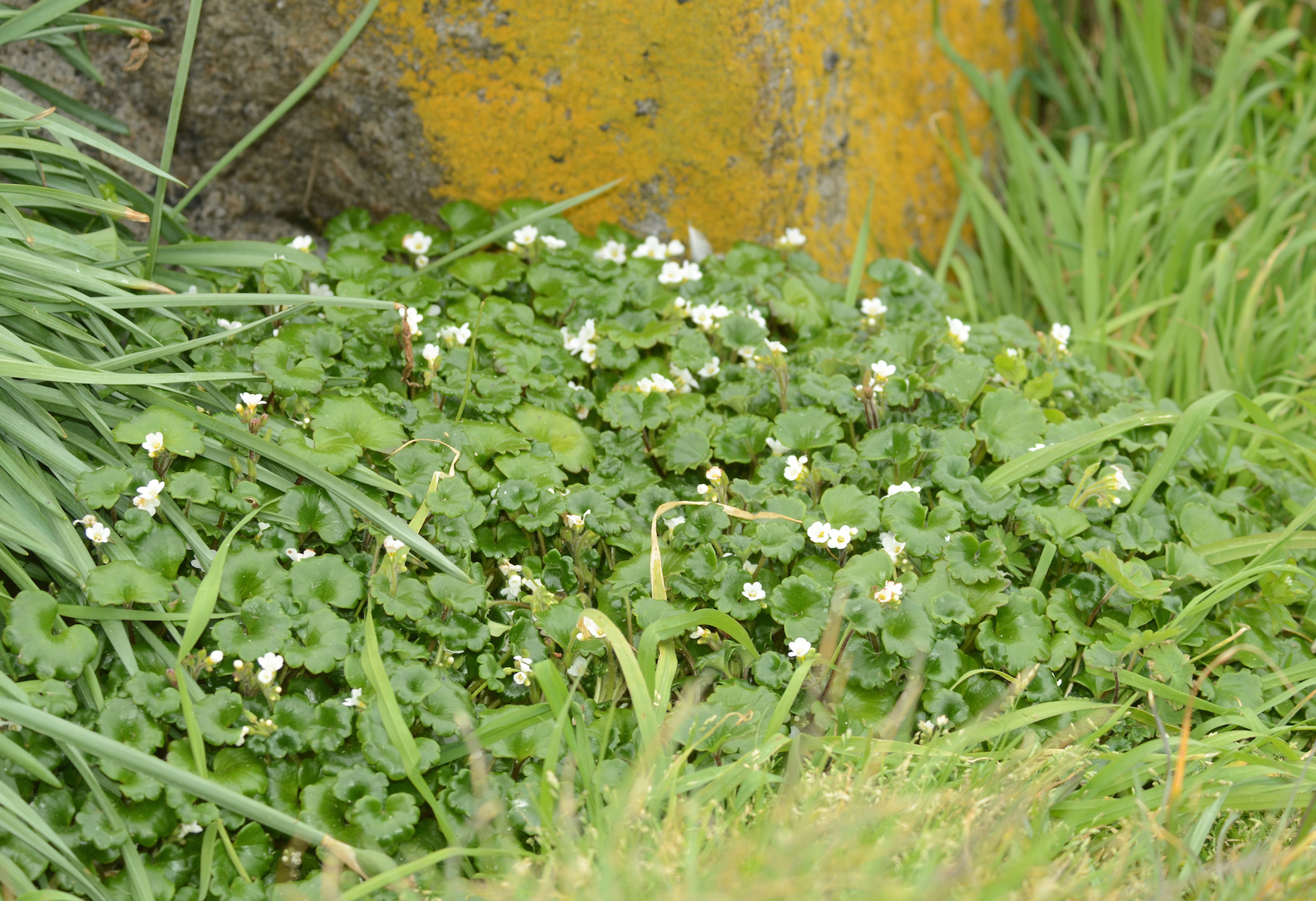
The Mist Maidens, which I mentioned a few days ago, are a rare plant found on Race Rocks and they seem to be doing really well. They don’t live in places frequented by the elephant seals so are safe from that threat. I will repeat Courtney’s documentation protocol in May to confirm or deny my qualitative impression that they are doing well.

Tracy's Mist Maidens, or Romazoffia tracyi are a rare plant that appears to be making a come-back on Great Race Island in the Race Rocks Ecological Reserve.

Tracy’s Mist Maidens, or Romazoffia tracyi is a rare plant that appears to be making a come-back on Great Race Island in the Race Rocks Ecological Reserve. It is an early bloomer with delicate white flowers.

The solar panels did not put out much energy today as could be expected from the low light levels. I had to start the generator early and run it a little longer, due to low solar power. It would really be great to have a small, bird-impermeable, wind generator for days like today and to supplement, the rest of the time, as it is usually windy here.

Other than the daily chores, I concentrated on risk mitigation today starting with locating and going through first aid kits. I tried to order first aid supplies and started a health, safety and environment risk mitigation report.

April 12

As the sun set, the wind shifted around to south-southeast after blowing about 10 knots  from a westerly direction most of the day. The snow line across the Strait is very low and the chill in the air continues. Although there was some sunshine today producing a high solar radiation reading of 1,000 watts/m2, there was also a lot of cloud. The barometer reached a high of 1020 hPa mid-day and then began to fall. The forecast is for southeast showers switching back to westerlies tomorrow afternoon.

Only one tour boat was observed in the Ecological Reserve today and although there were dozens of sports-fishing boats all around the reserve none were observed inside.

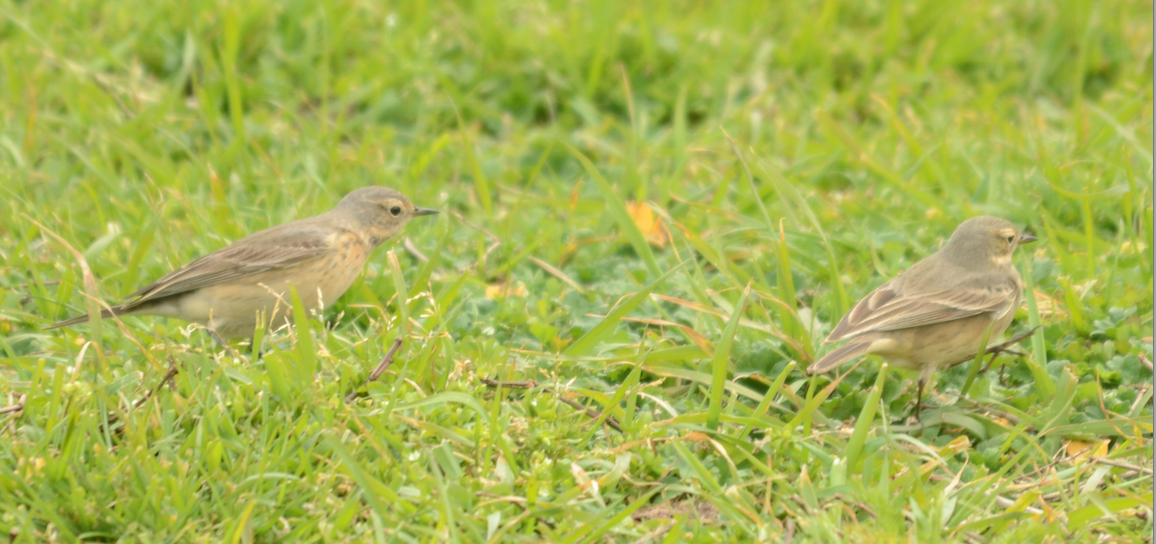
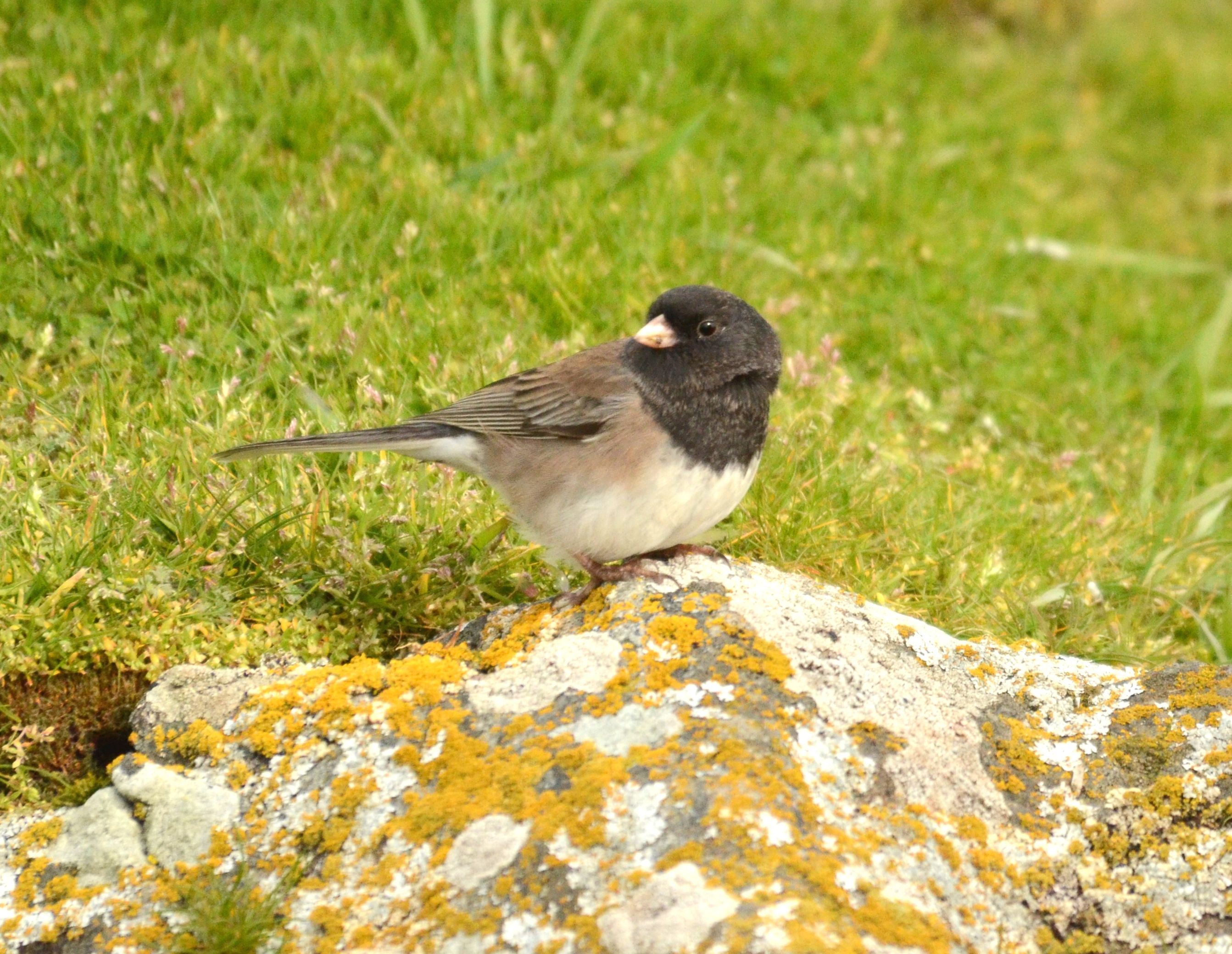
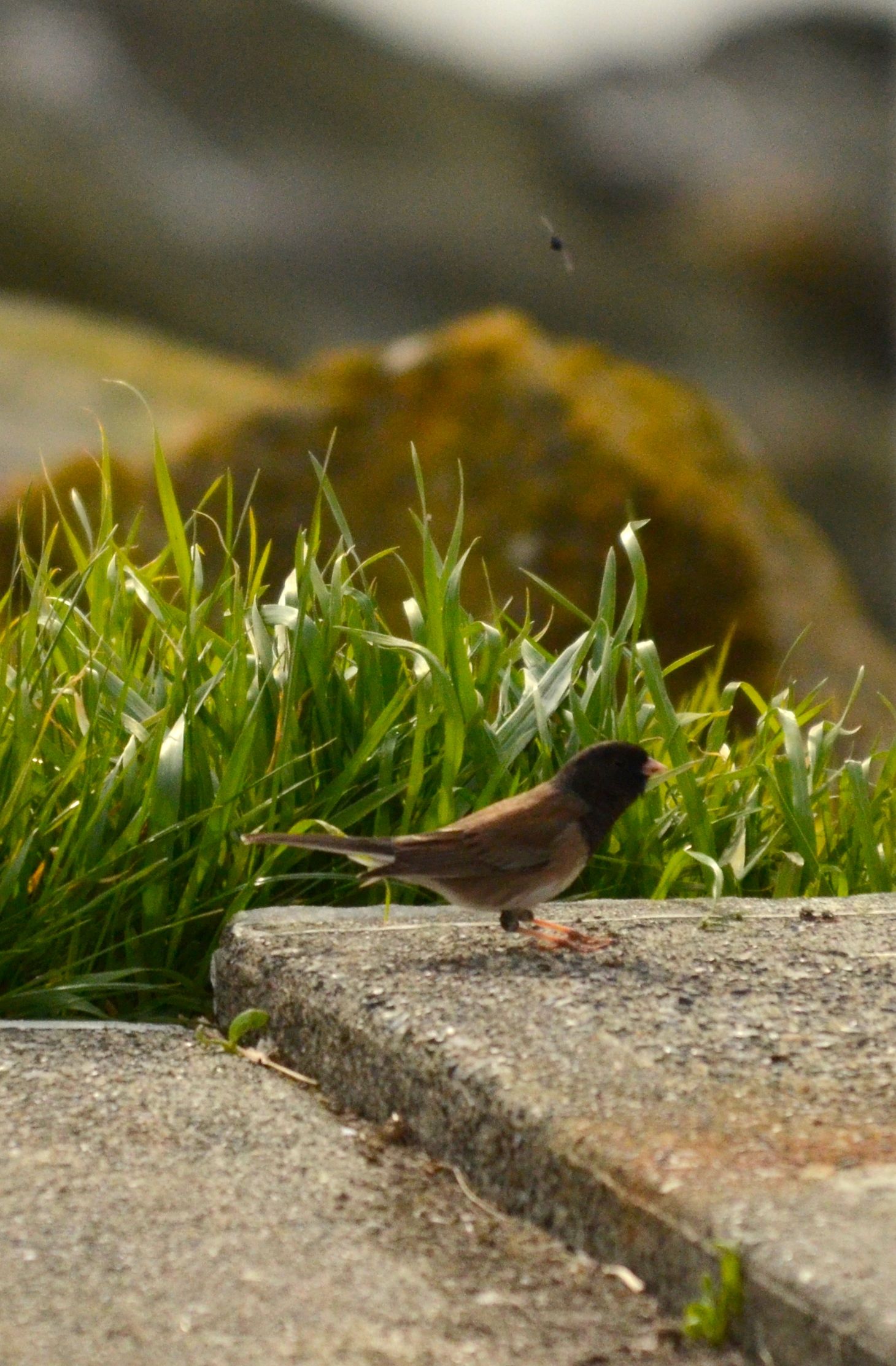
American Pipits have been spotted bobbing and flitting around Great Race and there is a photo below as evidence. Thanks go out to Rocky Point Bird Observatory for the identification confirmation.

American Pipits have been busy feeding on insects on the ground at Great Race.

American Pipits  busy feeding on insects on the ground at Great Race.

Six Northern Elephant Seals came ashore at first light and spent the whole day sleeping in the garden. One was a tagged, with a pale green tag #5850. This same individual had two tags when I first saw it last fall, October 14.

Goose exclusion cage keeps seals from flattening all the grass. Cage may be flattened too.

Goose exclusion cage keeps seals from flattening all the grass. Cage may be flattened too.

Northern Elephant Seal tagged at Ano Nuevo as a weaner in 2012.

Northern Elephant Seal tagged at Ano Nuevo as a weaner in 2012.


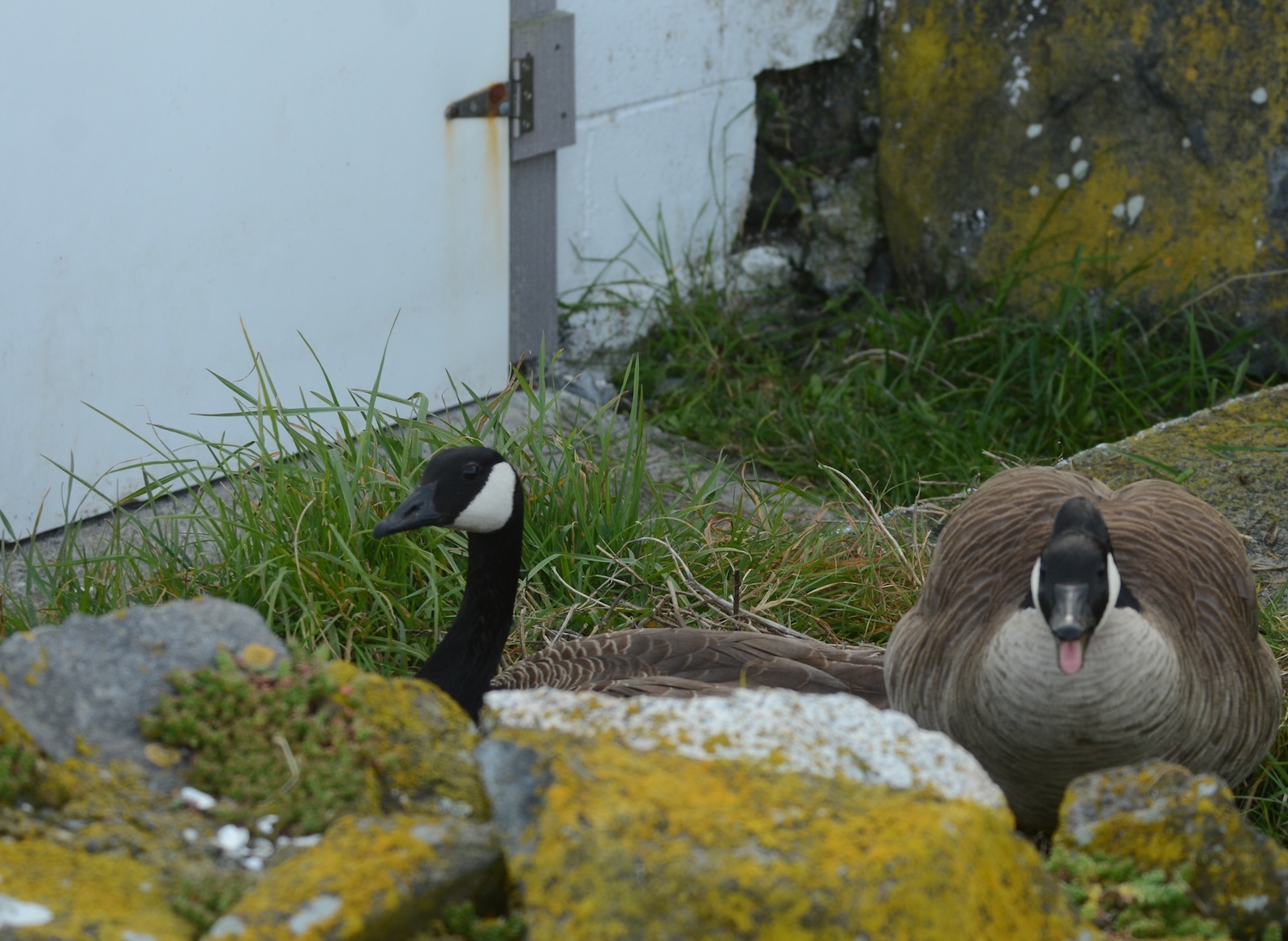
The Canada Geese are in over-drive right now and uber-territorial. One pair tried again to take up residence in the entrance way to the de-salinator room which is just not going to work.

Canada Geese defending the entrance to the de-salinator.

Canada Geese defending the entrance to the de-salinator.

The Glaucous-winged Gulls are engaging in more definite pairing behaviours and also becoming more territorial. Many are nest building, pulling out chunks of grass turf for padding. Black Oystercatchers are looking broody too and I observed Black Oystercatchers eating limpets today.


There were no visitors today.


Dramatic Weather

Strong west-southwest winds blew all day with a continuous cycle of showers and dramatic clouds scudding through. Wind velocities ranged from 10 to over 30 knots, up the tower. A low snowline could be seen in the Olympic Mountains from time to time and the air was chilly. The barometer has been climbing steadily since last night and the forecast is for more of the same with a risk of thunderstorms.

No tour boats or fishers were observed in the Ecological Reserve and Rockfish Conservation Area today.

A Sea Otter was spotted in the main channel in front of the eco-guardians’ house again today. As the tide turned, it swam over to Turbine Rock and on arrival was surrounded by six or seven small Harbour Seals. The adult seals remained uninterested, asleep on the rock. Through the spotting scope, it looked like interspecies play with lots of exaggerated diving and washing up onto the rock and back out. This is one of the first times I have looked at a sea otter for any length of time when it was not eating, grooming or sleeping.

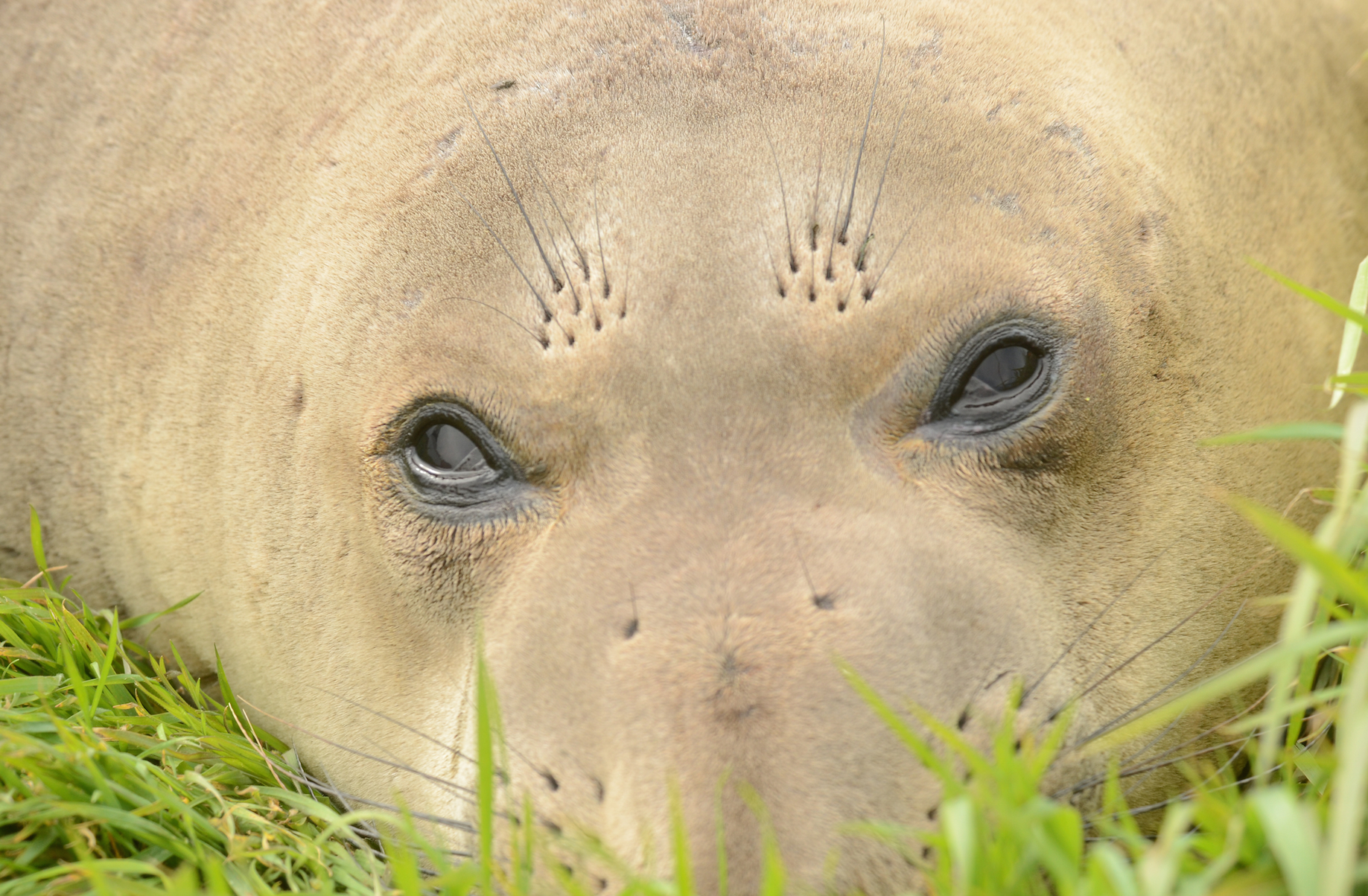
Sleepy head.

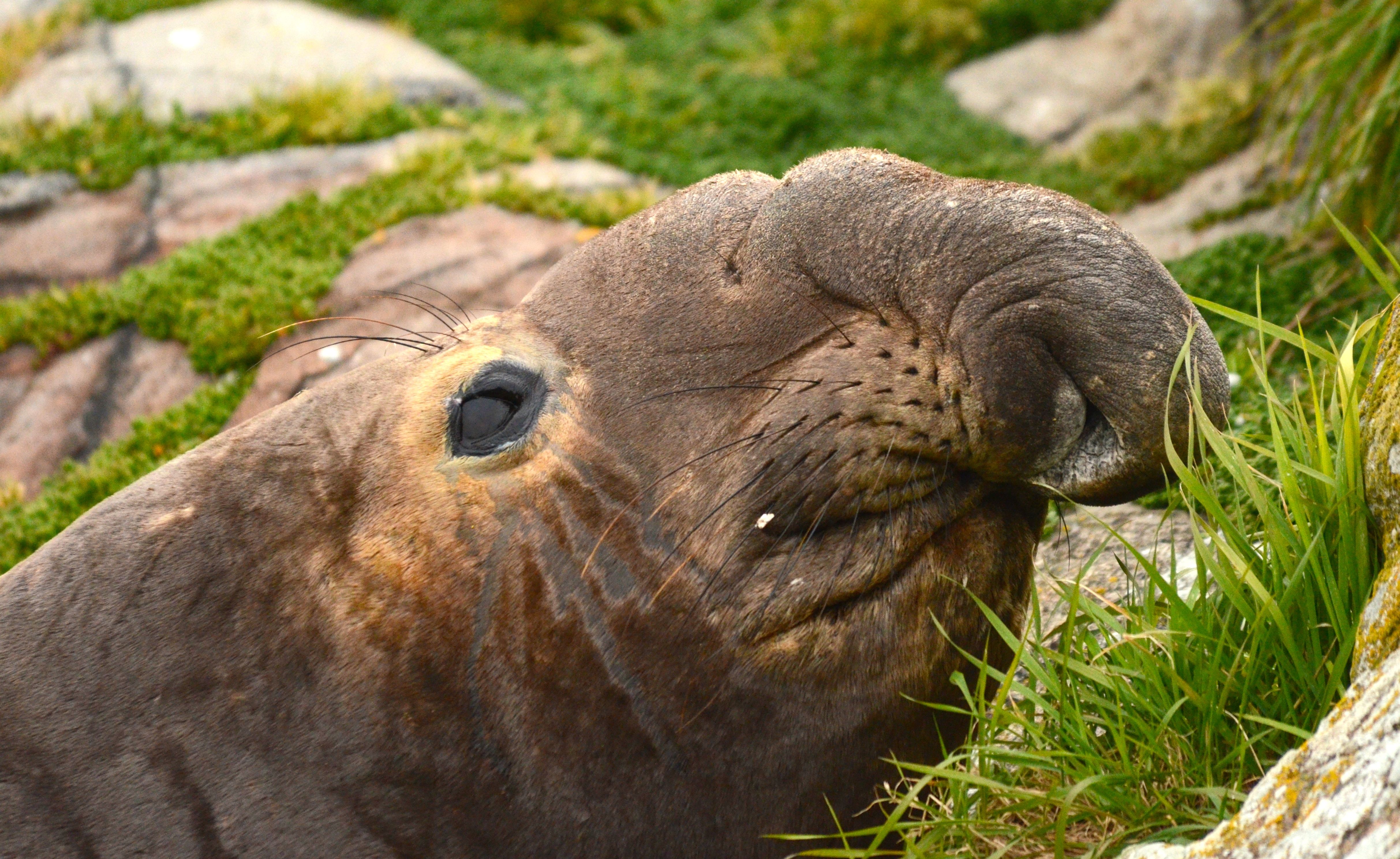
Sleepy head Mirounga angustirostrus.

Three Northern Elephant Seals moved right up onto Great Race today. When I did the water sample at six there was one individual lolling around by the jetty. I looked up mid-morning and three of them were doing the wave along the walkway. One stopped at the intersection, one went back closer to the boat shed and the third went right around the science house onto the rocks on the west side.  None of these individuals were tagged. Once settled, they slept soundly for the rest of the day.

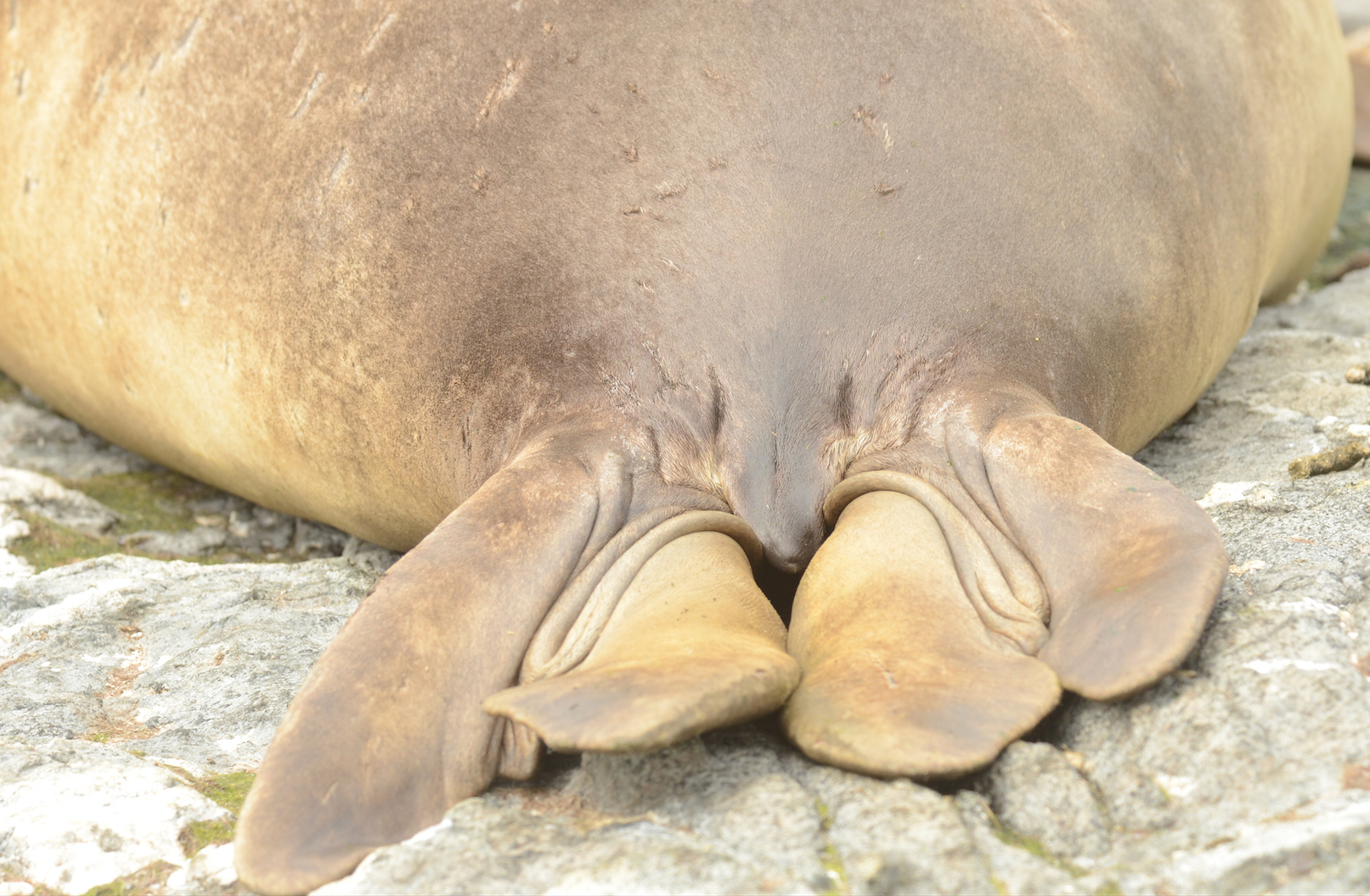
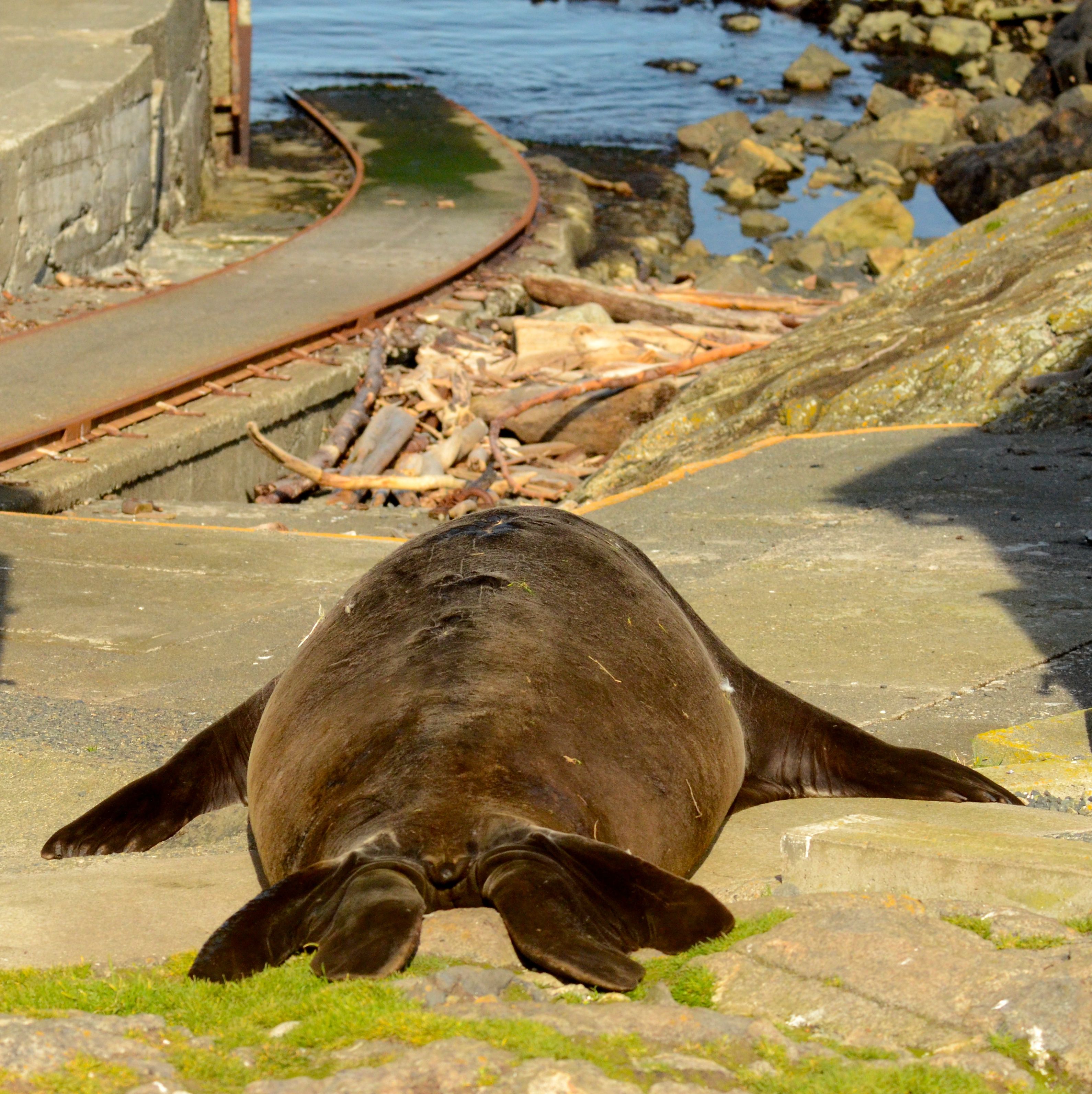
Rear view of Norther Elephant Seal. You can see why they are unable to rotate those flippers forward to support their weight.

Rear view of Norther Elephant Seal. You can see why they are unable to rotate those flippers forward to support their weight.

Most of the Canada Geese are sitting on eggs already and the ganders are fearless defenders. I am trying to discourage one insistent pair of geese that haven’t laid yet (I think) from nesting right beside the path to the Energy Building but it seems to be a losing battle.  The area near the stone burial cairns has been seriously overgrazed by the geese and the earth around the biggest one is eroding around the edges. In that area the goose exclusion cages show up a large difference between grazed and un-grazed (caged). In other areas where crab-grass dominates there is little difference inside and out of the cages.

There were no visitors today.

March 12 – Sunny Census Thursday

Sunny
Wind: 0-13 knots SW in the morning, NE from mid morning to afternoon and SW in the evening
Air Temperature: Low 9.9°C, High 13.2°C
Ocean Temperature: 9.0°C

Three Pearson students came to Race Rocks this morning. Karen, Sunny and Hanne joined Martin, who has been here since Monday.

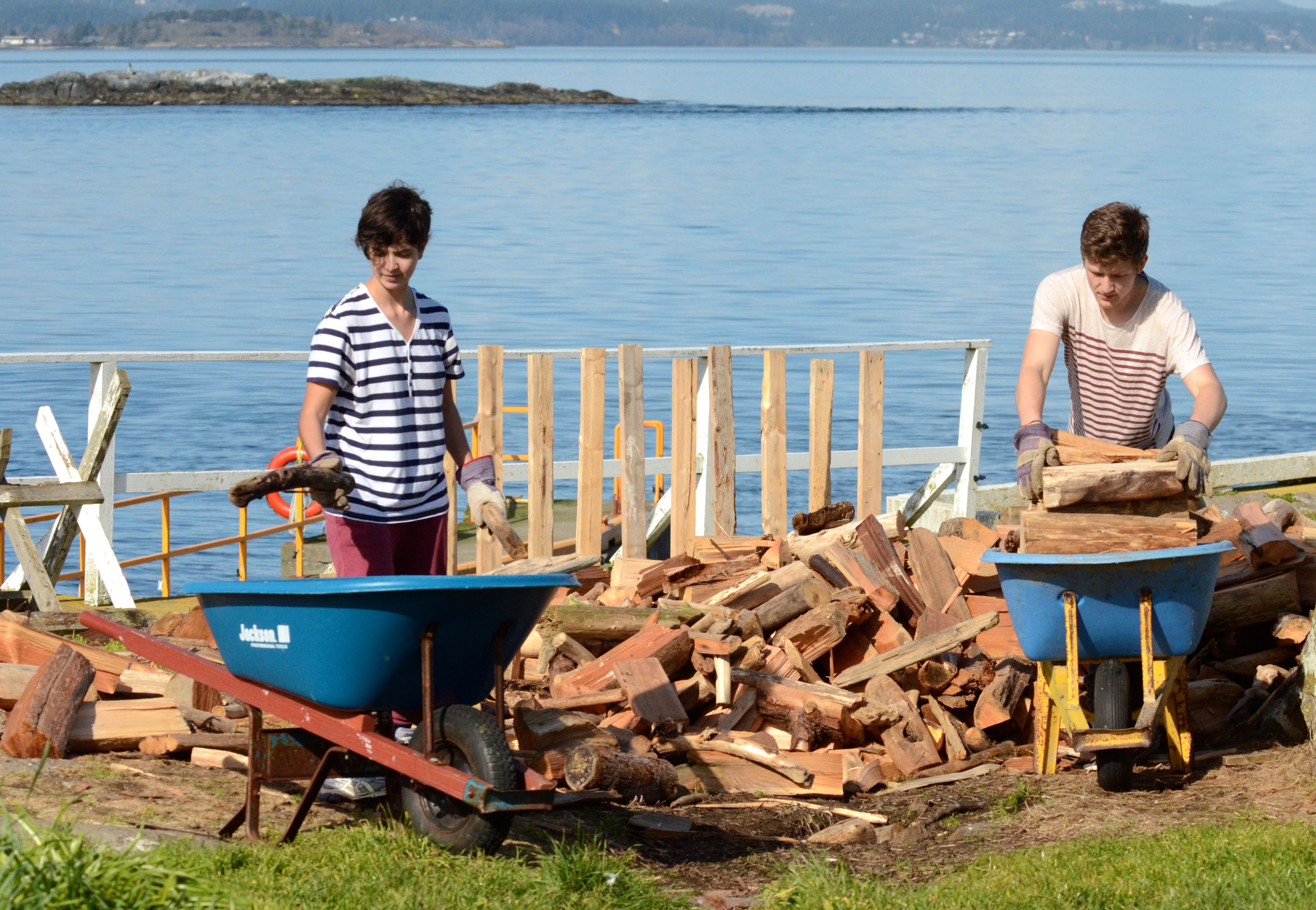
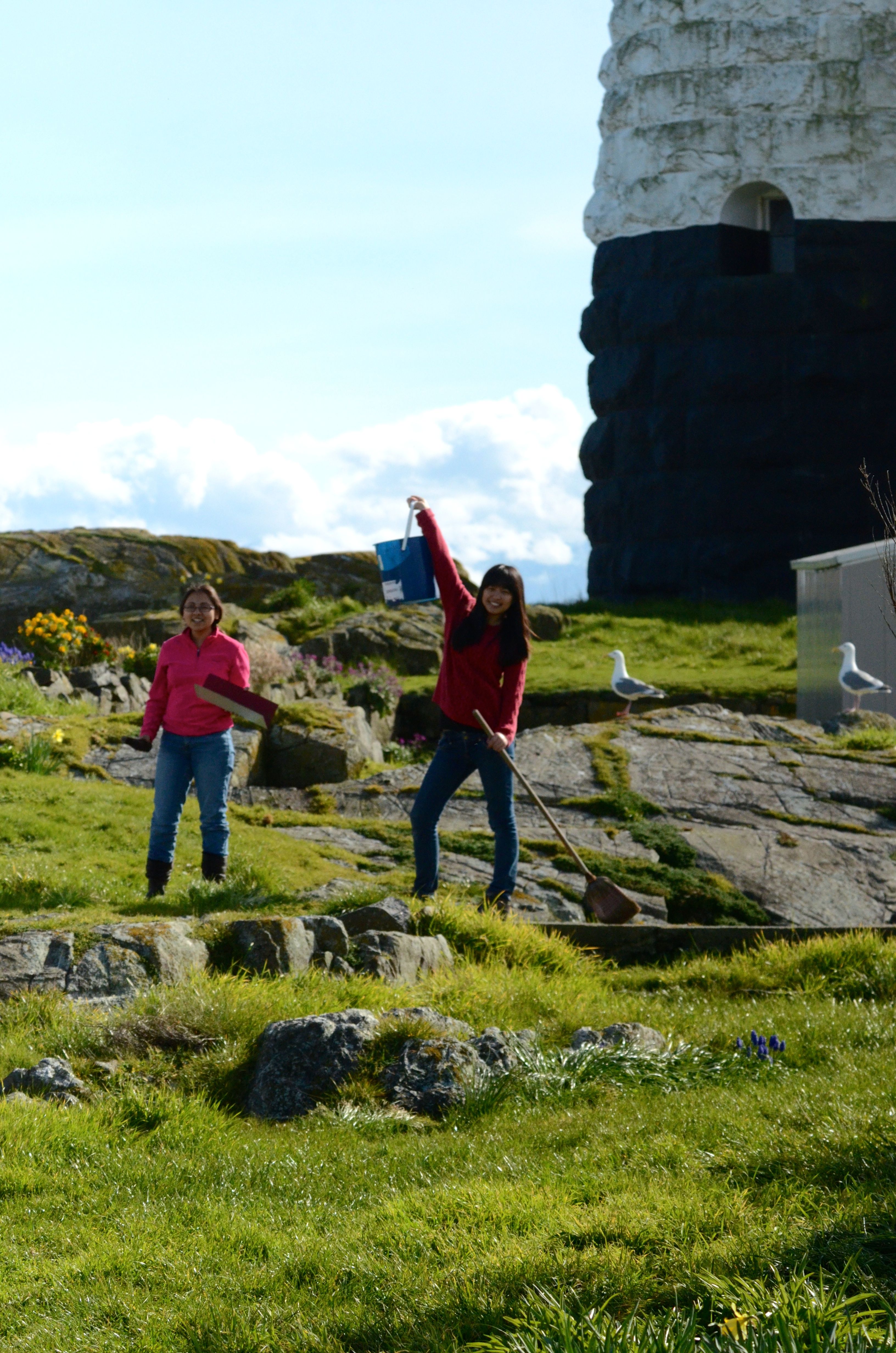
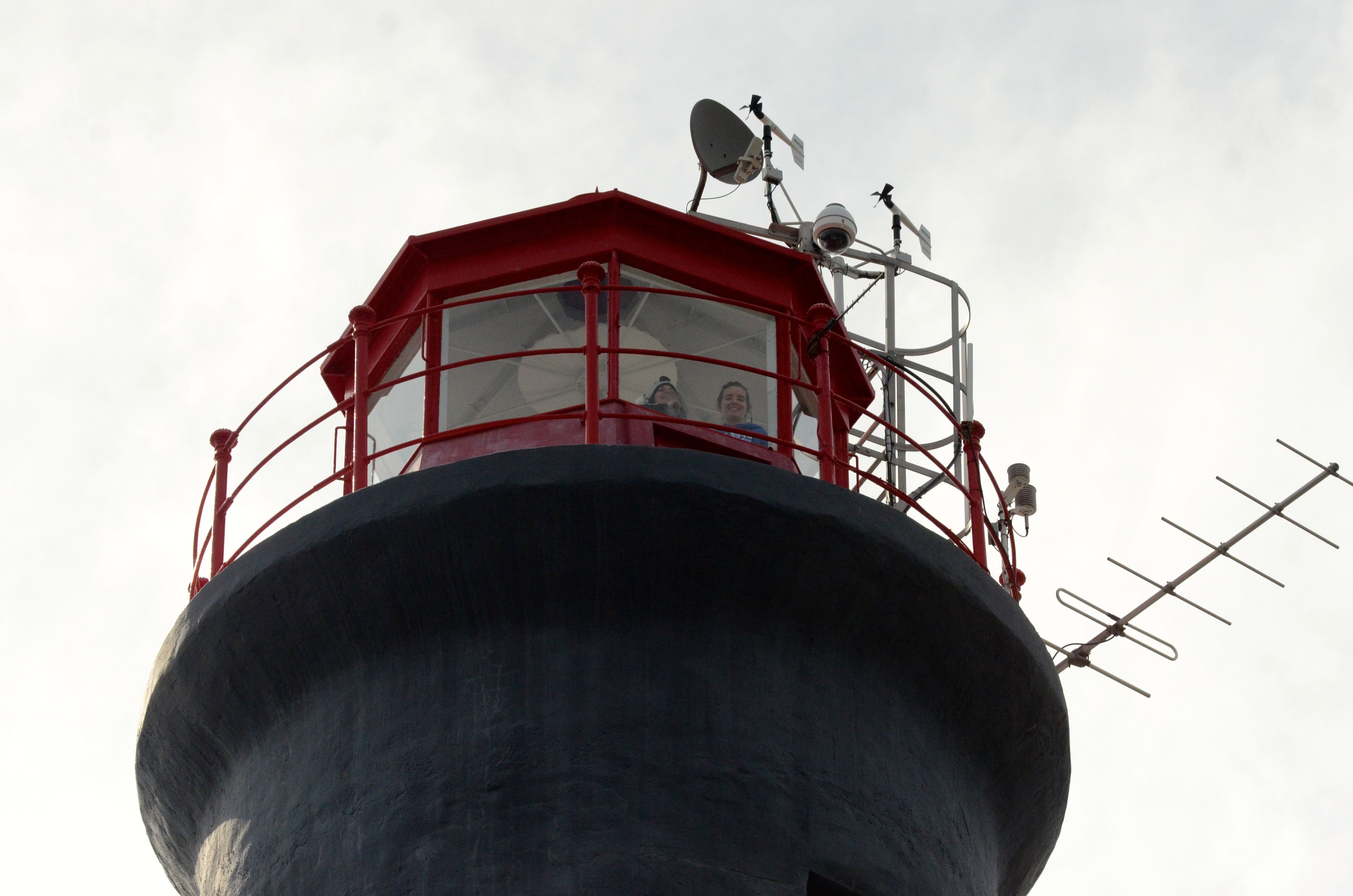
The students did some work this afternoon: sweeping all 99 steps of the lighthouse and continuing the process of stowing the chopped wood in all the nooks and crannies of the buildings, to be used next winter to heat the main house.

There was DND blasting happening in the morning and early afternoon on Bentinck Island, less than 1km away from the ecological reserve.

Today’s high temperature of 13.2°C, as measured at the ground weather station, was the highest recorded since 2006, when the weather station was installed. A high of 14°C was recorded by the instruments at the top of the lighthouse.

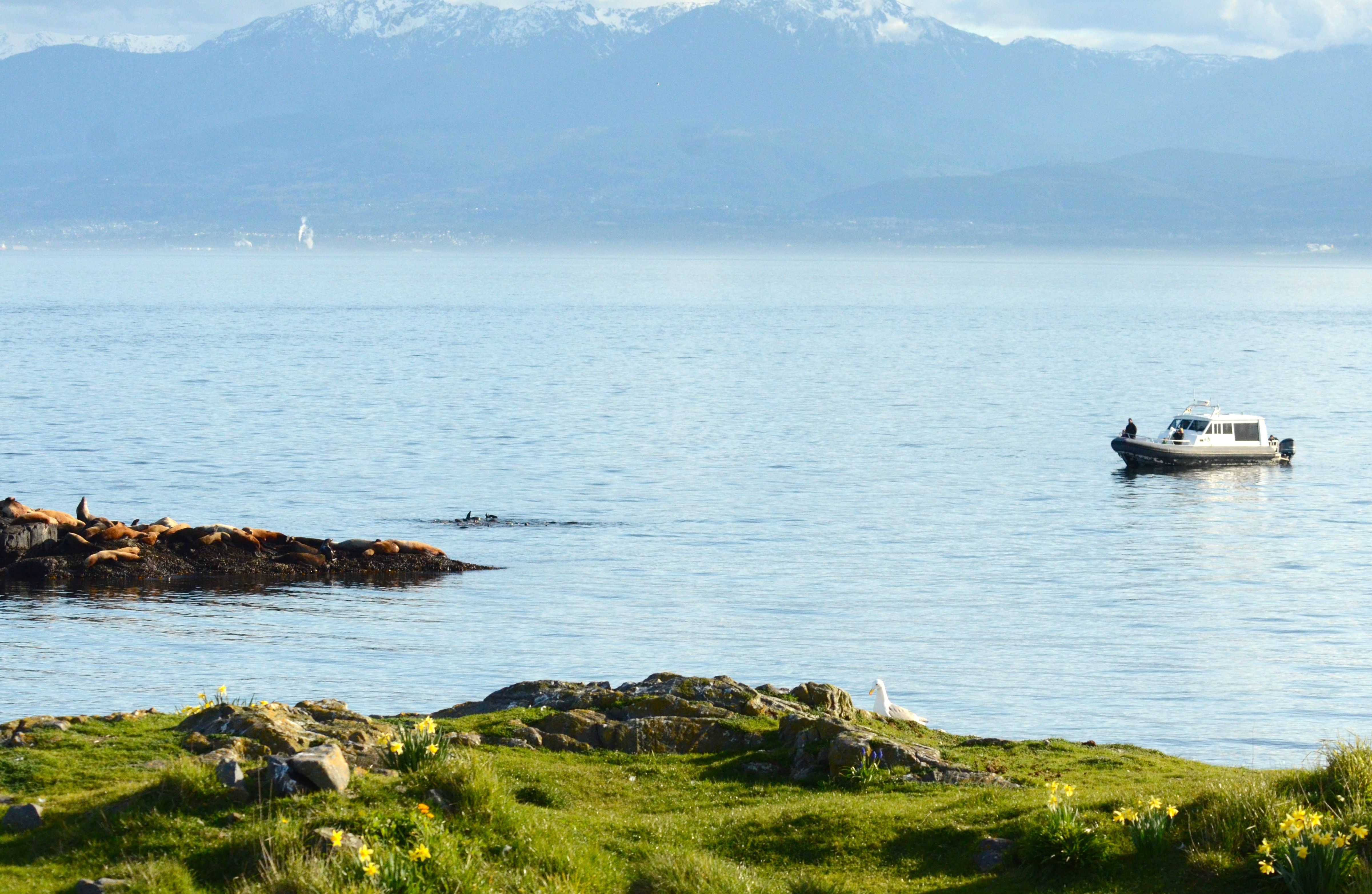
Three eco tour boats visited the reserve. One boat came very close to a group of sea lions swimming and others hauled out on the South Islands.

The low tide of 1.1m at 13:52, exposed lots of species from the low tide zone into the air. The shore and tidal pools were full of life: mussels, barnacles, limpets and lots of other flora and fauna of the sea. The oystercatchers and shore birds were having a feast.

There were no small birds perching birds seen today. There are usually a few fox, sparrows, savannah sparrows and occasionally juncos and robins zipping around the island.

Here are the results from today’s Megafauna Census:
Elephant Seal: 1
Steller Sea Lion: 54
California Sea Lion: 43
Harbour Seal: 52
Bald Eagle: 9
Great Blue Heron: 1
Crow: 1
Oystercatcher: 4
Double Crested Cormorant: 12
Brandt’s Cormorant: 21
Gull: 247
Canada Goose: 14
Pigeon Guillemot: 9
Harlequin Duck: 13
Surfbird: 3
Black Turnstone: 10
Rock Sandpiper: 2

March 11 – Cleaning, Diving and Nearby Blasting

Overcast with periods of sun and rain
Wind: 1 – 17 knots NE, switching to W in the evening
Air Temperature: Low 9.0°C, High 11.3°C
Ocean Temperature: 9.0°C

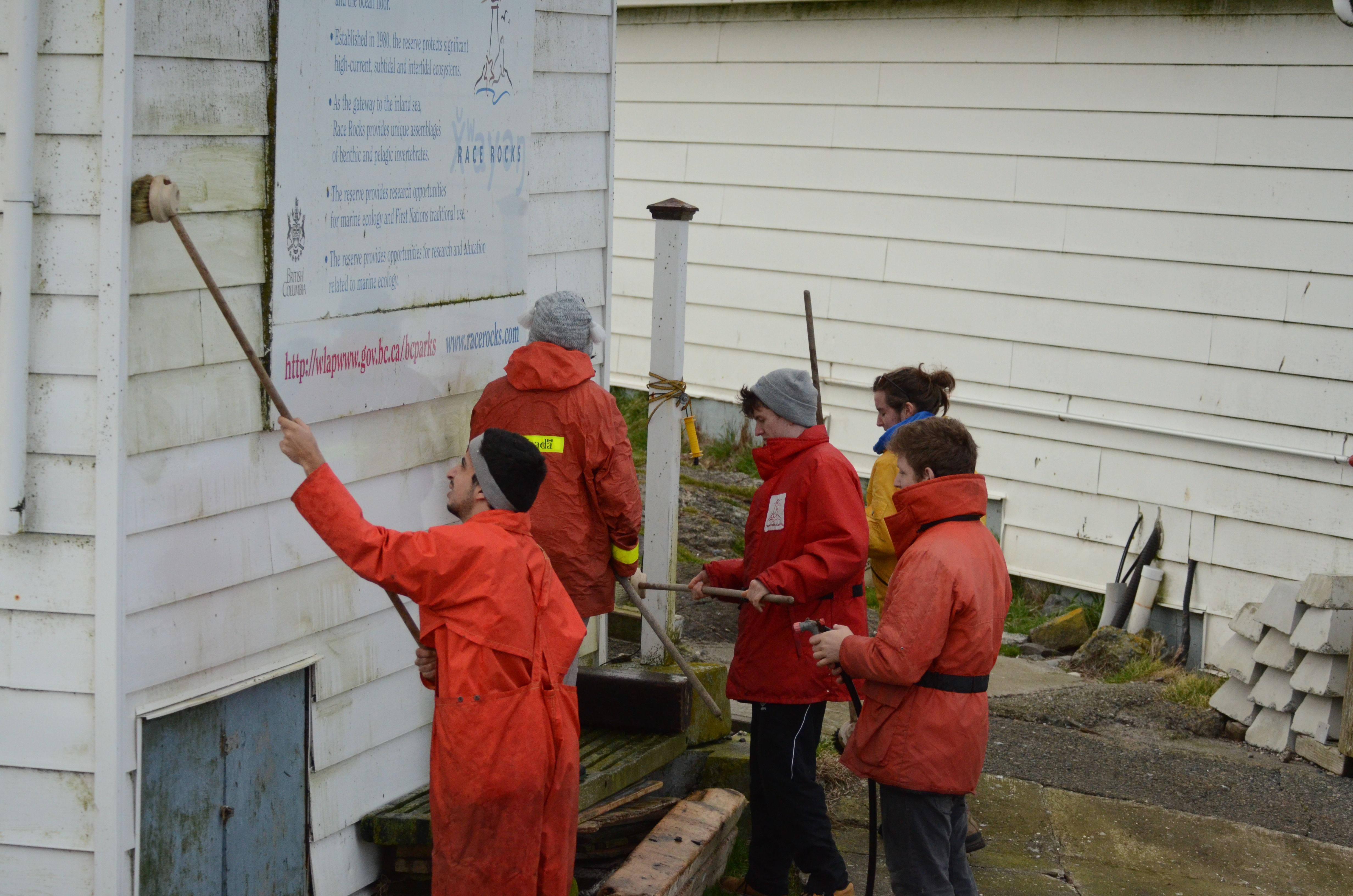
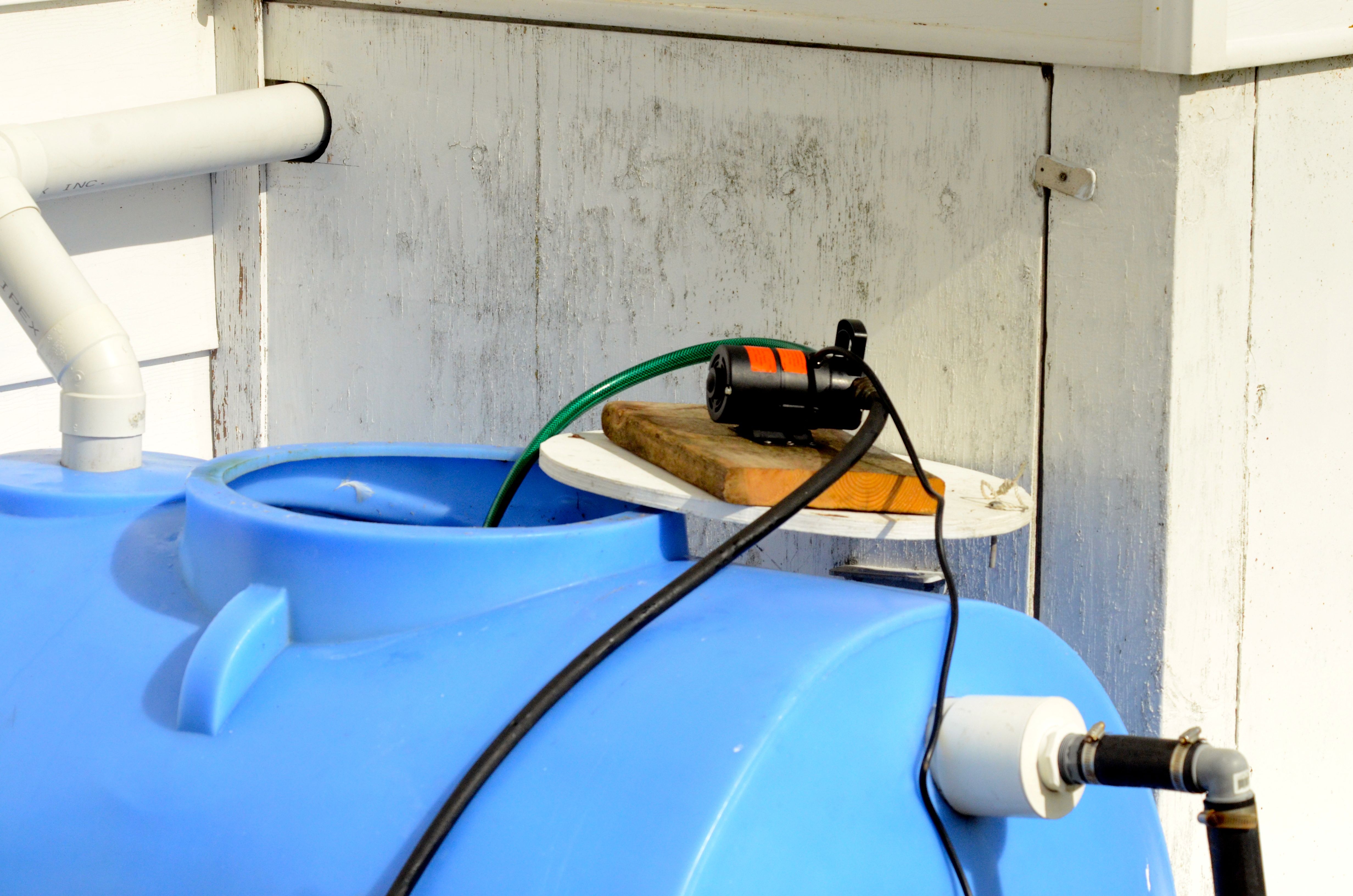
In the morning, the visiting students helped with a service project to clean the algae off the exterior walls of the tank room and boat house. Elbow grease, a non toxic de-algae formula, brushes and water were used to tackle the algae. Rain water was pumped from the collection tank at the Ecoguardian’s House, which saves the energy intensive desalinated water for the kitchens and washrooms.

For several hours beginning at 10:30, DND set off explosives on nearby Bentinck Island, which is less than 1km from the ecological reserve. Birds, marine mammals and an Ecoguardian were startled by the blasts.

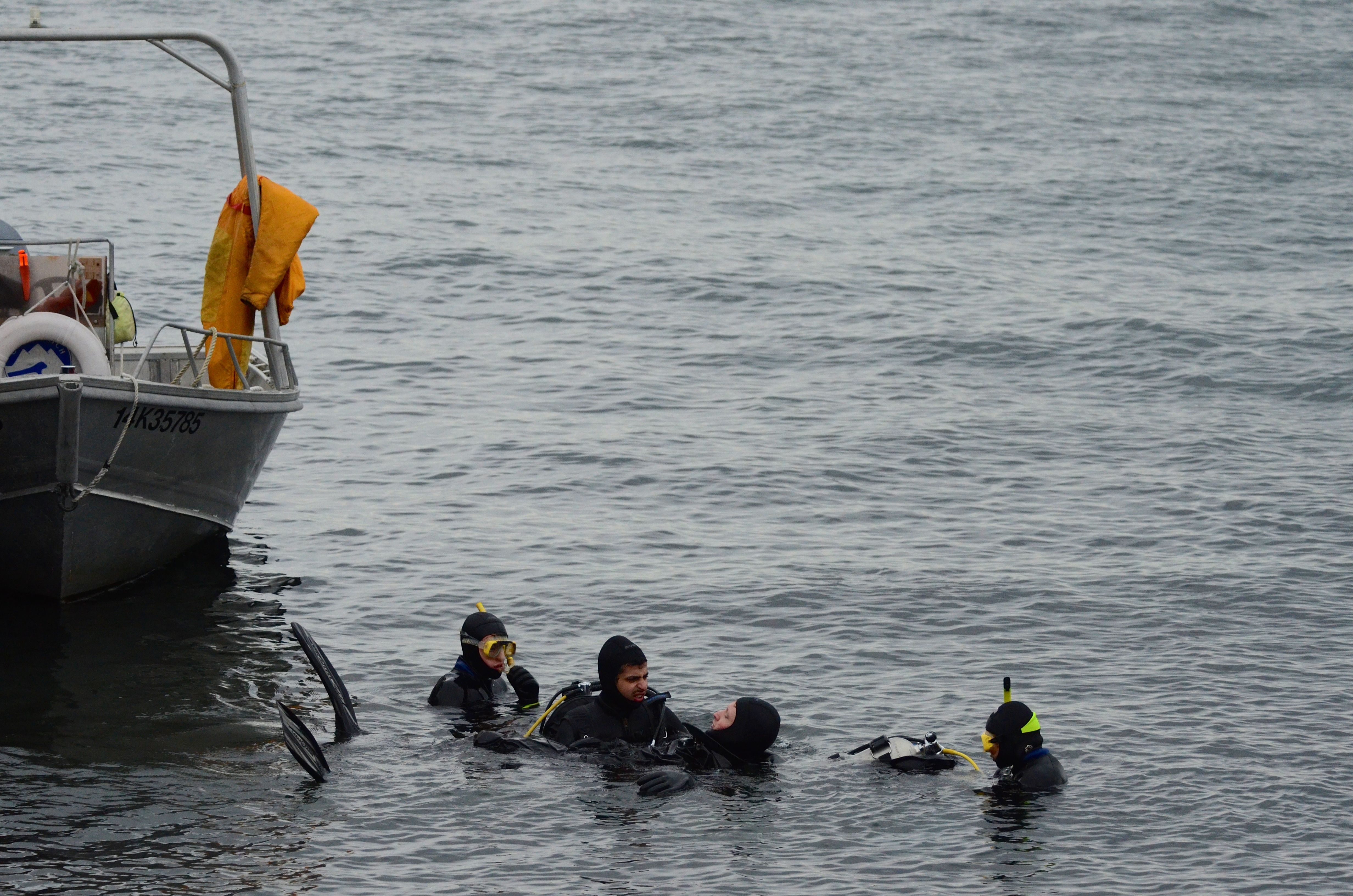
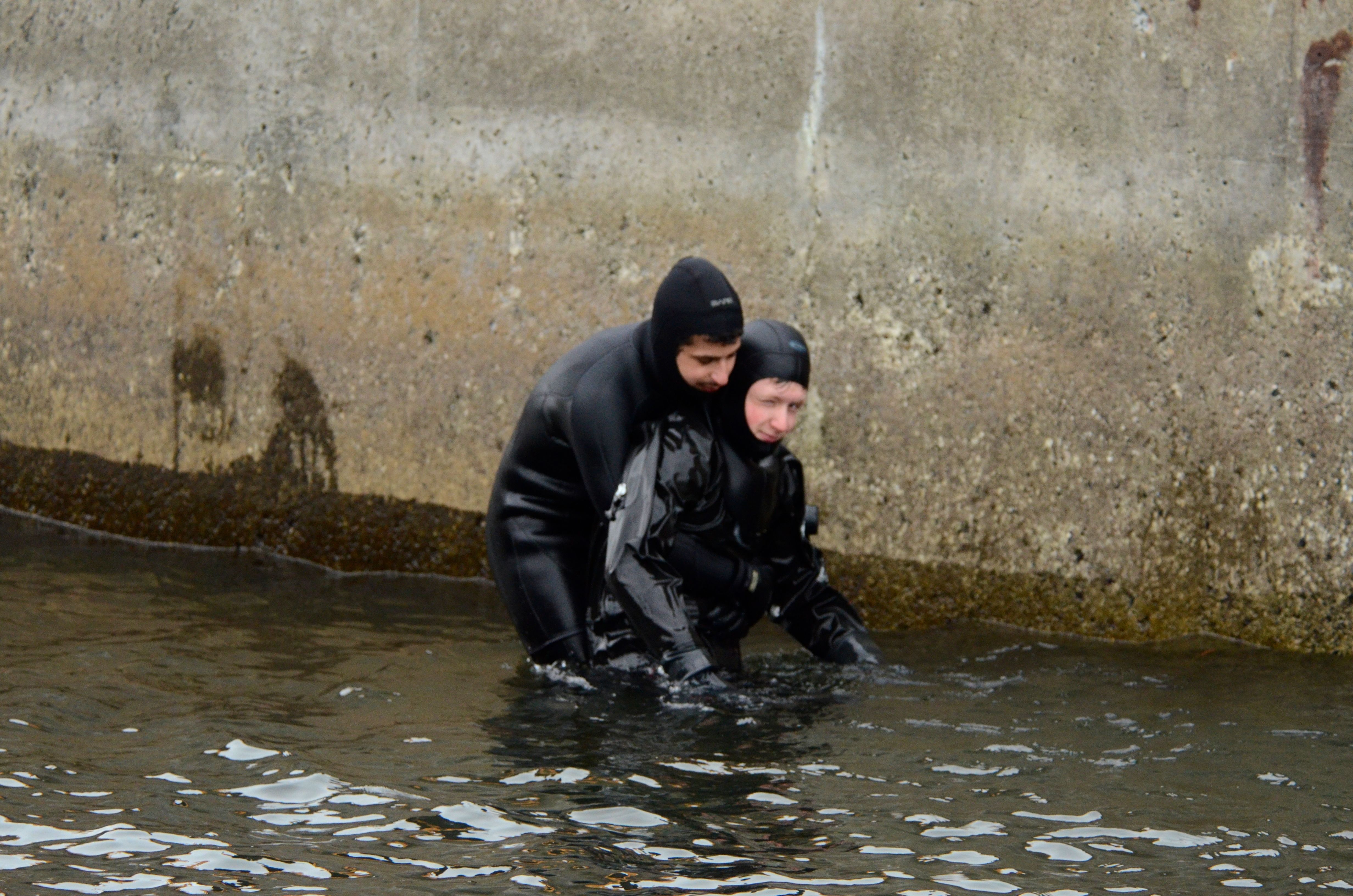
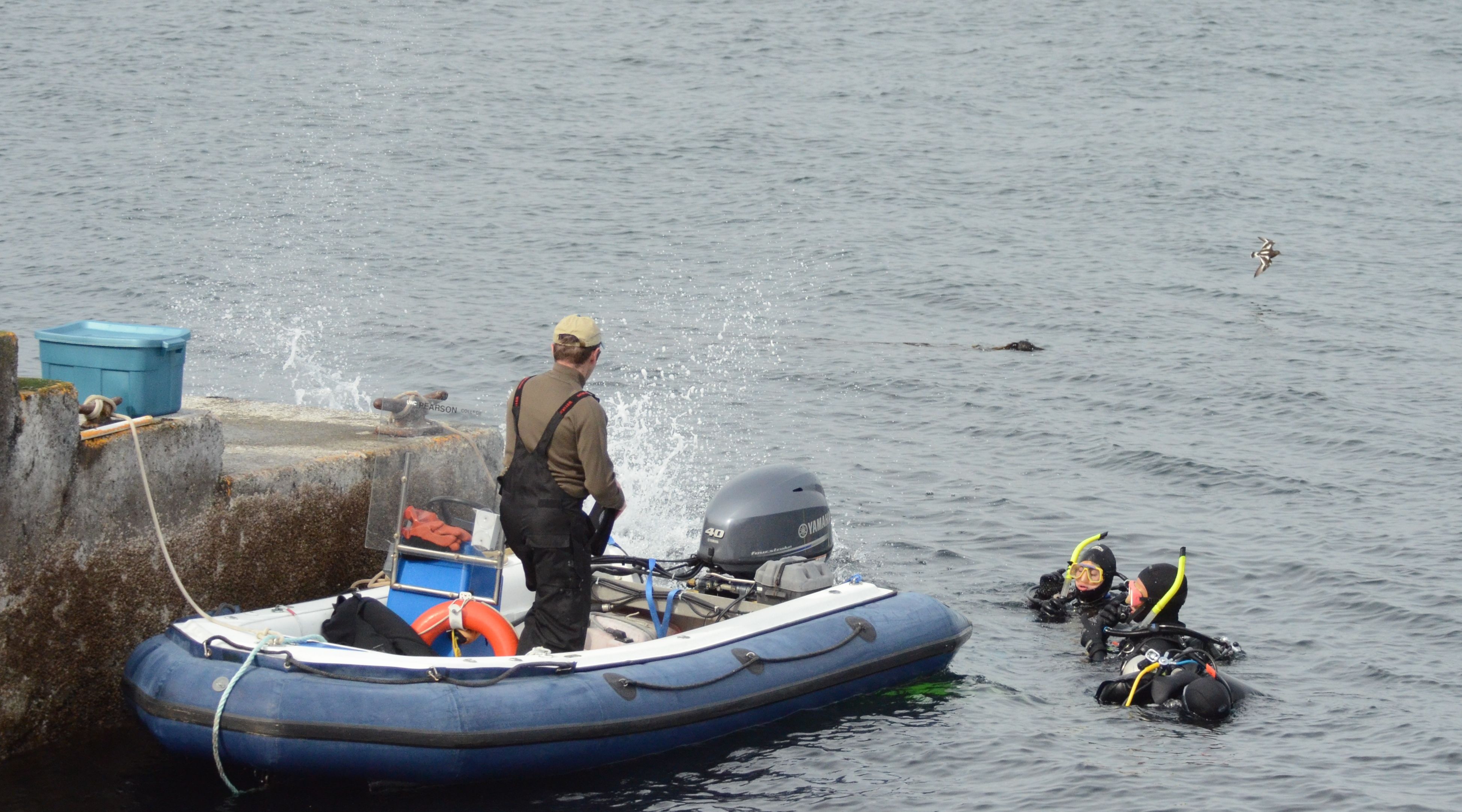
This afternoon, the four students doing the rescue diving course practiced more scenarios off the jetty with Chris.

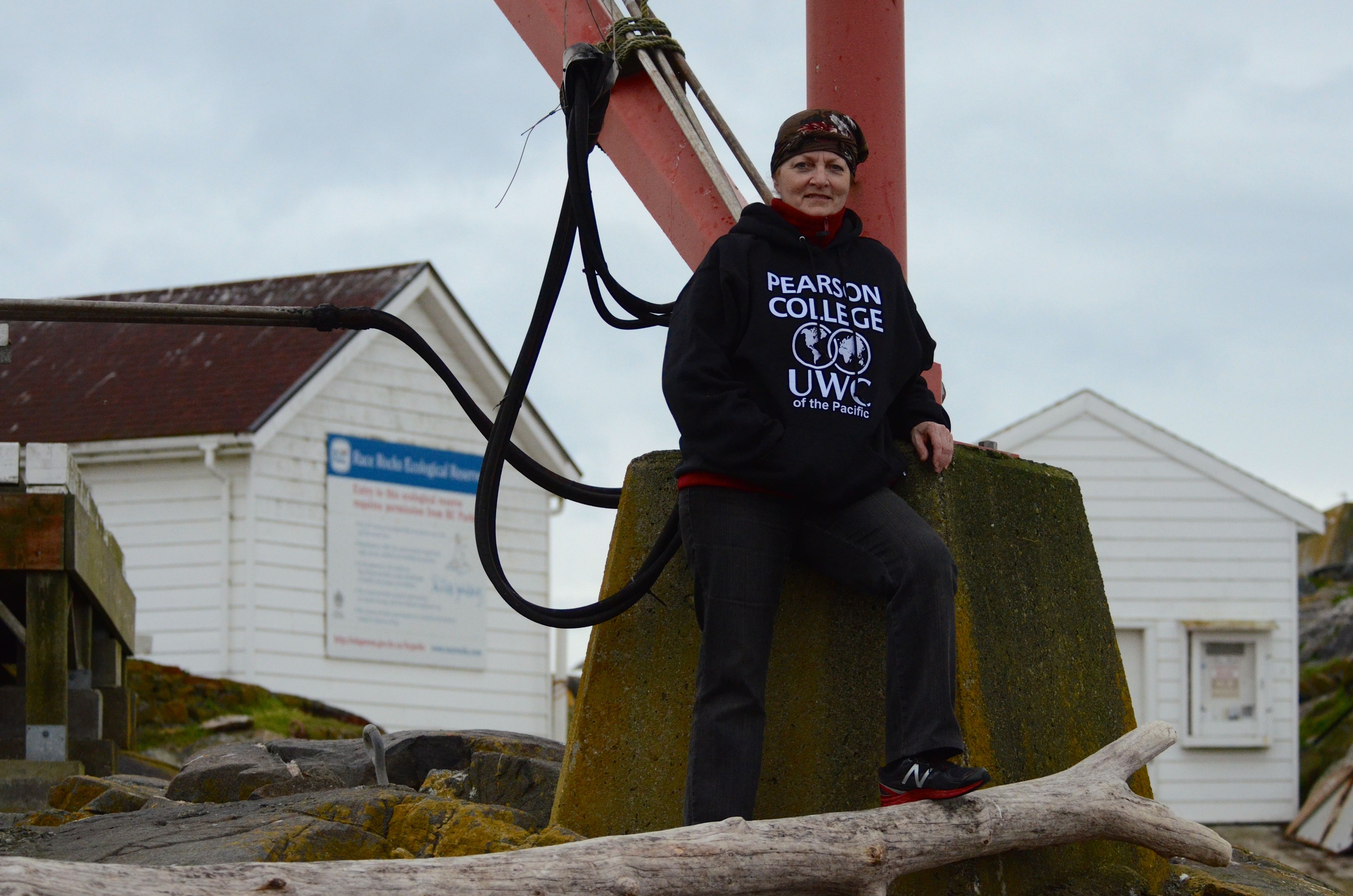
Chris brought a volunteer from Pearson to visit for a couple hours. Myriam Guilbert, who is the mother of second year student Chloé, toured around the island snapping photos of the flora, fauna and views. She had heard lots of stories about Race Rocks from her daughter.

There were two eco tour boats, one recreational boat and the Pearson’s Haiku in the reserve today.

March 10 – Juncos and a Robin

Cloudy, with fog in the morning
Wind: 0 – 16 knots from the W then NE in the morning, switching to SE in the afternoon
Air Temperature: High 10°C, Low 7°C
Ocean Temperature: 8.9°C

This morning, the Pearson students here for Project Week helped stack firewood in the cupboards outside of the Engine Building.

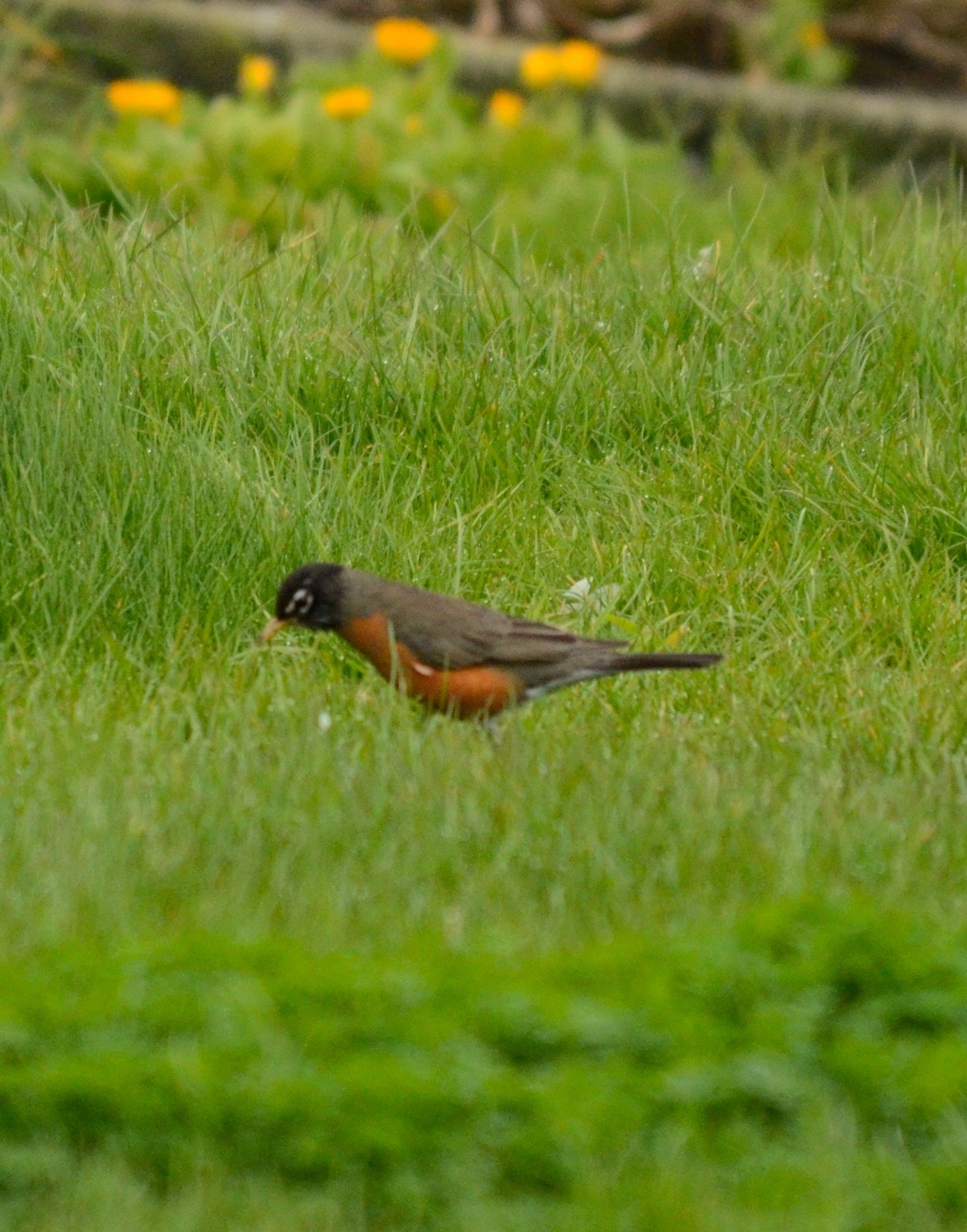
Four oregon juncos and a robin were seen flying around the southern part of Great Race.

This afternoon, four students took part in rescue diving scenarios with Chris. Afterwards a few of them went snorkelling around the jetty to check out the sea stars, a sea slug and other species.

Chunk continues to hang out near the Marine Science Centre.

Three ecotour boats came into the ecological reserve to share the sights, sounds and smells of the marine mammals and birds with their customers.

March 9 – Pearson Project Week Visitors

Fog overnight, sunny begining at 9:00
Wind: 6 – 27 knots W to SW
Air Temperature: High °C, Low °C
Ocean Temperature: 9°C

Five second year Pearson students came to Race Rocks this morning to spend part or all of Project Week. Yam, Sean, Martin, Neel and Bader will be exploring Race Rocks, helping out with tasks, studying and diving. Chunk came back onto the island just in time to welcome the visitors as they toured around the ecological reserve.

Yam helped shrink the firewood pile by the tank house by stacking it underneath the stairs of the Marine Science Centre. It will dry out over the summer and be ready to heat the Ecoguardian’s house next winter.

One eco tour boat visited the reserve today.